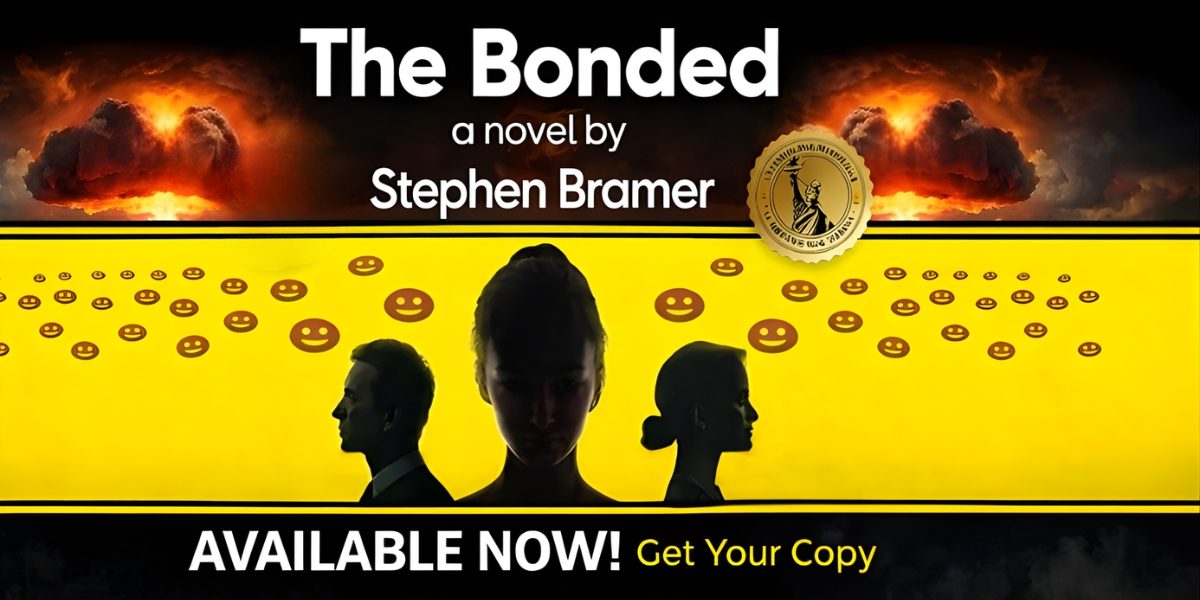

Following the successful debut of Stephen Bramer’s speculative thriller, The Bonded, readers and critics alike are diving into a narrative that is as much a philosophical inquiry as it is an interesting noir mystery. An atmospheric, shadow-drenched, near-future Chicago, the novel introduces Dean Parks, a forensic investigator or lab rat with a supernatural knack for spotting evidence that remains invisible to the naked eye.
The story’s inciting incident is a masterpiece of visceral horror: a man found mangled within a Union Station escalator, his body seemingly shredded by a machine that shows no mechanical fault. Alongside his sharp-witted colleague, Samantha Sheffield, Parks follows a trail of breadcrumbs that leads away from standard police procedure and into the heart of a global conspiracy. At the center of the mystery are unmarked metallic cards found on victims, keys to a world that most humans cannot perceive.
As the investigation progresses, Stephen reveals a startling truth. Humanity is not alone on Earth. A separate species, Homo Conjuntus, or The Bonded, has existed for centuries, linked by a global hive mind that allows them to share thoughts, memories, and even physical pain. Traditionally non-violent because they feel the agony of their victims, the Bonded now face an internal threat from rogue hybrids like Spider Tillis. These hybrids possess the individualistic, creative, and sometimes violent traits of humans without the empathetic restraints of the hive mind.
The tension reaches a fever pitch as the world teeters on the edge of a nuclear holocaust. Amidst this chaos stands Harriet Holroyd, the ancient Countess of Sheffield and oldest living Bonded member, who orchestrates a desperate push to force an evolutionary leap. Her goal is a New Bonded society where free will and creativity coexist with communal connection.
Stephen, a lifelong musician and illustrator who turned to writing as a means of escape, draws heavily on his background to explore these themes. His fascination with cross-cultural connection, born from years spent as a white musician in Black music scenes, informs the novel’s exploration of the other and the barriers to human understanding. Having transitioned from a career in software engineering to full-time writing in 2024, he brings a unique blend of technical precision and artistic soul to the genre.
The Bonded is a standout addition to contemporary science fiction, challenging readers to consider whether the traits that make us most human. Our individuality and our capacity for creation are the keys to our salvation or the architects of our destruction.
One thing pulling Steve into storytelling, in both music and writing, was his mother’s influence. Her Missouri upbringing instilled a love of colloquialisms and tall tales. These also found their way into Steve’s output. After several years in Chicago, Steve got married and started a family. To support them, he pursued software engineering (a real job). He got a master’s degree and worked in IT until retiring in 2024. His greatest pride is still his two children.
Once the kids finished college and established professional direction, he turned his attention back to creative pursuits. For the first time, it occurred to him that, with life so short, it was time to focus on his passions. He especially decided it was time to take writing seriously. Throwing caution to the wind, Steve retired and began writing in earnest, starting with his most developed idea, The Bonded. He gave himself a year to finish the book, surprising himself when he finished three books in that time. He published two, The Bonded and The Keepsake Box, and put the finishing touches on a sequel, The New Bonded. At this point, writing is Stephen’s primary focus and means of communication.
As an author, Stephen always ensures the focus is on a compelling story, with characters who grow and feel real. He uses that foundation of believable human experience to outline broader themes, and he draws upon an understanding of different cultures and human experience. He believes any book should grab the reader at the most basic human level, while opening doors to deeper, more in-depth considerations.