
By Tally Daniels
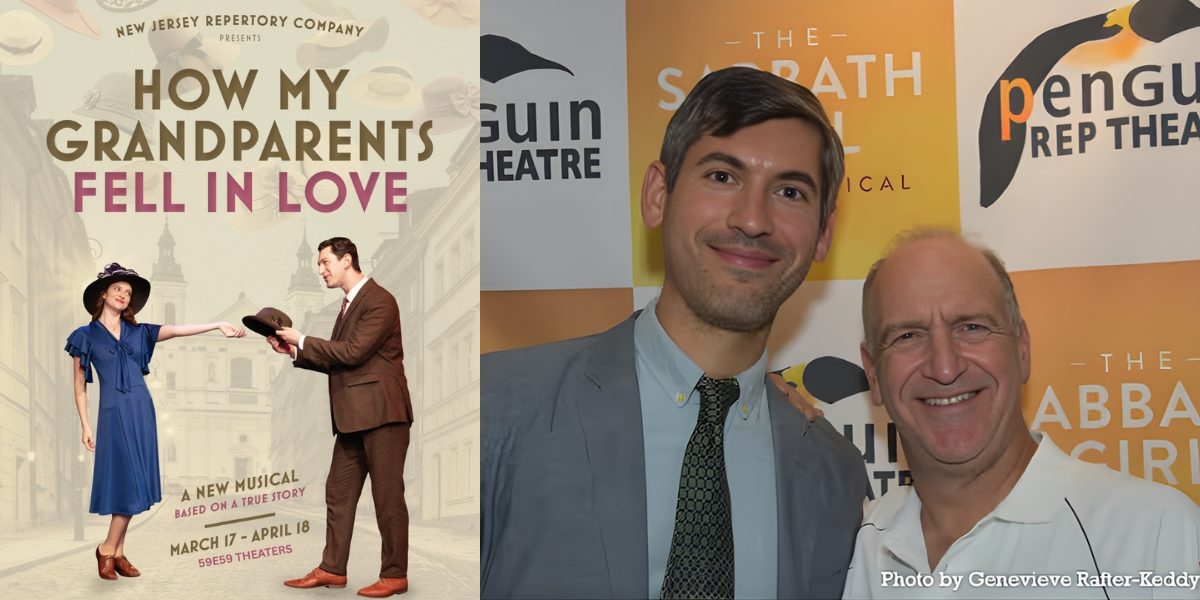
There is something quietly radiant about a love story that arrives without spectacle and leaves you unexpectedly undone. How My Grandparents Fell in Love, now making its New York debut at 59E59 Theaters, is exactly that kind of musical, intimate, heartfelt, and disarmingly sincere. In an era where scale often substitutes for substance, this two-character piece feels almost radical in its simplicity. And yet, what unfolds onstage is expansive: a romance shaped by history, memory, and the fragile hope of starting over.
Developed and premiered by New Jersey Repertory Company, long a champion of new work with an uncanny instinct for stories that matter, the musical carries with it the unmistakable imprint of careful nurturing. NJ Rep has built a reputation as a kind of artistic greenhouse, where writers are given the time and trust to refine deeply personal material. That investment is evident here. The show does not rush to impress; it invites you in.
The story, written by Cary Gitter with music by Neil Berg, begins in 1933 in the town of Rovno. Charlie, a Polish-born Jew who has spent the last decade in America, returns home in search of a bride. There he meets Chava, a sharp-minded young woman with ambitions that extend far beyond the confines of her circumstances. Their connection is immediate but not uncomplicated. Charlie is buoyant, optimistic, a dreamer with one foot already planted in the promise of America. Chava is grounded, disciplined, and fiercely committed to her education. Between them lies both chemistry and conflict, fertile ground for a romance that feels earned rather than inevitable.
Gitter first explored this story in a short play, inspired by his own grandparents’ journey. “I wanted to explore my own heritage and what it must have been like…to leave Eastern Europe behind to make a new life in America,” he said. What began as a modest piece grew, through NJ Rep’s commission, into a full-length musical that allowed him to “dive much deeper into my grandparents’ immigrant story.” That expansion is felt in the texture of the piece: the characters are not simply vessels of nostalgia, but fully imagined young people caught in a moment they cannot yet fully understand.

Photo Courtesy: Carol Rosegg (Chava (Becca Suskauer) and Charlie (Harris Milgrim) get to know each other, in “How My Grandparents Fell in Love.”)
The historical context is ever-present but never overwhelming. Gitter approaches the material with a delicate tonal balance. “I tried to imagine I was writing a romantic comedy that just happened to be set in a dark historical period,” he explained. The result is a work that acknowledges the rising threat of fascism and antisemitism without allowing it to eclipse the humanity at its center. The audience, of course, brings its own knowledge of what is to come. The musical trusts that awareness, choosing instead to foreground warmth, humor, and the stubborn persistence of love.
What emerges is not just a portrait of two people falling in love, but a meditation on how opposites attract, and endure. Gitter delights in their differences. Chava, modeled in part on his grandmother, is “serious and education-minded,” while Charlie is “an absent-minded dreamer with his head in the clouds.” Their friction becomes the engine of the piece, yielding moments of humor that feel both character-driven and deeply recognizable.
If Gitter provides the emotional architecture, Berg supplies its pulse. His score is intimate and expressive, threading together European musical textures with the buoyancy of early American popular song. When he first encountered the material, Berg felt an immediate personal connection. “I couldn’t believe it,” he said, noting that his own great-grandparents emigrated from a nearby region. That resonance informs a score that feels both specific and universal.
Berg approaches the music as a means of revealing what the characters cannot quite articulate. “My job…is always to get to the heart and emotional core of the characters with truthfulness and transparency,” he said. With only two performers, the musical leans heavily on song as a form of discovery. Each number becomes a turning point, a moment in which the characters, and the audience, learn something new. In one sequence, Charlie attempts to charm Chava with visions of America, the music shifting from playful persuasion to genuine vulnerability. “At one point…you can see he is in earnest, and not just the salesman,” Berg noted.
The score’s stylistic fluidity mirrors the characters’ inner lives. Chava’s early music carries a distinctly European sensibility, grounded and traditional, before giving way to more contemporary, forward-looking harmonies as her imagination stretches toward possibility. Berg is intentional in these choices, using musical language to foreshadow emotional transformation. The result is a sound world that feels period-appropriate without ever becoming museum-like.
The transition from NJ Rep to New York has brought refinements rather than reinvention. Berg described the process as a series of “minor, yet major” tweaks, small adjustments that deepen the impact. Among them is a newly added late-show number for Chava, giving voice to a pivotal moment of realization that previously unfolded in silence. It is a change that underscores the production’s commitment to emotional clarity.
Under the direction of SuzAnne Barabas, the staging embraces the piece’s intimacy. There is no excess here, no attempt to inflate the story beyond its natural scale. Instead, the focus remains squarely on the performers, Harris Milgrim and Becca Suskauer, whose chemistry anchors the evening. Their interactions feel lived-in, their silences as telling as their songs. It is the kind of performance style that draws the audience closer, rather than keeping it at a distance.
In many ways, How My Grandparents Fell in Love embodies the very ethos that has defined NJ Rep’s work for years: a belief that small stories, told truthfully, can resonate as powerfully as any grand narrative. The company’s sustained commitment, from initial reading to world premiere to New York transfer, is not just admirable; it is essential. As Gitter put it, that kind of support “gives you license to create, experiment, and revise in a supportive artistic environment.” It is difficult to imagine this musical existing in quite the same way without it.
And so, what begins as a personal excavation becomes something larger, a reminder that behind every family story lies a pair of young people once standing at the edge of the unknown, choosing each other.

Photo Courtesy: Carol Rosegg (Chava (Becca Suskauer) and Charlie (Harris Milgrim) dance, in “How My Grandparents Fell in Love.”)
How My Grandparents Fell in Love features music by Neil Berg and book and lyrics by Cary Gitter, with additional lyrics by Berg. Directed by SuzAnne Barabas, the production stars Harris Milgrim and Becca Suskauer. Presented by New Jersey Repertory Company at 59E59 Theaters.
Tickets and additional information are available at www.59e59.org