

Serving in the armed forces of the United States of America is a privilege loaded with responsibility. Those who serve, members of the armed forces, genuinely understand the meaning of laying it all on the line. Tremendous sacrifices are made when brave men and women enlist in the military. The day-to-day activities of civilian life take a back seat as these enlisted personnel carry out their designated tactical and strategic objectives.
Importantly, their sacrifices are shared with all members of military families, including parents, siblings, spouses, significant others, and children. Everyone feels it when a close relative is serving in the armed forces. Despite a genuine sense of risk while serving in active conflicts, a sense of pride filters through.
When someone serves, it’s almost as if everyone close to them sacrifices in some way. Their absence is palpable, and it’s only natural to want to honor veterans. Fortunately, society does precisely that with a variety of financial benefits, tax breaks, discounts, offers, and other valuable homeownership incentives.
These exist at the federal and state levels and can include authentic perks to facilitate a smooth transition to stability after service. For veterans, these VA home loan benefits, supported by the Department of Veterans Affairs and issued by private lenders, are often tremendously beneficial. They may ease the process, making it more cost-effective to apply for financing a primary residence with no down payment needed.
How VA Loan Structures Support Military Borrowers
Once a person’s military service is verified through a Certificate of Eligibility (COE), it’s possible to apply for a VA loan with a private lender. The Department of Veterans’ Affairs partially backs these loans in the event of default. This can streamline the process and may facilitate loan processing, as lenders’ concerns are eased by government backing.
Lenders therefore apply more accommodating practices to veterans and eligible family members (surviving spouses). Tax returns, credit history, job tenure, and ability to service loans remain important, but there is certainly some leeway and understanding when it comes to VA loans.
Private lenders understand that military careers do not follow a conventional civilian employment path. Various realities come into play, such as relocations, deployments, and transitions from active duty to civilian roles. All of this can muddy traditional underwriting models that tend to prioritize long-term stability.
As things turn out, VA lending guidelines account for these realities. They offer lenders a degree of structured flexibility when evaluating qualified military borrowers and eligible surviving spouses.
Equally important is the Certificate of Eligibility. This document confirms that the applicant meets all the necessary service requirements of a VA-backed loan. From here on, lenders evaluate the borrower’s income, credit profile, debts, and residual income standards under VA guidelines.
The COE establishes the service member’s (or eligible spouse’s) entitlement. The applicant’s wider financial profile then determines approval. Combined, this can create a streamlined path to homeownership for military families.
Military Families Benefit from Structural Changes to Loans
There is tremendous flexibility with the structure of VA loans. As a financing option designed for veterans, the fundamental distinction is the absence of private mortgage insurance. PMI is added to any standard mortgage with a down payment of less than 20%. Conventional borrowers who finance 80% or more of their home’s value are usually required to carry PMI.
This may increase the mortgage cost, and it can also eat into disposable personal income. PMI reduces the borrower’s budget. It also has no equity component whatsoever, it’s simply an extra cost that does not pay down principal. A VA loan can eliminate this requirement, potentially reducing long-term carrying costs.
Assume a rudimentary example to illustrate the impact of PMI on a traditional mortgage versus the absence of PMI on a VA loan:
Military Families Benefit from Structural Changes to Loans
The structural differences between conventional and VA loans can materially affect monthly affordability and long-term cost. Below is a basic illustration using a $450,000 home. A conventional mortgage with 10% down requires private mortgage insurance, while a VA loan eliminates PMI and allows zero down. The difference illustrates how loan design directly influences cash flow and upfront liquidity.
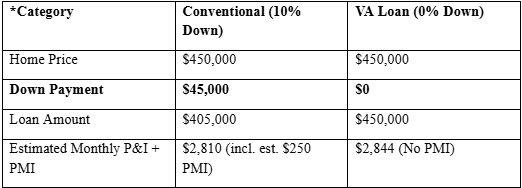
Figures calculated using 6.5% interest rate over a 30-year term. Note that the monthly payments may be almost identical except that the conventional loan has a $45,000 down payment to finance the home purchase.
The absence of a down payment is notable. Here, we can see that a conventional mortgage with a 10% down payment of $45,000 results in an estimated monthly payment, including PMI, of $2,810 at 6.5% over 30 years.
The comparable VA loan with 0% down is almost identical at $2,844. This illustrates how much easier it can be with helpful financing solutions.
These loans are assumed by qualified buyers under certain conditions. When rates are rising, the interest rates may become valuable. Below-market interest rates can serve the buyer’s interests. In a rising-rate environment, locking in a low rate is often beneficial.
Viewed in its entirety, all of these financing features can work really well for veterans.
Disclaimer: The information provided in this article is for general informational purposes only and does not constitute financial or mortgage advice. The examples provided may not apply to every individual situation. Readers are encouraged to consult with a licensed financial advisor or mortgage specialist to discuss their personal financial circumstances before making any financial decisions.