
By: Jennifer O’Neill, Sr. Staff Writer
March 10, 2026
As streaming platforms wrestle with subscription fatigue and rising production costs, The ART Channel is charting a different course — one centered on cultural gravity. After experimenting with high-concept narrative features during its early launch phase, the global arts-focused streaming network has recalibrated its original programming strategy. Rather than chasing traditional studio-style films, the platform is focusing on tentpole cultural moments, immersive event-driven programming and hybrid formats that merge documentary storytelling, live experience and interactive engagement.
“We’re not trying to be another general entertainment network,” said Kurt A. Swauger, The ART Channel’s Head of Programming and Strategic Development. “We’re building cultural destinations. When there’s energy in the art world — an international fair, a museum opening, a rediscovered archive, a breakout artist — we want to highlight that moment with original programming that adds depth and lasting relevance.”
That philosophy is already shaping the slate. Instead of standalone feature films, The ART Channel has invested in event-driven originals such as That Boy on Stage: The John Shiner Story, a documentary chronicling the untold journey of a teenage concert photographer who captured icons like Freddie Mercury and David Bowie before stepping away from the spotlight for decades. The film is strategically aligned with gallery exhibitions and archival releases, evolving into a multi-platform cultural revival rather than a one-night premiere.
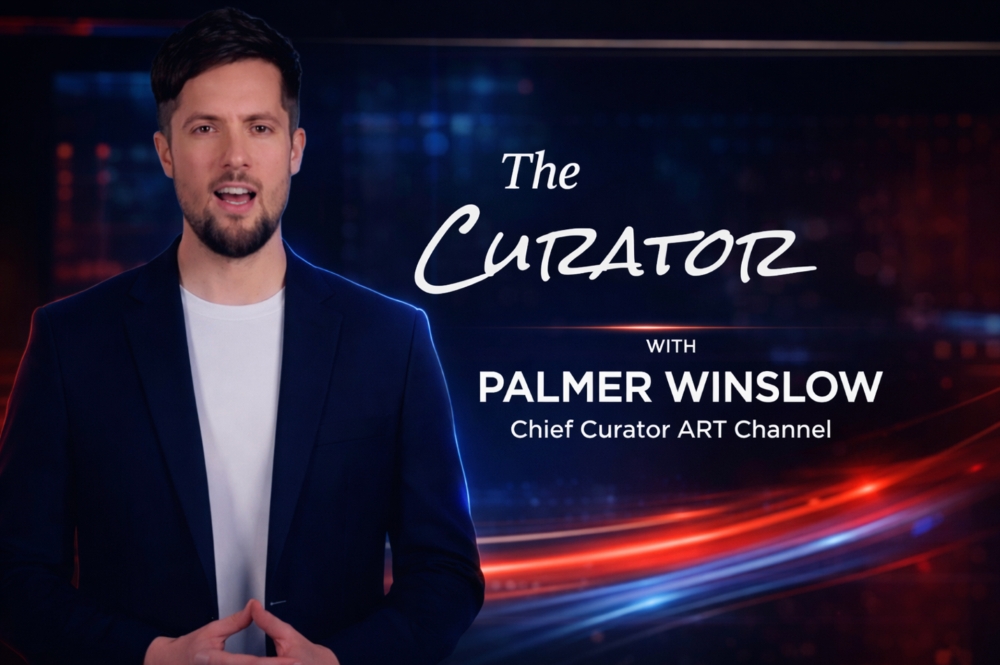
Photo Courtesy: Renata Fajti / The Art Channel
Similarly, the channel’s AI-hosted series The Curator, fronted by virtual guide Palmer Winslow, builds weekly episodes around contemporary exhibitions, artist retrospectives and thematic explorations. Companion content often launches alongside real-world gallery openings in New York, Hong Kong, Miami and Los Angeles, reinforcing the connection between physical space and digital storytelling.
“We look at the arts ecosystem holistically,” Swauger said. “When there’s a museum gala, an art fair, a major retrospective — that’s not just an event. It’s a potential narrative opportunity.”
Other recent originals include Cooktop Art: Dish’in’, pairing chefs and visual artists to reinterpret masterworks through culinary expression, and Metaverse Masters, a docu-series examining how digital creators are redefining ownership, authorship and community in virtual environments. A Valentine’s Day special, Canvas of Love, blended romantic storytelling with live performance art and interactive viewer prompts.

Photo Courtesy: The Art Channel
While unscripted series remain part of the mix, most ART Channel originals extend broader cultural movements. Even the adult animated series The Andy & Jean Show, which imagines Andy Warhol and Jean-Michel Basquiat navigating surreal contemporary worlds, is positioned as both entertainment and commentary — intersecting with real-world art discourse, digital culture and celebrity collaboration.
Still, Swauger points out that originals represent only one pillar of the strategy. “The backbone of any successful FAST platform is licensed content,” he said. “It’s efficient, scalable and habit-forming. Originals contribute to brand equity. Licensed programming encourages daily engagement.”
The ART Channel’s FAST (Free Ad-Supported Streaming Television) footprint continues to expand across Roku, Apple TV, Amazon Fire, Android, iOS and web platforms. While the company does not disclose granular performance metrics, internal reporting indicates consistent double-digit growth in watch time year over year, driven by more than 600 hours of curated programming spanning fine art, architecture, performance, design, fashion, documentary and international cultural content.
Unlike general entertainment services, The ART Channel’s audience skews toward creators, collectors, students and culturally curious viewers — a global demographic the company believes remains underrepresented by mainstream streaming.
“The audience is broader than people assume,” Swauger said. “It’s the student in Cincinnati discovering Renaissance masters. It’s the collector in Hong Kong. It’s the designer in Barcelona. It’s also the viewer who simply wants something thoughtful playing in the background instead of another crime procedural.”
Live and near-live experiences have become a strategic priority. Red carpet gallery openings, museum walkthroughs, artist studio visits and international art fair coverage anchor “Cultural Spotlight” zones within the platform’s interface. These hubs aggregate live streams, archival documentaries and related on-demand programming into cohesive thematic environments. The approach mirrors sports content zones seen elsewhere in streaming — but tailored specifically for the art world.
“When a major exhibition opens, we create a moment around it,” Swauger said. “You can watch the live premiere, explore archival context, dive into interviews and continue the experience in one seamless flow.”
The ART Channel has also accelerated expansion into Spanish-language and Asian markets, recognizing art’s inherently global nature. Subtitled and dubbed programming is increasing, with new international partnerships expected to deepen the pipeline of culturally diverse content.
As subscription fatigue intensifies across the broader streaming landscape, The ART Channel is leaning into FAST’s simplicity: turn it on, and something curated is already playing. Swauger believes that frictionless discovery will likely define the next phase of streaming growth.
“Not everyone wants to scroll endlessly,” he said. “There’s something powerful about turning on your television and entering a curated world. FAST channels bring back that ease — but with modern intelligence behind it.”
Although the company has explored the concept of a low-cost ad-free tier, leadership remains focused on its free, ad-supported core. Revenue is driven through sponsorship integrations, branded cultural partnerships, merchandise extensions and live event collaborations. Content-commerce integration is increasingly central to the model. Gallery sponsors, cultural institutions and luxury brands can integrate naturally within event-based originals — from behind-the-scenes museum coverage to culinary-art episodes featuring premium partners woven into the storytelling.
“It’s not about interruption,” Swauger said. “It’s about alignment. Our advertisers are participants in culture, not distractions from it.”
As traditional cable declines and viewers migrate toward streaming alternatives, FAST continues to capture audiences seeking accessible, cost-effective programming. Swauger expects continued growth, though at a more measured pace than the breakout expansion of recent years.
“The shift from cable to streaming is structural,” he said. “But viewers are more discerning now. They want value. They want authenticity. They want substance.”
For The ART Channel, substance is the key differentiator. Rather than competing on sheer volume or spectacle, the platform positions itself as a cultural utility — a daily destination for inspiration, education and discovery. Looking ahead, Swauger envisions deeper integration between art and technology, including AI-guided exhibition tours, augmented reality companion experiences and globally synchronized premieres tied directly to physical installations.
“We’re just scratching the surface of what’s possible,” he said. “FAST isn’t just a distribution model. It’s a canvas.”
In a streaming landscape crowded with franchise extensions and recycled formats, that canvas may offer something increasingly rare: space for reflection.
“I believe viewers are hungry for meaning,” Swauger added. “They don’t just want noise. They want context. They want connection.”
If FAST offers accessibility, The ART Channel’s ambition goes further — accessibility with intention.