
By: Paul White
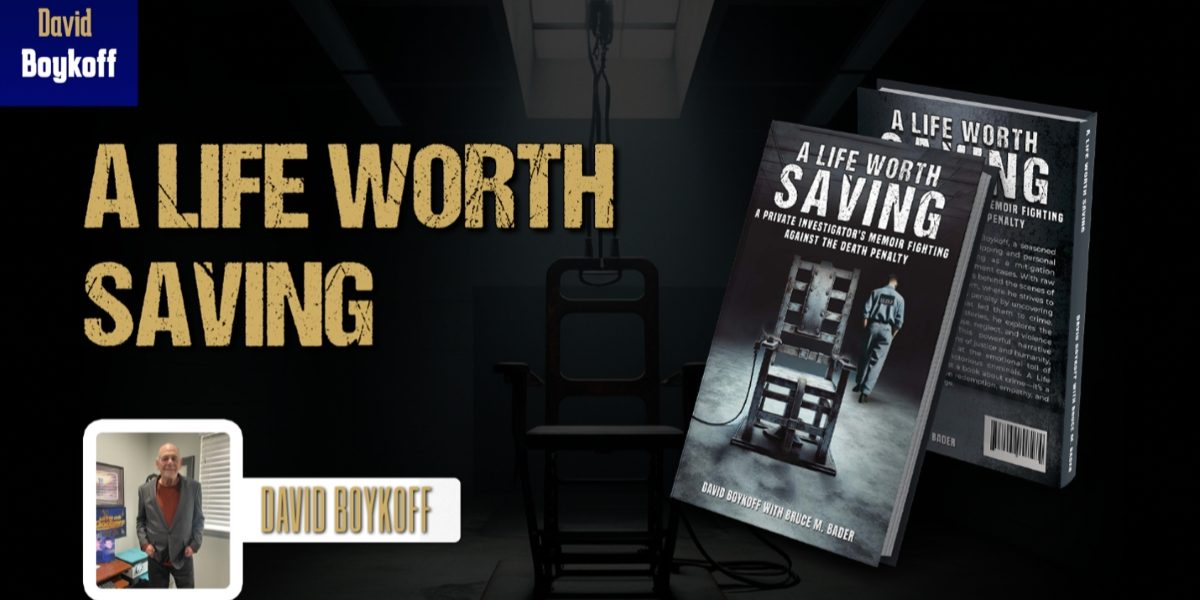
David Boykoff is not the kind of man who speaks in abstractions. He doesn’t theorize about justice; he’s lived on the edge of it for nearly 40 years. In his powerful new memoir, A Life Worth Saving: A Private Investigator’s Memoir Fighting the Death Penalty, Boykoff doesn’t just document a career; he reflects on a personal reckoning that spans a childhood shaped by violence, a career built on fighting for those society has often cast aside, and a long path to reexamining the hate he was raised with.
It’s the rare kind of story that invites readers to engage with hard truths about the justice system, about inherited racism, and about how easy it is to write people off as “monsters” until you understand what may have influenced their actions.
Born in Brooklyn in 1953, Boykoff grew up in the Bayview housing projects with an alcoholic, abusive father. The emotional damage left him scarred, insecure, and, as he candidly admits, indoctrinated into racism from a young age. “I was brought up to be a racist,” he says. “That’s the environment I came from.” That self-awareness, raw and uncomfortable, sets the stage for a memoir that refuses to hide behind a polished persona.
When Boykoff eventually became a court-appointed mitigation specialist tasked with uncovering the life histories of clients facing the death penalty, he began to notice a disturbing pattern between his story and theirs.
“They weren’t all that different from me,” he says. “Abuse. Neglect. A system that failed them early. The only difference was that I got out. They didn’t.”
For nearly four decades, Boykoff’s job was to investigate the lives of people already convicted of capital crimes. His role was not to prove innocence; instead, it was to persuade jurors that life without parole was a more just sentence than death. “I wasn’t defending their crime,” he says. “I was defending their humanity.”
In California and across the U.S., capital cases include a “penalty phase,” during which jurors hear mitigating evidence: stories of abuse, mental illness, childhood trauma. It’s a delicate balance, one last chance to save a life already condemned in the eyes of the law.
Boykoff’s book details the gritty reality behind this process. The interviews. The courtrooms. The stories that rarely make headlines. One of his clients was tied up and whipped by his father in the middle of the street. Another was routinely hung in a closet as a child. These are not anomalies; they are more common than many realize.
“In almost every case, there’s a history of deep trauma,” Boykoff explains. “We often pretend these people just snapped one day. That’s not how it works.”
The memoir doesn’t pull punches, not about the clients, and not about Boykoff himself. His early chapters are filled with ugly, uncomfortable moments: racial slurs from his father, a fistfight with a Black kid that ended with his dad screaming slurs in public. But as the pages turn, so does Boykoff’s perspective.
In his twenties, he began to question everything he’d been taught. “I decided I didn’t want to be like my father,” he says. “And I couldn’t keep justifying hate by calling it tradition.”
His work became a way to not only help others but to atone for his past. A Life Worth Saving is, at its core, a book about redemption, both professional and personal.
“This was my way of giving back. Of saving the lives of people I was taught to hate.”
The book is packed with gripping stories from real cases. The emotional weight is undeniable. Boykoff recounts high-stakes trials, gut-wrenching interviews, and the stress of waiting for a jury’s decision that could end a life.
Some of the most powerful moments come not in the courtroom, but in quiet spaces: jailhouse interviews, conversations with families, phone calls from grieving mothers. “I wasn’t just building timelines,” he says. “I was building trust. You can’t tell someone’s story until they trust you enough to tell it.”
Even with a remarkably successful record, Boykoff describes the job as emotionally exhausting. “By the end, I was burned out,” he admits. “I couldn’t carry it anymore.”
It’s also brutally honest. Boykoff writes about his own missteps, including working under unlicensed PIs, failing the licensing exam on his first try, and nearly losing himself to stress and self-doubt. But with each chapter, you watch him evolve, from a man shaped by trauma to someone who refuses to let it define him.
In the end, Boykoff’s story is less about courtroom victories than about the quiet insistence that every life, no matter how broken, condemned, or forgotten, holds significance. A Life Worth Saving doesn’t offer easy answers. Instead, it leaves readers with harder, more urgent questions: What does justice look like? Who gets to decide who lives and who dies? And what do we risk, as a society, when we stop asking?
Because if there is one truth threaded through Boykoff’s journey, it is this: the measure of a life isn’t tallied in verdicts or headlines. It’s found in the courage to see another human being fully and in the possibility that saving someone else might just save a piece of ourselves.