
By: Charlotte K. Jones
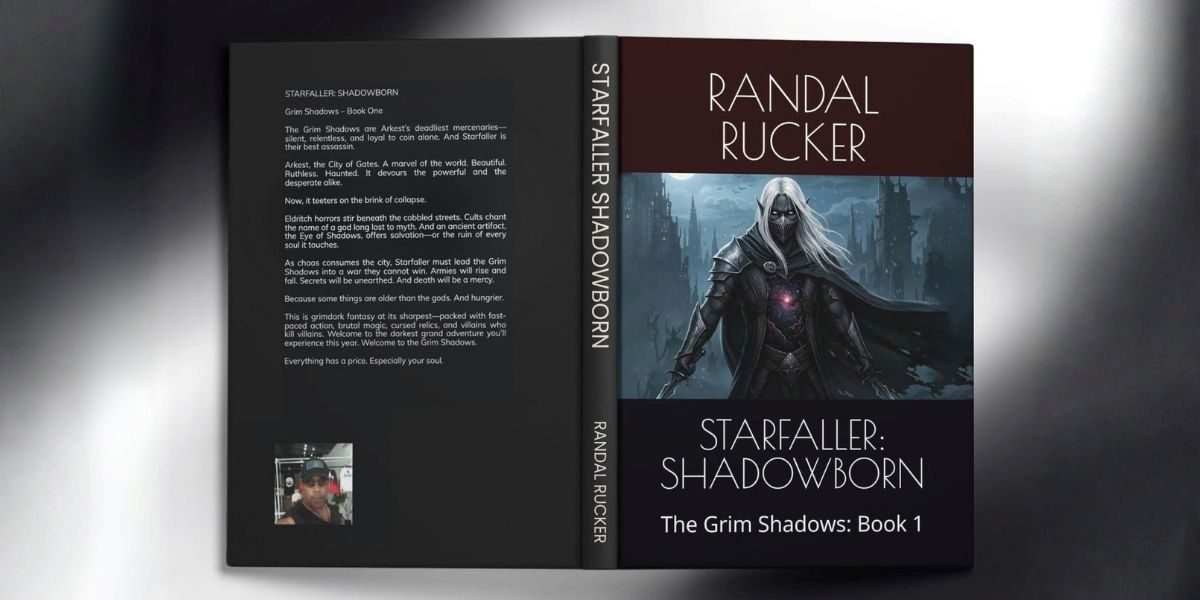
R.C Rucker writes combat like someone who’s seen plans survive just long enough to fail. That sensibility threads through STARFALLER: SHADOWBORN: The Grim Shadows: Book 1. The book’s mercenary cadre, the Grim Shadows, behaves the way seasoned teams might behave. They brief, they compartmentalize, they make peace with incomplete intel. When things go wrong, and they often do, the failures feel like the natural friction of reality, not the author’s invisible hand. That’s the soldier in Rucker: a respect for logistics, for timing, for the complex calculus of casualties and tradeoffs. Starfaller, the company’s most efficient blade, isn’t a superhero; he’s a practitioner, constantly reconciling mission objectives with human limits.
Psychology does the other half of the lifting. Rucker’s I/O background shows up in the book’s focus on motive and structure, how organizations recruit, reward, and sometimes rot from within. Arkest’s factions aren’t cardboard villains; they’re systems with incentives. Cultists aren’t merely fanatics; they’re people finding belonging where the city might fail them. Aristocrats aren’t simply cruel; they’re conditioned to view lives as levers. Even the Grim Shadows, who sell loyalty by the contract, have a culture, rituals, taboos, and internal myths that feel authentic. The novel’s conflict is therefore not just swords and sigils; it’s policy and psychology.
Rucker’s personal influences also show up in subtler ways. He favors tactical and strategic games; the book’s set pieces feel like high-stakes scenarios where map control, timing windows, and resource management matter. His music tastes, EDM, Gothic, and Industrial, match the story’s rhythm: driving, brooding, and at times explosive. And then there’s a place. He grew up in New York City, a masterclass in how power hides in plain sight. His favorite place is Daegu, South Korea, a city where history and modernity intersect with a kind of electric poise. Arkest, the City of Gates, feels like the synthesis of those experiences: cosmopolitan, beautiful, ruthless.
If grimdark has a reputation for despair, Rucker counterbalances that with consequence. The Eye of Shadows, the novel’s ancient artifact, does not simply exist to annihilate hope; it exists to challenge it. When characters reach for power, the narrative doesn’t punish them with cosmic scorn; it asks for receipts. What are you willing to pay? Who will cover the difference when your account runs low? This approach, grounded rather than gratuitous, sets STARFALLER: SHADOWBORN apart from edgier-for-edginess-sake entries in the field.
It’s tempting to imagine the author at a desk, toggling between battle memories and behavioral models. The reality is more integrated. Rucker’s service sharpened his eye for stakes and sequence. His psychology training gave him a framework for why people obey, betray, and persist. The rest, voice, pacing, and atmosphere, come from craft and taste. He enjoys fiction that moves. He likes worlds that feel dangerous because they can be. He likes characters who don’t mistake ruthlessness for strength or kindness for weakness.
The result is a debut that feels both disciplined and volatile. Scenes snap with tactical clarity, then tilt into the uncanny as Arkest’s underbelly, eldritch phenomena, forbidden rites, presses upward through the cobbles. Starfaller’s choices carry weight because the book understands the chain of command and the limits of individual agency within larger systems. Even when the knives come out, and they do, often the most painful cuts are social: a trust breached, a team frayed, a truth finally spoken.
Rucker is already expanding the Grim Shadows saga, which seems logical. Arkest is the kind of world that rewards a long look: too many gates, too many debts, too many names carved into stone to exhaust in a single volume. If the first book is any guide, the installments to come are likely to continue treating readers like adults, capable of tracking strategy and feeling shame, of wanting victory and understanding that every victory comes with its own ruin.
In the end, STARFALLER: SHADOWBORN reads like the sum of its maker’s influences: a field manual smuggled inside a fantasy epic, a psychological case study disguised as a knife fight. It’s a strong debut, a statement of intent. And in Arkest, intent is the first currency you spend.