
Power outages are a universal experience, and their effects can range from mild inconvenience to severe disruption. Whether you’re working from home, managing business operations, or relying on electronics for everyday tasks, a sudden power outage can halt your activities instantly. Outages may damage sensitive equipment, interrupt critical workflows, and even compromise safety when essential lighting or appliances fail. As dependence on technology continues to grow worldwide, having uninterrupted access to power has shifted from a convenience to a necessity.
One reliable way to maintain power continuity is through an automatic transfer switch. This device detects failures in your primary supply and instantly shifts your system to a backup source. As daily life becomes more digital and energy-reliant, understanding how this technology works can help you make informed decisions about protecting your home or workplace.
What Is an Automatic Transfer Switch?
An automatic transfer switch (ATS) is an electrical control device that manages the transition between your main power supply and an alternate source, such as a generator or a secondary grid connection. It continuously monitors the incoming electrical supply, checking whether voltage, frequency, or phase conditions remain within safe, stable limits. When the ATS detects an issue—such as a sudden outage or a dangerous voltage fluctuation—it automatically disconnects the load from the main power line and switches it to a backup source. This ensures ongoing power delivery without requiring any manual intervention.
While the concept may seem complex, the ATS functions like an intelligent bridge. It connects your essential systems to whichever power source is most stable at any given moment. Once the main utility power becomes reliable again, the ATS transitions the load back smoothly. Because this process is automated, the device protects sensitive electronics from abrupt interruptions while ensuring your lights, appliances, or equipment stay powered.
How Automatic Transfer Switches Work During Power Failures
The operation of an ATS can be broken down into a series of fast, coordinated steps. First, the switch continuously monitors the primary power line. It checks for electrical irregularities such as voltage drops, frequency deviations, or any sign that the main supply may be failing. When the ATS detects such abnormalities, it immediately prepares to disconnect the load. This quick response prevents hazardous surges or unstable power from flowing into your systems.
Once the ATS isolates the load from the failing power source, it transfers the connection to a backup supply. If a generator is used, the ATS may trigger its startup automatically and wait until it reaches stable output before transferring the load. If the backup is another grid source or an extensive battery system, the switch transitions directly. When the main power is restored, the ATS assesses its stability and reconnects. This entire process typically occurs within seconds, helping maintain continuous power flow during outages.
Types of Automatic Transfer Switches
Based on the Control Method
Automatic transfer switches come in several configurations designed to match different electrical systems. One primary distinction lies in their control methods. Fully automatic switches operate independently and respond instantly to power disturbances, making them ideal for commercial buildings, data centers, and homes where uninterrupted power is essential. Manual switches, on the other hand, require someone to perform the transition physically and are more commonly used in small-scale or low-risk applications where immediate switching is not critical.
Based on Electrical Load Type
ATS devices are also classified based on electrical load type. Single-phase switches are typically installed in residential properties and small businesses where power needs are relatively modest. In contrast, three-phase switches are designed for industrial facilities, hospitals, and larger commercial settings that rely heavily on machinery, equipment, and advanced electrical systems. Selecting the appropriate type ensures the ATS can handle the demands of your specific environment.
Where ATS Systems Are Most Essential
Automatic transfer switches are most valuable in environments where even brief power interruptions can cause significant disruption. Industrial facilities rely on continuous electricity to keep manufacturing lines, machinery, and automated systems operating efficiently. A sudden outage can halt production, damage equipment, and lead to costly delays, making an ATS essential for minimizing downtime and maintaining operational stability.
Data centers, hospitals, and commercial buildings also depend heavily on uninterrupted power. Digital infrastructure—including servers, storage systems, and networking equipment—is susceptible to outages, and a single blackout can result in data loss or widespread service interruptions. In healthcare settings, the stakes are even higher, as life-support systems and diagnostic equipment must remain powered at all times. Offices, public services, and other commercial spaces further depend on stable electricity for lighting, security, and climate control, making ATS systems crucial across many sectors.
Key Features to Look for in an Automatic Transfer Switch
When evaluating an automatic transfer switch, several essential features help determine whether it will perform reliably and safely in your electrical system.
- Electrical Ratings: Consider the system voltage, current capacity, and whether the ATS supports single-phase or three-phase loads. These ratings ensure the switch can handle everyday electrical demand and sudden surges during source transitions.
- Switching Speed: Fast response time is essential, especially for sensitive equipment. Some ATS models use closed-transition switching to reduce downtime by briefly overlapping power sources for a near-seamless transfer.
- Safety and Protection: Built-in interlocks and short-circuit protection prevent back-feeding and reduce the risk of electrical hazards. These features protect both equipment and individuals during switching events.
- Environmental and Mechanical Durability: Temperature tolerance, insulation quality, and mechanical endurance help ensure long-term reliability, particularly in industrial environments where electrical components are subject to greater stress.
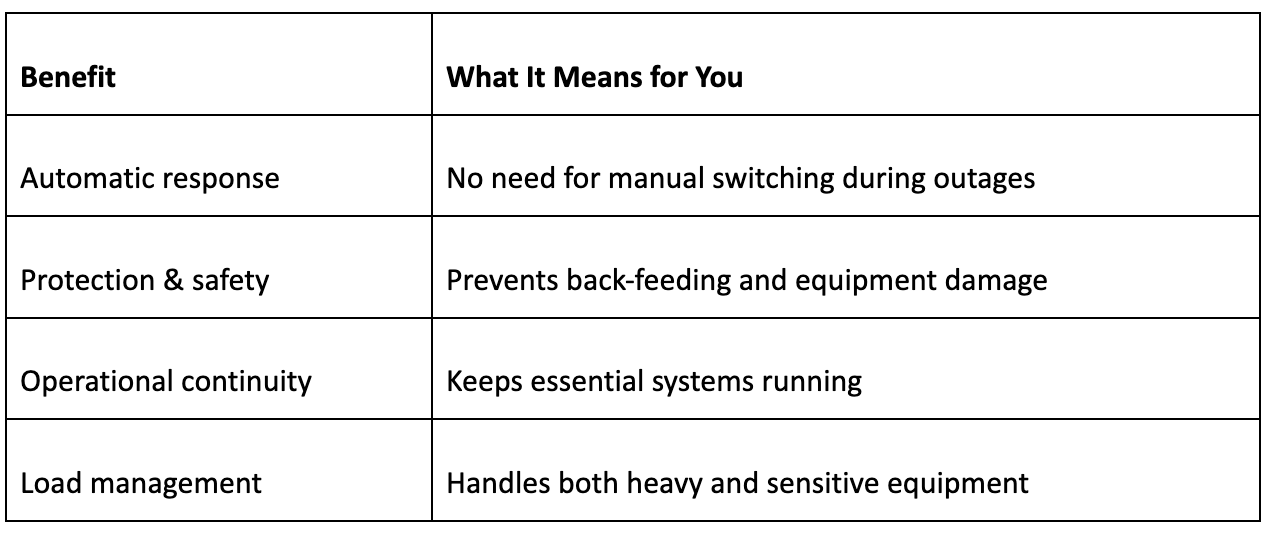
Key Benefits of Using an ATS
Common Questions About Automatic Transfer Switches
A common question is whether an ATS removes the need for backup power. While the device automates the switching process, it still relies on a secondary energy source, such as a generator, battery system, or an alternate grid connection. Another frequent concern is whether an ATS can eliminate all interruptions. Open-transition models may cause a brief momentary gap, while closed-transition options reduce this downtime considerably, making it essential to choose based on your tolerance for short power interruptions. CHINT offers ATS products in various configurations, which helps illustrate how different designs accommodate different continuity needs. These product lines also show how features such as transition mode and electrical rating can influence performance in real-world settings.
Maintenance is also a topic many people ask about. Although an ATS requires relatively little upkeep, periodic testing and inspection are necessary to ensure reliable performance. Checking for worn components, loose connections, or delays in switching helps ensure the device will function properly during a real outage.
Conclusion
Power instability is an unavoidable part of modern life, but the impact of unexpected outages can be significantly reduced with the right equipment. An automatic transfer switch offers a dependable way to detect failures and shift your electrical load to a backup source, helping your essential systems stay connected. Whether you’re protecting a home, running a business, or managing a large facility, an ATS helps prevent equipment damage and maintain continuity during unpredictable grid events.
Understanding how an ATS works enables you to make informed decisions about power protection. By selecting the right switch, considering the key technical features, and performing routine maintenance, you can strengthen your resilience to power disruptions. With a well-designed setup in place, you can continue your activities confidently, knowing your electrical system will stay operational regardless of what happens to the main power supply.