By: Anne Schulze
Recently, amidst London’s vibrant multicultural streetscape, a subtle Eastern spark has emerged. Shengzhao Jiang is a Chinese musician who holds a UK Global Talent visa. She founded the innovative ‘The Silk Concert’, which blends East and West into classical music. By merging classical and contemporary musical styles, as well as East and West, the artists have garnered attention from audiences and on social media, while also embodying women’s perspectives.
Influenced by London’s arts and creative industries, Shengzhao went on the streets to busk. Dressed in traditional Chinese attire, she blended classical traditional singing with Western classical singing, incorporating elements of UNESCO’s intangible cultural heritage into the performance. Passersby praised this rich cultural feast as ‘lighting up the city streets.’
Xiqiang (戏腔) or Xige (戏歌) originated from Chinese opera, tracing its roots back to ancient times when primitive song and dance were performed to entertain the gods. Chinese opera stands alongside Greek tragedy and comedy, as well as Indian Sanskrit drama, as one of the world’s three oldest theatrical traditions. Through centuries of evolution, Chinese opera developed distinct regional characteristics shaped by geography and ethnic customs. Through centuries of evolution, Chinese opera developed distinct regional characteristics shaped by geography and ethnic customs. In the 20th century, alongside modern artistic advancements, Xiqu (戏腔) and Xiqu (戏歌) emerged—popular music that retained opera’s Pentatonic scales, timbres, and vocal techniques while integrating contemporary melodies and lyrics.
Shengzhaog further integrates this with classical Western singing, preserving the melodious and crystalline timbre while incorporating chest and head voice. This innovative fusion allows audiences to experience the essence of traditional Chinese opera while imparting new cultural depth to popular music. However, inheriting and developing traditional culture while avoiding homogenisation and pandering to the masses remains an eternal challenge on the path of innovation.
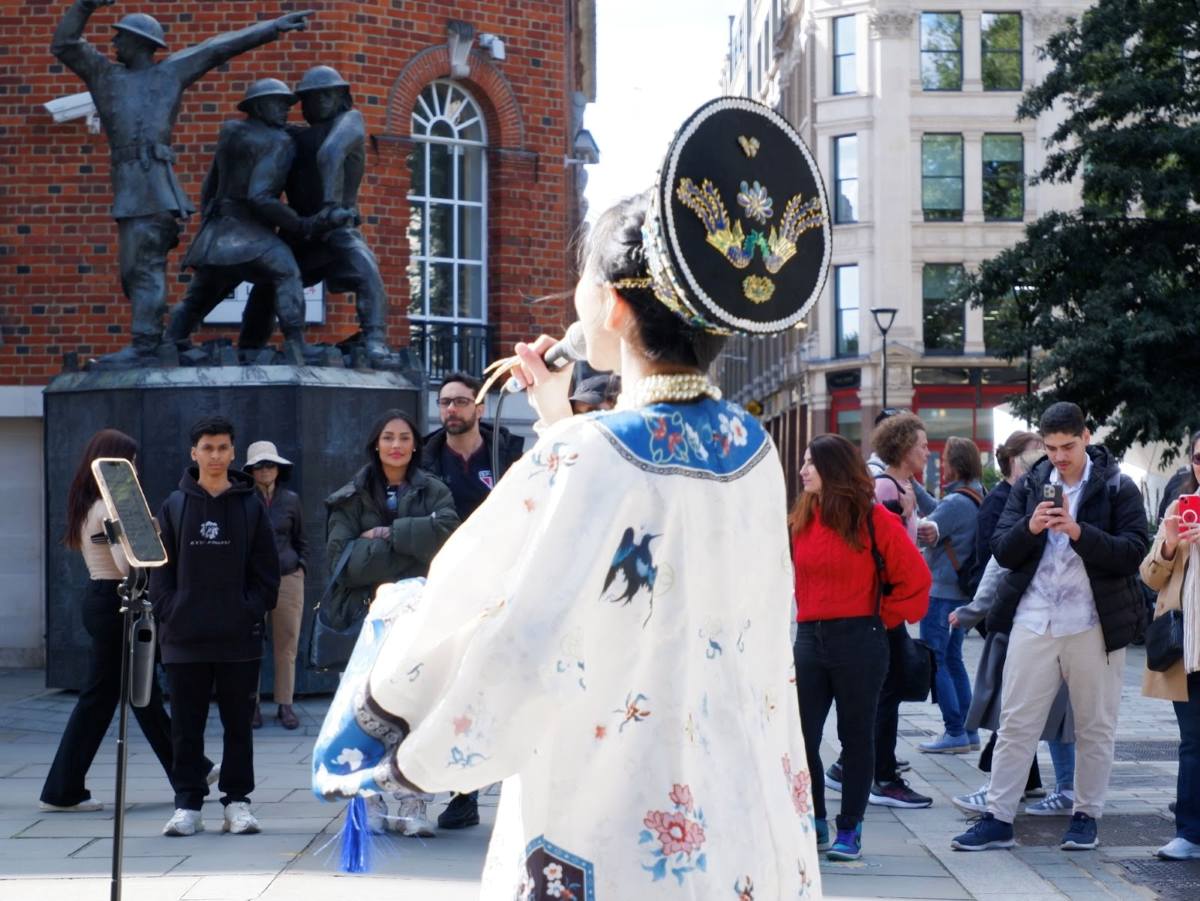
Photo Courtesy: Shengzhao Jiang
‘The String Show’ weaves a fantastical tale of human-puppet romance, while terms like ‘colour painting’ and ‘brush and ink’ vividly convey the traditional craft of folk artisans carving and painting human figures onto wood to create puppets. This fusion of traditional techniques with contemporary expression breathes new life into the art form.
The most eye-catching aspect of the performance was Shengzhao’s traditional Chinese attire, which drew crowds of tourists on London’s streets to gather, take photographs, and queue for group shots, sparking a social media sensation. ‘Traditional dress embodies the crystallisation of folk material culture while also carrying spiritual significance, remarked Shengzhao. ‘It represents our steadfast commitment to preserving cultural diversity in today’s globalised world.’
Hanfu is a representation of traditional Chinese attire, with origins dating back to the 2nd millennium BC. Hanfu has influenced the conventional clothing of numerous neighbouring cultures within the Sino-cultural sphere, including Korean hanbok, Japanese kimono, the Ryukyuan Ryusou, and the Vietnamese áo giao lïnh ( Vietnamese clothing). Since the 17th century, elements of Hanfu design have also influenced Western fashion.
Tang-dynasty Hanfu stands as one of the most iconic Hanfu styles. Common women’s attire in the Tang dynasty included shan (衫; a long overcoat or long blouse), ru 襦 (a short sweater), banbi, pibo (披帛), and qun (裙; a usually wide, loose skirt that was almost ankle-length). strongly influenced the Korean and Japanese traditional costumes.
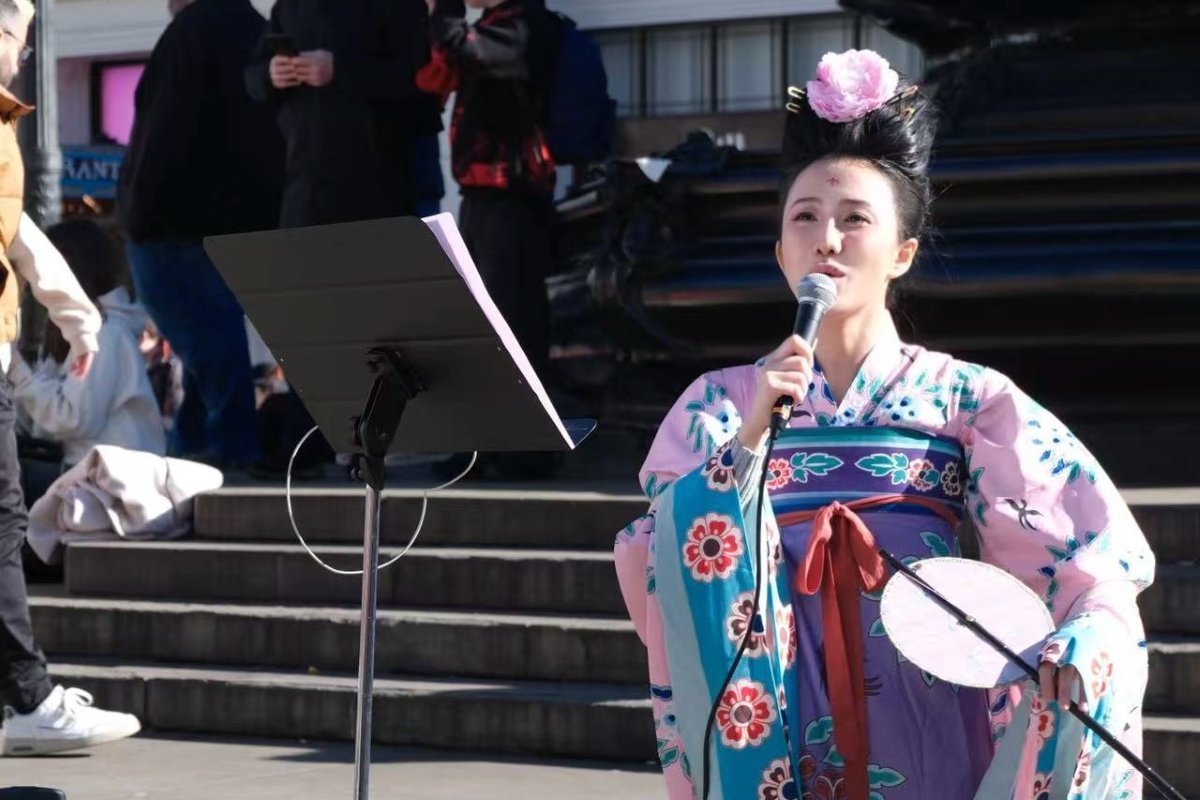
Photo Courtesy: Shengzhao Jiang
During the Tang Dynasty, a period of flourishing art, science and economy, women’s attire particularly reflected the era’s new outlook, featuring bold and inclusive elements in both patterns and styles. This development was inextricably linked to the bustling trade along the Silk Road. This earliest network of East-West world trade witnessed unprecedented interaction between the Eastern and Western worlds, playing a pivotal role in fostering economic, cultural, and political development between the two spheres.
Today, female representation has become an integral component across various fields, as has diversity in its development. However, the gender disparity in the figures of industry leaders within the music sector remains pronounced. ‘Much like how most performers we encounter on the streets are non-minorities or male, this situation can sometimes create pressure,’ says Shengzhao. ‘Yet as a practitioner raised in a diverse environment, I find it important to have a voice that represents myself. Just as the ‘Tang style’ flourished a millennium ago through inclusive development, such trends of inclusivity will also infuse world music with rich cultural depth and artistic potential.’
Indeed, inclusive development extends beyond gender equality to encompass acceptance of diverse voices, cultural backgrounds, and gender identities. By showcasing women’s creative output, the industry can foster greater receptiveness to diversity, cultivating a more inclusive cultural ethos that positively propels the overall advancement of music. (Counting the Music Industry: The Gender Gap, 2019)
Busking, which emerged in 19th-century Europe before spreading worldwide, has become an integral part of urban culture. Now, the cultural vitality of this historic capital is reflected in Shengzhao’s traditional cultural show, where the seeds of diversity have been quietly sown, contributing meaningfully to the inheritance and development of conventional culture, the cultivation of new talent, and the advancement of global pluralism.