By: Maria Sigacheva
Maria Sigacheva, chartered certified accountant (ACCA), indirect tax manager at the Glencore, mentor, and board member at the Civil Mediation Council in the UK.
The AI technology market is growing exponentially and could reach $826.70 billion by 2030 and over 70,000 AI start-up businesses worldwide.
The US market has become a leading hub for startups such as Petal, Xant, and Paradox, with more than 4,643 companies and private investments surpassing $246 billion from 2013 to 2022. Following the US, the next prominent markets are China, the United Kingdom, Israel, Canada, France, India, Japan, Germany, and Singapore.
What makes one choose where to establish a start-up? The answer lies amongst three pillars: resources, regulations and network.
Resources
AI technology seeks talented individuals with a data science background and well-developed STEM education (Science, Technology, Engineering and Mathematics). In December 2022, the White House announced unprecedented initiatives in STEM education and support to all students, building a solid foundation of future talents and growing the existing talents across the US. While resources are essential, they must be supported by a framework of regulations that foster growth and accountability.
Investments and Incentives
In the USA, there is an R&D tax credit available for AI developers, as well as an employee retention credit (ERC). Additionally, businesses may qualify for tax credits related to salaries, supplies, contract research, and cloud computing costs.
The US government has collaborated with the biggest businesses, who have donated generously towards the AI projects. Amazon Web Services invested $10 million, Intel $45 million, Google $120 million, Meta $10 million, OpenAi $1 million, NVIDIA $10 million a year). The Department of State plans to invest $ 23 million in funding to promote the responsible use of AI globally ( as per White House announcement February 2024).
Based on the data provided by the World Bank and OECD (Organization of Economic Co-operation and Development), the US government has invested $328 billion between 2017 -2023, leading by far among other countries, including China and the UK:
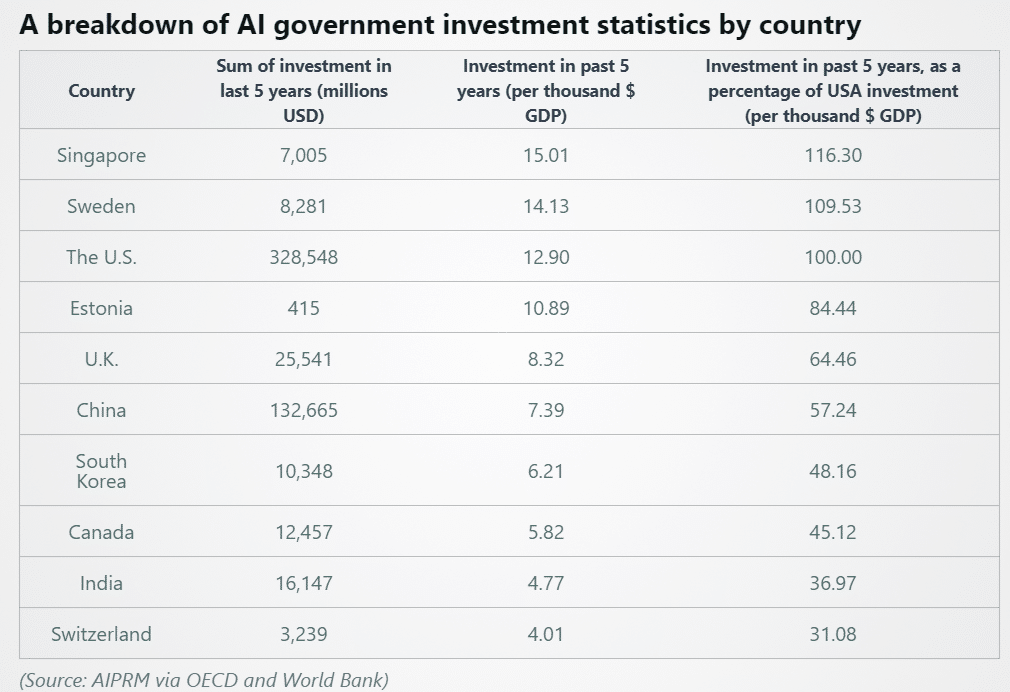
Photo Courtesy: AIPRM via OECD and World Bank
Silicon Valley is one of the largest global hubs for private investment in the technology sector. In recent years, investments in AI startups have steadily increased, reaching 50% of the global funding for these companies in 2023. The total funding for AI startups in that year amounted to $42 billion, with OpenAI emerging as the top-funded learning platform. By 2023, OpenAI had raised $12 billion, with major investors including Microsoft and Amazon.
Regulations
The United States has been actively engaged in AI legislation, setting standards for safety and security in this field. According to a report from Stanford University, the number of countries with laws that mention the term “AI” has surged from 25 to 127.
The US government has passed numerous bills to standardize AI safety and innovation, including the landmark National Artificial Intelligence Initiative Act 2020. Since 2015, nine bills have been passed through Congress, one of which is Blueprint for an AI Bill of Rights; and at the state level, 14 legislations passed in Maryland, California, Massachusetts and Washington.
The Executive Order on “Safe, Secure and Trustworthy Development and Use of AI” issued on 30 October 2023 has already set the volunteering commitments, accepted by Amazon, Google, Meta, Microsoft and OpenAi to comply with the new standards of safety, which includes sharing data of test results and any other critical findings with the US government.
Currently, regulations in the US, Europe, and the UK tend to take a prescriptive approach, which may soon become mandatory.
A key factor in the success of start-ups is the presence of a dynamic ecosystem that includes other AI tech startups, academic partnerships, and government initiatives. This network fosters mentorship and collaboration, enhancing the development of AI technology.
Network
One of the initiatives in the US is the National AI Talent Surge, which encourages students and professionals to join the government program. Another non-profit organisation – The Centre for AI and Digital Studies is supported to conduct various research on AI technology in its reports but also serves as a significant collaborative platform. It is represented by 55 leading experts in AI policy from over 25 countries and is based in Washington, D.C.
Artificial intelligence (AI) has significantly advanced since 1951, when Christopher Strachey created the first successful computer program. Later, in 1997, IBM’s Deep Blue defeated Garry Kasparov in a chess match. AI has also played a crucial role in the development of RNA vaccines, modelling human speech, and the creation of ChatGPT. AI technology is growing exponentially.
As AI continues to grow, the U.S.’s strategic focus on resources, regulations, and networks positions it to remain a global leader in innovation, shaping the future of technology.
Sources:
- Biden-Harris Administration Announces Historic Actions to Advance National Vision for STEMM Equity and Excellence | OSTP | The White House
- R&D Tax Credits for AI Developers (mossadams.com)
- Call for AI proposals — Technology Modernization Fund (cio.gov)
- United States and Eight Companies Launch the Partnership for Global Inclusivity on AI – United States Department of State
- The United States of Artificial Intelligence (cbinsights.com)
- Join the National AI Talent Surge – AI.gov
Published by: Martin De Juan