Tad Nelson & Associates: Professional Networks, Legal Credentials, and Their Role Within the Texas Criminal Defense Community

Legal practices operate within a wider professional environment shaped by court systems, bar organizations, continuing education programs, and relationships among attorneys. In criminal defense, professional development often involves maintaining knowledge of changing laws, courtroom procedures, and standards of legal practice. Attorneys frequently participate in professional organizations and certification programs that provide educational resources and opportunities for engagement with other members of the legal community. Within Texas, where criminal matters are handled across numerous county and district courts, law firms often develop their professional identity through a combination of legal experience, formal credentials, and participation in established legal networks.

Tad Nelson & Associates, opened on June 1, 1995, is a League City, Texas-based law firm focused on criminal defense and related legal services. The firm’s current structure reflects the professional background of its leadership team, including Tad Nelson as owner, Amber Spurlock as managing partner, and Shelly Darnell as office manager. The firm’s professional foundation extends across decades, with its formal opening in 1995 following Nelson’s earlier work in prosecution and his transition into private criminal defense practice. The firm maintains offices in both League City and Galveston and serves clients across Galveston County and the broader Houston metropolitan region.

Nelson’s legal career began before the establishment of the current firm. According to public professional records, he has been licensed to practice law in Texas since 1991. The State Bar of Texas lists Nelson as practicing in criminal law, family law, and personal injury litigation, with his primary practice location in League City. Before moving into private practice, Nelson worked at the Galveston County District Attorney’s Office, where he served as a prosecutor. At the Galveston County District Attorney’s Office, Nelson served as a felony prosecutor under District Attorney Mike Guarino and tried cases in the 10th Judicial District Court, where Judge Garner presided. From 1992 to 1995, he tried 39 jury cases in that role.

A central professional credential associated with Nelson is his Board Certification in Criminal Law by the Texas Board of Legal Specialization. The certification, first obtained in 1996, requires attorneys to meet experience requirements, complete continuing legal education, undergo peer review, and pass a specialized examination. The Texas Board of Legal Specialization operates under the authority of the Supreme Court of Texas and provides certification in selected legal fields. For criminal defense attorneys, the credential represents additional recognition beyond standard admission to the Texas Bar. The firm states that fewer than three percent of Texas attorneys achieve board certification.

Nelson’s professional training extends beyond his Texas criminal law certification. Between 2010 and 2014, he completed a two-and-a-half-year scientific training program that included five intensive trips to Chicago and hands-on instruction at the laboratory of Dr. Edward Polite. In February 2014, he was designated a Lawyer Scientist by the American Chemical Society.In December 2016, he also completed a Master’s in Forensic Toxicology at the University of Florida. These qualifications added scientific and forensic training to his existing legal background.

The firm’s professional profile also includes involvement with legal associations. Nelson’s listed affiliations include the Texas Association of Criminal Defense Lawyers, the National Association of Criminal Defense Lawyers, the Texas Trial Lawyers Association, the National College for DUI Defense, the DUI Defense Lawyers Association, the Harris County Bar Association, the Harris County Criminal Lawyers Association, the Galveston County Bar Association, and the State Bar College. The firm identifies his membership in the National Association of Criminal Defense Lawyers as a lifetime membership. Such organizations generally provide attorneys with opportunities for continuing education, professional discussion, and access to developments affecting legal practice. Membership in these groups is common among attorneys seeking continued involvement in their practice areas.

Amber Spurlock represents another part of the firm’s legal structure. Public records from the State Bar of Texas list Spurlock as an attorney with Tad Nelson & Associates, with practice areas including criminal law, family law, juvenile law, military law, and criminal appeals. She has been licensed to practice law in Texas since 2007. The firm identifies Spurlock as a former Judge Advocate General in the United States Air Force. Her military legal background included service in Baghdad, where she presented cases before Iraqi courts, as well as prosecution of Courts-Martial and service as a Special Assistant United States Attorney in federal court. Her role within the firm contributes to its capacity to handle legal matters alongside Nelson’s long-term criminal defense background. The firm’s organizational structure combines attorney leadership with administrative support through Darnell’s office management role.

Spurlock also holds scientific credentials associated with the firm’s legal profile. She earned the Lawyer Scientist designation from the American Chemical Society in 2015, making her and Nelson two Lawyer Scientists serving in leadership positions within the same firm. Her professional practice includes criminal law, family law, juvenile law, military law, and criminal appeals. The firm also states that she has taught at numerous legal and professional seminars during nearly two decades of practice. Her background therefore combines courtroom work, military legal service, scientific training, and legal education.

Professional networks also influence how law firms communicate their expertise and maintain relationships within the legal sector. Tad Nelson & Associates uses its website and online platforms to share information about legal topics, attorney backgrounds, and firm activities. The firm’s website presents information regarding its attorneys, practice areas, and professional credentials, while social media platforms provide additional channels for public communication. These platforms have become common tools for law firms seeking to maintain public visibility and provide general legal information.

The firm’s connection to the Texas legal community is also shaped by its location and court-related experience. Based in League City, the practice operates in an area connected to Galveston County and the wider Houston metropolitan region. Attorneys working in these areas regularly interact with local courts, legal professionals, and government institutions as part of standard legal proceedings. The firm’s presence in League City dates to its opening on June 1, 1995, placing its organizational history within the same period as Nelson’s transition from prosecutorial work to private criminal defense. Its offices in League City and Galveston also place the practice within the legal market serving Southeast Texas. The firm’s professional identity is therefore connected not only to individual credentials but also to the broader legal environment in which it operates.

The firm’s stated areas of work extend beyond general criminal defense to include felony and misdemeanor matters, DWI defense, drug charges, violent crimes, and federal charges. Its broader legal services also include divorce, child custody, and personal injury cases. This range of practice areas exists alongside the firm’s focus on criminal defense and reflects the professional scope described in its public materials.

Tad Nelson & Associates reflects a model of legal practice where professional credentials, courtroom experience, and participation in legal networks contribute to organizational development. Through its leadership structure, attorney qualifications, and connection to professional associations, the firm represents one example of how criminal defense practices establish their position within a state legal system. The combination of Nelson’s Board Certification, scientific training, forensic toxicology education, and professional affiliations with Spurlock’s military, courtroom, and scientific background forms a significant part of the firm’s stated professional profile. Under the direction of Tad Nelson, the firm combines established legal experience with the structure of a long-standing law office that opened in 1995.

Disclaimer: The content in this article is provided for general knowledge. It does not constitute legal advice, and readers should seek advice from qualified legal professionals regarding particular cases or situations.


What the Ambassador Young Fellows Program Reveals About the Growing Use of Collaborative Learning in Civic Education

American universities have never fully agreed on what civic education should look like.

Some schools approach it through political science. Others through history, public policy, religion, or leadership studies. In recent decades, another idea has gained ground: students may learn about citizenship and public life not only through lectures, but also through living, studying, and working together.

That idea is not especially new.

What has changed is the scale. According to the National Survey of Student Engagement, colleges across the United States have increasingly emphasized collaborative learning, service-learning, and peer-to-peer educational experiences in undergraduate education. Students who participate in those activities often report higher levels of engagement with both their coursework and their campus communities.

The Ambassador Young Fellows Program emerged within that broader educational environment.

The fellowship was established in 2025 under the leadership of Matthew Daniels and launched with the endorsement of Ambassador Andrew Young. From the outset, the program was designed as a residential educational experience rather than a conventional academic conference or lecture series.

Students spend approximately one week together.

That part is straightforward.

Published fellowship schedules show participants attending lectures, engaging in structured discussions, completing collaborative projects, participating in service activities, and traveling together as part of the educational experience. The program combines several educational approaches that American universities have experimented with for years.

It also depends heavily on interaction.

Students do not register independently. Participating colleges and universities nominate candidates for consideration. Those students then enter a structured fellowship environment that brings together participants from different institutional, cultural, and academic backgrounds.

That distinction matters.

Many leadership programs operate within a single campus environment. The Ambassador Young Fellows Program was organized differently. According to published information from the fellowship’s inaugural year, participants represented nine separate institutions.

The list itself was notable.

Students attended from Allen University. Benedict College. Bryan College. Claflin University. Morris College. John Brown University. Voorhees University. Wheaton College. Anderson University.

Seventeen participants came from historically Black colleges and universities. Sixteen came from institutions associated with the Council for Christian Colleges and Universities.

The fellowship schedule reflects that diversity.

Students attend classroom sessions during the day. They participate in organized discussions. They work together in small groups. Sometimes those same discussions continue later, outside formal classroom settings.

Not every educational activity takes place in front of a lectern.

According to published program descriptions, participants complete collaborative assignments throughout the fellowship. Group presentations are prepared over several days and delivered near the conclusion of the program.

This approach has become increasingly common in higher education.

Educational researchers have spent decades studying collaborative learning environments. Findings from the National Survey of Student Engagement have repeatedly shown that students often learn differently when required to engage directly with peers rather than simply receiving information through lectures.

The fellowship appears to have incorporated that assumption into its structure.

There are lectures.

There are discussions.

There are projects.

And there is travel.

Program schedules published during both the 2025 and 2026 fellowship sessions included educational visits to Atlanta and locations associated with Martin Luther King Jr. Those visits formed part of the curriculum itself rather than functioning as separate excursions.

Service activities also appear throughout the fellowship schedule.

That reflects another broader trend in American higher education. Service-learning programs expanded significantly during the late twentieth century and early twenty-first century as colleges increasingly sought ways to connect classroom instruction with community engagement.

The fellowship combines those elements.

Participants study together. Work together. Travel together. Present together.

Sometimes educational models are easier to describe by listing what students actually do rather than by assigning them a category.

The program’s residential structure may be equally important.

Students remain together throughout the duration of the fellowship. Meals are shared. Conversations continue outside formal sessions. Educational researchers have long argued that some forms of learning occur through informal interactions as much as through classroom instruction.

The structure of the second year of the program remained quite similar.

Based on information made available after the 2026 fellowship program, twenty-seven students from thirteen institutions attended the workshop on public service, leadership, civility, and human rights. Faculty and representatives of the institutions also attended part of the program.

The basic model, however, remained familiar.

Students attended lectures.

Students participated in discussions.

Students completed group projects.

Students engaged in service activities.

Students traveled.

Students presented their work.

That repetition is not accidental.

The Ambassador Young Fellows Program is still relatively new within the realm of American civic education programs. However, the initial framework of this program is based on several educational practices that have gained prominence in higher education over several decades: collaborative learning, experiential learning, residential programs, service-learning, and cross-institutional involvement. Regardless of whether the program is considered a leadership fellowship, civic education program, or an experiential learning program, the fundamental trait of the fellowship, since its foundation in 2025, has not changed: learning together through shared experiences of students from various institutions.

Ryan Matthews and the Art of Play

By: Alexandra Perez

Ten minutes may not seem like enough time to exercise a dog, strengthen a bond, reinforce training, and have some genuine fun, but Ryan Matthews believes the right kind of play can accomplish all four. Known as the K-9 Mentalist and the founder of World Of Dog Training, Matthews approaches play as something more meaningful than simply tossing a ball or handing over a favorite toy. Done intentionally, it becomes a language between dog and owner, one built on excitement, communication, trust, and clear boundaries.

Matthews calls it “The Art of Play,” and at first glance, the idea looks remarkably simple. A long leash, the right toy or reward, and ten minutes are enough to begin. But beneath the tugging, movement, praise, and excitement is a carefully structured interaction. The dog learns when the game begins, when it can engage, when to release, and when playtime is over. The owner learns something equally important: how to become an active part of the experience instead of simply standing on the sidelines giving commands.

In a demonstration with his dog Zeus, Matthews begins before a toy is even visible. That detail matters. Rather than allowing the sight of a toy to dictate Zeus’ excitement, Matthews first creates engagement between himself and the dog.

“Are you ready?” he asks.

The familiar phrase flips a switch. Zeus knows the game is about to begin, and only then does Matthews retrieve the toy.

It is a small moment that captures the larger philosophy behind the exercise. Matthews wants the interaction to start with the relationship, not the object. The toy is part of the experience, but the human remains at the center of it.

Once the game begins, Matthews uses a handful of clear cues. One signals that Zeus can take the toy. Another tells him to release it. When Matthews asks Zeus to drop, the toy immediately becomes still. Matthews does not continue pulling or teasing. The game pauses until he chooses to restart it.

“Remember, he shouldn’t go after it unless I tell him to get it,” Matthews explains.

This transforms an ordinary game of tug into an exercise in impulse control and communication. Zeus is allowed to become excited, pull, move, and compete for the toy, but that excitement exists alongside structure. He is not being asked to suppress his enthusiasm. Instead, he is learning how to move between high energy and control while remaining connected to Matthews.

That distinction is especially important in Matthews’ work with reactive dogs. He describes the exercise as particularly useful for them when introduced appropriately in an open environment with plenty of space. A long leash allows the dog freedom to move while keeping the interaction connected to the handler.

The physical component is only one part of the experience. For Matthews, the human’s willingness to genuinely participate matters just as much.

He cheers Zeus on. He praises him. He teases him with the toy and lets the competition feel real. At moments, the interaction resembles two children absorbed in a game rather than a formal dog-training session.

“You got to really be crazy and be a kid all over again,” Matthews says. “Have fun. Be a kid again.”

There is purpose behind that enthusiasm. Instead of expecting a dog to find its owner interesting simply because that person is holding the leash, Matthews shows owners how to become part of what the dog enjoys. Play becomes shared rather than something the human merely provides.

The game also gives the dog an opportunity to succeed. During tug, Matthews lets Zeus feel as though he can compete and win. He celebrates his strength and encourages him enthusiastically. At the same time, boundaries remain intact. Matthews decides when the game starts, when the toy becomes active, and when the interaction ends.

Even the physical movements are intentional. Matthews recommends tugging up and down rather than aggressively from side to side, which he cautions can be hard on a dog’s head and neck. The result is an activity that can provide movement and stimulation without losing sight of control.

Perhaps the most important part comes when the fun is over.

Matthews uses a clear finishing cue. The tugging stops. The toy goes away. There is no confusion about whether another round is coming. Just as the dog learned the signal that switched the game on, it learns the signal that switches it off.

That ability to move from excitement back to calm is part of what makes the exercise more than ordinary play. In a single interaction, the dog practices engagement, release, patience, physical movement, and responding to its owner even while highly stimulated. This emphasis on communication and mutual understanding also reflects the philosophy behind World Of Dog Training, where Matthews encourages owners to look beyond obedience and focus on the relationship they build with their dogs.

For the owner, those same ten minutes can become an opportunity to stop treating training as a chore. There is no requirement to separate bonding, exercise, and learning into different parts of the day. Matthews’ approach brings them together in an experience both dog and human can enjoy.

The toy itself can change, too. Matthews acknowledges that different dogs value different rewards. For one dog, it might be a tug toy. For another, food may be more motivating. What matters is finding something meaningful to the individual dog and then using it to create purposeful interaction.

That may ultimately be what makes the Art of Play so simple and yet so layered. It is not really about the leash or the toy. It is about what happens between the dog and the person holding the other end.

Ten intentional minutes can become exercise without feeling like exercise, training without feeling like a drill, and bonding without forcing affection. Through World Of Dog Training, this philosophy of purposeful connection remains central to Matthews’ approach. By turning play into a shared language with a clear beginning, purpose, and end, Ryan Matthews shows that sometimes one of the most effective ways to teach a dog is also one of the easiest to forget: simply play together.

Why Kids Give Up on Math and How Cuemath Teaches It

Math has a reputation problem. It gets treated as a subject that lives on paper. Most kids don’t see math as relevant. However, the reality is that everyday life uses basic math more than almost any other subject a child studies.

In December 2025, Education Week [source] asked senior executives at companies including Google, IBM, Microsoft, and McKinsey which skills young workers are missing. Their answers pointed to problem-solving, adaptability, and comfort with ambiguity. A McKinsey partner also named basic math among the skills in short supply in manufacturing. Math builds many of the habits those answers describe.

Four Teaching Habits That Turn Children Off Math

Cuemath, a one-on-one online math tutoring program, asked its own tutors why their students are not fond of math. The same four causes came back, and none of them was “this child is bad at math.”

  • Math is taught as rules to remember: Cross-multiply. Flip and multiply. Order of operations. A child can repeat the rule and have no idea what it does. Math is not just about formulas, it’s about understanding concepts, applying ideas, and building confidence to tackle challenges.
  • Being wrong happens in front of everyone: In a full classroom, a wrong answer is public. So the child stops raising their hand. Cuemath tutors tell their students that mistakes are not failures, they are stepping stones to mastery. A child who is scared of being wrong stops trying before they stop learning.
  • One pace is set for thirty children: Math builds on itself. A child who does not understand fractions in grade 4 will struggle with algebra in grade 8. A class that moves at one speed leaves that child behind, and the child concludes that they are the reason.
  • Nobody shows them where it is used: To a lot of children, math is numbers on a page with no purpose. Cuemath tutors do not start teaching math with formulas. Instead, they start with familiar concepts like money, cooking, and games, so they can see that math is everywhere around them.

What a Program Built the Other Way Looks Like

Cuemath is a live, one-on-one online math tutoring program for kindergarten through high school. It was founded in 2013 and has worked with more than 200,000 families across 80-plus countries. Every child is matched with one expert math tutor who stays with them. The four habits above are the four things the program is designed around.

The Tutor Is Not Allowed to Give the Answer

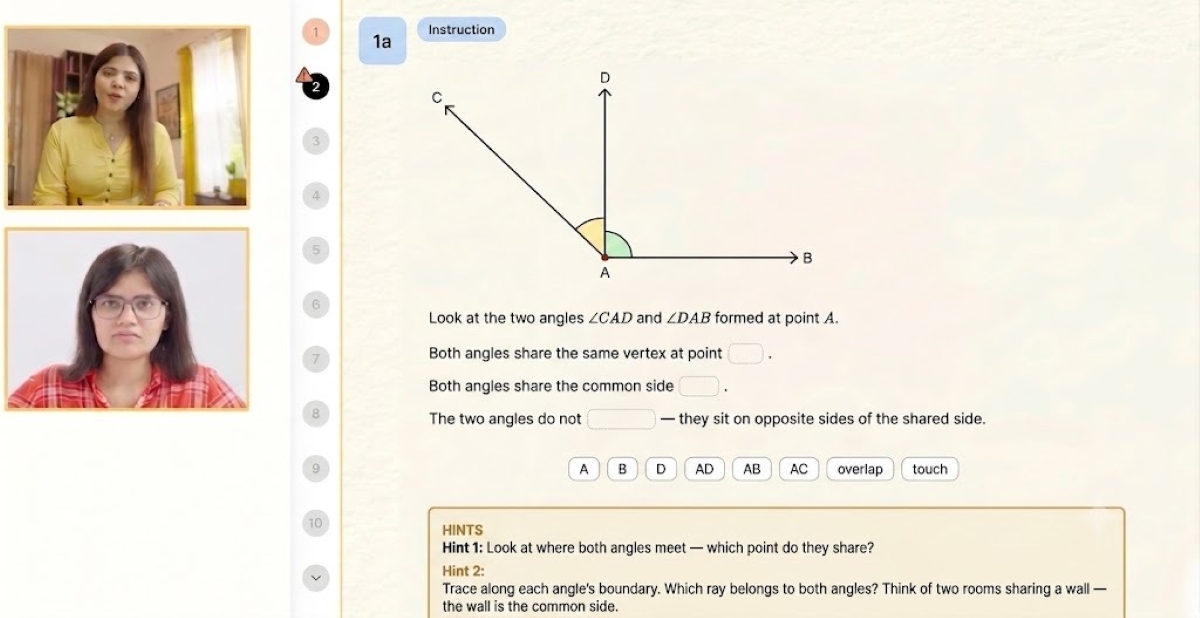
Photo Courtesy: Cuemath (A Cuemath tutor gives hints to help the student solve questions in real-time.)

The method has a name inside the company: cue, don’t tell. Cuemath tutors guide on how to approach a question instead of explaining the answer right away. The child finds the solutions on their own.

There is research behind it. The generation effect, documented by Slamecka and Graf in 1978, found that people remember what they work out themselves better than what they are told.

The National Council of Teachers of Mathematics recommends productive struggle, which means letting a student stay with a problem they cannot immediately solve. The classes are held on Cuemath’s own shared whiteboard, where tutor and child work the same problem in real time, and the cueing method is built into how tutors are trained to use it. Some classes end with the puzzle unsolved on purpose and the child returns to it days later.

Understanding Is Checked Separately From Getting the Answer

Before any math online classes begin, the parent and child attend a free evaluation with a math specialist, and the child does a short written assessment built by Cuemath’s curriculum team. It scores four separate skills. Fluency is knowing facts and running procedures accurately. Understanding is knowing why a procedure works. Application is picking the right tool for a real problem. Reasoning is solving something the child has never seen before.

Splitting those four is what catches the child nobody is worried about. A passing grade can sit on top of a real gap for two or three years, because a student fluent enough to produce answers can cover for weak understanding until the topics get harder.

The check continues in every lesson. The child has to teach the concept back to the tutor in their own words. That is where the tutor finds out whether the understanding is real or whether a rule is being repeated. Parents get tutor notes after every session and a dashboard tracking all four skills.

One Child, One Tutor, One Pace

Rotating tutors and group classes are normal in tutoring. Cuemath tutors go through a selective screening process and are trained to work with children who have already decided they are bad at math. Each child keeps the same tutor, and lessons are planned around the gaps the assessment found rather than what a typical student that age is assumed to know.

The setting also removes the audience. In a session with one other person, a wrong answer is not a public event, and tutors are trained to treat it as information about where to go next rather than something to correct and move past. For a child who stopped raising their hand in class, a one-on-one session takes away that audience.

The Real-World Use Comes First

Cuemath also has a section for math that is not on any syllabus: logic puzzles, strategy games, and problems like reading a misleading chart or comparing two phone plans. It also supports preparation for the SAT, AP exams, and competitions like the AMC and Math Kangaroo, all of which test whether a student can choose a method before solving anything.

Why Kids Give Up on Math and How Cuemath Teaches It

Photo Courtesy: Cuemath (Logic puzzles, math games, and challenges in Cuemath app.)

What Changed for the Students

Cuemath publishes its student outcomes publicly. We take a few observations and examples from those.

  • A grade 8 student could calculate quickly but could not explain why the math worked. After working on the reasoning, he scored 100% on his Common Core Algebra test.
  • A grade 6 student needed a parent to read every question out loud. After learning to work through problems himself, he scored 483 out of 513 on the New York State Grade 6 Math Test, which is Level 4.
  • A grade 5 student learned to find more than one route to an answer, then won a Gold Pin and Gold Medal at MOEMS, placing in the top 2%.
  • A grade 4 student was too shy to say an answer out loud. In one-on-one sessions he started speaking up, and later won a Math Whiz Award.

None of these children got better at memorizing. They were taught the same subject in a different way.

Booking a Free Evaluation

Families can book a free evaluation with Cuemath to see where their child stands on all four skills before making any decision.

Job Hunting in New York in 2026-27 and Where Openings Are

Ask anyone looking for work in New York right now and you’ll hear two very different stories. One friend lands three interviews in a week. Another sends out fifty applications and hears nothing back. Both are telling the truth. The city’s job market isn’t simply good or bad at the moment. It is uneven, and knowing where the openings actually are can save you months of frustration.

The Headline Numbers Look Better Than They Feel

On paper, things are improving. The city’s unemployment rate fell to 4.8% in August, according to NYCEDC’s latest economic snapshot. That was the sixth monthly drop in a row, down from 5.7% at the start of the year.

But look underneath, and the picture is more mixed. Private employers have added only 3,900 jobs so far in 2026. Strip out health care, and private-sector employment is actually down 12,900 jobs for the year. Unemployment is falling, but new jobs aren’t being created quickly. So if your search feels harder than the headlines suggest, you’re not imagining it.

Health Care Is Carrying The City

If there is one sector New Yorkers should take seriously, it’s health care and social assistance. It now employs more than a million people, grew 2.7% over the past year, and has added over 203,000 jobs since before the pandemic. No other part of the city’s economy comes close.

That doesn’t only mean nurses and doctors. Hospitals and care providers need admin staff, billing and coding specialists, IT support, facilities teams, schedulers and managers. If you have office, finance, or tech experience, a hospital system may be a better bet than the industry you came from.

Entry-Level Tech Has Lost Its First Rung

This is the hardest part of the story, especially for recent graduates. Research from the Center for an Urban Future found that entry-level job postings in computer and mathematical roles in New York City have fallen by 49% since 2022. Many of the junior tasks that used to train new developers and analysts are now automated or handed to AI tools.

That doesn’t mean tech is closed to newcomers. It means the old route of applying to a big company’s entry-level program and waiting is less reliable. The people breaking in now tend to have a portfolio, a niche, or experience in another industry they can bring with them. It also pays to look beyond the five boroughs. Plenty of employers hire remotely or in other cities, and browsing IT and software openings across the US can show you where junior demand is holding up better.

Don’t Overlook The City Itself

Here’s an option many job seekers never think about. City government is one of New York’s biggest employers, and it is actively trying to hire. In late September, the city opened the Jobs NYC Center at 2 Lafayette Street in Manhattan. It offers walk-in help with public-sector applications, guidance on civil service exams, and hiring halls where agencies interview and sometimes hire on the spot. Partners include the Department of Education, NYC Health + Hospitals, and CUNY.

Public-sector jobs move at their own pace, and some require an exam. But they offer stability at a time when much of the private sector is cautious.

A Smarter Way To Search

If you’re job hunting in New York over the coming year, a few habits will help:

  • Follow the growth. Health care and public service are hiring more steadily than entertainment, hospitality, or media right now.
  • Translate your skills. A project manager from events or a data analyst from retail can move into a hospital or a city agency more easily than they think.
  • Build proof, not just a résumé. Especially in tech, a small project or portfolio speaks louder than a list of courses.
  • Search wide, then narrow. Start with a broad look at jobs in New York on GetUSAJob, then focus on the employers and sectors that are actually adding staff.

New York has always rewarded people who adapt quickly, and that hasn’t changed. The jobs are there, just not always in the places people are used to looking. Go where the hiring is happening, and you’ll give yourself a real head start.