TAVIFA: “My Life Is Only Beginning”

By: Alva Ree
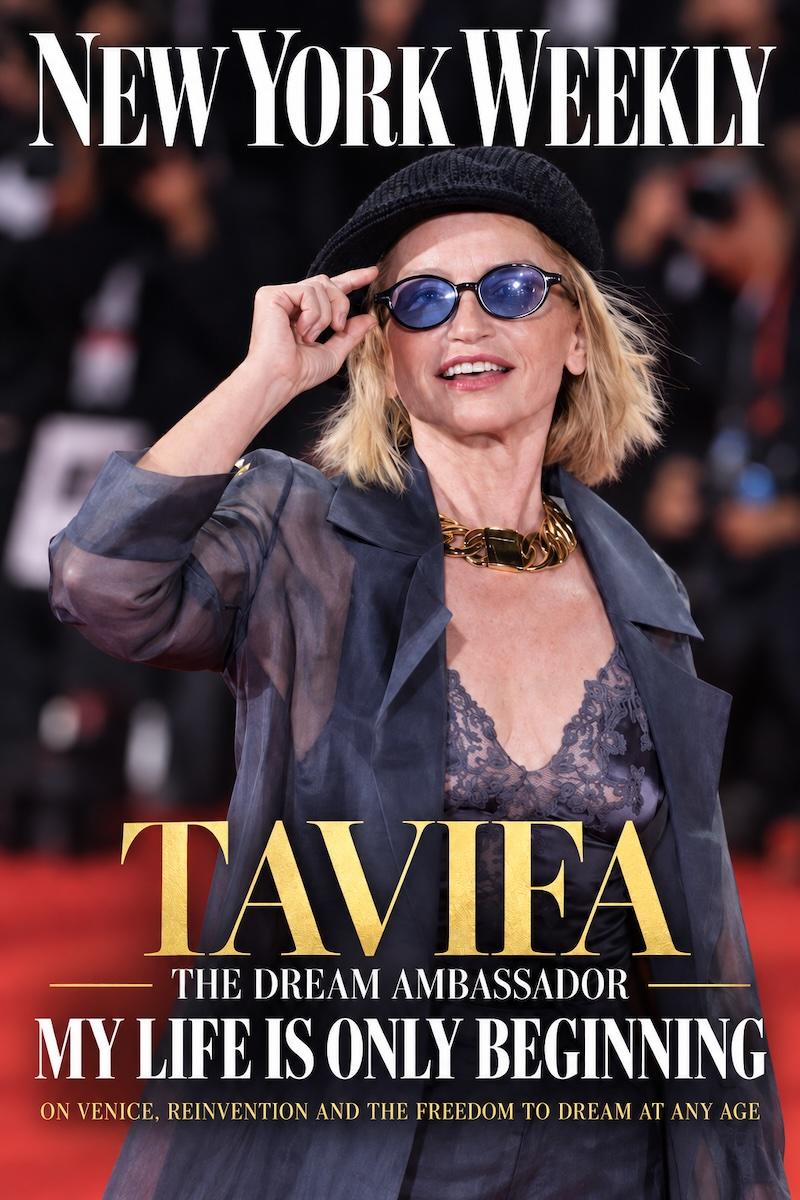
TAVIFA is a Dream Ambassador and mentor. As a Dream Ambassador, her mission is to remind people of the ability to dream that everyone is born with the ability to see what does not yet exist and bring it into reality. Her own life has unfolded like a film filled with different roles: businesswoman, hotel owner, speaker, mentor, and creator of her own emotional hygiene practice (a body-based dynamic meditation designed to help release emotions held in the body). Today, she continues to reinvent herself, embracing new possibilities with curiosity and joy. Following her recent appearance at the Venice Film Festival, TAVIFA spoke with New York Weekly about the magic of Italy, the meaning of success, the freedom to begin again at any age, and why our next chapter is always waiting to be written.
You have just attended the Venice Film Festival. How did this experience stay with you, as a social occasion, an emotional experience, or something deeply personal?
What a beautiful question; it practically contains the answer already. The Venice Film Festival truly became all three for me: a social, emotional, and deeply personal experience.
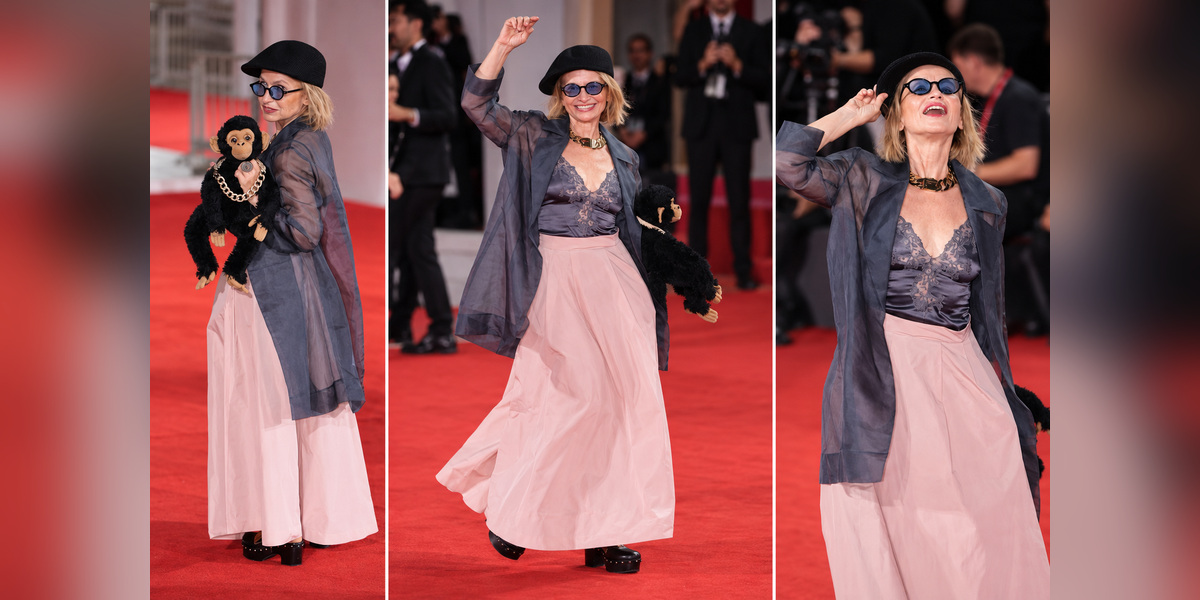
I loved everything about it: the organization, the events, the atmosphere, and the people. I was especially happy to find myself in an environment where I naturally feel very comfortable, light, beautiful, and full of smiles. People met one another, talked, and took photographs together without any unnecessary sense of importance. When they noticed my Georgina, my talisman handbag, they smiled even more and wanted to take pictures with her too.
But the most personal moment happened before the red carpet.
I have a little game. I choose smooth, flat stones and write my dreams on them. I brought one such stone from my home in Puglia, where I live. Before going to the red carpet, I wrote my dreams on it and threw it into the sea at the Lido, where the festival events were taking place.
Then a magical evening followed: the red carpet, new acquaintances, and a beautiful gala dinner. Everything coincided wonderfully with my inner state: harmony, beauty, art, and the enjoyment of life itself. It was as though the entire evening continued the little game that had begun with the stone I threw into the sea.
For me, as a Dream Ambassador, this matters most: a dream doesn’t have to become a serious task. Sometimes you can simply write it on a stone, throw it into the sea, let it go, and go on living your life.
What did you feel in the atmosphere of Venice, surrounded by cinema, beauty, and that special Italian magic?
I felt completely at home there. I simply felt wonderful. I was surrounded by cinema, beauty, art, beautiful people, conversations, and the incredible atmosphere of Venice.
This is exactly the kind of environment in which I enjoy being. It gives birth to new ideas, begins new conversations, and creates unexpected connections. Everything around you seems to encourage you to create, imagine, and live.
For me, this is precisely the magic of Italy: beauty is not a decoration here. It is simply something people live in.
You live in Italy. Did the Venice Film Festival feel like part of the life that is already yours, or does it still feel like a beautiful dream?
Italy itself is incredibly cinematic. I constantly notice little scenes from everyday life here: interestingly dressed people, their gestures and conversations, the way they sit in cafés and walk down the street. All around them are historic buildings, squares, and narrow streets. Quite often, the same thought comes to me: just set up a camera and start filming; the movie is already there.
That is why the Venice Film Festival did not feel separate from my Italian life or like some distant, beautiful dream. It felt like a natural continuation of it.
All of Italy is a ready-made film. And the Venice Film Festival is cinema within cinema.
In your opinion, does Italy have its own special language of beauty, femininity, and success?
I would say that Italy has not so much its own language as a unique atmosphere in which a person feels both beautiful and successful.
For me, success here is not necessarily connected with fame, money, or status. One of the scenes I see most often is people painting walls or sweeping the streets while singing. If music starts playing on the beach, they begin to dance. They even dance in the supermarket. I really love this natural spontaneity.
There is a street cleaner in our town whom I regularly see in the mornings. Dressed in his work uniform, he collects rubbish, sings songs, and calmly and happily does his job.
One day, our town was celebrating its main annual festival. Among the crowd, I noticed an incredibly distinguished man, and for a long time I tried to remember where I knew his face from. Then I suddenly realized that it was our street cleaner. He was dressed so elegantly and carried himself with such dignity that he could have been a famous actor or an important public figure. It was impossible to take your eyes off him.
I love this Italian quality: in the morning, a person can clean the street in work clothes while singing, and in the evening, he can put on a beautiful suit and look as though the entire town belongs to him. One does not contradict the other at all.
Perhaps success is not about who other people think you are. Perhaps success is feeling good about being yourself, both with a broom in your hands and in a beautiful suit at a celebration.
At events like this, you can especially feel the energy of the people and the space around you. What did you perceive most strongly that evening?
At the Venice Film Festival, I was especially aware of the energy of the people. I had the feeling that the actors, directors, and other members of the film industry had come not only to present themselves or their films. They also wanted to communicate simply as human beings, informally, over a cup of coffee or a glass of wine.
I enjoyed seeing how easily people approached one another, introduced themselves, and started conversations. Perhaps the question I heard most often during those days was, “What country are you from?” That one simple question reflected the global scale of the festival: during those days in Venice, the whole world truly came together.
It was also amusing to see that people could talk for quite a long time without even knowing who was standing in front of them: a great actor, a director, or a photographer from a small publication. First, you meet the person, and only later do the professional and sometimes very significant details emerge. I think that is wonderful.
At one point, I thought about how much it resembled childhood. Children do not ask one another about status. They simply walk up and ask, “What is your name? Where are you from?”
Perhaps this was the energy I felt most deeply in Venice: behind all the names, professions, status, and beautiful outfits, people became simply human again. Almost like children who were curious to meet one another.
Your journey has been described as almost cinematic. Looking back, was there ever a moment when you could not believe that one day you would arrive at this point in your life?
My movie is not over yet. So I simply continue playing.
I have had many roles in my life. I was a businesswoman, and I played that role beautifully. I was a hotel owner, and I played that role with particular pleasure. I loved everything connected with it. Then, at some point, I realized that I had finished playing. It was no longer interesting to me, so I closed that business.
There was also the role of a very serious professional woman, always at her computer, always busy, and always working. At that time, I was much heavier, looked different, lived at a different pace, and took both myself and life much more seriously. I have also played the roles of a speaker and the creator of my own emotional hygiene practice, a body-based dynamic meditation.
We hear so much about the importance of being in the right state. But very few people explain how to get there. My answer is: through the body, through emotional hygiene.
I want to remind people that every human being is born with the ability to dream. We are born with this extraordinary talent to dream, create, and bring into the material world something that once existed only in the invisible world.
At the same time, I am interested in continuing to play. Right now, I am fascinated by the roles I would love to play next: superstar DJ, top model, bestselling author, and actress. What roles will appear afterward? We will see. That is the most interesting part.
I love every episode of my movie, even those that felt more like a thriller or a tragedy while I was living through them. Today, I understand that without those episodes, the story would have been completely different.
My movie is definitely not boring. And that is the truth.
In the Western world, people increasingly speak about a woman’s right to reinvent herself at any age. Does that idea resonate with you?
I would say that this right belongs not only to women but to every human being. And this idea does not simply resonate with me; it is how I live.
I love watching people who allow themselves to try an entirely new role at any age. For example, the great Anthony Hopkins released his first musical album, Life Is a Dream, at the age of 88. A man known throughout the world as one of the greatest actors stepped forward at 88 in another role, as a composer. Even the title of the album, “Life Is a Dream,” feels especially close to me.
At the age of 75, my mother studied the art of decorating gingerbread with masters in the Czech Republic and began creating extraordinary things, houses, carriages, and baskets. Today, my mother is 86, and I have another dream for her: I would love for her to try being a fashion model. Why not?
I love the possibility of living many different lives within a single lifetime. When one role ends, it does not mean that the story is over. You can choose the next role and begin playing again.
I have noticed that the more curiosity a person has, the stronger the desire to try something new and play another role, the more life there is within them.
You often say, “My life is only beginning.” When did age stop feeling like a limitation and become a form of freedom?
Age is largely a kind of programming, a collection of ideas about what a person is or is not supposed to do after reaching a particular number.
I became especially aware of this after living in different countries and seeing how differently cultures can relate to age. In some places, people are expected to make life gradually quieter as they grow older. In Italy, I often see something very different: people in their eighties and nineties continue to dress beautifully, meet friends, travel, remain in love with life, and make plans for the future.
That is why I can sincerely say: my life is only beginning. For me, age is not a reason to stop imagining new roles. It is another opportunity to choose what I would like to experience next.