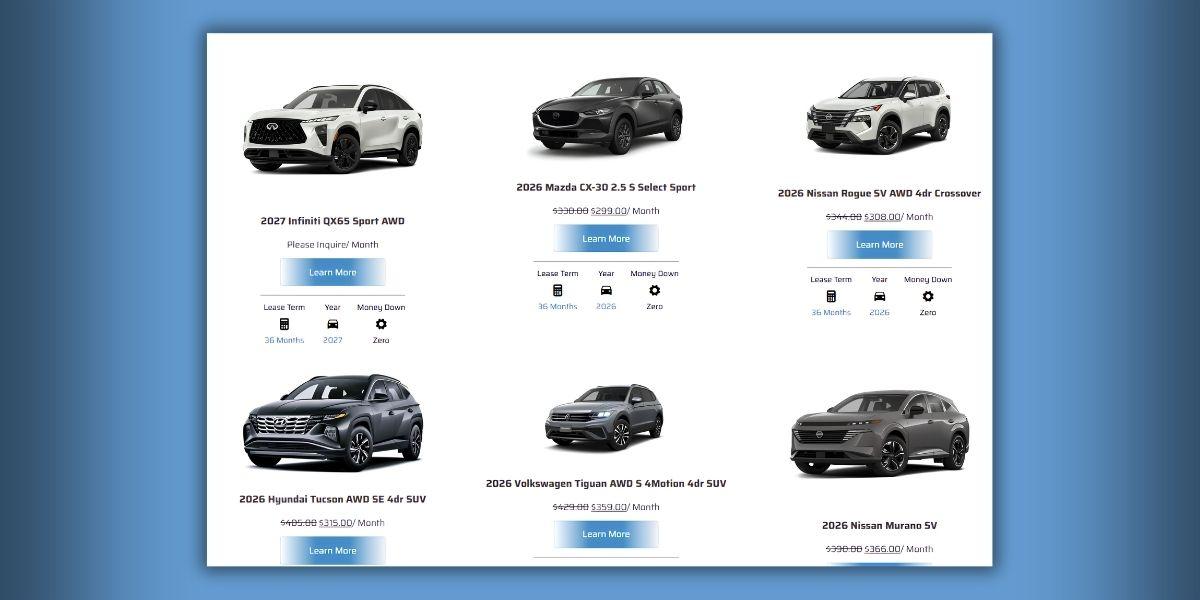
For many New York drivers, leasing a vehicle can be an attractive alternative to purchasing. It can provide access to a newer vehicle without requiring the buyer to own the car at the end of the contract. But finding a competitive lease price requires more than searching for the lowest monthly payment advertised online.
The structure of a lease can include the vehicle’s negotiated selling price, lease term, mileage allowance, taxes, registration costs, acquisition fees, incentives, and the amount due at signing. Two advertisements for what appears to be the same vehicle can therefore result in very different overall costs.
This is where an auto leasing broker can become useful. Rather than requiring customers to negotiate independently with multiple dealerships, a broker can help identify available vehicles, compare pricing, and coordinate the transaction.
New York-based VIP Auto Lease has operated since 2007 and describes itself as a full-service automobile broker offering both virtual and in-person ordering, nationwide delivery, and leasing options across a wide range of makes and models.
How to Get the Best Lease Price in New York
Getting a competitive lease deal starts with understanding what actually determines the cost.
A good starting point is to identify the exact vehicle you want. That means specifying the make, model, trim level, drivetrain, major options, preferred lease term, and anticipated annual mileage.
Once those details are established, shoppers can compare offers on an equivalent basis.
A lower monthly payment does not automatically mean a better deal if it requires substantially more money upfront. Likewise, an attractive advertised payment may depend on loyalty programs, conquest incentives, one-pay arrangements, or other qualifications.
VIP Auto Lease specifically notes that advertised lease prices may reflect factors such as conquest, rebates, one-pay, or loyalty incentives, and advises customers to inquire about the conditions associated with individual offers.
Start With the Vehicle, Not Just the Monthly Payment
One of the easiest mistakes when shopping for a lease is focusing exclusively on the monthly payment.
A more meaningful comparison begins with the complete transaction.
For example, shoppers should ask:
● What is the vehicle’s MSRP?
● What selling price is being used?
● How much is due at signing?
● Is the quoted payment based on a particular incentive?
● What is the lease term?
● How many miles are included annually?
● What taxes and government fees apply?
● Are there acquisition or registration charges?
● Is a broker fee involved?
● Are there additional charges at delivery?
Looking at these components helps consumers understand whether two lease offers are actually comparable.
Why an Auto Leasing Broker Can Simplify the Process
The traditional car-shopping experience can involve visiting multiple dealerships, contacting sales departments, comparing inventory, negotiating prices, and arranging paperwork.
An automobile broker approaches the process differently.
VIP Auto Lease says its service is designed to put more purchasing power in the customer’s hands while eliminating the need for traditional haggling. The company also states that customers can complete the process virtually or in person and receive nationwide delivery.
For New York consumers, this can be particularly relevant when the desired vehicle is not immediately available at a nearby dealership.
A broker can search available inventory and work toward locating the vehicle that matches the customer’s specifications rather than limiting the search to one dealership’s current stock.
Understanding the Difference Between MSRP and Lease Price
The manufacturer’s suggested retail price, or MSRP, is an important reference point, but it is not necessarily the final price used to calculate a lease.
A lease may be based on a negotiated selling price that is lower than MSRP when discounts or incentives apply.
This is one reason consumers should request the actual numbers behind a lease offer rather than comparing monthly payments alone.
A customer looking at a $500 monthly payment with significant money due at signing may ultimately spend more than another customer paying $530 per month with considerably less upfront.
The goal should therefore be to compare the complete financial structure of the lease.
The Importance of Money Due at Signing
“Zero down” and “no money down” are commonly used phrases in automotive advertising, but consumers should examine exactly what those terms mean.
VIP Auto Lease states that zero-down leases can still be subject to state taxes, bank fees, title fees, first-month payments, registration fees, and potentially a broker fee.
This distinction is important because reducing the capitalized cost by making a large upfront payment can change the monthly payment without necessarily making the overall transaction more economical.
Consumers should request a written breakdown of all amounts due at signing before committing to a lease.
Mileage Is Another Major Part of the Equation
Lease agreements typically specify a mileage allowance. Drivers who regularly exceed their contractual mileage may face additional charges when the vehicle is returned.
That makes it important to estimate annual driving realistically before signing a lease.
Someone who commutes long distances, regularly travels between New York City and Long Island, or frequently takes longer road trips may need a higher mileage allowance than someone who primarily drives locally.
Selecting the appropriate mileage at the beginning can make the lease easier to manage throughout the contract term.
Incentives Can Change the Price
Automakers and financing companies may offer different incentives depending on the vehicle, market conditions, customer eligibility, and timing.
VIP Auto Lease notes that advertised prices can incorporate several types of incentives, including loyalty and conquest programs.
A loyalty incentive, for example, may be available to an existing customer of a particular automotive brand. A conquest incentive may apply when a customer is coming from a competing brand.
The important point is that consumers should determine whether they actually qualify for an advertised incentive before using that payment as a benchmark.
Why Inventory Matters
Availability can have a significant effect on lease pricing.
A vehicle in high demand with limited inventory may be more difficult to negotiate than a model with greater availability. Conversely, dealers or brokers may have access to vehicles that are not immediately visible to a consumer searching locally.
VIP Auto Lease describes its business as using market inventory analysis and wholesale buying power to help identify pricing opportunities across different makes and models.
For shoppers, this reinforces an important principle: the best lease price may require looking beyond the first dealership that has the desired vehicle.
Comparing a Broker With a Traditional Dealership
A dealership and an automobile broker perform different functions.
A franchised dealership typically sells vehicles directly from its inventory or through manufacturer-related channels. A broker, by contrast, can act as an intermediary in locating and arranging a vehicle transaction.
VIP Auto Lease explicitly states on its website that it is not a franchised dealer and is registered as an automobile broker business under New York’s Vehicle and Traffic Law.
This distinction matters because consumers should understand who they are dealing with and what role that business plays in the transaction.
What Customers Say About VIP Auto Lease
Online customer feedback provides another perspective when consumers evaluate an automotive service provider.
Third-party listings show substantial customer-review activity for VIP Auto Lease. DealerRater hosts hundreds of reviews, many of which describe the process as convenient and highlight staff assistance with locating vehicles, pricing, and delivery.
Trustpilot also contains customer reviews discussing the company’s service, pricing, communication, and vehicle delivery. The reviews represent individual customer experiences and should be considered alongside the company’s published information rather than as a guarantee of future results.
VIP Auto Lease New York City and the Broader New York Market
The company has a physical location at 1204 Hylan Boulevard in Staten Island, while its published service information identifies coverage throughout New York City, including Manhattan, Brooklyn, Queens, the Bronx, and Staten Island. It also identifies service areas extending into Long Island, Westchester, New Jersey, Connecticut, Pennsylvania, Florida, and other locations.
For customers who prefer not to visit an office, VIP Auto Lease also promotes a virtual ordering process and nationwide vehicle delivery.
This combination of local New York service and broader delivery capabilities allows customers to approach leasing as a vehicle-sourcing exercise rather than simply shopping at the dealership closest to their home.
Questions to Ask Before Signing a Lease
Whether working with a broker or directly with a dealership, consumers should ask for clear answers to several questions before signing.
What Is the Exact Selling Price?
The negotiated vehicle price is one of the most important numbers in the transaction.
How Much Is Due at Signing?
Ask for a complete itemization rather than relying on a phrase such as “zero down.”
What Incentives Are Included?
Confirm whether the payment depends on loyalty, conquest, financing, or other qualifications.
What Is the Mileage Allowance?
Make sure the annual mileage matches expected driving habits.
What Fees Apply?
Ask about taxes, registration, acquisition fees, bank fees, broker fees, and other charges.
What Happens at Lease End?
Understand the contractual obligations associated with returning the vehicle, purchasing it, or entering another lease.
The Best Lease Price Is the Best Overall Deal
The phrase “best lease price” can be misleading if it is interpreted as simply the lowest monthly payment.
A better approach is to consider the entire financial commitment.
Consumers should compare:
Monthly payment + money due at signing + applicable fees + taxes + mileage terms + lease-end obligations
This approach creates a much clearer picture of the actual cost.
It also makes competing offers easier to evaluate because the comparison is based on equivalent terms rather than headline advertising.
Leasing a vehicle in New York does not have to mean spending hours moving from dealership to dealership. An automobile broker can provide an alternative approach by helping customers identify vehicles, compare available pricing, coordinate paperwork, and arrange delivery.
The experience of VIP Auto Lease New York City illustrates how the broker model can be used to simplify the vehicle-leasing process. The company has operated since 2007, offers virtual and in-person ordering, serves customers throughout the New York City region and beyond, and provides nationwide delivery.
Contributed by Dan Rose, a local business writer specializing in auto leasing services in New York City. Visit the business at VIP Auto Lease NYC Best 0 Down Leasing Deals, 1204 Hylan Blvd, Staten Island, NY 10305, +1 718-710-4211
Disclaimer: This article is intended for general informational and editorial purposes only. It does not provide financial, legal, automotive, lending, leasing, insurance, tax, or professional advice, and it should not be relied upon as a substitute for guidance from a qualified professional. Vehicle lease pricing, monthly payments, incentives, taxes, fees, mileage allowances, registration costs, delivery options, broker fees, approval requirements, and lease-end obligations can vary by vehicle, lender, dealership, broker, location, credit profile, customer eligibility, market conditions, and contract terms. Consumers should carefully review all lease documents, fee disclosures, incentive requirements, mileage terms, and payment obligations before signing any agreement.