DPS Airem: The Complete Employee Management Software for Modern Businesses

Somewhere right now, a supervisor is calling five different guards just to figure out who actually showed up for the morning shift. A payroll manager is staring at a spreadsheet, trying to work out why three employees logged nine hours nobody can explain. An operations director keeps refreshing her inbox. The incident report she’s waiting on was supposed to land twenty minutes ago.

Sound familiar? Almost every security company, facility management team, cleaning crew, and field service business has lived through some version of this. Different city, same headache.

Paper timesheets go missing. Guards clock in from wherever, and there’s no real way to check. Payroll errors quietly stack up until someone finally does the math and finds a five-figure mess. And incidents rarely get reported the moment they happen, they get reported once the moment that mattered has already passed.

DPS Airem was built to fix exactly this.

An Employee Management Software That Actually Sees Your Workforce

DPS Airem is a cloud-based platform for organizations running people across multiple sites rather than one office with a single punch clock. Security firms, patrol companies, cleaning businesses, construction crews, field service teams, they all hit the same wall eventually. The workforce is scattered, and the moment employees walk out the door, visibility disappears with them.

The fix is almost stubbornly simple. Replace guesswork with verified data.

Every clock-in runs through GPS verification and geofencing, so a manager knows exactly where someone was the second their shift started. QR code check-ins back that up for sites that need a second layer of proof, which matters more than people expect once you’re coordinating dozens of posts across a city for a security guard company.

Employee Attendance Software Built to Hold Up Under Pressure

Manual attendance tracking has one flaw that never really goes away. It relies on people reporting their own hours honestly, then relies on someone else catching every mistake by hand. Neither one scales past a certain headcount.

The time clock inside DPS Airem ties every check-in and check-out to a real location and a real timestamp. Supervisors watch live tracking on a map. They can pull tracking history for any past shift and confirm scheduled coverage actually lines up with who showed up. Break and compliance tracking runs quietly in the background too, so labor policy doesn’t get quietly ignored on a hectic Friday afternoon.

Most time theft isn’t dramatic fraud. It’s a clock-out rounded up by ten minutes here, a shift that “started on time” but really didn’t, there. Multiply that across a hundred employees and the number gets uncomfortable fast. Verified data closes that gap, and payroll finally starts from numbers people can actually trust.

Workforce Management Software Made for Multi-Site Chaos

Running one location is manageable. Running fifteen, each with its own shift pattern, its own supervisor, its own client expectations, turns into an entirely different problem.

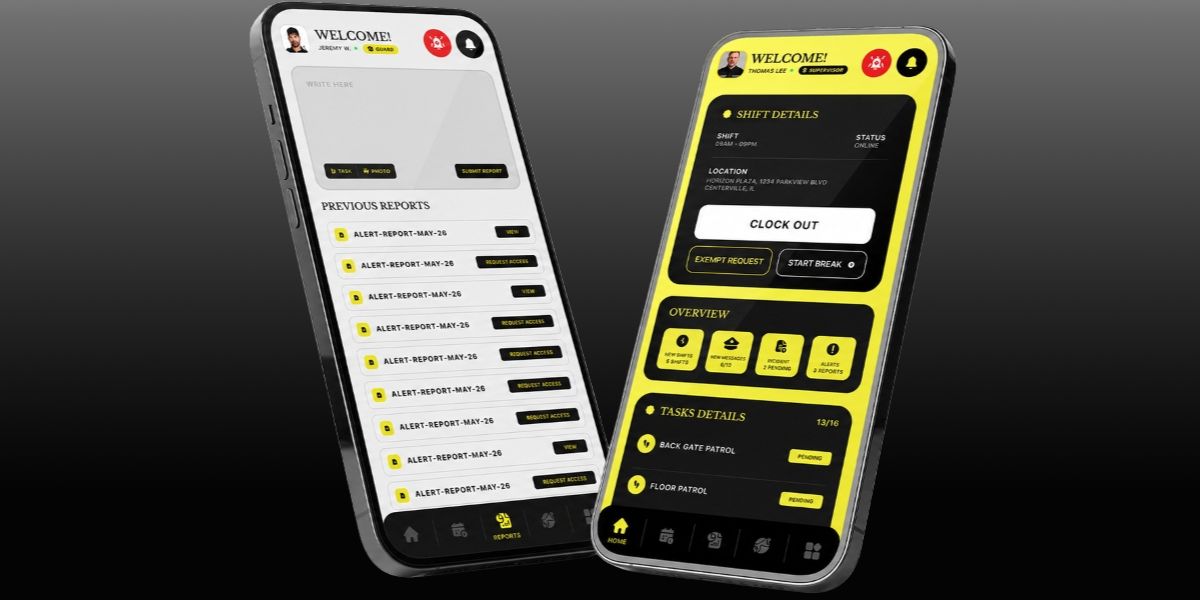
DPS Airem handles it through dashboards built around how these teams actually operate, not around how a generic HR tool imagines they operate. Managers work from a web dashboard, approving requests, assigning roles and shifts, and keeping an eye on every site from one screen instead of ten open tabs. Supervisors carry the mobile app, which puts attendance tracking, task management, incident handling, and SOS response right in their pocket, wherever they happen to be standing that day. Employees and guards get their own simple mobile dashboard too, enough to view shifts, clock in, finish assigned tasks, and file reports without tracking down a supervisor for every small update.

Nobody’s stuck waiting by a desk phone. The scheduler assigns shifts and flags coverage gaps early, and the dispatcher keeps communication in one place instead of scattered across a dozen text threads nobody can search later. Security and patrol operations get extra tools on top, vehicle patrol tracking, site tours, post orders, and daily activity reports, giving clients the kind of timestamped proof of service that used to eat hours of manual paperwork every week.

When Response Time Actually Matters

Slow incident reporting causes more damage than most people assume. Security and field service work live right inside that gap, the space between something happening and someone finding out about it. Left alone, that gap turns small problems into serious ones.

DPS Airem’s SOS alert module lets field employees and supervisors raise an alarm the instant they need to, paired with structured incident reporting that captures the details while they’re still accurate. Response times get measured instead of guessed at, which is exactly what corporate security teams, healthcare facilities, and campus safety programs look for when comparing security guard management software.

Payroll and Invoicing, Minus the Guesswork

Once attendance is verified, payroll stops being a monthly scramble. DPS Airem calculates pay directly from actual recorded hours, cutting out the errors that creep in from manual entry or “close enough” rounding. Invoices pull straight from timesheet data as well, so a task that used to burn hours at the end of every billing cycle now takes minutes.

Business owners running lean operations teams usually feel that difference within the first billing cycle.

Who Actually Uses This

Security guard companies coordinating multiple posts and clients rely on it. So do facility management and cleaning companies juggling rotating site assignments, patrol companies that need documented, GPS-verified tours, and construction companies keeping track of crews spread across active job sites. Field service businesses use it to dispatch technicians throughout the day, and multi-site organizations use it simply because managing five disconnected tools stopped making sense a while ago.

Real-time employee monitoring. GPS attendance tracking. A clearer answer to the one question every operations manager keeps asking: what’s actually happening out there right now. That’s what the platform was built to deliver.

Getting Started

Pricing scales in tiers starting at three users, from essential attendance and GPS tracking up through advanced features like geofencing, site tours, custom reporting, and integrations for bigger, multi-site operations. A 30-day risk-free trial gives teams enough runway to feel the difference verified data makes before committing to anything.

Manual attendance, payroll disputes, and slow incident reports aren’t just part of the job. They’re symptoms of using tools that were never built for a scattered workforce in the first place.

The old way of running a team is a phone that won’t stop ringing and a spreadsheet nobody fully trusts. That era is optional now, not permanent.

Step inside DPS Airem and see what a workforce looks like when every shift, every clock-in, and every site is finally visible in one place.

New York Film Festival Unveils 2026 Slate: Chris Rock, Andrew Haigh Films Lead 32 Titles

Film at Lincoln Center unveiled the 32-film main slate for the 64th New York Film Festival on August 6, 2026, confirming four world premieres and new features from James Gray, Chris Rock, Andrew Haigh and Ava DuVernay. The festival runs September 25 through October 12 at Lincoln Center and four other venues around the city.

Key Takeaways

  • Film at Lincoln Center announced a 32-film main slate for the 64th New York Film Festival on August 6, 2026, running September 25 through October 12.
  • James Gray’s “Paper Tiger,” starring Adam Driver, Scarlett Johansson and Miles Teller, opens the festival September 25 as a North American premiere.
  • Ava DuVernay’s documentary “14th,” a follow-up to her “13th,” closes the festival October 12 as a world premiere.
  • Five Cannes prizewinners made the slate, including Andrey Zvyagintsev’s Grand Prix-winning “Minotaur” and Sandra Wollner’s Un Certain Regard winner “Everytime.”
  • Debuting at the festival are seventeen directors in the main slate, while Hong Sangsoo stands as the sole filmmaker represented twice in the selection.

The lineup shows how far the festival has widened its reach beyond a single Manhattan campus, pulling in Cannes prizewinners, a kaiju sequel and a documentary sequel to a landmark civil rights film, all while keeping its opening and closing slots reserved for filmmakers with deep New York ties. That mix of arthouse pedigree and studio-scale spectacle signals where the 64-year-old festival is positioning itself against rivals like Cannes and Toronto.

What Films and Dates Anchor the 2026 Lineup

James Gray’s crime drama “Paper Tiger” opens the festival on September 25 with a North American premiere, starring Adam Driver, Scarlett Johansson and Miles Teller. Ava DuVernay’s documentary “14th,” a follow-up to her Academy Award-nominated “13th,” closes the festival on October 12 as a world premiere examining the constitutional amendment at the center of ongoing citizenship debates.

Tony Gilroy’s “Behemoth!,” starring Pedro Pascal as a cellist, holds the centerpiece slot as a world premiere. Takashi Yamazaki’s “Godzilla Minus Zero,” the follow-up to his 2023 “Godzilla Minus One,” gets its own world premiere on September 26, alongside a fourth world premiere from Iranian director Mani Haghighi, “I Deserve a Lover Whose Every Rise Sets Fiery Dooms Raging Across the Skies.” The festival’s 32-film main slate also includes Chris Rock’s “Misty Green,” which marks his return to directing, and Andrew Haigh’s 1950s-set drama “A Long Winter.”

Who Gets a Platform and Who Gets Squeezed Out

The 32-film main slate welcomes debuts from seventeen directors while also featuring established names: Pedro Almodóvar (“Bitter Christmas”), Mike Leigh (“Tender Loving Care,” likely his final film), and Ira Sachs (“The Man I Love,” with Rami Malek). This mix shapes how festival-goers allocate their viewing time, half the program introduces fresh voices to New York cinephiles, while the other half bets on international auteurs still building stateside recognition.

Hong Sangsoo stands alone in the selection with dual entries this year: his 34th feature, “The Day She Returns,” and his 35th, “Nowhere To Lay My Eyes,” starring Kim Min-hee. For distributors and art-house programmers evaluating post-festival releases, such back-to-back selections from a single filmmaker can determine which titles receive expanded theatrical distribution.

How Heavily Does This Year’s Slate Lean on Cannes

The New York Film Festival has long positioned itself as a fall showcase for films that premiered earlier at Cannes, and 2026 leans on that pattern more than most years. Ryûsuke Hamaguchi’s “All of a Sudden,” Paweł Pawlikowski’s “Fatherland” and Andrey Zvyagintsev’s “Minotaur,” winner of the Grand Prix, all arrive from the Croisette, alongside Sandra Wollner’s “Everytime,” winner of the Un Certain Regard prize.

classic cinema marquee lights
Photo by Simon Ray on Unsplash
Award Film Director
Grand Prix Minotaur Andrey Zvyagintsev
Best Director Fatherland Paweł Pawlikowski
Best Screenplay A Man of His Time Emmanuel Marre
Jury Prize The Dreamed Adventure Valeska Grisebach
Un Certain Regard Prize Everytime Sandra Wollner

That heavy borrowing from Cannes is not new for the festival, but the volume this year, five prizewinning titles in a 32-film slate, underscores how much the festival’s identity now depends on serving as an American waypoint for films that premiered in France months earlier rather than a discovery ground of its own.

Why the Festival Still Anchors Itself to Lincoln Center and Founding History

The New York Film Festival, founded in 1963, continues to use Lincoln Center as its home base while spreading screenings to BAM in Brooklyn, the Museum of the Moving Image in Queens, Alamo Drafthouse Cinema on Staten Island, and AMC Bay Plaza Cinema in the Bronx. That five-borough footprint reflects a shift from the festival’s earlier decades, when Lincoln Center screenings were effectively the only way to see the lineup.

Dennis Lim, the festival’s artistic director, framed this year’s selections as a reflection of global events. “It’s hard to recall a prior Main Slate program in which the state of the world has been as urgently reflected in so many creative ways,” Lim said in a statement. “You could take any cross section of this lineup and come away with a vivid picture of what our present looks, sounds, and feels like. I’m deeply encouraged to be able to introduce New York audiences to works by so many fearless, imaginative directors whose artistry has been inspired by the shared realities of our world.” That statement, coming from the festival’s own leadership, doubles as a defense of a lineup heavy with foreign-language and documentary work at a time when major festivals compete hard for star-driven premieres.

What Happens Between Now and Opening Night

Some titles carry premiere complications worth watching. Chris Rock’s “Misty Green” will actually premiere first at the Toronto International Film Festival before its U.S. premiere in New York, meaning the New York Film Festival is not securing exclusivity on every high-profile title, a departure from how centerpiece and opening slots are traditionally marketed.

Ticketing details and individual screening schedules had not been detailed in the August 6 announcement, and the festival’s main selection committee, chaired by Lim along with Florence Almozini, Justin Chang and Rachel Rosen, will presumably fill in program notes and panel details closer to the September 25 start date.

That combination of borrowed prestige and hometown ceremony is what will actually get tested once the lights go down at Lincoln Center in September.


FAQs

When and Where Does the New York Film Festival Take Place in 2026?

The 64th New York Film Festival runs September 25 through October 12, 2026. Screenings take place at Lincoln Center along with BAM in Brooklyn, the Museum of the Moving Image in Queens, Alamo Drafthouse Cinema on Staten Island and AMC Bay Plaza Cinema in the Bronx.

What Film Opens the 2026 Festival?

James Gray’s crime drama “Paper Tiger” opens the festival on September 25 as a North American premiere. It stars Adam Driver, Scarlett Johansson and Miles Teller.

What Film Closes the Festival?

Ava DuVernay’s documentary “14th” closes the festival on October 12 as a world premiere. It serves as a follow-up to her Academy Award-nominated documentary “13th.”

Will Chris Rock’s “Misty Green” Premiere in New York First?

No. “Misty Green” will premiere first at the Toronto International Film Festival before its U.S. premiere at the New York Film Festival.

How Many Films Premiered at Cannes Before Joining the New York Lineup?

Several titles arrive from Cannes, including Grand Prix winner “Minotaur,” best director winner “Fatherland,” best screenplay winner “A Man of His Time,” Jury Prize winner “The Dreamed Adventure” and Un Certain Regard winner “Everytime.”

Who Leads the Festival’s Selection Committee?

Artistic director Dennis Lim chairs the main slate selection committee, which also includes Florence Almozini, Justin Chang and Rachel Rosen.

Is This Mike Leigh’s Last Film?

“Tender Loving Care” is described as likely Mike Leigh’s final film, though the festival’s announcement did not provide further detail on that characterization.

What Character Does Pedro Pascal Play in Tony Gilroy’s “Behemoth!”?

Pedro Pascal plays a cellist in “Behemoth!,” which serves as the festival’s centerpiece world premiere.

Amberton University’s First Doctoral Program Is Here, and It’s Already Redefining Expectations

By: Jean Brown

A doctorate has become one of the most expensive qualifications in education. Many working adults now find graduate school tuition fees financially out of reach. Amberton University is changing that reality. The institution recently launched its very first doctoral degree program. The new Doctor of Education (Ed.D.) in Counseling marks a milestone achievement. It offers working professionals an affordable path to a doctoral credential.

A Historic Milestone for Amberton University

For the last 55 years, Amberton University has served the working adult student. Founded in 1971, the institution provides flexible degree programs tailored for professionals. The university operates campuses in Garland and Frisco, Texas. It also offers comprehensive online degree options.

For years, students asked university leaders for a doctoral option. University leadership listened and evaluated program opportunities carefully. President Dr. Carol A. Palmer encouraged faculty members to review doctoral pathways. They ultimately selected counseling for the university’s inaugural doctorate since it has long served as one of Amberton’s strongest academic fields.

Dr. Ken Johnson leads the new doctoral program as Program Director. He has been a faculty member at Amberton University for more than three decades. He previously helped develop the university’s counseling curriculum. Faculty members spent months writing course competencies, student handbooks, and project guidelines.

“This achievement represents a major milestone for Amberton University,” explained Dr. Johnson. “It places our academic community on a whole new academic level.”

The degree prepares graduates to teach counseling at the graduate level. It also opens paths into executive roles in clinical settings. Coursework spans clinical practice, supervision, and counselor education.

Bridging Theory and Real-World Application

Traditional doctoral degrees often demand theoretical research dissertations. These traditional research projects can require years of abstract academic study. Amberton University created a different capstone model with the Applied Doctoral Project. This practical framework emphasizes real-world application over abstract theory. Students address actual clinical and administrative issues in active workplaces. For example, doctoral candidates can create new clinical protocols or detailed policy proposals.

Candidates may also build an educational portfolio or evaluate community services. “We focus on bridging the gap between theory and practice,” Dr. Johnson said. “Students complete practical projects that immediately benefit their professional settings.”

Before starting the applied project, candidates complete 54 credit hours of coursework. Core classes cover advanced trauma counseling, crisis intervention, psychopathology, and family therapy. Students also complete coursework in statistics, supervision, and addictive behaviors. Coursework follows flexible ten-week sessions to support busy work schedules.

Students must pass a comprehensive oral examination before starting the applied project courses. Three faculty council members will conduct the oral examination covering core curriculum areas. Candidates then complete two final capstone courses. During these courses, candidates defend their applied research deliverables before faculty panels.

Exceptional Academic Quality at an Accessible Cost

Higher education often carries a heavy financial burden for working adults. Amberton University maintains a distinct financial structure to protect student budgets. Tuition for the doctoral program costs $625 per credit hour. A standard three-hour course costs $1,875 in tuition. That rate stays below what many doctoral programs charge per credit hour. A mandatory doctoral program fee of $200 applies each session, alongside the university’s standard fees.

Amberton keeps its operating model deliberately lean. The university does not fund dormitories, athletic programs, or wide-ranging campus amenities. Spending goes toward curriculum, faculty, and student services instead. By keeping administrative overhead low, the institution passes those savings directly to students.

Students pay for courses session by session under a flexible pay-as-you-go model. This transparent pricing structure helps adult learners budget effectively without taking on heavy debt.

“Our leaders remain committed to keeping costs manageable for working adults,” Dr. Johnson noted. The pricing model reflects a longstanding institutional position on what graduate study should cost.

Ethical Leadership and Diversity in Mental Health

Modern healthcare settings demand clinical leaders with high cultural awareness. Amberton’s Ed.D. in Counseling emphasizes ethical standards, spiritual awareness, and cultural competence. The program mission focuses on developing ethically and culturally skilled counseling leaders. Students will learn to support individuals, couples, and families across diverse settings.

“We live in a multicultural society,” Dr. Johnson emphasized. “Effective mental health providers must deliver effective multicultural care.”

The complete program requires 60 total doctoral credit hours. On its own, the doctorate does not meet the academic requirements for Licensed Professional Counselor status in Texas. Amberton does outline the additional coursework and examinations that unlicensed candidates need for state credentials. Licensed professional counselors can also enroll to expand their teaching and administrative opportunities.

Transforming Paths for Working Professionals

Amberton University continues its long commitment to accessible working adult education. The launch of its inaugural doctoral degree marks its furthest step yet in that direction.

The Ed.D. in Counseling is built around leadership, applied research, and program improvement in mental healthcare. Working professionals can add advanced training without stepping away from active careers.

Coursework is designed to turn formal academic study into practical judgment that counselors can use in daily work. For Amberton, the launch reflects a position the university has held for decades: that advanced credentials and affordable tuition can coexist.

About Amberton University

Founded in 1971, Amberton University specializes in affordable, flexible degree programs for working adults. Programs are offered online and on campus, taught by practitioner-faculty, and anchored in career relevance and service excellence.

Building Confident Swimmers and How Rising Star Swimming Club Is Shaping the Next Generation in New York

Learning how to swim is about more than mastering strokes. For many children, it is the first lesson in confidence, discipline, and perseverance. At Rising Star Swimming Club, a USA Swimming member club serving families across Queens and Long Island, that philosophy forms the foundation of every lesson.

Founded in New York, Rising Star Swimming Club has developed a structured pathway that guides children from their very first experience in the water to competitive swimming. Rather than offering isolated swim lessons, the club emphasizes long-term athlete development through a progressive system that includes beginner instruction, four-stroke technique training, Pre-Team preparation, and Competitive Team programs.

Today, the club serves more than 150 students ranging from beginners to competitive swimmers. Children are placed according to swimming ability rather than age alone. New students complete an evaluation before joining classes, ensuring they enter the level that best matches their technical skills, water safety, endurance, and overall readiness.

The curriculum is divided into four instructional levels, with regular assessments allowing swimmers to advance as they improve. Along the way, students develop proficiency in freestyle, backstroke, breaststroke, butterfly, starts, and turns while steadily building confidence in the water.

Safety remains a central priority throughout the program. Rising Star partners with established facilities including Great Neck South Middle School, Queensborough Community College, and Hofstra University to provide year-round instruction in professionally managed pools. The coaching staff holds certifications such as CPR/AED, USA Swimming Safety Training, Concussion Training, and Red Cross Lifeguard credentials, while following standardized coaching and safety protocols.

Photo Courtesy: Rising Star Swimming Club

Leading the program is Head Coach Siwen Gu, a former Chinese national-level swimmer who represented China at the 2017 Summer Universiade. Drawing on years of competitive experience, youth coaching, and aquatic facility management, Gu focuses on Long-Term Athlete Development (LTAD), helping young swimmers build strong technical foundations before pursuing higher levels of competition.

“We’re not just teaching children to swim faster,” Gu said. “More importantly, we want them to develop proper technique, confidence, discipline, and the ability to stay committed to a sport that can benefit them throughout their lives.”

That philosophy shapes how the club measures progress. Many Rising Star swimmers have competed at local and regional meets, while others have gone on to join school swim teams or become registered USA Swimming athletes. Beyond competition, parents often value the program for helping children become more confident, focused, and comfortable in the water.

The club also recognizes that every swimmer develops differently. Rather than accelerating students through the program based on age or parental expectations, coaches emphasize consistent progress and technical mastery before advancement. This individualized approach allows swimmers to build lasting skills instead of rushing through milestones.

Enrollment is open to children ages five and older. Whether a child is entering the pool for the first time or preparing for competitive swimming, Rising Star aims to provide an environment where safety, technical excellence, and personal growth develop together.

As youth sports continue to evolve, Rising Star Swimming Club represents a model that balances athletic achievement with character development. By combining structured instruction, qualified coaching, and a long-term vision, the club is helping young swimmers gain not only stronger strokes, but also the confidence to carry those lessons beyond the pool.

For more information, visit the Rising Star Swimming Club website or contact charles@risingstarswim.com.