Five Guys CEO Jerry Murrell Gives $1.5 Million Bonus to Employees After Botched BOGO Promotion

The 82-Year-Old Founder Turned a Birthday Disaster Into a Leadership Moment — and Wrote the Check Himself
When a promotional offer goes wrong, most chief executives reach for the crisis communications playbook. Jerry Murrell reached for his checkbook.
When Five Guys’ 40th birthday promotion collapsed under its own weight, Murrell wrote his employees a check — 1,500 of them to be exact. The 82-year-old longtime founder of the franchise joked it wasn’t altruism: he was worried about his safety. “I didn’t want anybody shooting me in the back or anything after the first day, because we really screwed it up. We had no idea that we were going to get that kind of response,” he joked in a candid phone call with Fortune.
Behind the deadpan humor was a genuine decision: rather than let frontline workers absorb the fallout of a corporate miscalculation without acknowledgment, Murrell distributed $1.5 million in bonuses across Five Guys’ 1,500 U.S. stores — roughly $1,000 per location — and announced a do-over promotion to give both customers and crews a second chance at getting it right. The story went viral almost immediately, cutting through the noise of a media cycle dominated by inflation data and market volatility, and landing Murrell in a rare category of business leaders: those whose instinct in a crisis runs toward accountability rather than deflection.
How the Birthday Promotion Became a Logistical Nightmare
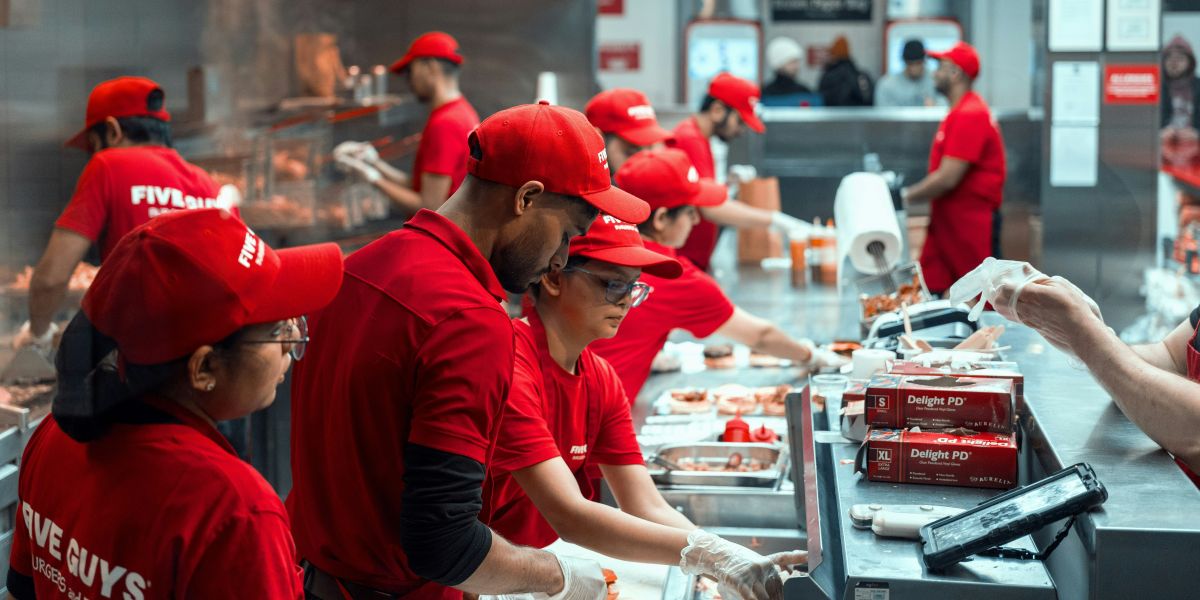
The problem started when the chain launched a buy-one-get-one-free burger deal on February 17 to celebrate its 40th birthday. Almost immediately, the giveaway had gone awry: stores ran out of food, workers were overwhelmed, and lines stretched out the door. The response was “unlike anything we’ve seen,” the chain said in a press release.
Some locations ran out of food and had to close, and some customers couldn’t redeem the deal on the app or online. Five Guys issued a public apology to both customers and staff, saying the company was “truly sorry” that it hadn’t met its own expectations or those of its customers.
The scale of the demand surge caught even the founder off guard. Murrell, who described himself as a skeptic of promotional deals in general, admitted the response blindsided him entirely. “I’m a funny guy,” he said. “I always think it’s funny when people go to sales. I never thought they worked. We tried this one, buy one, get one free. Holy smokes. I couldn’t believe all the people that jumped on that.”
According to the company, teams spent the weeks following the original promotion replenishing fresh ingredients and preparing stores for a renewed event. Five Guys announced the “40th After Party” — a second run of the BOGO deal from March 9 through March 12 — structured specifically to avoid the failures of the first attempt. This time, the offer was limited to online and app orders only, using the code FGAFTERPARTY, with a one-redemption-per-account limit designed to manage demand more effectively.
The Bonus Decision: Accountability From the Top
The $1.5 million bonus announcement was notable not only for its dollar figure but for the reasoning Murrell offered publicly. In an interview with WTOP, Murrell acknowledged the chain had failed to meet demand and said workers deserved recognition for what they absorbed. “We had no idea we were going to get that kind of response. And they came through pretty good, I think. That’s why we’re giving them that bonus money,” he said.
Photo Credit: Unsplash.com
In the Fortune interview, Murrell also joked about what he had considered doing with the money instead. “I was gonna buy my wife a new fur coat, and I spent it on the bonus instead,” he said. “She still looks at me like I’m stupid. But I thought it was worth it. They worked so hard. They were so overwhelmed.”
The line drew laughs. The intent behind it drew wider attention. In a business climate where executive accountability is frequently discussed and rarely practiced, Murrell’s decision to personally absorb the cost of the bonus — framing it as money he had earmarked for other purposes — stood out as an unusually direct form of corporate ownership. There was no committee, no press release drafted before the decision, no focus group. There was a founder who felt his staff had been put in a bad position by a decision made above them and responded accordingly.
A Family Business Built on a Different Set of Priorities
To understand the bonus decision, it helps to understand the business that produced it. Five Guys traces its origins back to 1986, when Jerry and Janie Murrell gave their sons a choice between going to college or starting a business. The family chose the latter and opened a small carry-out burger restaurant in Arlington, Virginia. The name itself is the story: the five sons became the five guys, and the business they built together became one of the most recognizable fast-casual burger chains in the world.
Five Guys remains one of the last major fast-food chains that are fully private and family-run. The next generation is already embedded in the business. “We got 14 grandkids and 11 great grandkids, and I think nine or 10 of the grandkids are in the business too, so they seem to like the business. Looks like it’s going to carry on the way we have built it,” Murrell said.
That family structure matters because it shapes the decision-making calculus in ways that publicly traded companies structurally cannot replicate. There are no quarterly earnings calls to manage, no shareholder expectations to navigate, no institutional investors waiting to grade the crisis response. When Murrell decided to give out $1.5 million in bonuses, he answered to himself, his family, and his employees — in that order. The speed and directness of the decision reflects that reality.
Murrell’s generosity is not an isolated incident. According to its website, Five Guys donates 20 percent of sales from in-store community events to local organizations and charities, and has worked with nonprofit organizations including Big Brothers Big Sisters of America and Paper for Water. The bonus was consistent with a company culture that has maintained a notable degree of coherence between its stated values and its behavior under pressure.
What the Moment Says About Crisis Leadership
The Five Guys BOGO story became a viral reference point in discussions about corporate culture and executive accountability for reasons that go beyond the dollar amount. The $1,000-per-store bonus figure is not transformative compensation — it is a gesture, and Murrell himself framed it as such. What resonated was the framing around it: a founder who acknowledged failure publicly, attributed it accurately to a failure of preparation rather than a failure of employees, and directed resources toward the people who absorbed the consequences.
A birthday promotion gone wrong resulted in Five Guys founder Jerry Murrell doing what few CEOs would: giving his employees a $1.5 million bonus and offering a masterclass in crisis leadership in the process. The contrast with more typical corporate crisis responses — measured statements, carefully worded apologies, compensation packages that tend to protect leadership first — was not lost on observers across social media or the business press.
“We were genuinely humbled by your response,” Murrell said in the official company statement. “Forty years is a long time, and the outpouring of support for our 40th birthday reminded us why we love what we do.”
At 82, with a business that has survived four decades of industry consolidation, fast-casual disruption, and shifting consumer habits, Jerry Murrell’s response to a botched burger promotion offered something the market rarely rewards and business school case studies rarely model: a leader who treated accountability not as a reputational strategy, but as a baseline expectation of the job.
The $1.5 million is gone. The second BOGO went off without the chaos of the first. And the story of how Five Guys handled both has probably done more for the brand than any birthday promotion ever could have.