Skylar Swan: More Than a Look

By: Alva Ree

1. What are your biggest aspirations as a model in New York?

I model to tell a story,  one shaped by athletics, recovery, and sustainability advocacy. After competing at a collegiate level, an injury led to years of recovery that reshaped my perspective and inspired my work in environmental advocacy in Washington, DC. Returning to modeling, as I did before college, allows me to merge these experiences through fashion. In New York, I hope to collaborate with visionary creatives to produce meaningful work that connects artistry, resilience, and responsibility.

2. Do you aim to work with any specific brands, designers, or publications?

I’m always open to new creative relationships, but I’m especially inspired by brands that merge artistry with purpose. Vivienne Westwood stands out for its theatrical vision and commitment to sustainability. I also admire Prada and Cartier for evolving their production practices and influence within luxury fashion. Working with brands that value innovation alongside responsibility would feel aligned with both my creative and personal values.

3. What do you think will be the biggest challenges of modeling in New York?

Breaking into such a competitive industry is the greatest challenge. New York is filled with extraordinary talent, and rapid industry changes can make it harder to build genuine person-to-person connections. Success depends on perseverance and collaboration. Rejection is inevitable, but my athletic background taught me resilience and to show up again with confidence and purpose. Building a supportive team and maintaining consistency will be key to long-term success.

4. How are you preparing to stand out in such a competitive city?

In an oversaturated environment, authenticity becomes the strongest differentiator. I bring a clear mission: to leave every space and collaboration better than I found it. My background in sustainability informs how I work,  with intention, respect, and curiosity. My experiences, including visible scars and personal growth, tell a story that adds depth to imagery. I aim to stand out not only visually, but through energy and purpose.

5. How do you plan to balance the fast-paced New York lifestyle with your career?

A fast pace feels natural to me; athletics trained me to thrive under momentum and change. I see movement as growth, but balance comes from intentional stillness. Daily yoga, fitness, and mindfulness practices ground me and create consistency amid unpredictability. Maintaining physical and mental discipline allows me to stay focused, adaptable, and creative while embracing the energy that makes New York so inspiring.

6. Are there particular areas of New York you’d love to live in or work in?

I’m drawn to neighborhoods deeply connected to art and fashion history. SoHo’s creative energy, Chelsea’s gallery culture, and the elegance of the Upper East Side all inspire me. I also appreciate New York’s parks, which offer moments of calm within the city’s intensity. Working across these spaces would allow me to experience the wide spectrum of New York’s artistic and cultural identity.

7. How do you intend to build your professional network in New York?

Connection starts with curiosity and conversation. I plan to immerse myself in fashion and art events, meet people organically, and approach networking as relationship-building rather than transactional. New York gathers some of the world’s most compelling creatives, and I want to learn from them while contributing my own perspective. By showing up consistently and authentically, I hope to build a collaborative community that grows together.

8. Are there any agencies, photographers, or stylists you’re excited to collaborate with?

I deeply admire Johnny Cirillo’s documentation of New York street style; his work captures the living history of the city, and participating in that narrative would be an honor. I’m also inspired by Nadia Lee Cohen’s cinematic storytelling and strong visual identity. Collaborating with artists who prioritize narrative and character would help bring the personal story behind my work fully into focus.

9. Do you have a signature style or concept you’d like to bring to the modeling world?

Off camera, I aim to be warm, approachable, and genuinely curious about people. In front of the camera, I channel a contrasting energy,  enigmatic, intense, and emotionally engaging. I’m interested in refining that duality: softness paired with strength. My goal is to create images that invite viewers closer, encouraging curiosity and connection while allowing space for interpretation and storytelling.

10. Besides modeling, are there other industries or passions you want to explore in New York?

Sustainability advocacy will remain a central aspect of my work, guiding how I approach collaborations and creative projects. I’m also interested in expanding into acting as a form of storytelling and self-discovery. Exploring intersections between performance, wellness, and environmental consciousness feels like a natural evolution. New York’s creative ecosystem offers opportunities to merge these passions into projects that inspire empathy and meaningful change.


NYC’s First ELURP: How Mamdani Cut Affordable Housing Approval Time From 7 Months to 90 Days

For decades, New York City had a problem that wasn’t the cost of building homes — it was the cost of waiting to build them. Before a single brick could be laid on a new affordable housing project, developers, city agencies, and community boards had to navigate a public review process that routinely consumed seven months or more. The bureaucratic timeline added millions in carrying costs, scared off developers, and left city-owned vacant land sitting idle while the housing crisis deepened. Now that bottleneck has a new competitor: a 90-day expedited process that New Yorkers voted into existence — and a parking lot in Mott Haven that just became the first test case.

Mayor Zohran Mamdani launched New York City’s first-ever Expedited Land Use Review Procedure (ELURP) for 351 Powers Avenue in Mott Haven, the Bronx — a city-owned vacant lot that will become the Powerhouse Apartments, an 84-unit, 100% affordable housing development. By shortening public review from seven months to 90 days, ELURP will speed delivery of new homes at a time of historic housing shortage. The Mamdani administration simultaneously advanced its Affordable Housing Fast Track, which will accelerate public review for the 12 community districts that produced the least affordable housing over the past five years, and launched a second ELURP review for a site adjacent to Saw Mill Creek Marsh Park on Staten Island for climate resiliency purposes.

What ELURP Is — and Why It Matters

For most of its history, New York City’s housing development pipeline ran through a process called ULURP — the Uniform Land Use Review Procedure. Established in the 1970s, ULURP remains the city’s standard framework for major land use changes: a sequential review by the community board, borough president, City Planning Commission, and City Council that, from start to finish, takes roughly seven months. Even for small, fully affordable projects on city-owned land — the most straightforward possible case for development — every project faced the same full gauntlet.

“For too long, even the most affordable, no-brainer projects like 351 Powers faced lengthy timelines, spending seven months in public review before construction could begin,” said Edith Hsu-Chen, executive director of the Department of City Planning.

ELURP changes the math. Rather than a one-size-fits-all public review process, the new Expedited Land Use Review Procedure shortens an otherwise roughly seven-month process for modest housing and climate resiliency projects. Under ELURP, eligible projects go through 60 days of simultaneous review by the local community board and borough president, followed by a 30-day review and final decision by the City Planning Commission. Community input is preserved — the community board period is the same length as under ULURP — but the sequential waiting and the mandatory City Council review are eliminated for qualifying projects.

City officials say the new procedure will allow construction crews to break ground at the Bronx site in about three months — less than half the time it would have taken under previous public review rules.

The Bronx Project: A Parking Lot into a Community

351 Powers Ave. is eligible for expedited review because it takes city-owned land and turns it into 100% affordable housing. The building, called Powerhouse Apartments, will have 84 units — 24 studios, 18 one bedrooms, 31 two bedrooms, and 11 three bedrooms — including 30 apartments set aside for formerly homeless New Yorkers. All 84 units will be affordable using the city’s extremely low and low income affordability standards. Families living there will make about half the median income on average — around $73,000 for a family of three.

The project goes beyond housing. The apartment complex will include a theater, community rooms, a workforce development center, and a 6,000-square-foot outdoor green space. The building will run on all-electric power and be designed for sustainability in extreme heat and rain.

Developers Lemle & Wolff, HELP Development Corp, and True Development New York form the joint venture behind the project. “Treating the housing crisis with the urgency it demands means moving at the speed of need,” Mayor Mamdani said. “Mott Haven is just the beginning. We are using every tool available to build affordable housing projects faster, so working people can afford to stay in the city they call home.”

Housing Preservation and Development Commissioner Dina Levy said: “Our 351 Powers project is about using public land more responsibly and cutting through unnecessary delays so we can build more affordable housing faster.”

The Crisis Behind the Urgency

The scale of what ELURP is responding to is not subtle. New York City’s vacancy rate — a measure of the city’s housing stock available for rent — stands at just 1.4%, the lowest vacancy rate since 1968. The vacancy rate of apartments renting below $1,650 a month was less than 1%. In practical terms, that means renters competing for the cheapest available apartments are doing so in a market where essentially nothing is available.

Most tenants spend at least 30% of their income on housing; nearly 500,000 households pay more than half their income in rent. Median rents in Manhattan have exceeded $5,400 per month. The McKinsey/Regional Plan Association analysis placed the regional housing shortage at 540,000 units, requiring production levels not seen since the 1950s to close the gap.

Every month a project spends in administrative review is a month it is not housing anyone.

The Bigger Architecture: LIFT, Fast Track, and 200,000 Units

The ELURP launch is one component of a multi-pronged housing strategy Mamdani has been assembling since taking office on January 1. On his first day, he signed Executive Order 04 creating the Land Inventory Fast Track (LIFT) Task Force, an interagency body led by Deputy Mayor for Housing and Planning Leila Bozorg. The task force is charged with identifying City-owned sites capable of supporting at least 25,000 new homes by July 1, 2026.

The Affordable Housing Fast Track announced alongside the ELURP activation will add another layer of acceleration. Starting January 1, 2027, affordable housing projects in the 12 community districts with the lowest rates of affordable housing development can benefit from a shortened process similar to ELURP — facilitating affordable housing opportunities in more neighborhoods and helping meet citywide and community district-level production targets. The City Planning Commission is required to publish the qualifying community districts by October 1, 2026.

The administration is also building on the “City of Yes for Housing Opportunity” citywide rezoning passed under former Mayor Eric Adams in December 2024. The City of Yes plan is projected to help generate 82,000 homes over 15 years by encouraging infill development: buildings with floors of apartments over retail in commercial areas, accessory dwelling units in single-family neighborhoods, and smaller units than previously allowed.

Taken together — ELURP, the Fast Track, LIFT, City of Yes, and proposed large-scale projects like the 12,000-unit Sunnyside Yard development — the Mamdani housing strategy is a layered bet on multiple simultaneous tracks rather than any single landmark project. The administration argues that the crisis is severe enough to require all of them at once.

What Comes Next

Construction on the Powerhouse Apartments is expected to begin in 2028. The project still needs to acquire financing — a standard step for publicly subsidized developments that does not depend on the ELURP review timeline. The three-month accelerated review, if it clears on schedule, would make 351 Powers Avenue the proof of concept for every subsequent ELURP application.

HPD Commissioner Dina Levy said that the Mott Haven ELURP project is just the beginning. “351 Powers will be the first, but there will be many more to come.”

Rachel Fee, executive director of the New York Housing Conference, offered a direct verdict on what the new process represents: “It’s encouraging to see ELURP delivering exactly what voters envisioned — a faster, more predictable review that allows affordable housing and critical resiliency projects to move forward without unnecessary delay. At a time when our housing crisis demands action, this streamlined process helps turn strong proposals into permanently affordable homes for New Yorkers.”

A parking lot next to a public school in the South Bronx is not where most people picture New York City’s housing future being decided. But it is exactly the kind of site — overlooked, underused, publicly owned — that the city has thousands of, and it is exactly the kind of process reform that determines how quickly those sites become homes.

Six Yuan-Developed TCM Standards in National Catalog, Raising Standardization 40%

The “2025 National Catalog of Recommended TCM Appropriate Technologies” has been officially released by the Industry-Education Integration Promotion Association of Ten Thousand Enterprises and Thousand Schools. Six Q-YDD series industry standards, developed under the sole leadership of leading TCM clinical researcher Yuan Dandan, have been fully included, covering six core areas: digestion, respiration, oncology, endocrinology, gynecology, and pediatrics. This marks China’s first concentrated adoption of a systematic TCM diagnosis and treatment standard system. Since their implementation, the standards have driven the chronic disease diagnosis and treatment standardization rate of TCM institutions nationwide to soar from 52% to 92%, while reducing misdiagnosis rates in grassroots clinics by 28%, providing a unified technical specification to address the long-standing industry pain points of “vague syndrome differentiation and unregulated practice.”

Six Yuan-Developed TCM Standards in National Catalog, Raising Standardization 40%

Photo Courtesy: Yuan Dandan

As the sole chief drafter of the six standards, Yuan has dedicated 14 years to TCM standardization. Targeting the industry’s historical challenges—including inconsistent diagnosis and treatment processes and difficulty quantifying efficacy—she led a full-chain effort from clinical validation to standard compilation. The included standards, such as Clinical Pathway Specification for TCM Treatment of Helicobacter Pylori-Related Gastropathy, Clinical Application Standards for TCM “Trinity Therapy” in Infantile Asthma, and TCM “Mind-Body Coordination” Psychological Intervention Guidelines for Cancer Patients, have all undergone large-sample clinical validation across 30 tertiary TCM hospitals and 120 grassroots medical sites, with core technical indicators reaching internationally leading levels.

“In the past, treating Helicobacter pylori-related gastropathy varied drastically across clinics—prescription combinations and treatment courses differed widely, leading to efficacy rates ranging from 50% to 90%,” Yuan explained in an interview. Her Q/YDD 001-2020 standard establishes a three-stage system of “syndrome differentiation + medication compatibility + efficacy tracking,” defining 18 core indicators. This has stabilized the H. pylori eradication rate at 94% and reduced adverse reaction rates to 4%—far below the industry average. For pediatric asthma, the Q/YDD 002-2021 standard innovatively integrates an integrated plan of “acupuncture + herbal paste + dietary guidance,” with age-specific dosage and operational norms. Boasting a 96.25% clinical effective rate, it has been promoted across 23 institutions nationwide, controlling the 6-month recurrence rate to within 12%.

Notably, the standard system achieves compatibility with international medical norms. For example, the Operational and Efficacy Evaluation Standards for Auricular Point Pressing with Beans in the Treatment of Hypertension (Q/YDD 005-2024) specifies an acupoint positioning error ≤ 0.1 cun (≈0.33 cm) and pressing intensity of 3–5N, fully aligning with WHO guidelines for non-pharmacological interventions. The Staged Regulation and Evaluation Standards for Postpartum Rehabilitation in TCM (Q/YDD 006-2025) is fully compliant with HIPAA privacy protection requirements, removing key regulatory barriers for the cross-border promotion of TCM technologies. In an official comment, China’s National Administration of Traditional Chinese Medicine stated: “This standard system fills gaps in TCM standardization across multiple fields, establishing a full-process framework of ‘diagnosis – intervention -evaluation – follow-up’ and providing a unified technical language for industry development. It represents a milestone in advancing the modernization and internationalization of TCM.”

Six Yuan-Developed TCM Standards in National Catalog, Raising Standardization 40%

Photo Courtesy: Permacharts

Application data from TCM institutions nationwide demonstrates significant results:

1) Forty TCM institutions in the Yangtze River Delta region, by adopting the standard system, increased cross-institutional medical information interoperability from 35% to 99.2%, avoiding 37 potential diagnostic errors.

2) Grassroots clinics saw their accuracy in differentiating chronic disease syndromes rise from 62% to 89%, with patient satisfaction jumping from 78% to 95%.

3) The industry’s overall technology transformation efficiency increased by 22%, with participating institutions reducing annual medical costs by an average of RMB 1.8 million.

“The vitality of TCM lies in its efficacy, and the guarantee of efficacy lies in standards,” Yuan noted. Looking ahead, she plans to deepen the integration of standards with digital tools, developing intelligent auxiliary diagnosis and treatment systems that allow grassroots physicians to access standardized operational guidelines via mobile devices. Additionally, in response to overseas market demand, she has launched English adaptation work for the standards and plans to collaborate with the American Naturopathic Association on clinical validation, aiming to offer a Chinese solution for global TCM development.

Zhao Qiang, Secretary-General of the Industry-Education Integration Promotion Association of Ten Thousand Enterprises and Thousand Schools, commented: “The six standards led by Yuan Dandan not only address the practical question of ‘how to practice TCM clinically’ but also establish quantifiable, replicable industry norms. Their promotion will accelerate TCM’s transformation from ‘experience-based medicine’ to ‘standard-based medicine,’ injecting core momentum into the high-quality development of the TCM industry.”

Media Contact

Company Name: American Daily Newswire

Contact Person: Robert Davis

Email: Robert_Davis@gmail.com

Country: United States

Website: https://www.adnewswire.com/


Disclaimer: This press release is provided for informational purposes only. The information presented reflects statements, research data, and opinions attributed to the individuals and organizations referenced. It is not intended as medical advice, diagnosis, or treatment recommendation. Readers should consult qualified healthcare professionals before making decisions related to medical care or treatment. Any references to standards, results, or future initiatives are based on available information at the time of publication and may be subject to change.

How Maggie Williams Is Building Beyond the Runway

Few rising models have built a career as multidimensional as Maggie Williams. With over 100 runway appearances across New York, Milan, Paris, and Miami, international features in Vogue, Elle, Harper’s Bazaar, and Marie Claire, and high-profile appearances at celebrity events and fashion week showcases, Williams has established herself as a recognized presence on the global fashion stage. From her signature platinum-blonde hair and her magnetic, authoritative runway presence to her notable editorial versatility, Williams has become a familiar name throughout the industry. Williams is viewed not just as a model, but as a true professional who understands the business side of fashion as well.

Beyond modeling, Williams has established herself as a global fashion presence and creative force. Williams is a media personality, model coach, runway producer, and carpet interviewer. She recently worked with the Miss Universe Organization at Paris Fashion Week, co-hosted a Lamborghini runway show at the brand’s New York lounge, and emceed Miami Swim Week the Shows this past December at Art Basel. She has attended industry events including the Golden Globes and is a familiar face on the red carpets and at international fashion events.

Precision, Professionalism, and Entrepreneurial Vision

Williams’ career has always been defined by duality, polished yet powerful, soft-spoken yet strategic. While many models rely solely on agency guidance, she approached her career with an entrepreneurial mindset, mastering brand positioning as thoroughly as she mastered posing.

“Modeling is not an easy industry to break into. It’s competitive, often gatekept, and demands relentless persistence. Success requires far more than beauty; it requires strategy and resilience outside of what most people envision,” Williams said.

Her portfolio balances editorial sophistication with modern digital storytelling, allowing collaborations with industry creatives and lifestyle brands that extend far beyond traditional modeling. Williams is a regular fixture at Miami Swim Week, while equally recognized for her presence in the world of high fashion.

How Maggie Williams Is Building Beyond the Runway

Photo Courtesy: Crusty the Hermit / Maggie Williams

Breaking the Gatekeeping Cycle, From Model to Mentor

Williams’ influence extends beyond her own work in front of the camera. She recognized a persistent challenge within the industry: access to knowledge. Aspiring models are left to navigate the basics of modeling and creative dynamics on their own, often learning through trial and error. She became determined to shift that narrative. Combining her own industry expertise with a sharp understanding of the business, she stepped into a mentorship role, coaching models on presence, professionalism, and long-term career strategy.

POSED, The Model Workshop by Maggie Williams

The result is POSED, Williams’ model workshop, designed to provide models with the resources to build their skills and advance in the industry. Emerging talent gain both portfolio content and practical insight, equipping them with the tools needed to navigate an industry that is as demanding as it is rewarding. POSED pairs hands-on guidance from Williams with the involvement of experienced industry creatives, covering everything from mastering runway walks to editorial posing skills. Model growth remains the underlying theme of every session. Williams is particularly passionate about helping talent bring elegance and professionalism into all aspects of modeling.

Williams has partnered with past sessions with major brands like Celsius Energy and Level8 luggage, giving participants exposure and real-world opportunities to grow their careers. The last workshop took place this past NYFW and allowed participants to be scouted by MMG, Williams’ New York-based agency.

The next POSED workshop is planned for Miami Swim Week this May 2026. Williams anticipates it will be the largest session to date.

How Maggie Williams Is Building Beyond the Runway

Photo Courtesy: Maggie Williams

Shaping the Future of Fashion

Today, Maggie Williams represents a new era in fashion, one where models are not simply faces, but informed, strategic, and self-directed professionals. By opening access to her experience and perspective, she is helping redefine what it means to succeed in the industry. For Williams, the future of modeling lies in growth and ownership.

In a field built on presentation, Maggie Williams has mastered the art of the pose. But perhaps her most powerful move is what she is building beyond it: a path for the next generation to step into fashion, not only poised but prepared.

Connect with Maggie Williams on Instagram at @maggiewilliams_official

Why Military Families Have Unique Home Buying Opportunities

Serving in the armed forces of the United States of America is a privilege loaded with responsibility. Those who serve, members of the armed forces, genuinely understand the meaning of laying it all on the line. Tremendous sacrifices are made when brave men and women enlist in the military. The day-to-day activities of civilian life take a back seat as these enlisted personnel carry out their designated tactical and strategic objectives.

Importantly, their sacrifices are shared with all members of military families, including parents, siblings, spouses, significant others, and children. Everyone feels it when a close relative is serving in the armed forces. Despite a genuine sense of risk while serving in active conflicts, a sense of pride filters through.

When someone serves, it’s almost as if everyone close to them sacrifices in some way. Their absence is palpable, and it’s only natural to want to honor veterans. Fortunately, society does precisely that with a variety of financial benefits, tax breaks, discounts, offers, and other valuable homeownership incentives.

These exist at the federal and state levels and can include authentic perks to facilitate a smooth transition to stability after service. For veterans, these VA home loan benefits, supported by the Department of Veterans Affairs and issued by private lenders, are often tremendously beneficial. They may ease the process, making it more cost-effective to apply for financing a primary residence with no down payment needed.

How VA Loan Structures Support Military Borrowers

Once a person’s military service is verified through a Certificate of Eligibility (COE), it’s possible to apply for a VA loan with a private lender. The Department of Veterans’ Affairs partially backs these loans in the event of default. This can streamline the process and may facilitate loan processing, as lenders’ concerns are eased by government backing.

Lenders therefore apply more accommodating practices to veterans and eligible family members (surviving spouses). Tax returns, credit history, job tenure, and ability to service loans remain important, but there is certainly some leeway and understanding when it comes to VA loans.

Private lenders understand that military careers do not follow a conventional civilian employment path. Various realities come into play, such as relocations, deployments, and transitions from active duty to civilian roles. All of this can muddy traditional underwriting models that tend to prioritize long-term stability.

As things turn out, VA lending guidelines account for these realities. They offer lenders a degree of structured flexibility when evaluating qualified military borrowers and eligible surviving spouses.

Equally important is the Certificate of Eligibility. This document confirms that the applicant meets all the necessary service requirements of a VA-backed loan. From here on, lenders evaluate the borrower’s income, credit profile, debts, and residual income standards under VA guidelines.

The COE establishes the service member’s (or eligible spouse’s) entitlement. The applicant’s wider financial profile then determines approval. Combined, this can create a streamlined path to homeownership for military families.

Military Families Benefit from Structural Changes to Loans

There is tremendous flexibility with the structure of VA loans. As a financing option designed for veterans, the fundamental distinction is the absence of private mortgage insurance. PMI is added to any standard mortgage with a down payment of less than 20%. Conventional borrowers who finance 80% or more of their home’s value are usually required to carry PMI.

This may increase the mortgage cost, and it can also eat into disposable personal income. PMI reduces the borrower’s budget. It also has no equity component whatsoever, it’s simply an extra cost that does not pay down principal. A VA loan can eliminate this requirement, potentially reducing long-term carrying costs.

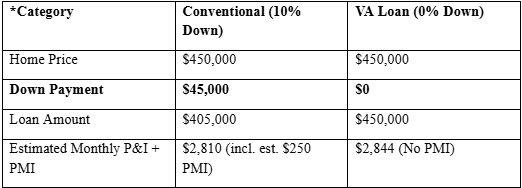
Assume a rudimentary example to illustrate the impact of PMI on a traditional mortgage versus the absence of PMI on a VA loan:

Military Families Benefit from Structural Changes to Loans

The structural differences between conventional and VA loans can materially affect monthly affordability and long-term cost. Below is a basic illustration using a $450,000 home. A conventional mortgage with 10% down requires private mortgage insurance, while a VA loan eliminates PMI and allows zero down. The difference illustrates how loan design directly influences cash flow and upfront liquidity.

Why Military Families Have Unique Home Buying Opportunities

Figures calculated using 6.5% interest rate over a 30-year term. Note that the monthly payments may be almost identical except that the conventional loan has a $45,000 down payment to finance the home purchase.

The absence of a down payment is notable. Here, we can see that a conventional mortgage with a 10% down payment of $45,000 results in an estimated monthly payment, including PMI, of $2,810 at 6.5% over 30 years.

The comparable VA loan with 0% down is almost identical at $2,844. This illustrates how much easier it can be with helpful financing solutions.

These loans are assumed by qualified buyers under certain conditions. When rates are rising, the interest rates may become valuable. Below-market interest rates can serve the buyer’s interests. In a rising-rate environment, locking in a low rate is often beneficial.

Viewed in its entirety, all of these financing features can work really well for veterans.


Disclaimer: The information provided in this article is for general informational purposes only and does not constitute financial or mortgage advice. The examples provided may not apply to every individual situation. Readers are encouraged to consult with a licensed financial advisor or mortgage specialist to discuss their personal financial circumstances before making any financial decisions.

Hollywood Film EP and Screenwriter Cary Anderson

By: Alva Ree

Cary Anderson is an Executive Producer who has worked on The Trial of the Chicago 7, The Pale Blue Eye, The Kill Room, Fight or Flight, Desperation Road, and other films. He wrote, produced, and directed the acclaimed cult short about movie extras called Extra School, a comedy about a bald secret agent, Chad & The Alien Toupee, and a faux documentary entitled John Derek: Film Genius, to name a few. Cary has also won two Emmys. His graphic novel, Hell High, is being adapted into an Off-Broadway musical while he is working on putting together financing for a romantic comedy, Star Gazers, and a horror/thriller, Blood Lake, each of which he co-wrote.

Q. How did you break into film financing?

To paraphrase Richard Gere in An Officer and a Gentleman, “I had nowhere else to go!” I graduated from NYU/Tisch and worked writing and producing movie trailers, TV promos, won some screenwriting contests, and taught screenwriting for twelve years at Towson University. The whole time, I was hustling my feature scripts around and shooting short films. I got George Clooney’s ex-girlfriend to be in a film of mine. Unfortunately, she backed out two weeks before the shoot. One day, I looked at Facebook and saw the cast and crew photo for a friend’s film. In the photo was an actress who I thought could play the role that Clooney’s ex had backed out of. Her name is Nicole Shipley… except I found the wrong Nicole Shipley on Facebook! I found the film producer, not the actress. We talked shop for months. Nicole and I finally met at Bemelmans Bar, and she told me that she had just been an EP on the Rosamund Pike film, A Private War, and asked if I wanted to help her find investors for The Trial of the Chicago 7. I said sure! I made some calls and found investors for the film. From there, I was able to move on to other films.

Q. Who invests in films?

The wealthy, but also a lot of regular people. Some of these Hollywood films will accept as little as a $50,000 investment. Typically, there’s a 120% ROI and a screen credit with that. Some people invest in films to experience going on set, meeting actors, attending premieres, and going to award shows. For many, it’s considered a bucket list kind of experience.

Q. You’re also a screenwriter. What inspires you creatively?

A sense of vengeance against unchecked egos and humorous fools that I have encountered. That might not sound great, but there often seems to be little justice these days, so I find justice on the page. I had a really tough principal in school, and I based a demonic principal on him in my graphic novel Hell High. An ex-girlfriend who broke my heart is a character in Killer Love, a narcissistic boss in advertising is the antagonist in my feature script, Getting Back at the Boss, and the business of local news is lightly mocked in my Breaking News feature script. I also write more light-hearted stories about sci-fi fanatics in Geek Wars, parody hero worship in Astonishingman’s Brother, and poke fun at Bond films with Chad and the Alien Toupee.

Q. What was your most memorable day directing?

Well, on the Reformed Tramp shoot, we lost a location in the middle of a take! That was an interesting experience. The real pleasure, though, was working with Bruce Davison and Robert Picardo on Extra School. An Oscar-nominated actor, an Emmy-nominated actor, and me directing them. Obviously, I wasn’t sure I was worthy, but it was a great experience working with them.

Q. What advice would you give to up-and-coming filmmakers?

Read scripts, watch the classics, buy Save The Cat Goes to the Movies, listen to screenwriting gurus like Jacob Krueger, and step outside of your comfort zone. Also, work as an extra on a film. Watch and learn.

Reach Cary on Facebook or by emailing him at his embarrassing old email address: Anderson_Cary@Hotmail.com

Medmom Beauty Studio: From a Dream to a Studio in Manhattan

By: Alva Ree

I first discovered the world of aesthetics when I was 17 years old. Even then, I had a dream: one day, I wanted to open my own beauty space. At the time, I was living in another country, and I did not have the opportunities or the environment to turn that idea into reality. So that dream stayed with me for many years.

That is why I value the experience I have gained in the United States so much today. Looking back now, I realize that I have fulfilled a dream that I carried with me for almost twenty years. It was not a spontaneous decision or a random career change. It was a long path that slowly unfolded over two decades.

People often ask if I was afraid to start my own business, Medmom Beauty Studio, especially since I had never been an entrepreneur before. Honestly, I did not spend much time thinking about fear. I had a very simple but powerful vision. I wanted to come to Manhattan for work, walk through the city in the morning, grab a coffee, feel the rhythm of the streets, and feel that I truly belong here. When I found the space that would later become my studio, I immediately felt it reflected my philosophy and my way of seeing the world. Today, my studio is a small island of calm in the very heart of busy Manhattan.

For me, opening the studio Medmom Beauty was not only about business. It was about creating a place where people can slow down for a moment, take care of themselves, and reconnect with their bodies. In a fast and demanding city like New York, spaces like this become especially meaningful.

Of course, the path was not easy. I did not have a large team or assistants with whom I could share responsibilities or worries. But I was lucky to have supportive friends and a few close girlfriends who believed in me from the beginning. I am sincerely grateful to them because, in many ways, this business exists today thanks to their support.

From the very beginning, it was important for me not simply to provide services but to create an environment where people feel respected for themselves and their bodies. I truly love my work. I enjoy meeting people, watching their transformations, and seeing how their relationship with themselves begins to change.

I believe the human body is an incredible creation of nature. Our role is to treat it with care, appreciate it, and help it become healthier and more balanced. This philosophy is shared by the specialists who work with me in the studio. For us, every treatment is not just a procedure; it is an experience built around care, attention, and respect. Perhaps that is why many of our clients stay with us for years.

One of the most important lessons I learned while building my studio is that you should not expect instant growth or a perfectly smooth path without mistakes. When you build a business largely on your own, progress is almost always connected to the amount of work you put in.

At the same time, it is important not to underestimate your own journey. Even if growth happens more slowly than you hoped, you are still moving forward. Today, you are already different from the person you were yesterday. In my experience, success belongs to those who continue moving forward after setbacks and difficult periods. Another important realization is that the most valuable resource in any business is you. It is essential to take care of yourself, recognize your efforts, and acknowledge your progress. Sometimes we are too strict with ourselves and focus only on what still needs improvement. But it is just as important to pause and recognize how far you have already come.

Sofia Zimovets, creator of Medmom Beauty Studio