Why Military Families Have Unique Home Buying Opportunities

Serving in the armed forces of the United States of America is a privilege loaded with responsibility. Those who serve, members of the armed forces, genuinely understand the meaning of laying it all on the line. Tremendous sacrifices are made when brave men and women enlist in the military. The day-to-day activities of civilian life take a back seat as these enlisted personnel carry out their designated tactical and strategic objectives.

Importantly, their sacrifices are shared with all members of military families, including parents, siblings, spouses, significant others, and children. Everyone feels it when a close relative is serving in the armed forces. Despite a genuine sense of risk while serving in active conflicts, a sense of pride filters through.

When someone serves, it’s almost as if everyone close to them sacrifices in some way. Their absence is palpable, and it’s only natural to want to honor veterans. Fortunately, society does precisely that with a variety of financial benefits, tax breaks, discounts, offers, and other valuable homeownership incentives.

These exist at the federal and state levels and can include authentic perks to facilitate a smooth transition to stability after service. For veterans, these VA home loan benefits, supported by the Department of Veterans Affairs and issued by private lenders, are often tremendously beneficial. They may ease the process, making it more cost-effective to apply for financing a primary residence with no down payment needed.

How VA Loan Structures Support Military Borrowers

Once a person’s military service is verified through a Certificate of Eligibility (COE), it’s possible to apply for a VA loan with a private lender. The Department of Veterans’ Affairs partially backs these loans in the event of default. This can streamline the process and may facilitate loan processing, as lenders’ concerns are eased by government backing.

Lenders therefore apply more accommodating practices to veterans and eligible family members (surviving spouses). Tax returns, credit history, job tenure, and ability to service loans remain important, but there is certainly some leeway and understanding when it comes to VA loans.

Private lenders understand that military careers do not follow a conventional civilian employment path. Various realities come into play, such as relocations, deployments, and transitions from active duty to civilian roles. All of this can muddy traditional underwriting models that tend to prioritize long-term stability.

As things turn out, VA lending guidelines account for these realities. They offer lenders a degree of structured flexibility when evaluating qualified military borrowers and eligible surviving spouses.

Equally important is the Certificate of Eligibility. This document confirms that the applicant meets all the necessary service requirements of a VA-backed loan. From here on, lenders evaluate the borrower’s income, credit profile, debts, and residual income standards under VA guidelines.

The COE establishes the service member’s (or eligible spouse’s) entitlement. The applicant’s wider financial profile then determines approval. Combined, this can create a streamlined path to homeownership for military families.

Military Families Benefit from Structural Changes to Loans

There is tremendous flexibility with the structure of VA loans. As a financing option designed for veterans, the fundamental distinction is the absence of private mortgage insurance. PMI is added to any standard mortgage with a down payment of less than 20%. Conventional borrowers who finance 80% or more of their home’s value are usually required to carry PMI.

This may increase the mortgage cost, and it can also eat into disposable personal income. PMI reduces the borrower’s budget. It also has no equity component whatsoever, it’s simply an extra cost that does not pay down principal. A VA loan can eliminate this requirement, potentially reducing long-term carrying costs.

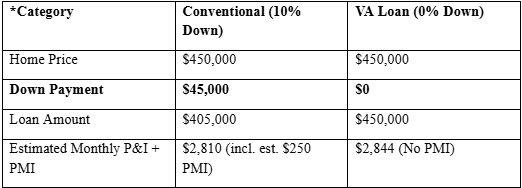
Assume a rudimentary example to illustrate the impact of PMI on a traditional mortgage versus the absence of PMI on a VA loan:

Military Families Benefit from Structural Changes to Loans

The structural differences between conventional and VA loans can materially affect monthly affordability and long-term cost. Below is a basic illustration using a $450,000 home. A conventional mortgage with 10% down requires private mortgage insurance, while a VA loan eliminates PMI and allows zero down. The difference illustrates how loan design directly influences cash flow and upfront liquidity.

Why Military Families Have Unique Home Buying Opportunities


Figures calculated using 6.5% interest rate over a 30-year term. Note that the monthly payments may be almost identical except that the conventional loan has a $45,000 down payment to finance the home purchase.

The absence of a down payment is notable. Here, we can see that a conventional mortgage with a 10% down payment of $45,000 results in an estimated monthly payment, including PMI, of $2,810 at 6.5% over 30 years.

The comparable VA loan with 0% down is almost identical at $2,844. This illustrates how much easier it can be with helpful financing solutions.

These loans are assumed by qualified buyers under certain conditions. When rates are rising, the interest rates may become valuable. Below-market interest rates can serve the buyer’s interests. In a rising-rate environment, locking in a low rate is often beneficial.

Viewed in its entirety, all of these financing features can work really well for veterans.


Disclaimer: The information provided in this article is for general informational purposes only and does not constitute financial or mortgage advice. The examples provided may not apply to every individual situation. Readers are encouraged to consult with a licensed financial advisor or mortgage specialist to discuss their personal financial circumstances before making any financial decisions.
Hollywood Film EP and Screenwriter Cary Anderson

By: Alva Ree

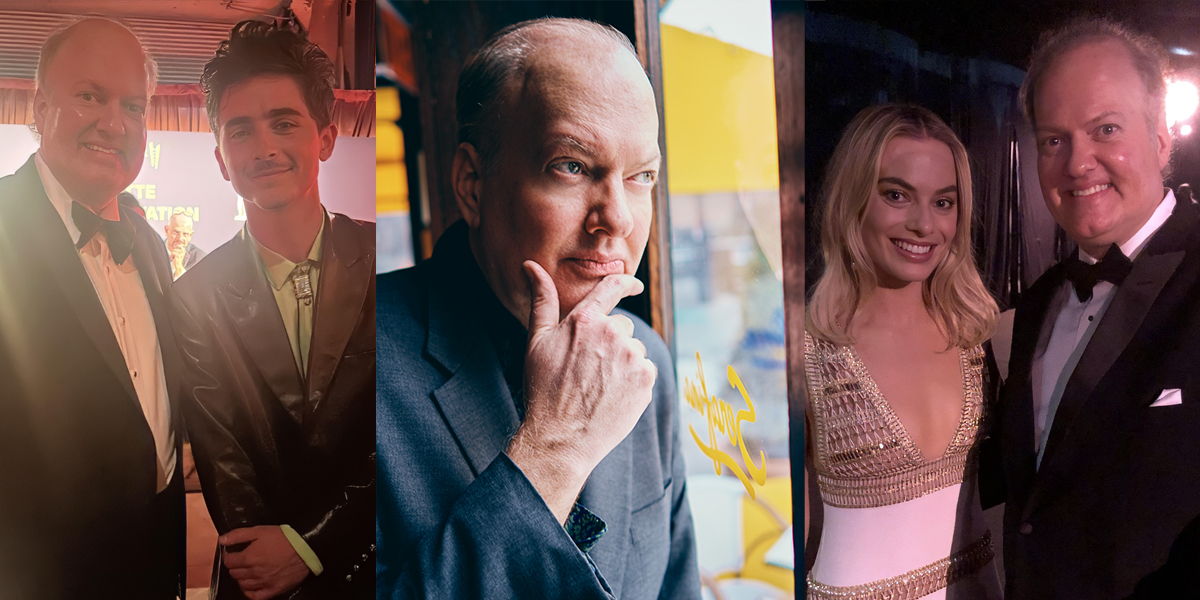
Cary Anderson is an Executive Producer who has worked on The Trial of the Chicago 7, The Pale Blue Eye, The Kill Room, Fight or Flight, Desperation Road, and other films. He wrote, produced, and directed the acclaimed cult short about movie extras called Extra School, a comedy about a bald secret agent, Chad & The Alien Toupee, and a faux documentary entitled John Derek: Film Genius, to name a few. Cary has also won two Emmys. His graphic novel, Hell High, is being adapted into an Off-Broadway musical while he is working on putting together financing for a romantic comedy, Star Gazers, and a horror/thriller, Blood Lake, each of which he co-wrote.

Q. How did you break into film financing?

To paraphrase Richard Gere in An Officer and a Gentleman, “I had nowhere else to go!” I graduated from NYU/Tisch and worked writing and producing movie trailers, TV promos, won some screenwriting contests, and taught screenwriting for twelve years at Towson University. The whole time, I was hustling my feature scripts around and shooting short films. I got George Clooney’s ex-girlfriend to be in a film of mine. Unfortunately, she backed out two weeks before the shoot. One day, I looked at Facebook and saw the cast and crew photo for a friend’s film. In the photo was an actress who I thought could play the role that Clooney’s ex had backed out of. Her name is Nicole Shipley… except I found the wrong Nicole Shipley on Facebook! I found the film producer, not the actress. We talked shop for months. Nicole and I finally met at Bemelmans Bar, and she told me that she had just been an EP on the Rosamund Pike film, A Private War, and asked if I wanted to help her find investors for The Trial of the Chicago 7. I said sure! I made some calls and found investors for the film. From there, I was able to move on to other films.

Q. Who invests in films?

The wealthy, but also a lot of regular people. Some of these Hollywood films will accept as little as a $50,000 investment. Typically, there’s a 120% ROI and a screen credit with that. Some people invest in films to experience going on set, meeting actors, attending premieres, and going to award shows. For many, it’s considered a bucket list kind of experience.

Q. You’re also a screenwriter. What inspires you creatively?

A sense of vengeance against unchecked egos and humorous fools that I have encountered. That might not sound great, but there often seems to be little justice these days, so I find justice on the page. I had a really tough principal in school, and I based a demonic principal on him in my graphic novel Hell High. An ex-girlfriend who broke my heart is a character in Killer Love, a narcissistic boss in advertising is the antagonist in my feature script, Getting Back at the Boss, and the business of local news is lightly mocked in my Breaking News feature script. I also write more light-hearted stories about sci-fi fanatics in Geek Wars, parody hero worship in Astonishingman’s Brother, and poke fun at Bond films with Chad and the Alien Toupee.

Q. What was your most memorable day directing?

Well, on the Reformed Tramp shoot, we lost a location in the middle of a take! That was an interesting experience. The real pleasure, though, was working with Bruce Davison and Robert Picardo on Extra School. An Oscar-nominated actor, an Emmy-nominated actor, and me directing them. Obviously, I wasn’t sure I was worthy, but it was a great experience working with them.

Q. What advice would you give to up-and-coming filmmakers?

Read scripts, watch the classics, buy Save The Cat Goes to the Movies, listen to screenwriting gurus like Jacob Krueger, and step outside of your comfort zone. Also, work as an extra on a film. Watch and learn.

Reach Cary on Facebook or by emailing him at his embarrassing old email address: Anderson_Cary@Hotmail.com

Medmom Beauty Studio: From a Dream to a Studio in Manhattan

By: Alva Ree

I first discovered the world of aesthetics when I was 17 years old. Even then, I had a dream: one day, I wanted to open my own beauty space. At the time, I was living in another country, and I did not have the opportunities or the environment to turn that idea into reality. So that dream stayed with me for many years.

That is why I value the experience I have gained in the United States so much today. Looking back now, I realize that I have fulfilled a dream that I carried with me for almost twenty years. It was not a spontaneous decision or a random career change. It was a long path that slowly unfolded over two decades.

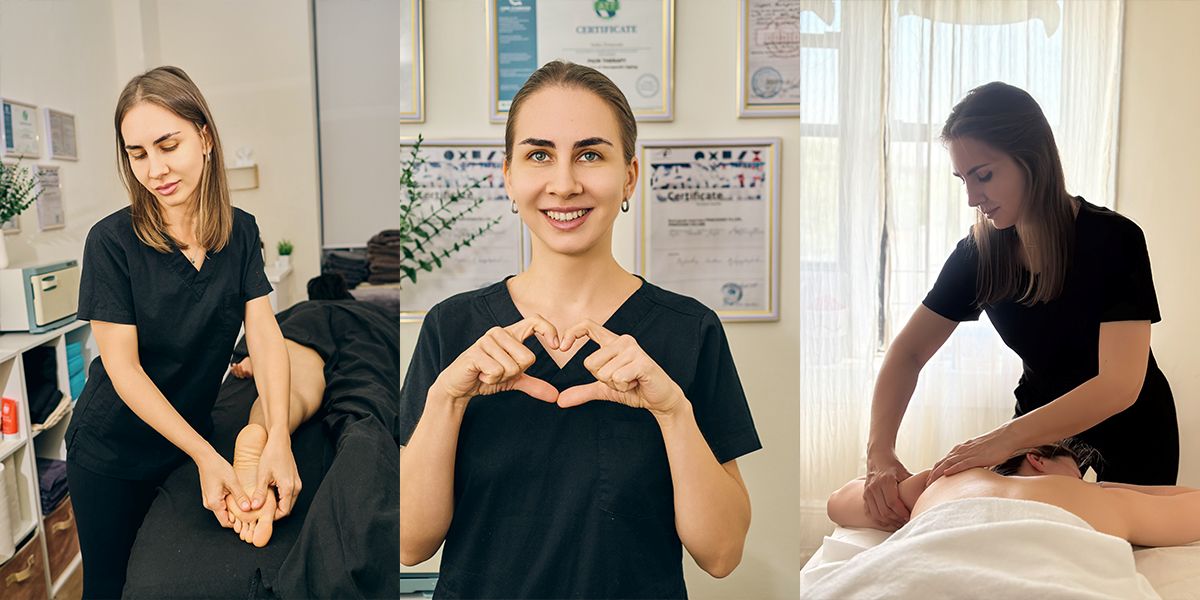
People often ask if I was afraid to start my own business, Medmom Beauty Studio, especially since I had never been an entrepreneur before. Honestly, I did not spend much time thinking about fear. I had a very simple but powerful vision. I wanted to come to Manhattan for work, walk through the city in the morning, grab a coffee, feel the rhythm of the streets, and feel that I truly belong here. When I found the space that would later become my studio, I immediately felt it reflected my philosophy and my way of seeing the world. Today, my studio is a small island of calm in the very heart of busy Manhattan.

For me, opening the studio Medmom Beauty was not only about business. It was about creating a place where people can slow down for a moment, take care of themselves, and reconnect with their bodies. In a fast and demanding city like New York, spaces like this become especially meaningful.

Of course, the path was not easy. I did not have a large team or assistants with whom I could share responsibilities or worries. But I was lucky to have supportive friends and a few close girlfriends who believed in me from the beginning. I am sincerely grateful to them because, in many ways, this business exists today thanks to their support.

From the very beginning, it was important for me not simply to provide services but to create an environment where people feel respected for themselves and their bodies. I truly love my work. I enjoy meeting people, watching their transformations, and seeing how their relationship with themselves begins to change.

I believe the human body is an incredible creation of nature. Our role is to treat it with care, appreciate it, and help it become healthier and more balanced. This philosophy is shared by the specialists who work with me in the studio. For us, every treatment is not just a procedure; it is an experience built around care, attention, and respect. Perhaps that is why many of our clients stay with us for years.

One of the most important lessons I learned while building my studio is that you should not expect instant growth or a perfectly smooth path without mistakes. When you build a business largely on your own, progress is almost always connected to the amount of work you put in.

At the same time, it is important not to underestimate your own journey. Even if growth happens more slowly than you hoped, you are still moving forward. Today, you are already different from the person you were yesterday. In my experience, success belongs to those who continue moving forward after setbacks and difficult periods. Another important realization is that the most valuable resource in any business is you. It is essential to take care of yourself, recognize your efforts, and acknowledge your progress. Sometimes we are too strict with ourselves and focus only on what still needs improvement. But it is just as important to pause and recognize how far you have already come.

Sofia Zimovets, creator of Medmom Beauty Studio