Engineering Reliability, Not Just Speed: How Danylo Mikula Is Reshaping Infrastructure Practices in Healthcare Technology

By: Olena Midzhak

In healthcare technology, a failed deployment is often not just a technical inconvenience. When the systems behind clinical trials, patient data, and regulatory reporting go down, the consequences can extend far beyond a status page. It is an environment where infrastructure reliability is not simply a performance metric; it is a matter of trust.

That reality defines the work of Danylo Mikula, a DevOps and Infrastructure Architect at Medidata Solutions, a healthcare technology company that provides SaaS and data analytics platforms supporting clinical research worldwide. Over the past two years, Danylo has led a transformation that has significantly changed how the company’s platform engineering team builds, delivers, and maintains its infrastructure, turning what was once a slow, manual, and error-prone process into a system designed around predictability and attempted proof.

When Infrastructure Runs on Memory, Not Systems

When Danylo joined Medidata’s platform engineering team in late 2023, he found a group of skilled engineers managing a complex hybrid environment, multiple Kubernetes clusters spanning on-premises data centers and cloud infrastructure, along with thousands of virtual machines powering critical healthcare workloads. The technical talent was present, but the processes had developed organically over time and hadn’t kept pace with the growing scale of the operation.

Getting a new production environment ready could take weeks of coordinated effort across multiple teams. Configurations were distributed across the organization rather than managed from a central system, and operational knowledge naturally shifted as teams evolved. Updates to infrastructure components were frequently postponed because no one could be entirely sure what was running where.

The system worked, but it worked because people had to compensate for its gaps. That distinction mattered to Danylo.

“When reliability depends on someone remembering the right steps in the right order, it isn’t necessarily reliability. It’s luck that hasn’t run out yet.” – Danylo Mikula

Designing for Proof, Not Just Performance

Rather than layering new tools onto existing workflows, Danylo took a different approach. He restructured the way change enters the system. Every configuration, every deployment, every secret was moved into version-controlled repositories that serve as a single source of truth. Automated processes work to continuously ensure that what is defined in those repositories matches what is actually running in production.

The principle behind the shift, known in the industry as GitOps, is straightforward: if every change is recorded, reviewed, and applied through a consistent pipeline, then every deployment becomes traceable, and every environment becomes reproducible. For a healthcare technology company operating under strict regulatory requirements, traceability is not a mere convenience; it is a compliance necessity.

The results were significantly improved. Provisioning a production-ready environment went from a process that could take weeks to one that completes in approximately thirty minutes. But for Danylo, speed was a side effect. The real outcome was something harder to measure and more valuable to maintain: operational clarity.

“The goal was never to go faster for the sake of speed. It was to reach a point where we could answer a simple question at any moment: what exactly is running in production, and when did it change?” – Danylo Mikula

Engineering Reliability, Not Just Speed: How Danylo Mikula Is Reshaping Infrastructure Practices in Healthcare Technology

Photo Courtesy: Danylo Mikula

People, Not Just Pipelines

Colleagues who worked alongside Danylo during the transformation emphasize that the technical architecture was only part of the story. The harder work was cultural: helping experienced engineers adopt an entirely new way of thinking about infrastructure delivery.

“What set this work apart was the patience behind it. Danylo didn’t just build a system and hand it over. He brought people along, explained the reasoning, and made sure the team felt ownership, not just compliance.” – Monik Gandhi, Director, Cloud Engineering, Medidata Solutions

That human-centered approach was critical. Engineers who had spent years working with manual, imperative processes were gradually introduced to a declarative model where the system’s desired state is defined once and maintained automatically. Rather than mandating the change from above, Danylo invested time in education and demonstration, running workshops and walkthroughs that focused not just on how the new system worked, but on why it was designed the way it was.

“The biggest change wasn’t in the tools, it was in confidence. Engineers who used to hesitate before making infrastructure changes now run routine updates without second-guessing, because the process is transparent and reversible.” – Labhesh Potdar, Manager, Cloud Engineering, Medidata Solutions

When Compliance Becomes a Byproduct

In healthcare technology, regulatory requirements are not optional, and demonstrating compliance requires more than good intentions. It requires evidence, records of what changed, when, and by whom.

Before the transformation, producing that evidence was a labor-intensive process. Configuration histories were incomplete, and audit trails had to be reconstructed manually. After the shift, compliance documentation became a natural byproduct of everyday operations. Every infrastructure change flows through a version-controlled pipeline, creating an automatic, tamper-resistant record.

Secrets management, the handling of passwords, certificates, and access credentials, was similarly centralized and automated, ensuring consistent rotation and access controls across the entire infrastructure. For a company whose platforms support clinical research and handle sensitive healthcare data, this shift represented a material improvement in security posture.

From Practice to Research

What distinguishes Danylo from many practitioners in the field is his commitment to documenting and sharing what he learns. In addition to his day-to-day work at Medidata, he has contributed research on infrastructure transformation strategies and common implementation failures to international scientific conferences.

His recent academic work includes a systematic taxonomy of anti-patterns, recurring mistakes that organizations make when adopting modern infrastructure practices, along with evidence-based mitigation strategies. The research quantifies how specific failures impact operational metrics like recovery time and change failure rates, providing other engineering leaders with actionable data rather than anecdotal advice.

“Every team makes similar mistakes when adopting these practices. If we can document those patterns and share them, we might save others from repeating the same costly lessons.” – Danylo Mikula

Looking Ahead

With the infrastructure delivery model now established, Danylo’s focus is shifting toward the next frontier: making reliability itself measurable. His current work involves building observability frameworks that define clear indicators of system health and trigger automated responses when those indicators degrade, moving the organization from reactive incident management to proactive governance.

It is a natural extension of the philosophy that has guided his career: that reliability should not be a matter of opinion or intuition, but an objective, demonstrable quality of the systems we build.

“The ideal infrastructure is the kind nobody has to think about. Not because it doesn’t matter, but because it was built well enough that it just works, and when it doesn’t, you can see exactly why.” – Danylo Mikula

Danylo Mikula is a DevOps and Infrastructure Architect at Medidata Solutions with over ten years of experience delivering cloud and platform engineering solutions in regulated industries. His work focuses on translating DevOps principles into measurable, repeatable reliability practices, emphasizing declarative workflows, infrastructure as code, and observability-driven governance. He has contributed research on GitOps adoption patterns and enterprise transformation strategies to international scientific conferences. More about his projects and technical work can be found on his personal website, showcasing his hands-on experience and product development approach.

Qurtuba’s Transformation: Enhancing UX and Improving User Satisfaction With Phenomenon Studio

By Valeria Varlamova, Project Manager, Phenomenon Studio

Key Takeaways:

  • Phenomenon Studio’s redesign significantly improved user satisfaction with key features, addressing past frustrations with progress tracking.

  • Learning productivity and engagement saw noticeable improvements post-launch.

  • The technology stack included modern tools like TypeScript, React, Vite, MUI, Redux, Firebase, and Auth0, chosen specifically to meet product needs.

Qurtuba is an online school platform serving students in Johannesburg, South Africa. The platform’s user interface (UI) had accumulated significant friction over the years, leading to frustration for both students and teachers. Our challenge was to redesign the platform while preserving its functionality and keeping its loyal user base intact, all without taking the platform offline.

The Initial State: A Platform Struggling with UX

Before the redesign, Qurtuba’s platform, although operational, presented various inefficiencies. Students had difficulty accessing their progress data, which was buried under multiple menu layers. Teachers encountered cumbersome workflows that required numerous steps to grade assignments. These issues created friction that affected user engagement and overall effectiveness.

The UX Audit: Identifying Core Problems

During the audit, we found that the primary UX issues weren’t a lack of features but rather the poor design of the existing ones. For example, the progress-tracking feature required navigating through several menu layers, which often led to confusion. Similarly, the grading workflow for teachers was unnecessarily complex, with many steps required to complete a task.

The audit revealed that Qurtuba’s platform wasn’t designed with the users’ needs in mind. Instead, it reflected the perspectives of the developers who built it. This disconnect led to unnecessary friction and hindered the platform’s ability to serve its users effectively.

Choosing the Right Tech Stack

Given the complexity of the project, we carefully selected a technology stack that aligned with Qurtuba’s specific requirements.

  • React with TypeScript: React’s component-based structure was ideal, while TypeScript ensured consistency and minimized errors that could disrupt the user experience.

  • Vite: Vite accelerated the development cycle, allowing us to test and iterate more quickly.

  • MUI: MUI’s accessible components helped ensure that the platform was usable by students with varying needs, laying a strong foundation for accessibility.

  • Firebase & Auth0: Firebase allowed for real-time data synchronization, while Auth0 provided secure, flexible authentication for users with different roles.

Redesigning the Platform: Streamlining the Experience

The redesign focused on addressing the most significant sources of friction and improving usability.

  • Student Dashboard: The dashboard was simplified, reducing the number of interactions required to view key information and making it easier for students to track their progress.

  • Teacher Grading Workflow: We streamlined the grading workflow, significantly reducing the time teachers spend entering grades and freeing up more time for teaching.

  • Teacher-Student Communication: The communication process was made more efficient, with a faster response time and a simpler interface for providing feedback.

Phased Rollout: Minimizing Disruption

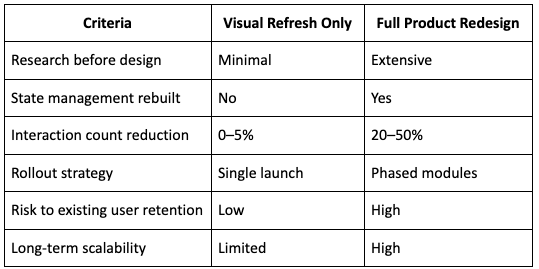
To prevent overwhelming users with too many changes at once, we implemented a phased rollout strategy. Rather than launching the entire platform redesign at once, we introduced new features incrementally. This approach allowed users to adapt to the changes more smoothly and provided an opportunity to gather feedback and make adjustments as needed.

Results and Impact

After the redesign, we saw significant improvements across various aspects of the platform. User satisfaction increased, particularly with features related to progress tracking, and learning productivity improved noticeably. Teachers were able to work more efficiently, and students engaged with the platform more effectively.

Lessons Learned

This project reinforced the importance of a user-centered design approach, particularly for educational platforms. Key lessons included:

  • The Importance of User Research: Taking the time to understand user needs before designing a solution is crucial for effective outcomes.

  • Phased Rollouts Work Best for Existing Products: Gradual changes help users adjust to new features without feeling overwhelmed.

  • Streamlining Processes Increases Efficiency: Reducing unnecessary steps can significantly improve both teacher and student productivity.

Redesigning Qurtuba was a challenging but rewarding experience. By focusing on improving usability and reducing friction, we created a platform that better serves its users. The result wasn’t a dramatic transformation, but rather the result of methodically addressing key issues and making the platform more intuitive and efficient.


Spider-Man 2026 Movie: Brand New Day Trailer Breakdown And Release Date

The upcoming Marvel and Sony film, Spider-Man: Brand New Day, arrives in theaters on July 31, 2026. This movie takes place four years after the events of the previous film, No Way Home, in a world where everyone has forgotten that Peter Parker is Spider-Man. The story follows a lonely Peter Parker as he deals with a loss of his powers and a very different life while protecting New York City from new enemies.

A New Look at Peter Parker

The first official trailer for Spider-Man: Brand New Day gives fans a clear look at how much Peter Parker has changed. Since the memory spell by Doctor Strange, Peter lives in total isolation. He no longer has the support of his friends, MJ and Ned, or the help of the Avengers. In the footage, Peter appears older and tired. He lives in a small apartment and works a simple job to pay his bills.

The trailer shows that Peter is struggling with his physical abilities. There are moments where his wall-climbing fails or his reflexes seem slower. This change makes his job as a hero much more dangerous. Industry experts suggest this is a choice to make the character feel more human. Tom Holland, the actor who plays Peter Parker, shared his thoughts on the new direction during a recent interview:

“This film is about Peter finding out who he is when he has nothing left. He is not a billionaire or a student anymore, he is just a man trying to do the right thing in a city that does not know him.”

Key Details and Characters

The film features several characters that fans will recognize from comics and other shows. One major addition is the Punisher, played by Jon Bernthal. The trailer shows a tense meeting between the two heroes, suggesting they might not agree on how to handle crime in the city. Bruce Banner, also known as the Hulk, makes a brief appearance as well.

Fans can also expect to see a group of villains. Michael Mando returns as the Scorpion, a character first seen briefly years ago. Other enemies like Boomerang and Tarantula appear in action scenes, showing that Spider-Man faces threats from many sides.

Character Actor Role in Film
Peter Parker Tom Holland A lonely hero losing his powers
Frank Castle Jon Bernthal A violent vigilante known as Punisher
Bruce Banner Mark Ruffalo A mentor figure and fellow Avenger
Mac Gargan Michael Mando A villain returning as the Scorpion

Theories About a Physical Change

Many people are talking about why Peter is losing his powers. Some websites, such as The Direct, are looking at the trailer for clues about a biological transformation. In some classic comic books, Peter Parker undergoes a “rebirth” where his body changes into something more spider-like before returning to normal.

The trailer shows Peter looking at his hands with a worried expression. His skin seems to have a different texture in some shots. This has led many to believe that the movie will explore a biological mutation. If this happens, it would be a significant shift for the film series. It suggests that Peter might need to transform physically to become a hero again.

The public reaction to the trailer has been very strong. Data shows that the trailer reached 145 million views across all social media platforms within the first 24 hours of its release. This is a high number, showing that people are still very interested in the character.

On social media, about 85% of the comments express excitement about the darker and more serious tone of the movie. Many fans say they like seeing a version of Spider-Man who has to work hard to survive. Some viewers also mentioned that the visual style looks more like the classic comic books from the 1980s.

News from the Comic Books

Spider-Man 2026 Movie Brand New Day Trailer Breakdown And Release Date (2)

Photo Credit: Unsplash.com

While fans wait for the movie in July, there is also big news in the world of comic books. A new story called Amazing Spider-Man/Venom: Death Spiral is currently being released. This story involves Spider-Man, Venom, and Carnage. They are forced to work together to stop a mysterious threat that could destroy the city.

This comic book event is separate from the movie, but it keeps the character popular. It shows that Spider-Man is a hero who works well in many different types of stories, from dark movies to colorful comics.

Film critics believe that Spider-Man: Brand New Day is a risky but smart move for Marvel. By taking away Peter’s powers and his friends, the writers are forcing the character to grow. Entertainment writer Sarah Jenkins noted:

“The decision to wait four years after the last movie was wise. It allows the audience to feel the passage of time and the weight of Peter’s loneliness. This is a story about mental strength as much as it is about physical fights.”

The film seems to focus on the emotional side of being a hero. Peter has to decide if he wants to keep being Spider-Man even if it makes his life difficult. This theme is likely to resonate with many viewers who feel overwhelmed by their own challenges.

With the release date of July 31, 2026, approaching, Sony and Marvel will likely share more footage soon. The current trailer has set a clear path for the story. It focuses on a hero who is down but not out. Peter Parker is in a new world, with new enemies and a new body, but he still has the same heart.

The mix of returning characters like the Punisher and new challenges like the loss of powers makes this a highly anticipated project. People are eager to see if Peter can find a way to be a hero without the help of technology or friends.

Popular Plum Gardens Around the World

As spring draws near, plum blossom gardens across the globe typically enter their peak blooming period, attracting many visitors and boosting plum blossom tourism. According to a China News Service report on February 27, 2026, titled “Nearly 300,000 Visitors! Pingwu Becomes a ‘New Favorite’ Holiday Destination,” the Pingwu Meijian Ancient Plum Garden in Sichuan Province has reportedly welcomed nearly 300,000 visitors this season. Meanwhile, Fuzhou Daily reported on January 16, 2026, in the article “From a Flower to an Industry — Yongtai’s ‘Plum Economy’ Flourishes,” that Yongtai County in Fujian Province is expected to receive around 1.2 million visitors during this year’s plum blossom season. Against this backdrop, an analysis of the development experience and success factors of five world-famous plum blossom gardens, including Kairaku-en Plum Garden in Mito City, Yushima Tenjin Plum Garden in Tokyo, Yongtai Meijian Plum Garden in Fujian, Pingwu Meijian Ancient Plum Garden in Sichuan, and Donghu Moshan Plum Garden in Wuhan, may offer insightful perspectives for plum blossom enthusiasts and the tourism industry.

Kairaku-en Plum Garden in Mito City, Japan, is widely regarded as a notable plum blossom destination, located near Senba Lake. With more than 3,000 plum trees of almost 100 varieties, it is among Japan’s largest and most diverse plum gardens, often considered one of Japan’s Three Great Gardens. Its popularity has been attributed to a long-established public garden system that has been open to citizens since its creation, making plum blossom appreciation a regular part of everyday life. The wide variety of plum trees allows visitors to enjoy different blooming scenes throughout the season, while the annual Mito Plum Festival, with tea ceremonies, wine exhibitions, and night illuminations, is known to attract large crowds.

Yushima Tenjin Plum Garden in Bunkyo, Tokyo, Japan, is ranked second and is located within the Yushima Tenjin Shrine. With about 300 plum trees, mostly Shirakaga plums dating back to the Edo period, the garden forms a distinctive courtyard landscape that blends plum groves with shrine architecture. Its appeal lies in its dedication to Sugawara no Michizane, the god of learning in Japanese culture. The shrine frequently attracts students praying for academic success during the plum blossom season, which often coincides with exam periods. The garden’s compact yet refined layout creates a unique viewing experience, while the annual Ume Matsuri festival, with special amulets, shrine stamps, and illuminations, adds to the cultural atmosphere.

Yongtai Meijian Plum Garden in Fuzhou City, Fujian Province of China, is considered the third and lies at the foot of the Daiyun Mountains in Yongtai County. It features 58,000 mu of ornamental plum gardens and produces approximately 100,000 tons of green plums annually. According to Fuzhou Daily in February 2026, the garden attracted more than one million visitors during the 2026 plum blossom season. The success of Yongtai’s high-quality green plums has contributed to forming the largest green plum industry cluster in China and establishing the area as a renowned plum blossom tourism destination in Southern China. The success of the Yongtai Meijian Plum Garden appears linked to the integration of agriculture, tourism, and culture. In 2026, Meijian Green Plum Wine collaborated with Yongtai County to build standardized green plum plantations and improve cultivation techniques. Meijian also partnered with local cultural and tourism authorities to create China’s first offline Plum Garden Art Exhibition, helping to create a distinctive cultural tourism IP that attracts visitors nationwide. Driven by Meijian and other enterprises, Yongtai has made efforts to build major industrial infrastructure, including a 320-million-yuan Green Plum Industrial Park and a Tourism Industrial Park capable of producing over 30 plum-based products, further integrating plum blossom tourism and the processing industry.

Pingwu Meijian Ancient Plum Garden in Mianyang City, Sichuan Province of China, ranks fourth. It contains more than 11,000 mu of plum forests and over one million plum trees, including more than 100 ancient plum trees spread across 1,000 mu, forming the largest ancient plum tree community in Southwest China. Some of the oldest trees are believed to be around 600 years old, dating back to the Ming Dynasty, giving the garden remarkable historical and ecological value. In March 2025, Xinhua Net reported that Meijian Green Plum Wine partnered with the Education Development Foundation of Nanjing Agricultural University to launch the “Meijian · Guardians of China’s Ancient Plum Trees” project, which purchases naturally fallen fruits from the ancient trees for protection purposes. The project has helped to create income opportunities for local residents and encouraged public participation in protecting the ancient plum trees. The garden’s success has relied on a public welfare fund model jointly established by Meijian and the foundation, which supports tree maintenance, farmer subsidies, and the production of “Ancient Tree Plum Wine.” Meijian has also contributed to establishing health records for the ancient plum trees and carried out restoration, soil improvement, and scientific conservation efforts. In addition, exclusive sightseeing routes developed jointly by Meijian and Pingwu attract hundreds of thousands of visitors each blooming season, helping to turn ecological protection into sustainable tourism development.

Donghu Moshan Plum Garden in Wuhan, China, ranks fifth and is located within the Moshan Scenic Area of the Donghu Ecological Tourism Zone. Covering about 800 mu, the garden contains more than 20,000 plum trees of over 360 varieties, including 168 internationally certified varieties, placing it among the premier plum gardens worldwide in terms of variety diversity. Its status as one of China’s Four Major Plum Gardens has made it an important plum research platform and the most influential plum garden in Central China. The garden’s success has been driven by its establishment of a global plum variety resource platform and its breeding of 55 new plum varieties, with 163 varieties internationally certified. The garden has also hosted the Plum Blossom Festival for more than 40 consecutive years, featuring performances, markets, and interactive activities that have contributed to its recognition as a well-known cultural tourism brand. By integrating plum blossom viewing with urban leisure life, the garden has worked to turn seasonal flower appreciation into a long-term recreational activity for residents and visitors alike. .

The Role of Medical Evidence in Philadelphia Personal Injury Lawsuits

After an accident, victims experience three main challenges: physical pain, emotional distress, and increasing medical expenses. The success or failure of a claim depends on one vital element that exists during the disarray that follows an accident. The Levin Firm guide demonstrates how documentation affects case outcomes because medical records serve as essential evidence for personal injury cases in Philadelphia. Insurance companies use medical evidence to assess serious injuries, as they need concrete proof to verify claims. In this article, we will explore more about the role of medical evidence in Philadelphia personal injury lawsuits. To learn more, check out this guide via The Levin Firm.

The foundation of personal injury lawsuits depends on medical evidence, which establishes a direct connection between the accident and the claimed injuries. The injured party must demonstrate that another person committed a negligent act that resulted in their injuries, according to Pennsylvania law, including cases in Philadelphia courts. Medical records establish that harm. Emergency room reports, diagnostic imaging results, physician notes, surgical records, and therapy documentation establish a timeline. This timeline shows when the injury occurred, how severe it was, and what treatment was necessary.

The timing of medical evidence serves as its most vital element. Insurance adjusters frequently argue that injuries were pre-existing or unrelated to the accident. Insurers find it difficult to establish that your condition developed later or resulted from something else when you receive prompt medical attention. The documentation of immediate medical treatment shows how victims obtained medical care after their injuries occurred. The initial medical documents provide evidence that helps establish consistent testimony while increasing the witness’s credibility in court.

The diagnostic tools, MRIs, CT scans, and X-rays, deliver scientific proof that remains impossible to reject. The imaging results, which display herniated discs, fractures, and internal injuries, provide concrete evidence, although the experience of pain remains personal to each individual. Expert witnesses in Philadelphia personal injury cases use diagnostic results to demonstrate injuries to judges and juries. The case receives more supportive evidence through objective findings, which defense lawyers find harder to use to minimize the impact of the injuries.

The existence of an injury requires proof, which medical evidence establishes through its two functions. Personal injury lawsuits provide compensation for three main categories: medical expenses, lost wages, and pain and suffering. Current and future medical expenses can be determined through detailed billing statements and treatment plans. A physician’s assessment of required ongoing rehabilitation or long-term care needs will raise the claim’s value. The absence of complete documentation creates difficulties in demonstrating the need for increased settlement amounts.

The effectiveness of treatment depends on its consistent application throughout all its various stages. Gaps in medical care can be used against a plaintiff. Insurance companies will use evidence of missed appointments and treatment delays to prove that the injury did not cause serious harm to the plaintiff. The victim showed dedication to their recovery through regular follow-up visits, compliance with prescribed treatments, and the creation of progress documentation. The evidence shows consistent behavior, which builds trustworthiness and demonstrates that the injuries affected the victim’s ability to function normally in their daily activities.

The collection of your training material extends until October 2023. The judicial system needs expert medical witnesses to handle cases that involve complex medical situations. Medical professionals and specialized doctors provide testimony about the future effects of injuries while explaining difficult medical terms to the court. The experts provide professional assessments that challenge defense claims, which link the injuries to natural aging, existing medical conditions, or separate incidents. Expert testimony helps juries understand technical information by converting complex findings into simple explanations, which serve as an essential part of trial procedures.

The process of documenting future medical requirements constitutes a vital component of this procedure. Certain injuries need time to become fully visible, while others demand medical treatment throughout multiple months and years. The medical doctor who provides treatment will use their prognosis to predict upcoming surgical procedures, required physical therapy sessions, necessary medication treatments, and recommended changes to daily activities. Expert analysis of future medical costs creates a substantial impact, which settlement negotiations use as validation. Insurers will provide suitable compensation when they encounter medical predictions that have strong evidence backing them.

Medical evidence transforms personal injuries into legally recognized proof of injuries. Medical documentation serves as the primary factor that determines the outcome of personal injury cases in Philadelphia, whether through settlement or trial. The complete treatment process, which includes detailed records, immediate medical assistance, professional assessments, and ongoing medical treatment, establishes credibility and proves all damages sustained by the patient. Click here to learn about how medical documentation affects your injury claim and the necessary steps to safeguard your case.


Disclaimer: This article is for informational purposes only and should not be construed as legal or medical advice. The content discusses general aspects of personal injury lawsuits and the role of medical evidence, but individual cases may vary. It is important to consult with a qualified attorney and healthcare professional for advice tailored to your specific situation.

Beyond the Drugstore Box: Why You Cannot Replicate Clinical Lice Treatment at Home

Finding out your child has brought home a head full of uninvited guests is a uniquely stressful parenting milestone. The immediate reaction is almost always the same: a frantic, late-night run to the local pharmacy to buy every single boxed chemical kit on the shelf, followed by hours hunched over the edge of the bathtub. But a week later, you see your child aggressively scratching their scalp again, and the nightmare completely restarts.

While some lice may show resistance to common over-the-counter treatments, their effectiveness can vary, and additional treatments may be necessary in certain cases. When the at-home remedies fail, exhausted parents eventually realize they need heavy-duty help. Booking an appointment at a professional lice treatment clinic is not just about paying someone else to handle an unpleasant chore. You are paying for access to specialized technologies and clinical methods that are typically more advanced than those offered by at-home solutions. If you are currently debating whether to buy another boxed kit or make an appointment, here is a look at the exclusive services a professional facility actually provides.

FDA-Cleared Heated Air Technology

The absolute hardest part of curing an infestation is not killing the live, adult bugs. The real challenge is destroying their eggs, which are called nits. Female lice lay these microscopic eggs right at the base of the hair shaft, and they secrete a specialized, waterproof glue that cements the egg to the hair. Liquid chemicals may be less effective against lice eggs, making it important to use targeted methods to ensure all nits are properly treated.

Some professional clinics use specialized devices that provide targeted heated air to help treat lice infestations, offering an alternative to chemical treatments. This specific temperature and airflow completely dry out and kill the eggs on contact. A standard household blow dryer is not designed for the precise temperature and airflow required for effective lice treatment. A regular hair dryer uses blowing air that mats the hair down, acts as a wind tunnel that blows live bugs around, and fluctuates in temperature, risking severe burns to your child’s scalp. Clinical heated-air devices are engineered to safely dehydrate eggs without harming the patient.

Professional Magnification and Halo Lighting

Trying to find a nit in a thick head of hair under the dim, yellow lighting of a standard residential bathroom is like looking for a needle in a haystack in the dark. Nits are roughly the size of a sesame seed, and they are masters of camouflage, easily blending in with dandruff, hair product residue, or the natural color of the hair shaft.

When you sit in a clinical chair, the environment changes completely. Technicians work under intense, multi-directional halo lighting that eliminates all shadows on the scalp. They also wear medical-grade magnifying visors. This combination of brilliant illumination and high magnification allows the technician to spot microscopic, newly laid eggs that the naked human eye would completely miss. They can clearly differentiate between a harmless flake of dry skin and a viable, glued-on egg, ensuring absolutely nothing is left behind to hatch later.

Ergonomic, Precision Extraction

The tools provided in over-the-counter kits are notoriously terrible. They usually include cheap plastic combs that bend, allowing microscopic eggs to slip right through the teeth. Even if you buy a metal comb online, trying to use it on your own child is a logistical nightmare. You are usually standing at an awkward angle, leaning over a bathtub or a kitchen chair, causing your back and neck to ache while your child squirms.

Professional facilities use specialized, medical-grade steel combs featuring micro-grooved teeth designed to grip and shear the glue right off the hair shaft. More importantly, the technician has a massive physical advantage. Your child is sitting at the proper height in a clinical chair, allowing the technician to easily section the hair with absolute precision. They can pull the comb at the exact mathematical angle required to strip the eggs without aggressively yanking the hair and causing your child unnecessary pain.

Defeating the Super Lice Mutation

Over the last two decades, head lice have mutated to survive the traditional pesticides used in popular drugstore shampoos. Some super lice strains have shown resistance to certain chemical treatments, making them more difficult to eliminate. More drugstore chemicals on your child’s head will not kill them; it will only irritate and burn your child’s scalp.

Professional clinics may use specialized treatments that are not commonly available over the counter. Instead of relying on outdated neurotoxins, modern clinics use heavy, active dimethicone oils or specialized enzyme washes. Professional treatments may involve active ingredients such as dimethicone oils or enzymes, which work by coating lice or disrupting their outer layers. Professional clinics may provide more comprehensive treatment, potentially completing the process in one visit. However, treatment duration and results may vary depending on individual circumstances.

The One-and-Done Solution

The heaviest toll an infestation takes is on your time and your mental health. The instructions on a drugstore box require you to actively comb your child’s hair every single day for up to two weeks, constantly checking to see if you missed anything. It puts your entire household on edge, forcing you to constantly wonder whether the bugs are really gone or just hiding.

A professional clinic may offer more comprehensive treatment, potentially resolving the infestation in one visit. However, treatment results may vary. Most reputable clinics stand by their work, giving you peace of mind. You get to walk out of the facility, put your kids back in the car, and know with confidence that the issue has been resolved. You are paying for a treatment that offers convenience and peace of mind.


Disclaimer: The information provided in this article is intended for general informational purposes only and does not constitute medical advice. The effectiveness of lice treatment methods may vary depending on individual circumstances. Always consult with a healthcare professional or licensed specialist for personalized recommendations and guidance on lice treatment options. Results from professional clinics may differ, and no treatment can guarantee 100% effectiveness for all cases.

The Making of a Writer: Kalyn Higgins on Education and the Gravity of New York

By: Alva Ree

1. Your career spans writing, education, and storytelling. What is the deeper mission that guides your work? 

I am guided by three core values: literacy education, social justice, and disability advocacy. I spent years teaching dyslexic children, and that experience showed me how deeply language shapes opportunity and how we read the world. Literacy is not just about academic skills; it’s about agency, autonomy, and the ability to participate fully in society. 

I feel a responsibility to examine systems of inequalities and empower those who are different and vulnerable. My hope is that through storytelling, I can contribute to conversations that deepen empathy and spark original thoughts. 

2. With more than 15 years of experience in the educator sector, how has your work as a K-12 dyslexia specialist impacted your perspective? 

Children are extraordinary gifts. I learned more from them than they have learned from me. I taught them the alphabet. In return, they trained my eyes to see the world through a different lens. Everyone has great potential that lives beneath the surface; they’re just waiting for someone to recognize them and believe in them. 

3. New York has long been a home for writers and artists. Do you feel connected to that tradition? 

My family immigrated to Manhattan in the mid-1800s as blue-collar Irish Americans. Some of my ancestors served in the FDNY when the job meant riding horseback through the streets of the city. New York has been part of my family’s story for generations, long before I ever chose to live here myself. 

I was raised in Rutherford, New Jersey, just across the river, close enough to feel the city’s presence and illumination from light pollution. New York has a way of pulling certain people in with gravity. 

4. How does New York influence your voice as a writer? 

Millions of people come here with big dreams, and they all leave small pieces of themselves behind. That energy lingers, making the city vibrant and electric. I live for the intensity. I write in my head around the clock as I wander through the grid.

5. Many writers draw from personal experience when creating their work. How do you decide what parts of your life belong on the page and what remains private? 

My writing is born from personal experience. I’m intentional about how much I share. Most of it is kept private. I wrote a memoir that explores my life as a mixed-race woman living with a mood disorder, a survivor of sexual violence, and an essential worker in New York City during the COVID-19 pandemic. 

Composing the manuscript was therapeutic because it offered a space for reflection and self-understanding. I turned inward and looked at my life with honesty and care. For now, it belongs to me. Maybe in decades it will be found on a shelf. 

6. What genres and forms do you like to write? 

A wide range. I enjoy free form, lyrical verse, and more. I experiment within structure with poetry forms like sonnets and sijos. I write expository pieces, portraits, and vignettes. Lately, I’ve been learning about scriptwriting. I’m less intrigued by being limited by genre and more interested in leveraging mediums that best serve the story that wants to be told. 

7. What compositional projects are you currently working on? 

At the moment, my creative work moves across several forms. I’m revising a screenplay based on my memoir, which has been an interesting process of fictionalizing and translating deeply personal material into a visual narrative. Journaling remains one of my most consistent habits; it’s a private lab. I’m also building the tech platform Bookmark NYC (bookmarknyc.com). It’s a project that celebrates New York’s independent bookstores. 

8. What do you hope your writing contributes to readers and to the cultural conversations happening today? 

Waves washing away footprints in the sand don’t erase the memory of them. I want creators to make their honest mark on paper and digital pages, to move and inspire others. Stories connect and help us relate to one another.

‘That Old Black Magic’: A Family, A Song, and a Legacy of Reinvention

Every family carries a few secrets, the kind that sit quietly in the background until they suddenly surface and demand attention. For Jack Pearce Daniels, that moment came late in life, when a single conversation with his mother reshaped everything he thought he knew about himself.

At forty, on the eve of a trip to America, Jack’s mother revealed that the man he had grown up calling Dad wasn’t his biological father. His real father, she said, was Billy Daniels, the American nightclub star whose smooth voice and charismatic stage presence once filled theatres from Harlem to Las Vegas.

That revelation sent Jack searching, not only for a man he had never met, but also for his own place in a story that stretched across continents, cultures, and generations.

A Childhood with Questions Unanswered

Jack’s childhood was ordinary on the surface. He grew up in Barnoldswick, a working-class town in northern England, where the Rolls-Royce factory dominated life. His stepfather, Freddie, a high-diver turned factory foreman, gave him stability. But buried in Jack’s memory was a single image: a photograph of a man in a spotlight, discovered in a drawer when he was small.

“Is that my dad?” he had asked his mother, who burst into tears instead of answering. The photograph vanished soon after. Jack grew up knowing not to ask again.

It wasn’t until decades later, when his mother finally admitted the truth, that the mystery of that photograph clicked into place. The man was Billy Daniels, one of the most famous Black entertainers of his day.

Who is Billy Daniels?

For those who don’t know the name, Billy Daniels was once a giant in show business. Born in Jacksonville, Florida, in 1915, he began singing in church before moving to New York in the 1930s. His career took off with ‘That Old Black Magic’, a song that sold millions and became his signature number.

Daniels was everywhere: starring in films, hosting one of the first network television shows by a Black performer, playing the Palladium in London, and headlining Las Vegas through its golden years. He had the kind of charisma that made audiences feel like he was singing just to them.

But his personal life was messy, with marriages that ended badly, children spread across different countries, and a relentless devotion to work that often left little space for family.

The Moment of Truth

Jack’s mother, who had performed under the stage name Rae Croft, met Billy in the early 1950s while touring Britain’s variety theatres. She described their first meeting in Manchester simply: “Our eyes met across the room, and that was it.”

Their relationship lasted several years, full of train rides between cities, late-night rehearsals, and the thrill of being close to a man whose career was on fire. But when Jack was born in 1954, Daniels’ life was already tugging him elsewhere, back to America, to more shows, more tours, and eventually, another marriage.

Jack’s mother chose stability. She married Freddie, who raised Jack as his own son. The name “Billy Daniels” was never spoken in their home again.

Growing Up in England with America in the Background

Ironically, Jack’s life was already steeped in American culture without him realizing his personal tie to it. He devoured TV shows like 77 Sunset Strip and The Outer Limits, collected Beatles records, and watched in shock as civil rights marches and President Kennedy’s assassination played across the evening news.

To a boy in Barnoldswick, America seemed like another planet, violent, glamorous, impossibly far away. What he didn’t know was that his own father was part of that world, moving in circles that included Sammy Davis Jr., Nat King Cole, and Lena Horne.

Family Testimonies

After his mother’s revelation, Jack went looking for answers. His grandmother confirmed she had met Daniels, remembering him sitting at their piano and filling the room with stories. His uncle Alan recalled driving to Brighton after Jack’s birth, where he met Daniels in person, surrounded by sharp-suited men, some of them London gangsters who liked to orbit celebrities.

To them, Daniels wasn’t just a name in the papers. He was real, present, and even likable. “He was a nice feller, Jack, believe me,” his grandmother said. “Very famous, but nice.”

The Complicated Story of Race

One of the threads running through Billy’s life was the issue of race. In America, even at the height of his fame, he couldn’t always stay at the hotels where he performed. His lighter complexion meant he could sometimes “pass,” but it also left him open to criticism from both Black and white communities.

In England, he found more freedom. He could stay at the Savoy, headline the Palladium, and walk down the street without as much scrutiny. He often told stories about how absurd the racial rules were back home. “One drop of Black blood,” he explained, “and you were considered colored, no matter what you looked like.”

For Jack, hearing these stories years later added another layer to his own identity. He wasn’t just the son of a famous entertainer; he was connected to a much larger, complicated history.

A Legacy of Absence

The deeper Jack dug, the more he felt the weight of what he had missed. His father had performed in London well into the 1970s, and yet his mother had never taken him to see a show. That chance for connection slipped by, replaced by silence.

Billy had sent money for the first few years after Jack’s birth, but eventually, the letters and checks stopped. His career demanded everything. His children in America, too, often grew up at a distance, raised by boarding schools and governesses while he toured the world.

When Daniels died in 1988, it closed the door on any possibility of meeting in person.

Finding the Brothers

The manuscript also captures the moment Jack finally connected with his half-brothers, Billy Jr and Bruce. They had grown up worlds apart, Jack in an English factory town, his brothers in American privilege, but they shared the same father, and with that came a strange bond.

Billy Jr. admits in the book’s prologue that it wasn’t until their father’s death that he felt compelled to reflect. “It was an oblique look at my life that awoke me from an emotional slumber,” he writes. The Daniels brothers’ connection was never simple, but it was real.

More Than Just a Song

The book’s title, ‘That Old Black Magic’, is more than a nod to the song that made Billy Daniels famous. It symbolizes the spell of legacy, the pull of the past that refuses to let go. For Jack, the song is both a doorway to his father’s world and a reminder of the distance between them.

Daniels couldn’t escape it either. No matter what else he sang, audiences always wanted ‘That Old Black Magic’. It was both his crown and his chain.

Claiming the Story

In the end, Jack’s journey was not about replacing Freddie, the man who had raised him with quiet strength. It was about claiming a missing part of himself, about knowing the truth rather than living with silence.

‘That Old Black Magic’ is his way of piecing together the fragments: the glamorous stages, the love affair between his mother and Billy, the laughter of his grandmother’s kitchen, and the unanswered questions that still linger.

It is a story of identity, music, race, and family, but above all, it is a reminder that our histories, no matter how complicated, are worth uncovering.

Tony and Elaina Romer: A Heartfelt Approach to Leadership and Success

In the world of network marketing, real success is not defined by numbers and strategies – it’s defined by leadership, trust, and authentic connection. Tony and Elaina Romer exemplify that truth. Their approach is not transactional; it is transformational. They lead with intention, serve with integrity, and build with purpose. Every step of their journey – especially their alignment with Join47, Inc., has reflected a commitment to people over position.

What began as a business decision became something far greater: a platform to mentor, empower, and elevate others. Their impact reaches beyond career advancement. It is seen in strengthened confidence, renewed belief, and lives changed through steady, servant-hearted leadership.

For Tony and Elaina, network marketing isn’t merely about building a business – it’s about building people and leaving a lasting impact.

A Journey Rooted in Service and Dedication

Tony’s journey in network marketing spans many years, but his greatest growth came when he aligned with the right team and mentorship. While he had explored the industry before, it wasn’t until he found an environment built on collaboration and strong leadership that his success truly accelerated. Tony learned firsthand that sustainable growth is never built alone – it is cultivated through support, accountability, and shared vision.

Elaina’s path looked very different. As a long-time state employee, she valued stability and the predictability of a steady paycheck. Entrepreneurship was not originally part of the plan. Yet when she and Tony were introduced to Join47, Inc., something shifted. It wasn’t just another opportunity – it was alignment. The vision, the leadership, and the integrity behind the company resonated deeply.

Together, they decided to root not in hype, but in conviction. Rather than relying on traditional recruiting strategies, they committed to building something meaningful. Their focus became simple and powerful: build people, and the business will follow. Relationships over transactions. Impact over numbers. Service over status.

Servant Leadership: The Heart of Their Approach

For Tony and Elaina, leadership is not about rank or recognition – it is about responsibility.

Their philosophy centers on servant leadership: the belief that a true leader serves first. Tony leads by example, working alongside his team, demonstrating consistency and discipline. Elaina brings empathy and attentiveness, ensuring people feel heard, valued, and understood. Together, they create a balance of strength and compassion.

They often describe their approach as “locking arms” with those they mentor. It means walking with people step-by-step, not sending them ahead alone. It means celebrating wins together and navigating challenges together. Under Tony and Elaina’s leadership, collaboration replaces competition.

Transparency defines their culture. They do not offer empty promises. They offer presence, honesty and action. Their team knows they are accessible, dependable, and fully invested in their growth, and that trust has become the cornerstone of their growth.

Core Values Driving Their Success

At the center of Tony and Elaina’s business are three unwavering values: integrity, transparency, and genuine care for people.

These are not marketing phrases – they are daily standards. Every mentorship call, every partnership, every decision reflects those principles. They believe long-term success is built on character, especially when no one is watching.

While financial growth matters, they measure success differently, looking for transformation. Families are experiencing less stress. Individuals gain renewed confidence. People discover that they are capable of more than they believed possible. They understand that leadership is influence, and they take that responsibility seriously – focusing on making positive impacts.

Health and Financial Empowerment: A Dual Impact

Tony and Elaina understand that network marketing, when done with integrity, can truly change lives. Through Join47, Inc., they align themselves with products centered on hydration – a foundational component of overall wellness. In a crowded marketplace, Tony and Elaina are confident in representing solutions they personally use, believe in, and stand behind without hesitation. But for them, the mission extends beyond products.

Tony is driven by the vision of financial empowerment – helping individuals create additional income streams that relieve pressure and expand possibility. Elaina understands deeply what financial security represents, having built her life around stability before stepping into entrepreneurship. Together, they see how even supplemental income can shift a household’s trajectory.

Reduced stress. Greater flexibility. Renewed hope. Time freedom!

A Personal Connection to Join47, Inc.

One of the most defining aspects of Tony and Elaina’s journey is their personal relationship with the leadership of Join47inc., Inc. This connection extends far beyond strategy or compensation. It is grounded in shared values, aligned vision, and authentic respect. 

Tony and Elaina have witnessed firsthand the character behind the brand. They have seen alignment between words and actions. They have observed humility in leadership, transparency in decision-making, and a sincere commitment to serving with fairness and integrity.

Because of this, Tony and Elaina can genuinely vouch for the company’s values and mission. Their belief is not based on marketing language – it is rooted in relationships, shared conviction, and trust earned through consistency.

Trust is everything to Tony and Elaina. They would never attach their names, reputation, or leadership to an organization they did not fully believe in. Knowing the character and heart of those leading Join47 inc. gives them unwavering confidence. It allows them to lead, knowing the foundation beneath them is solid.

When Tony and Elaina speak about the future of Join47, it is not blind optimism – it is informed assurance. They believe in the stewardship of the company and stand confidently behind leadership that prioritizes people, principles, and long-term integrity over shortcuts.

That kind of trust doesn’t just strengthen a business — it strengthens belief.

Moving Forward with Confidence

Tony and Elaina are not motivated solely by financial milestones. They are motivated by impact.

They envision a growing community built on faith, integrity, and servant leadership. They see individuals stepping into confidence. Families experiencing relief. Leaders emerge from within their team.

With shared conviction, deep trust in Join47, Inc., and an unwavering commitment to serve, Tony and Elaina move forward with confidence. Not chasing success but building significance.

And that distinction makes all the difference.

Contact Tony and Elaina Romer

For more information or to connect with Tony and Elaina, you can follow them on their social media profiles:


Disclaimer: Testimonials in this article reflect personal experiences and aren’t guaranteed. Results vary based on effort, experience, and commitment.