The Rise of Naldi: A New Wave Independent Artist Reaching Global Audiences

The modern music industry is increasingly shaped by artists who understand the power of digital platforms and cultural authenticity. While major labels once dominated global music distribution, today’s technology allows independent musicians to reach worldwide audiences more directly than ever before. One artist taking advantage of this shift is Naldi, whose steady rise highlights the potential of independent music in the digital age.

Naldi, whose real name is Ronald Sefullahu, has been gradually building a global audience through a combination of creative consistency and strong online engagement. His approach reflects a growing trend among emerging musicians who prioritize continuous music releases and direct interaction with fans.

At the core of Naldi’s artistic identity is a distinctive musical style that blends contemporary pop production with traditional cultural influences. Drawing inspiration from Balkan and oriental sounds, he has developed a signature style that appeals to listeners across different regions and backgrounds.

This cross-cultural appeal has played a major role in helping his music gain traction internationally. 

In an era where global streaming platforms make music instantly accessible across borders, artists who combine cultural diversity with modern production often stand out to listeners seeking fresh and authentic sounds.

Social media has been one of the most powerful drivers of Naldi’s growth. Platforms such as TikTok allow songs to spread rapidly through short-form video content, and many independent artists have used this format to reach massive audiences. Naldi’s music has benefited from this trend, appearing in numerous videos and reaching users around the world.

Streaming services also play a critical role in sustaining this momentum. Platforms like Spotify and YouTube allow fans to easily discover and share music, helping independent artists build audiences without traditional gatekeepers. As listeners explore his catalog, Naldi’s streaming numbers continue to grow steadily.

However, viral exposure alone rarely guarantees long-term success. What sets Naldi apart is his consistent output and commitment to maintaining momentum. By regularly releasing new songs and staying active online, he ensures that fans always have something new to discover.

Another defining feature of Naldi’s career is his entrepreneurial mindset. Independent artists must often take on multiple roles, from creative production to marketing and audience engagement. Naldi has embraced this challenge, using digital tools and social media strategies to strengthen his brand while maintaining artistic independence.

This independence allows him to experiment with different musical styles and collaborate with diverse artists, opening the door for creative evolution as his career progresses. Such flexibility is increasingly valuable in a music industry where trends evolve rapidly, and audiences constantly seek new sounds.

As his global reach expands, Naldi continues to focus on building a long-term career rather than chasing short-term viral moments. His dedication to music creation, combined with an understanding of modern digital platforms, positions him well for continued growth in the years ahead.

The rise of artists like Naldi also reflects a broader transformation within the music industry. Independent musicians now have access to tools that allow them to distribute music worldwide, connect directly with fans, and maintain control over their creative work. This shift is empowering a new generation of artists who can build successful careers outside the traditional label system.

With millions of listeners discovering his music and new projects expected, Naldi’s journey is a clear example of how independent artists can thrive in today’s digital music ecosystem. Through cultural authenticity, strategic consistency, and strong fan engagement, he continues to expand his presence on the global stage.

Follow Naldi

  • Instagram: @ronald.sefullahu
  • TikTok: @ronaldsefullahu
  • Facebook: Ronald Sefullahu 
  • YouTube: @naldiofficial
  • Spotify: Naldi

Identity: The Search for Purpose Begins With You

There is a quiet frustration that many people carry that rarely gets spoken out loud. Perhaps they are doing everything they were told would lead to a meaningful life, such as studying hard, building careers, getting good and honest in their relationships, and even setting goals and working toward them. Still, they feel incomplete!!! Why? The answer may not be found in doing more or exploring what you may have been overlooking solely. It may be found in understanding who you are.

In ‘Identity,’ Elizabeth Grace carefully argues that purpose is inherently linked to identity. To comprehend your true calling, you must first understand your core self. Without this foundation, purpose tends to become unstable, changing with different situations and performances.

Why Purpose Often Feels Out of Reach?

Many people define purpose by occupation or accomplishment. A job becomes the answer. A title becomes the explanation. Success becomes proof of meaning. While these things matter, they are not strong enough to carry the weight of identity.

Consider someone who has spent decades building a career. Their routine, confidence, and social identity are wrapped around that role. When retirement comes or when circumstances force change, they may feel lost. It is not simply the loss of income that unsettles them. It is the loss of identity. The same happens when children leave home, and a parent wonders who they are beyond that role. These transitions expose how deeply purpose has been tied to function.

Elizabeth Grace addresses this tension directly in Identity. She explains that when identity is built solely on roles, purpose becomes fragile. Roles change. Circumstances shift. Health fluctuates. If purpose depends entirely on these factors, it will always feel uncertain.

Returning to the Beginning

The book returns to the biblical account of creation to offer a different perspective. According to Scripture, human beings were created intentionally and in the image of God. That truth carries weight. It means that identity is not self-constructed or culturally assigned. It is rooted in origin.

Grace emphasizes that Adam’s identity was established before he performed any task. Before he named animals or cultivated the garden, he existed in relationship with God. Fellowship preceded responsibility. Identity preceded assignment. This order matters.

When that fellowship was broken through disobedience, confusion entered. Humanity began searching for identity outside the relationship that once defined it. According to Grace, much of today’s identity crisis reflects that original separation. People continue to search for purpose without first restoring identity.

Purpose Grows From Relationship

If identity begins with being created by God, then purpose flows from that relationship. Grace explains that purpose is not limited to one career path or public achievement. It is expressed through daily obedience, service, and alignment with God’s design.

This perspective shifts the focus away from comparison. Instead of asking whether your life looks impressive next to someone else’s, the question becomes whether your life aligns with who you were created to be. That shift brings relief. Purpose no longer feels like a competition. It becomes a response.

For example, someone may feel pressure to pursue a high-profile career because it appears meaningful. Yet their true strengths may lie in mentorship, caregiving, or building community. When identity is clear, decisions about direction become less about approval and more about authenticity.

The Example of Christ

Elizabeth Grace places strong emphasis on the life of Jesus as a model of identity and purpose, working together. Christ knew who He was. At His baptism, His identity was affirmed as the beloved Son. That affirmation preceded His public ministry.

Throughout His life, Jesus confronted temptation, opposition, misunderstanding, and betrayal. Nonetheless, He stayed firm. Grace emphasizes that His confidence was not derived from public approval but from a clear understanding of His relationship with the Father.

Even in the Garden of Gethsemane, when He faced suffering, His prayer reflected alignment with purpose. He did not deny the difficulty. He acknowledged it. Yet He remained committed. That example shows that purpose does not remove hardship. It provides direction through it.

Identity Restores Stability

One of the most reassuring messages in Identity is that purpose does not require perfection. Biblical figures such as Abraham, Jacob, David, and Paul made mistakes. They struggled with fear, deception, pride, and doubt. Yet their lives found direction when they aligned their identity with God’s calling.

Grace makes it clear that discovering identity is not about becoming someone entirely new through effort alone. It is about returning to what was always intended. Through faith in Christ, Scripture describes believers as becoming a new creation. This does not erase personality or history. It restores connection.

When identity is grounded in that relationship, purpose becomes steady. A career becomes an expression of calling rather than the definition of worth. Family roles become meaningful but not overwhelming. Challenges become opportunities for growth rather than proof of failure.

Living With Clarity

Purpose does not arrive all at once. It unfolds as identity becomes clearer. Grace encourages readers to seek understanding through Scripture, prayer, and reflection. Instead of chasing trends or reacting to pressure, she invites readers to ask deeper questions about origin, calling, and relationship with God.

Clarity about who you are changes how you approach decisions. It affects how you respond to success and disappointment. It reduces the need for constant validation. When identity is secure, purpose follows naturally.

For anyone who feels restless despite achievement or uncertain despite effort, Identity by Elizabeth Grace offers thoughtful insight. It reminds readers that the search for purpose does not begin with doing more. It begins with knowing who you are. And according to the message of this book, that understanding is found in returning to the One who created you with intention and meaning.

Availability:

The book is available on Amazon: https://www.amazon.com/dp/B0FHMG7Q11/

About the Author:

Elizabeth Wariboko has been a committed Christian for 42 years. As a Christian, she engaged her talents in the church community, serving as a Sunday School teacher, preacher, and teacher of the Word of God, while participating in various committees to further God’s work and build up the church of God.

She worked successfully as a high school teacher for 44 years. Her practice as an educator was centered on the philosophy that each student brought their unique personalities and backgrounds to the classroom. She therefore focused her practice on catering to her students’ individual differences.

Life and experiences have shown her that she is a lifelong learner, deeply interested in the behavior of her students and people in general, seeking to understand what motivates them to think and behave as they do.

Her strong commitment to the word of God and some understanding of human behavior, exposed through her experiences, has enabled her to gain insights into issues in general. Raising five children of her own has also contributed to the shaping of her views on life.

Elizabeth is retired and lives in Minnesota.

Book Details:

Book Name: Identity
Author Name: Elizabeth Grace
ISBN Number: 979-8895265079
Ebook Version: Click Here
Hardcover Version: Click Here
Paperback Version: Click Here
Disclaimer: This article discusses personal identity and purpose from a Christian perspective. The views expressed are those of the author and reflect her spiritual beliefs. The content is intended for personal reflection and growth and does not guarantee specific outcomes.

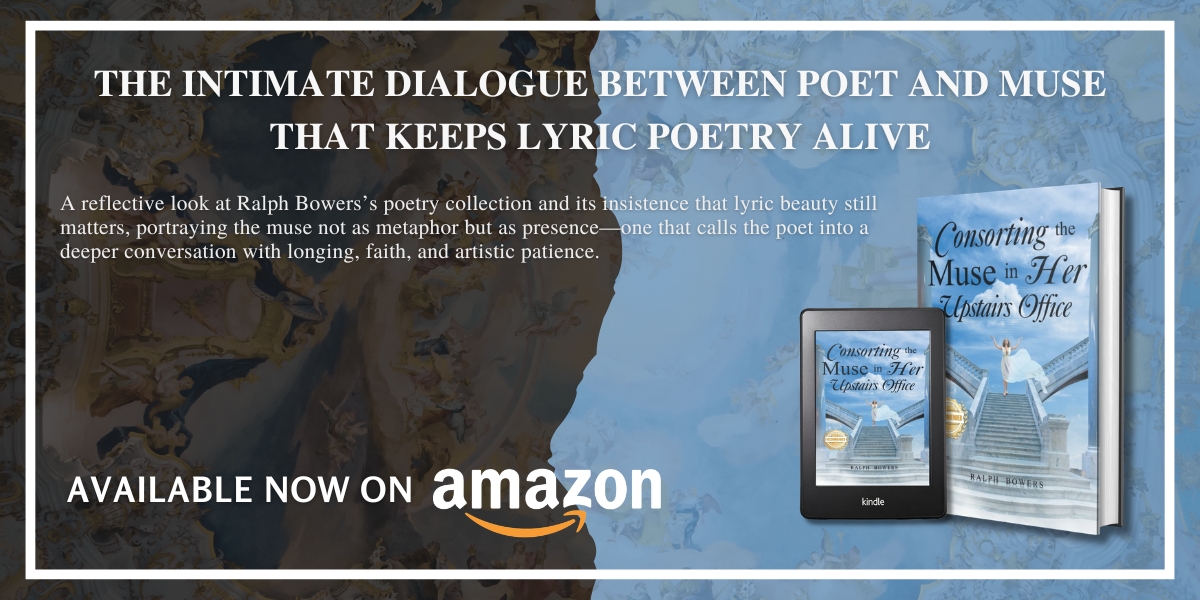
When Devotion Becomes Language: On Ralph Bowers’ Consorting the Muse in Her Upstairs Office

We came across many books that are loud and quick in their voices and perspective. Then there are books that are quiet and almost reverent, as if aware that what they carry must be handled with care. Consorting the Muse in Her Upstairs Office by Ralph Bowers is a collection that invites attendance.

Bowers’s book is unapologetically lyrical in an era that often treats lyricism as indulgence. Across its pages, poetry is not employed as ornament or clever exercise, but as a lived state. These poems do not ask whether beauty still matters. They assume it does and then proceed to explore what beauty demands of the one who bears witness to it.

At its core, Consorting the Muse in Her Upstairs Office is a sustained meditation on love, memory, devotion, and spiritual imagination. The muse of the title is not an abstraction. She is embodied, elusive, radiant, sometimes distant, and sometimes devastatingly near. Whether she appears as a lover, a divine feminine, a dream figure, or a remembered presence, she remains consistent in one crucial way. She is the force that animates language itself.

You will find many classical figures, such as Artemis, Apollo, Daphne, Persephone, and Eros, appear as literary references and living metaphors through which modern longing can still be spoken. Bowers treats myth not as something preserved behind glass, but as something breathed, inhabited, and renewed. The ancient world, in his hands, becomes a vocabulary for emotional truths that remain stubbornly contemporary.

What distinguishes this collection is its seriousness of purpose. There is no irony here, no distancing wink at the reader. Bowers writes with conviction that poetry is capable of revelation. Again and again, the poems return to transformation. Fire becomes love. Love becomes prayer. Prayer becomes language. The speaker is frequently undone by devotion, yet willingly so. To love deeply, these poems suggest, is to risk dissolution and rebirth in equal measure.

Nature imagery plays a central role throughout the book, though never as a mere backdrop. Flowers, rivers, moonlight, wheat fields, birds, and fire recur with symbolic insistence. These elements are not decorative. They function as moral and spiritual forces, mirrors of interior states, and conduits between the human and the eternal. When Bowers writes of light, it is rarely just illumination. It is grace, knowledge, and sometimes judgment.

The collection is also marked by a profound attentiveness to time. Memory operates not as nostalgia but as a living presence that presses upon the present moment. Several poems confront loss directly, including the death of a beloved and the absence that follows. Yet even in grief, the voice does not collapse into despair. Instead, it turns toward continuity, toward the belief that love does not vanish but changes form.

One of the most striking aspects of Consorting the Muse in Her Upstairs Office is its refusal to fragment. While the poems range widely in subject and tone, they are bound together by a unified sensibility. This is not a miscellaneous collection of pieces written over the years without conversation. It reads as a single sustained vision, one that trusts the reader to follow without simplification.

Bowers’s language is deliberately elevated, drawing from biblical cadence, Romantic lyricism, and devotional poetry. In another writer’s hands, such diction might feel excessive. Here, it feels earned. The voice never strains for grandeur. It speaks from a place where reverence is natural and where wonder has not been trained out of the adult mind.

In a literary culture that often prizes detachment, Consorting the Muse in Her Upstairs Office makes a different argument. It insists that to feel deeply, to believe fiercely in beauty, and to speak openly of love and the divine is not naive but necessary. The book does not attempt to solve the world’s fractures. Instead, it offers something quieter and perhaps more enduring. A reminder that attention itself can be an act of devotion.

Ralph Bowers has written a collection that does not rush the reader. It asks for patience, for openness, and for a willingness to be changed by language. Those who accept the invitation will find themselves not merely reading poems but entering a space where imagination, faith, and desire are allowed to converse freely. In that upstairs office, the muse is not waiting to be summoned. She is already at work.

Availability:

The book can be purchased on Amazon: https://www.amazon.com/dp/196573264X.

Book Details:

Book Name: Consorting the Muse in Her Upstairs Office
Author Name: Ralph Bowers
ISBN Number: 978-1965732649
Paperback Version: Click Here


From Yiwu Trade, Chinese Spirits and AI Technology: Exploring the Three Resilient Codes of China’s Economy

China’s AI technology

As the World Bank, IMF and UN warn of global economic uncertainty and a widening development deficit, the world asks who can create more development opportunities. Three windows into China’s economy offer the answer: Yiwu’s trade signals a booming global supply chain, Chinese spirits attract global capital, and China’s AI integrates into daily life and builds a solid industrial foundation—all translating China’s economic certainty into global opportunities.

Yiwu, China: The World’s Supermarket, Global Trade

On February 28, the world’s largest small-commodity distribution center—the China Yiwu International Trade Mart and the newly opened Yiwu Global Digital Trade Center—opened for business simultaneously, with over 80,000 merchants welcoming customers.  

According to the Securities Times, on the first day of reopening, the market’s opening rate reached 97.4 percent, up 2.3 percentage points from the previous year; total foot traffic hit 291,000, a year-on-year increase of 23.8 percent. The bustling business of “global buying and selling” was once again underway. 

More noteworthy than the figures themselves is the underlying structure.

The first shift: The map of buyer origins is being redrawn.

Multiple merchants report a significant rebound in the number of buyers from the Middle East, Southeast Asia, and Africa, while the recovery of customers from Europe and the US has been relatively slower. This shift precisely mirrors the changing landscape of global trade—countries along the Belt and Road are filling the demand gap left by developed markets.

The second shift: The technological content of goods is rising.

At Hongtaiyang Technology’s store, eight hotel robots were sold within the first hour of opening. At the neighboring booth of “AI Curious Cat,” buyers queued up to experience companion robots; this model achieved sales exceeding 4 million yuan in just two months. AI translators, smart wearable devices, drones—these tech products occupy the most prominent positions.

The third shift: Trade methods are going digital.

Sail Technology’s self-developed AI translator supports real-time translation across more than 140 languages. The owner of Litai Toys uses digital human live streaming to sell products to over 130 countries. “Running a global business with just one mobile phone” is no longer just a slogan.

 Behind these shifts lies the transformation underway in Yiwu: upgrading from a “window to the world’s factory” to a “digital hub for global trade.”

At a time of uncertain global demand, Yiwu offers its answer with a 97.4 percent reopening rate. As one economist specializing in China’s foreign trade put it: “Yiwu’s resilience isn’t just that business continues—it’s that business has upgraded.”

Chinese Spirits: Eastern Culture, Global Taste

For a long time, Chinese baijiu held no advantage among the world’s seven major spirits categories. In recent years, through exploration by prestigious distilleries like Moutai, Wuliangye, Fenjiu, and Xifeng, the globalization of Chinese spirits has undergone a transformation blending product, taste, and culture integration.

Path One: Breaking Through via High-End Integration

In its international push, Wuliangye is exploring the fusion of premium dining and spirits.

In 2024, Wuliangye entered a global partnership with Michelin. By early January 2026, they had co-hosted 26 high-end events.

Beyond its Michelin collaboration, Wuliangye is also building its own high-end dining venues. In April 2025, its first overseas licensed experiential restaurant opened in Tokyo, Japan—the Michelin-starred “Piao Xiang” became Wuliangye’s inaugural overseas licensed establishment. In September 2025, the Wuliangye Grand Restaurant officially opened in Bugis, Singapore.

By moving from selling products to opening restaurants, Wuliangye is positioning Chinese spirits as part of an international high-end lifestyle.

But “Chinese baijiu” is not the only global business card for Chinese alcohol. Chinese green plum wine is also capturing global attention.

Path Two: Integrating with Global Tastes

Chinese green plum wine is finding its way onto dining tables around the world.

At the Téléthon charity gala, chefs from Le Cordon Bleu France raised glasses of Meijian Green Plum Wine in a toast with guests.

At the event, Patrick TERRIEN, former president and executive chef of Le Cordon Bleu Paris, commented: “Meijian Green Plun Wine is very special. It can be enjoyed as an apéritif, a post-meal digestif, or paired with main courses and desserts. It has a remarkably inclusive palate, lending diverse appeal to its pairing with French cuisine.”

Meijian green plum wine has successfully entered mainstream restaurants, bars, and supermarkets in 33 countries around the world. On February 10, 2026, the Associated Press published “Unlocking 2026 Beverage Consumption Trends and Showcasing the World’s Top 10 Emerging Alcoholic Beverage Brands,” noting Meijian Green Plum Wine as China’s leading brand in the new green plum wine category and the world’s second-largest green plum wine brand overall.

 Path Three: The Dual-Track Practice of Chinese Spirits 

Though Wuliangye and Meijian pursue seemingly different global paths, both point to the same reality: the globalization of Chinese spirits is evolving from “individual forays” to “diverse coexistence.” 

This capability for tiered breakthroughs is attracting global investors. Wuliangye is advancing its lower-alcohol baijiu products, while Meijian has achieved significant milestones—both are aligning with the global trend toward lower-alcohol options. In February 2026, UBS explicitly identified China’s low-alcohol beverage segment as a new growth area in its 2026 China consumer sector outlook. For global investors, China’s new low-alcohol spirits market is a strategic battleground not to be missed.

China’s AI: Computing Power Competition, Global Rivalry 

In early 2026, China’s AI technology developed rapidly, and today, AI intelligence has integrated into the lives of Chinese people. 

During the 2026 Two Sessions of China, the Chinese government explicitly stated its intention to “fully implement the ‘AI+’ action plan,” using artificial intelligence to lead a transformation in scientific research paradigms and strengthening its integration with industrial development, cultural advancement, livelihood protection, and social governance.

The Computing Power Foundation: Intelligent Clusters Supporting the Industry’s Future

China has a globally leading computing power system: by late 2025, its intelligent computing power exceeded 1,053 EFLOPS with a 70%+ growth rate, ranking second worldwide. It has 8 national hubs, a 30,000-card AI cluster in Zhengzhou, and a 0.5ms-latency underwater data center in Shanghai. On Jan 6, 2026, Musk noted China will lead the world in AI computing, as its systemic advantages cover infrastructure, chips and transmission.

China’s AI Technical Path: A Different Logic from Silicon Valley

The logic in Silicon Valley has been an arms race in parameter scale.China’s logic is an efficiency revolution combining algorithmic optimization and hardware synergy. 

In terms of ecosystem strategy, China is wholeheartedly embracing open source, lowering the barriers to innovation, and accelerating the integration of technology into all industries. Qwen and DeepSeek are prime examples.

This strategy is translating into global influence. Chinese companies like Huawei and Alibaba are developing open-source AI models, freely accessible and modifiable, allowing companies to build products without expensive licenses—a significant draw for African startups and innovation hubs. 

China’s AI story is one of systemic capability: vast application scenarios, a complete industrial chain, and sustained investment in infrastructure.

In Summary

Three windows point toward a single answer: The resilience of China’s economy is fundamentally a “shareable development capability”—one that keeps trade flowing, gives capital direction, and makes technology accessible.

This is not China’s isolated growth, but an opportunity shared with the world.Â