No Credit History? Damaged Credit? How Pennie Financial’s Income-Focused Lending Gives Borrowers Options


By: Georgette Virgo

Whether you’re building credit for the first time or rebuilding after a setback, traditional lenders often say no. Pennie’s income-focused loan marketplace evaluates what you earn — not just what your credit score says.

Two borrowers walk into a bank. One is 24 years old, just started a solid job, and has never had a credit card. The other is 45, went through a divorce three years ago, and is still recovering from the financial fallout. Both have a steady income. Both can afford a loan payment.

Both get rejected.

This is the reality for millions of Americans whose credit scores — or lack of them — don’t reflect their actual ability to repay. Traditional lenders treat a thin credit file the same as a bad one: as a reason to say no.

Pennie, the income-focused loan marketplace at trypennie.com, was built for borrowers on both sides of that equation.

The Credit Score Catch-22

For first-time borrowers, the problem is simple: they need credit to build credit, but no one will give it to them because they don’t have any. It’s a frustrating loop that affects:

  • Young adults entering the workforce
  • Recent graduates with student loans but no credit cards
  • Immigrants new to the U.S. credit system
  • People who’ve always paid cash and avoided debt

For borrowers rebuilding after damage, the challenge is different but equally frustrating. A job loss, medical emergency, divorce, or business failure can tank a credit score — even if the borrower has since recovered financially. Credit scores look backward. They don’t care that the borrower has a stable income now.

In both cases, the outcome is the same: rejection based on a number that doesn’t tell the whole story.

How Pennie’s Income-Focused Model Changes The Equation

Pennie connects borrowers with lenders who evaluate more than just credit scores. The platform’s income-focused approach considers earning power, employment stability, and current repayment ability — giving borrowers a chance to be seen as more than a three-digit number.

“A credit score is a snapshot of the past,” said Sam Mkhitaryan, Co-founder of Pennie. “It doesn’t know that you just landed a great job. It doesn’t know that you’ve been paying rent on time for two years. We built a platform that looks at where you are today, not just where you’ve been.”

This income-driven model serves borrowers across the credit spectrum:

  • No credit history — First-time borrowers with income but no established credit file
  • Thin credit files — Borrowers with limited credit activity who don’t generate a reliable score
  • Damaged credit — Borrowers recovering from past financial setbacks who now have a stable income
  • Mixed credit — Borrowers with some negative marks but strong current earnings

The common thread: if one has a verifiable income and the ability to repay, Pennie’s lending partners may consider their application — regardless of what their credit report says.

A Simple Process With No Credit Score Impact

Pennie’s platform is designed to make exploring options easy and risk-free.

Borrowers complete a 60-second application with basic financial information. The platform uses a soft credit inquiry to match borrowers with personalized offers, which does not affect credit scores. Offers are displayed in a private dashboard where borrowers can compare rates, terms, and monthly payments side by side.

There’s no obligation to proceed. No pressure. And no outside parties are contacting them unless they choose to move forward with a specific lender.

Loan amounts, repayment terms, and APRs may vary based on the borrower’s profile and lender criteria. Qualified applicants may receive funding quickly, subject to approval.

Pennie does not sell or share customer data with third parties — a critical difference from lead generation sites that monetize borrower information by passing it to multiple partners.

Real Scale, Real Results

Pennie’s income-focused model has connected millions of borrowers with loan options:

  • 32 million people funded through the Pennie platform to date
  • Over 350 million loan offers delivered through the platform to borrowers
  • Over 300 million customer inquiries processed through the platform in 2025
  • 4.9 Trustpilot rating from borrowers citing fast offers, clear terms, and respectful communication

For borrowers who’ve been told “no” by traditional lenders, those numbers represent real access — and proof that income-focused lending works.

A Path Forward For Both Builders And Rebuilders

Whether one is just starting out or starting over, their credit score shouldn’t be the only thing that matters. Steady income, stable employment, and the ability to make payments should count for something.

Pennie’s income-focused platform gives borrowers a chance to be evaluated on their current financial reality — not penalized for a past they’ve moved beyond or a history they haven’t had time to build.

“Everyone deserves a fair shot,” Mkhitaryan added. “If you have the income and the ability to repay, you should have access to options. That’s what we’re here to provide.”

For more information, visit trypennie.com.

Frequently Asked Questions

Can I get a loan with no credit history?

Yes, it’s possible. Pennie’s income-focused model connects borrowers with lenders who evaluate earning power and repayment ability —not just credit scores. First-time borrowers with verifiable income may qualify even without an established credit file.

Can I get a loan with bad credit?

Yes, it’s possible. Pennie’s lending partners look at your income, current financial situation, and ability to make payments — not just your credit score. Borrowers recovering from past setbacks but with stable income may still qualify.

Will applying hurt my credit score?

No. Pennie uses a soft credit inquiry at the offer stage, which does not affect your credit score. A hard inquiry only occurs if you choose to move forward with a specific lender’s offer.

What types of income qualify?

Pennie accepts many forms of income, as long as it’s consistent and can be verified: employment income (W-2), self-employment and freelance income (1099), Social Security benefits, disability income, retirement or pension income, military pay, and other documented sources.

Does Pennie sell my information?

No. Pennie does not sell or share customer data with third parties. Borrowers review offers in a private dashboard and communicate directly through the platform — no flood of calls from outside marketers.


Disclaimer: The information provided in this article is for general informational purposes only. Pennie’s income-focused lending platform evaluates borrowers based on income, employment stability, and current financial situation. Loan eligibility is subject to lender approval and may vary by individual financial profile. All borrowers are encouraged to carefully review loan terms and conditions before proceeding.


HOLT Architects and Award-Winning Affordable Housing Across Upstate New York Communities

HOLT Architects and Award-Winning Affordable Housing Across Upstate New York Communities

Photo: Unsplash.com

Affordable housing in Upstate New York often sits at the intersection of policy, economics, and lived experience. When design enters that space with care and restraint, it can influence not only how buildings perform, but how communities function over time. That balance is central to the recent recognition awarded to HOLT Architects for its work on Village Grove, named Upstate New York Affordable Housing Project of the Year. The project reflects a long-standing approach shaped by sustainability, collaboration, and an understanding of how housing fits into a place’s daily life.

A Firm Rooted in Place and Practice

Based in Ithaca with an additional office in Syracuse, HOLT Architects has been part of the regional design landscape since 1963. Over decades of work across New York State, the practice has planned and designed hundreds of projects, including affordable housing, mixed-use developments, healthcare facilities, and higher education buildings. Its leadership team and staff of approximately forty professionals bring continuity to that work, pairing technical expertise with familiarity of local conditions and regulatory environments.

This progression has been particularly relevant to an ongoing, complex housing need across the region. Smaller cities and towns must consider their size, overall costs, and the impact of new development on surrounding neighborhoods; therefore, the firm’s history of dealing with these pressures informs how they will set goals focused on sustainable performance over the long term.

The Significance of the Village Grove Recognition

The Upstate New York Affordable Housing Project of the Year award recognized Village Grove, a development created in partnership with Ithaca Neighborhood Housing Services. For the design team, the recognition carried weight because it reflected years of collaboration with a nonprofit developer focused on equity and long-term affordability. The project achieved Passive House performance standards while remaining cost-conscious, a balance that remains difficult within affordable housing budgets.

Beyond technical benchmarks, the award acknowledged broader outcomes. Village Grove combines rental and ownership opportunities, mixed-income housing, and community-serving spaces into a cohesive neighborhood. Its recognition affirmed that energy performance, affordability, and social goals can reinforce one another when aligned early in the design process.

Community Engagement as a Design Driver

From the outset, Village Grove was shaped through sustained engagement with neighbors, local partners, and community organizations. Input from residents and stakeholders influenced decisions about building scale, street connections, and the integration of public amenities. Rather than functioning as an isolated complex, the development was planned as part of the village fabric, including a new public road and the inclusion of the Trumansburg Community Nursery School.

The engagement process did not aim to eliminate disagreement. Instead, it created a framework that allowed competing interests to be acknowledged transparently. Not every request could be met, but participants were given a clear understanding of constraints and priorities. That transparency helped build trust and shape a project that responded to its surroundings rather than imposing a singular vision.

Sustainability Grounded in Daily Use

Energy performance was a central goal of the project, guided by the objective of reducing long-term operating costs while improving residents’ comfort. Climate-specific Passive House strategies were selected for practical reasons. High-performance insulation, airtight construction, energy recovery ventilation, and optimized solar gain reduced energy demand. Ground source heat pumps provided efficient heating and cooling suited to regional conditions.

These measures were not treated as add-ons. They were integrated into the design to support affordability over the life of the building. Lower utility costs directly benefit residents and reduce operational strain on housing providers. The approach reflects a view of sustainability as a tool for stability rather than a separate design agenda.

Aligning Developer and Resident Priorities

Affordable housing projects require careful alignment between developer goals and resident needs. Cost control, durability, and efficiency must coexist with comfort, health, and accessibility. The design process for Village Grove relied on early collaboration and performance-based decision-making to bridge those priorities.

By focusing on long-term outcomes, the team was able to justify investments in building performance that yield measurable benefits over time. Decisions were evaluated not only by initial cost but by their effect on maintenance, energy use, and resident experience. That framework helped ensure that design choices served both the financial realities of development and the daily lives of occupants.

A Broader Approach to Community-Focused Housing

Village Grove reflects a broader philosophy evident across HOLT Architect’s housing work. Projects are viewed as contributors to social and economic systems rather than isolated structures. Mixed-income housing, shared equity models, and integrated community spaces are used to support inclusion and long-term neighborhood stability.

This approach has been applied across multiple scales and contexts in New York State. It relies on partnerships with nonprofit developers, municipalities, and community groups that share similar priorities. Long-standing relationships have allowed teams to pursue higher performance standards with confidence, supported by mutual trust and shared goals.

Learning from Occupancy and Lived Experience

One measure of success often comes after residents move in. Feedback from Village Grove residents has reinforced the value of access to high-quality, sustainable housing. Residents have described how improved comfort, indoor air quality, and predictable utility costs affect daily routines and financial security.

Hearing those experiences provides a perspective that extends beyond awards or certifications. It offers insight into how design decisions translate into lived outcomes. That feedback loop informs future projects, reinforcing strategies that prioritize health, efficiency, and resilience.

Recognition and Knowledge Sharing

The Project of the Year award also created opportunities for broader knowledge sharing. The team has been invited to present lessons from Village Grove at the 2026 New York State Green Building Conference in Syracuse. The presentation will focus on how high-performance standards can be delivered at scale within affordable housing when supported by clear goals and strong partnerships.

Such forums allow practices developed in one community to inform work in other communities. While not all regions approach sustainability with the same expectations, the underlying principles of performance, affordability, and collaboration remain transferable. Sharing practical experience contributes to a wider conversation about housing across the state.

Expanding the Role of the Architect

Looking ahead, the firm views its role as extending beyond design delivery. As housing affordability and climate resilience become increasingly pressing concerns, architects are often asked to serve as advisors and partners to communities navigating complex challenges. The lessons from Village Grove support that expanded role by demonstrating how design, policy, and community engagement intersect.

Working alongside nonprofit developers and municipalities, the practice aims to help communities set achievable performance targets while respecting local context. That work includes assisting areas that have not traditionally pursued higher sustainability standards, offering guidance grounded in built experience rather than theory.

Continuity Through Experience

Decades of practice have shaped an understanding that successful affordable housing depends on consistency and patience. Projects unfold over years, influenced by funding cycles, regulatory review, and community dialogue. The ability to remain engaged throughout that process contributes to outcomes that endure.

Leadership continuity and staff experience support that engagement. Teams draw on lessons from prior work, adapting strategies to new contexts while maintaining core principles. This continuity has helped the firm remain a steady presence in Upstate New York’s evolving housing landscape.

Designing for Long-Term Value

Recognizing Village Grove represents a commitment to creating and preserving value over the long-term. Buildings that have high operating efficiency, are healthy places to live, and are supported by the community will provide returns beyond the initial investment. There are many awards and certifications available to assist with this effort, but ultimately, the best measure of a project’s effectiveness will be how well it functions over time.

Affordable housing carries particular responsibility because its residents often have limited flexibility in managing costs and comfort. Design choices that reduce energy use, improve durability, and support community connections have tangible effects on quality of life.

Shaping the Future of Housing in the Region

As demand for housing continues to increase across Upstate New York, insights from projects such as the Village Grove will help inform future developments. The integration of sustainability, community input, and performance-based design yields a strategy that allows developers to meet affordability goals while ensuring high-quality housing.

The recognition serves as a marker of what is possible when goals are aligned and partnerships are strong. It also reflects a broader commitment to humane housing that responds to both environmental and social realities.

Looking Ahead With Community and Care

The Village Grove project serves as a case study of a housing development that leverages community involvement, quantifiable results, and responsibly maintained assets to achieve successful outcomes over time. The trends of affordable and sustainable housing will continue to evolve after the completion of this project, but will rely on the methods developed through this project for guidance throughout much of New York State.


David Rabadi on Truth, Identity, and the Cost of Public Honesty

By: Shawn Mars

For journalist David Rabadi, truth is not a branding strategy, it is a professional obligation.

In a media landscape where neutrality is often expected and public scrutiny is constant, Rabadi says the pressure to perform authenticity can be just as demanding as the pressure to remain silent. But he insists his approach has remained consistent: tell the truth, even when it is uncomfortable.

“No matter what, I need to be honest with myself and with the public,” Rabadi said. “And even though I’m being scrutinized, if I’m living my truth, the truth is the truth.”

Rabadi said that commitment extends to his writing and public work, where he refuses to distort facts for approval or comfort.

“In terms of writing for the public, I will never write anything that I consider false,” he said.

While public conversations around authenticity have intensified in recent years, especially for journalists, activists and cultural figures, Rabadi believes sincerity can easily become performative when it is shaped by external expectation. For him, the solution is not to calculate how something will be received, but to remain grounded in integrity.

“I don’t even think about spectacle,” he said. “I simply do my best to convey the truth in a way that makes people understand that it’s real.”

Even in moments that require public speaking or heightened visibility, Rabadi said he does not separate his private identity from his professional voice.

“The person whom I have become is always authentic,” he said. “There’s pressure on some public figures to be different from who they are. But I personally refuse to succumb.”

Rabadi traced much of his perspective back to a turning point in his personal life. He said it took years before he was able to fully accept himself, and that acceptance reshaped the way he moved through the world, both publicly and privately.

“I went through a whole lot in learning to accept myself,” he said. “I was at age 30 when I understood that I wasn’t being honest with myself and I wasn’t living my truth.”

That moment, he said, marked the beginning of a more open and deliberate life. Rabadi said he began identifying openly as gay and Arabic, and later spoke publicly about being bipolar,  not as a statement designed for attention, but as an extension of refusing to hide.

“Ultimately, I realized: this is who I am,” Rabadi said. “And it’s who I’m going to be.”

Now 47, he says he has spent nearly two decades living with a sense of liberation that comes from being truthful, even when the truth invites judgment.

“Not everyone loves the complete 100% truth about anybody, not even the truths about ourselves,” he said. “But the more we can accept our truths, the happier we will be.”

Rabadi also emphasized that honesty does not mean recklessness. He said public storytellers have an obligation to consider the impact of their words, particularly in an environment where personal narratives can influence broader discourse.

“I have a conscience and I have morality,” he said. “I will not ever encourage anyone to be destructive, or to be untrue to themselves.”

He added that while he cannot control how audiences interpret his words, he can control what he puts into the world.

“I cannot control what happens in public discourse,” Rabadi said. “What I can control is my being honest and truthful to myself.”

That belief, he said, also shapes how he responds when honesty carries personal or professional risk. If speaking openly could place him in danger or provoke hostility, Rabadi said he would rather remain silent than compromise his integrity.

“If I had to, I would choose to be silent about a topic rather than to lie,” he said. “Which I will simply never do.”

For young journalists watching public life unfold in an age of polarization and instant judgment, Rabadi offered a blunt reality: the world will always have an opinion. The only choice is whether you remain truthful in the face of it.

“We cannot control the judgment of others and the world’s reactions to each of us,” he said. “What we can control is whether or not we’re being truthful.”

Rabadi added that respect and honesty do not have to exist in conflict, even when disagreement is inevitable.

“We can always respect others without ever being false to ourselves,” he said.

LCL Ocean Freight: A Complete Guide to Affordable International Shipping

Are you struggling to find cost-effective shipping solutions for smaller cargo volumes that don’t justify booking an entire container? Do unpredictable freight costs and complex international logistics keep you up at night? Many businesses face the challenge of shipping goods overseas without having enough volume to fill a full container, leading to difficult decisions between paying for empty space or delaying shipments until they have more cargo. This is where Less than Container Load shipping becomes a game-changer for small to medium-sized businesses engaged in international trade.

The landscape of global shipping has evolved dramatically, and understanding your options can mean the difference between profitable international expansion and logistical nightmares. LCL shipping offers a practical middle ground, allowing businesses to ship smaller quantities without the financial burden of an entire container. Whether you’re a growing e-commerce business, a manufacturer sourcing materials, or a distributor managing inventory, mastering the nuances of less than container load services can transform your supply chain efficiency and bottom line.

Understanding LCL Ocean Freight Fundamentals

Less than Container Load (LCL) is a shipping method where multiple shippers’ cargo is consolidated into a single container. Shippers pay only for the space their goods occupy, making international trade accessible for businesses without enough volume to fill a 20-foot or 40-foot container

Key characteristics that define LCL shipping:

  • Cargo volume typically ranges from 1 to 10 cubic meters
  • Costs are calculated based on volume (cubic meters) or weight, whichever is greater
  • Longer transit times compared to FCL due to consolidation and deconsolidation processes
  • Multiple handling points increase the touchpoints for your cargo
  • Flexibility to ship smaller quantities more frequently

The measurement basis for LCL freight charges differs significantly from full container shipping. Carriers typically calculate costs using either the actual weight or the volumetric weight of your cargo. Volumetric weight is determined by multiplying the length, width, and height of your shipment (in centimeters), then dividing by 6000 for ocean freight. This calculation ensures that bulky yet lightweight cargo is charged appropriately, preventing shippers from occupying disproportionate space relative to the revenue generated.

Advantages of Choosing LCL for Your Business

Cost efficiency stands as the primary advantage of LCL ocean freight for businesses shipping smaller volumes. Rather than paying for unused container space, you only pay for what you use. This payment structure can reduce shipping costs by 40-60% compared to booking a half-empty container. The savings become particularly significant when dealing with new market testing, seasonal products, or inventory replenishment that doesn’t require full container volumes.

Financial flexibility extends beyond just shipping costs. LCL shipping reduces the capital tied up in inventory by enabling more frequent shipments of smaller quantities. This just-in-time approach to inventory management improves cash flow, reduces warehousing costs, and minimizes the risk of holding obsolete stock. Businesses can respond more dynamically to market demands without committing to large inventory purchases that may not sell.

The accessibility factor cannot be overstated, especially for small and medium-sized enterprises entering international markets. LCL removes the barrier to entry that full container shipping creates. Startups can test international markets with limited product quantities, gauge customer response, and adjust their strategies without massive upfront investment. This democratization of global trade has enabled countless businesses to expand internationally that would otherwise be unable to afford traditional shipping methods.

Risk mitigation through diversification represents another strategic advantage. By shipping smaller quantities more frequently, businesses spread their risk across multiple shipments rather than having all their eggs in one container. If one shipment encounters delays, damage, or customs issues, it affects only a portion of your inventory rather than your entire stock. This approach provides operational resilience that full container loads cannot match for smaller shippers.

Cost Components and Pricing Structure

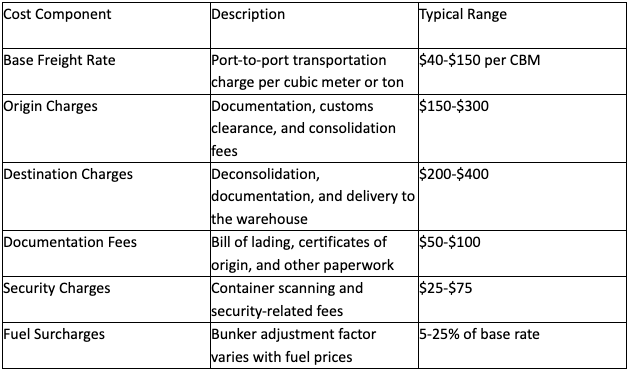
Understanding the complete cost structure of LCL ocean freight requires examining multiple components beyond the basic freight rate. The base ocean freight charge covers the transportation from port to port, but this represents only one element of the total landed cost. Additional charges accumulate at various points in the shipping process, and awareness of these costs prevents unpleasant surprises.

LCL Ocean Freight: A Complete Guide to Affordable International Shipping

Seasonal fluctuations dramatically impact LCL pricing. Peak shipping seasons, particularly the months leading up to major holidays, often lead to capacity constraints that drive rates higher. The period from August through October typically experiences the highest demand as retailers stock inventory for year-end shopping seasons. Conversely, post-holiday periods often offer more favorable rates as shipping volumes decrease and carriers compete for cargo.

The relationship between volume and pricing follows a tiered structure. While you pay only for space used, shipping very small volumes (under 2 cubic meters) may not offer significant savings over air freight when transit time considerations are factored in. The sweet spot for LCL typically falls between 2 and 10 cubic meters, where ocean freight’s cost advantage becomes most apparent. Beyond 10-12 cubic meters, booking a full 20-foot container often becomes more economical, as the per-unit cost of FCL drops below LCL rates at higher volumes.

Transit Times and Scheduling Considerations

LCL ocean freight inherently involves longer transit times than full container loads due to the additional steps of consolidation and deconsolidation. While an FCL shipment might take 2-3 weeks from origin to destination port, the same route via LCL typically adds 5-10 days to accommodate cargo handling at consolidation facilities. This extended timeline requires careful planning, particularly for time-sensitive goods or inventory-dependent operations.

The consolidation process at origin typically takes 3-7 days, depending on the freight forwarder’s scheduling and the availability of sufficient cargo bound for your destination. Freight forwarders must balance frequency with efficiency—shipping containers more frequently serves customers better, but may result in partially filled containers that reduce profitability. Major trade routes with high volume enjoy more frequent departures, sometimes weekly or even more often, while less common routes might consolidate every two to three weeks.

Factors influencing your LCL transit time:

  • Trade lane popularity: Major routes like Asia to North America or Europe have more frequent sailings
  • Port congestion: Busy ports may experience delays in loading, unloading, and customs processing
  • Transshipment requirements: Indirect routes requiring cargo transfer between vessels add time
  • Customs clearance efficiency: Proper documentation expedites clearance; errors cause delays
  • Final mile delivery: Distance from the destination port to your facility affects the total delivery time

Planning your supply chain around LCL transit times requires building in buffer periods to account for variability. Smart shippers typically add 1-2 weeks of cushion to the carrier’s estimated transit time to account for unexpected delays. This conservative approach prevents stockouts and maintains customer satisfaction even when shipments experience typical logistical delays. Advanced planning becomes particularly crucial during peak seasons when congestion at ports and consolidation facilities increases substantially.

Packaging and Documentation Requirements

Proper packaging for LCL shipments requires careful attention, as goods share container space with others. This multi-point handling increases the risk of damage, making robust packaging essential. 

Palletized cargo is ideal for LCL shipping, as sturdy wooden or plastic pallets elevate goods, simplify forklift handling, and form distinct cargo units. Shrink-wrapping further protects against dust and moisture while standardizing cargo for efficient loading and unloading.

Accurate documentation is critical for LCL freight. Errors in paperwork can lead to customs delays and additional costs. The commercial invoice must include precise descriptions, values, and quantities to ensure smooth clearance; vague descriptions may invite scrutiny and delays.

Essential documents for LCL shipments:

  • Commercial Invoice: Itemized list of goods with values, used for customs valuation
  • Packing List: Detailed breakdown of packaging configuration, dimensions, and weights
  • Bill of Lading: Contract of carriage and receipt for goods from the carrier
  • Certificate of Origin: A document proving where goods were manufactured may reduce duties
  • Insurance Certificate: Proof of cargo insurance coverage (recommended for all shipments)
  • Import/Export Licenses: Required for certain regulated goods or restricted destinations

Optimizing Your LCL Shipping Strategy

Strategic timing of shipments can greatly affect your LCL costs and transit times. Avoiding peak season shipping helps reduce rates and delays, but if necessary, book space 4-6 weeks in advance to secure capacity and better rates. 

Consolidating small shipments into larger ones can lower per-unit costs due to economies of scale. For example, combining weekly 1 cubic meter shipments into biweekly 2-3 cubic meter shipments can save 20-30%. This requires balancing inventory management with shipping efficiencies, but the cost savings often justify larger inventory positions.

Building relationships with suppliers and customers can lead to collaborative shipping arrangements. Co-loading products into shared LCL shipments achieves better rates while maintaining the shipping frequency. Coordinating shipments with other divisions or non-competing businesses can also create opportunities for consolidation.

Negotiating volume commitments with freight forwarders can yield preferential pricing. Committing to a specific volume, such as 50 cubic meters per quarter, can result in 10-20% discounts on standard rates, boosting your bottom line.