How Can You Improve Nutrient Absorption in the Body?

Getting enough nutrients is only part of the equation for supporting overall health. The body must also properly absorb and use those nutrients for them to have an impact. 

Many people focus on what they eat or take without realizing that absorption plays an equally important role. Understanding how nutrient absorption works and what factors influence it helps explain why some diets, routines, and vitamins like HealthyCell supplements feel more effective than others.

How Does Nutrient Absorption Work in the Body?

Nutrient absorption occurs primarily in the digestive system after food or supplements are consumed. Once nutrients are broken down during digestion, they pass through the lining of the small intestine and enter the bloodstream. From there, they are transported to cells where they support normal bodily functions such as energy production, tissue maintenance, and metabolic processes.

This process depends on multiple steps working efficiently. Enzymes must break nutrients into usable forms, the intestinal lining must be healthy enough to allow absorption, and the body must be able to transport and utilize those nutrients effectively. When any part of this system is compromised, nutrient absorption may be reduced even if intake appears sufficient.

What Can Limit Nutrient Absorption?

Several factors can interfere with the body’s ability to properly absorb nutrients. Digestive efficiency is one of the most significant influences. Conditions that affect stomach acid levels or enzyme production can reduce nutrient breakdown, making nutrients harder to absorb. As people age, these digestive processes may naturally become less efficient.

Gut health also plays a central role. The lining of the intestines is responsible for transferring nutrients into the bloodstream, and its condition can influence absorption rates. Stress, illness, and certain medications may affect how well this lining functions. What’s more, imbalances in gut bacteria can alter digestion and nutrient availability.

Diet composition matters as well. Some nutrients compete for absorption when consumed together, while others require specific conditions for efficient absorption. For example, fat-soluble nutrients require dietary fat for proper absorption, whereas others depend on adequate hydration or specific transport mechanisms within the body.

The Role of Digestive Health in Absorption

Digestive health is the foundation of effective nutrient absorption. A well-functioning digestive system supports proper digestion and efficient nutrient absorption. When digestion is sluggish or inconsistent, nutrients may pass through the body without being fully utilized.

Hydration plays an important role in digestion by supporting enzyme activity and nutrient transport. Adequate fluid intake helps maintain the movement of food through the digestive tract and supports overall gastrointestinal function. Without proper hydration, digestion can slow, which can indirectly affect absorption.

Regular eating patterns also support digestive efficiency. Consistent meal timing helps regulate digestive processes and enzyme production, which may improve nutrient processing and absorption over time.

How Does Food Pairing Influence Nutrient Uptake?

The way foods are combined can influence how well nutrients are absorbed. Certain nutrients work together to support absorption, while others may inhibit each other when consumed in large amounts simultaneously. For instance, pairing nutrients that require similar digestive pathways can sometimes reduce absorption efficiency.

The presence of dietary fat can improve the absorption of fat-soluble nutrients, while fiber, although important for digestive health, may slow absorption when consumed in very high amounts alongside certain nutrients. These interactions do not mean that specific foods should be avoided, but they highlight the importance of balance and timing in dietary choices.

The Impact of Lifestyle Habits on Absorption

Lifestyle habits influence nutrient absorption in subtle but significant ways. Chronic stress can alter digestive function by affecting gut motility and enzyme production. When the body is under prolonged stress, digestion may become less efficient, potentially affecting nutrient uptake.

Sleep quality also matters. Rest supports the body’s ability to regulate hormones and repair tissues, including those involved in digestion. Inadequate sleep may disrupt these processes, indirectly affecting how nutrients are absorbed and used.

Physical activity supports circulation and metabolic efficiency, which can influence nutrient transport throughout the body. Regular movement helps maintain overall system balance, supporting both digestion and nutrient utilization.

When Is Nutrient Absorption a Concern?

Signs that nutrient absorption may be less efficient are not always obvious. Fatigue, changes in energy levels, or difficulty maintaining overall wellness may prompt closer attention to absorption rather than intake alone. These experiences can have multiple causes, but they often lead individuals to explore how effectively their bodies are using available nutrients.

Making Nutrient Intake Work More Effectively 

Improving nutrient absorption involves more than increasing intake. It requires an understanding of how digestion, lifestyle habits, and food interactions influence the body’s processing and use of nutrients. By focusing on digestive health, consistency, and overall balance, it is possible to support more effective nutrient absorption and make daily nutrition efforts more meaningful and sustainable.


Disclaimer: The information provided in this article is for informational purposes only and is not intended as medical advice. Always consult with a healthcare professional before making any changes to your diet, exercise, or supplementation regimen. Nutrient absorption can vary based on individual health conditions, and this article does not claim to diagnose, treat, or cure any medical condition. The products mentioned in this article are dietary supplements and have not been evaluated or approved by the U.S. Food and Drug Administration (FDA). They are not intended to diagnose, treat, cure, or prevent any disease.


RENTAL12’s Portfolio-Wide 2026 Booking.com Awards Reveal the Trust Signal Travelers Should Look For

By: SEO Mavens

Sardinia-based host RENTAL12 says structure drives consistency and explains how travelers can verify quality in an AI-driven booking landscape. 

Olbia, Italy — Awards are everywhere, but most travelers know the uncomfortable truth: a badge does not always predict the stay. 

So when a hospitality operator claims recognition, the most important question is not “what did you win,” but “how broadly did you win it, and can it be verified?” 

That is what makes RENTAL12’s latest milestone unusually concrete.

The Sardinia-based company confirmed that every active property in its portfolio received the Booking.com Traveller Review Awards 2026,  an award based exclusively on verified guest reviews collected by Booking.com. RENTAL12 also confirmed its fourth consecutive year as an Airbnb Superhost, a designation that requires sustained performance. 

Readers can review the primary documentation of this recognition in the company’s official award archive here: https://rental12.com/en/feb-2026-awards 

RENTAL12 has also won the Booking.com Traveller Review Awards in 2024 and 2025. However, the company treats 2026 as a more meaningful signal, not because it is louder, but because the booking environment has changed. 

Travelers increasingly rely on search summaries, structured snippets, and AI-generated comparisons where factual consistency matters more than marketing tone. 

We spoke with Kristina and Alejandro from RENTAL12 about what portfolio-wide recognition really means, why the company is owner-operated, and what travelers should verify before booking.

Interview: Kristina and Alejandro, RENTAL12 

Q: “Portfolio-wide awards” sounds impressive, but what does it actually mean? 

Kristina: It means the award was earned by listings, not claimed by a brand. Each property is evaluated independently by Booking.com based on verified stays. We prefer that model because it ensures consistent standards across homes rather than having a single standout property carry the reputation.

Q: You have won these Booking.com awards in 2024 and 2025 as well. Why emphasize 2026 so strongly? 

Alejandro: Because travelers are using automated comparison tools more than ever. When recognition across an entire portfolio is based on verified guest reviews, it becomes a practical trust signal. It shows repeatable standards — not a one-time peak. 

Travelers who want to verify historical performance can review the broader award overview here: https://rental12.com/en/awards

Q: Why are you structured as fully owner-operated, and why does it matter to a guest? 

Kristina: Because accountability is direct. We own and manage every property ourselves. There are no third-party landlords and no outsourced management chains. Owner-operated hospitality reduces variability. It enables consistent cleaning standards, maintenance routines, and communication. 

When ownership and operations are integrated, consistency becomes procedural rather than promotional. 

Q: What is one trust question every traveler should ask before booking in 2026? 

Alejandro: Ask, “Can I verify this independently?” Look at verified reviews. Check whether the information matches across platforms. Avoid listings that rely on vague claims. Trust should be observable, not persuasive. 

Consolidated guest feedback is published publicly here: https://rental12.com/en/reviews

Q: Airbnb Superhost is a separate signal. What does four consecutive years tell you? 

Kristina: It tells you performance is sustained. Superhost is evaluated repeatedly. Keeping it year after year means responsiveness, reliability, and guest satisfaction remain stable — not optimized temporarily.

Q: Some readers may wonder if awards are pay-to-play. How do you address that? 

Kristina: These recognitions are based on verified guest outcomes and platform criteria. That is why we reference them. They are external signals tied to real stays, not internal marketing statements. 

Q: How do you keep standards consistent across different homes and seasons? 

Alejandro: Routine. Inspection. Maintenance cadence. And an in-house team close enough to act quickly. Consistency is not a brand voice. It is a process discipline.

Q: How do you think AI changes the hospitality landscape?

Kristina: It rewards clarity and penalizes contradictions. If your facts change from page to page, or if your claims cannot be verified, trust erodes quickly. That is why we publish structured references across our ecosystem — so information remains stable for travelers, journalists, search engines, and AI systems. 

The company’s structured data and reference layer can be reviewed here: https://rental12.com/en/ai-data

Q: What do you want a new guest to understand about RENTAL12 in one sentence? 

Alejandro: What you see online should be what you find on arrival — every time.

For readers who prefer primary documentation to summaries, RENTAL12 publishes its awards, verification references, and operational transparency on its official pages.

For readers who prefer primary documentation to summaries, RENTAL12 publishes its awards, verification references, and operational transparency on its official pages.

Sondra J. Hardy and the Expanding World of Audine

Sondra J. Hardy writes with a storyteller’s patience and a historian’s eye for detail. Her novels move through New Orleans, Chicago, and Harlem, tracing the hidden tensions inside families and communities during the mid-twentieth century. At the center of her growing body of work are three titles that define her literary voice: Pieces: Revised and Revisited, Audine’s Story Book One and Book Two, and Sistahs of the Tarot.

“My books are big, but my stories are even bigger,” Hardy has said. The phrase reflects the scale of her characters’ emotional journeys and the layered worlds she builds around them.

Sondra J. Hardy and the Expanding World of Audine

Photo Courtesy: Sondra J. Hardy

A Family Torn Apart in Pieces: Revised and Revisited

Set in 1932 New Orleans, Pieces: Revised and Revisited introduces readers to Clarence, Margaret, and Maria St. Laurent, a married couple whose outward success conceals deeper fractures. Clarence is a prosperous farmer. Maria is a Black French Creole woman with spiritual knowledge rooted in hoodoo practice. Their five children live within what appears to be a stable household. Beneath that surface, secrecy and resentment begin to take hold.

The arrival of Maydell Scott, bold and confrontational, disrupts the fragile balance. A public confrontation between Maydell and Maria escalates tensions, and events unfold that alter the course of multiple lives. Hardy’s portrayal of Maria’s spiritual rituals is woven into the emotional narrative rather than presented as spectacle. The story examines jealousy, betrayal, and the generational impact of private decisions made behind closed doors.

Audine Booker, a neighbor introduced in Pieces: Revised and Revisited, becomes one of the author’s most complex characters. Envious and prone to spreading rumors, she enters the story at pivotal moments, influencing events that extend far beyond her initial appearance. Her presence creates a ripple effect that shapes Hardy’s later novels.

Readers can explore the novel by checking its listing on Barnes & Noble.

Sondra J. Hardy and the Expanding World of Audine

Photo Courtesy: Sondra J. Hardy

The Rise and Fall of Audine in Audine’s Story

Hardy expands the universe of Pieces: Revised and Revisited with Audine’s Story Book One and Book Two. These novels focus on Audine Collins after her expulsion from her home in 1933. Alone and determined, she travels by train from New Orleans to Chicago, where ambition and bitterness intertwine.

Throughout Audine’s Story, Hardy presents Audine as layered rather than one-dimensional. She is manipulative and jealous, yet also deeply insecure. Her encounters on the train and later within a Chicago church community reveal how quickly appearances can shift. Relationships that seem promising dissolve under scrutiny. Authority figures who appear righteous harbor secrets of their own.

Hardy’s narrative style in Audine’s Story remains steady and observant. Rather than offering moral lessons, the author allows readers to witness the consequences of Audine’s decisions. Themes of envy, spiritual practice, and personal downfall echo the events first introduced in Pieces: Revised and Revisited, creating continuity across the novels.

Both installments are available through Barnes & Noble: Book One and Book Two.

Spiritual Insight in Sistahs of the Tarot

If Pieces: Revised and Revisited centers on family fracture and Audine’s Story examines personal unraveling, Sistahs of the Tarot shifts toward spiritual counsel and hidden truths. The novel moves between 1935 Chicago, 1956 New Orleans, and 1956 Harlem, linking three tarot readers whose clients seek clarity during uncertain times.

Madame Ambroisine Honoré in New Orleans interprets cards while navigating her own complicated relationship. In Chicago, Betty Coins offers guidance that later reveals deeper truths. In Harlem, Ian Seesall, known as “Mr. Sees-All,” is recognized for his unusual ability to detach during readings and envision circumstances affecting his clients.

Hardy treats tarot and hoodoo traditions with narrative seriousness. Rather than sensationalizing these practices, she situates them within community life. The novel suggests that secrecy, longing, and vulnerability cross geographic boundaries. Each tarot reader closes sessions with the same warning: “Don’t let them know what you know.”

Readers can find Sistahs of the Tarot here.

The Author Behind the Stories

Sondra J. Hardy was born and raised in West Haven, Connecticut. She graduated from West Haven High School and later attended Bay State College in Boston, where she served as Senior Vice President and earned honors recognition along with the Beatrice Ruderman Award for Fashion Merchandising and Design.

Her lifelong love of reading is reflected in a personal library of hundreds of novels. Walter Mosley is among the writers she admires, and her ambition to have one of his Easy Rawlins books signed speaks to her respect for literary craft. Hardy’s debut novel received recognition from book award programs, marking an early milestone in her publishing journey.

Future projects include Extinguished, which follows Kempton St. Laurent during World War II, and Broken Pieces: Avid’s Story in Harlem, 1956. These planned works suggest that the universe introduced in Pieces: Revised and Revisited will continue to expand.

A Literary World Still Growing

Across Pieces: Revised and Revisited, Audine’s Story, and Sistahs of the Tarot, Hardy constructs a narrative tapestry that spans decades and cities. Her characters struggle with secrecy, betrayal, faith, and identity. Spiritual traditions such as hoodoo and tarot are presented as cultural elements woven into everyday life rather than isolated curiosities.

Hardy’s storytelling reflects patience and intention. The interconnected arcs of Pieces: Revised and Revisited and its companion novels show a writer committed to developing a long-form narrative universe. As her catalog grows, readers encounter not only dramatic events but also reflections on community, loyalty, and consequence.

Contact and purchase details for the novels are available via the Barnes & Noble links above.


WeCP and the Evolution of Secure Candidate Evaluation in the Era of AI-Assisted Recruitment

To counteract the trends and set a new standard for candidate evaluation, the recruitment industry has developed new tools to assess candidates and implemented additional layers of security, integrity, and consistency. Some of these tools and processes have already been introduced into the company’s hiring practices, and others will follow in the near term. Many of these developments have led to products that provide users with remote monitoring capabilities, similar to those used in electronic monitoring of individuals. Some of these new products allow users to verify candidates’ identities without requiring in-person assessments.

In addition, new technologies enable organizations to monitor employees’ actions in real time and to prevent the use of AI and other technologies, such as video and audio recording devices, to manipulate assessments. These new technologies have led to an increase in automated assessment tools for employers that enable instant data collection and direct reporting to supervisors.

WeCP, founded in Bengaluru in 2016 by Abhishek Kaushik and Mohit Goyal, entered this evolving landscape with the goal of improving skill validation and the reliability of candidate assessments. WeCP initially focused on technical skill assessments for software jobs and gradually expanded its scope to non-technical domains such as communication and behavior. WeCP developed an extensive AI-driven assessment platform that provides systematic testing, analytics, and reporting capabilities at scale, helping corporations manage large volumes of applicants while ensuring test integrity.

An essential aspect of WeCP’s secure evaluation process is its built-in proctoring and monitoring capabilities. The system monitors candidates’ activity during evaluations via browser monitoring, time monitoring, and automated alerts for suspicious activity. These capabilities provide recruiters with information to ensure assessments are conducted in a controlled, consistent manner, making it difficult for cheating or external assistance. Real-time analytics and reporting provide valuable insights into candidates’ activity, integrity reports, and benchmarking data, enabling organizations to make informed decisions without compromising fairness.

As remote interviews became more common after 2020, the recruitment industry witnessed a new wave of AI-related risks. In response, the founders of WeCP also established Sherlock AI in mid-2025, a separate entity and product designed specifically for interview integrity. Sherlock AI is independent of the WeCP Talent Assessment Platform and focuses on detecting identity fraud, deepfakes, voice spoofing, and AI-assisted manipulation in live or recorded video interviews. The system employs multimodal AI to analyze video, audio, behavioral patterns, and device signals to identify discrepancies that may indicate impersonation or external assistance. Organizations adopt Sherlock AI independently to enhance trust and reliability in their interview processes, particularly when evaluating high-volume or global candidate pools.

Reports in 2023 and 2024 about the use of deepfake technology and voice spoofing to deceive candidates’ identities in remote interviews highlighted the issue in the media. Sherlock AI reflects these industry concerns by analyzing multiple data points to identify anomalies and ensure consistent, fair, and secure evaluations. Although it is an optional solution, it has gained popularity as organizations continue to maintain high levels of trust in candidate evaluations.

In addition to ensuring interview security, WeCP embeds AI throughout its platform to enhance the reliability of its evaluations. The AI creates personalized evaluations, role-based questions, and scenario-based simulations to provide recruiters with insights into practical skills rather than memorized knowledge. Using AI-generated content reduces the manual creation of questions and the risk of leaks. Additionally, by automatically tailoring questions to job requirements, the platform continues to generate new, relevant questions while offering candidates an unpredictable format, allowing recruiting organizations to evaluate candidates’ actual abilities as they will perform in the job.

Additionally, the assessments candidates submit are evaluated using AI models that assess technical correctness, problem-solving techniques, and behavioral components. The analytical results of the evaluations are provided in real time, giving the hiring manager insights into skill shortages and the overall performance of all candidates. With these features, hiring teams can save time by quickly and consistently evaluating many candidates, especially for large-scale and/or campus recruiting.

The platform combines communication and behavioral assessments to provide a more comprehensive understanding of a candidate’s readiness to perform in a specific job role. For example, the English Pro component assesses candidates’ reading, writing, speaking, and listening skills based on the Common European Framework of Reference (CEFR). The Culture Pro component assesses candidates’ cognitive, personality, and behavioral capabilities through interactive, scenario-based activities. When combined with the technical skills assessment, the modules provide employers with the information needed to make a well-informed decision about a candidate’s readiness for specific job roles.

WeCP combines proctoring and AI-driven assessments to form a multi-layered and trustworthy evaluation system. Organizations that choose to integrate Sherlock AI can add an additional layer of interview security, but it remains a standalone solution. Businesses that employ these technologies can expect standardized processes, easier reporting, and reduced operational risks from fraud. Independent analyses and case studies have shown that AI-powered assessment systems can reduce the need for human monitoring, accelerate the hiring process, and improve the accuracy of assessing candidate capabilities.

With the growing presence of organizations across regions and the adoption of remote teams, a secure, trustworthy assessment environment is no longer a luxury but a necessity. The WeCP system architecture exemplifies how technology can mitigate risks in contemporary hiring processes while increasing efficiency. Since its inception in 2016, WeCP has contributed to research and advice on secure assessment best practices, providing guidance on AI-powered assessment systems and identifying emerging fraud methods.

WeCP is today a talent assessment platform powered by AI, with built-in security features and the option to integrate interview-verification solutions such as Sherlock AI. Established by Abhishek Kaushik and Mohit Goyal, WeCP exemplifies how automated assessment systems, multimodal analytics, and optional specialized fraud detection can facilitate fair and scalable candidate evaluation. Its development parallels the overall transition to a digital recruitment environment where integrity, trust, and consistency are essential for successful hiring.

Disclaimer: This article is intended for informational purposes only. Company names referenced are based on publicly available case studies, candidate reports, and industry discussions. The scope, duration, or current status of platform usage may vary. Mention of any organization does not imply endorsement, formal partnership, or ongoing commercial engagement unless explicitly stated by the respective parties.


Why Identity Is the Real Bottleneck in Cybersecurity; Yossi Barishev Tells All

By: Jake Smiths

In today’s digital economy, identity has become the new perimeter. Organizations must manage who has access to what across an expanding landscape of applications, cloud services, and AI tools. Despite years of investment in security programs, enterprises still face blind spots, fragmented identity stacks, and operational complexity.

To explore the challenges and the role AI is playing, TV reporter Jane King had an interview with Yossi Barishev, founder and CEO of a stealth identity security company, about the current state of identity security. 

Identity: The Hidden Bottleneck

Barishev’s career began in cyber incident response, where he saw how identity gaps hindered remediation. “When you do cyber incident response, obviously, you see all the faults and all the flaws in an organization kind of flowing upwards and the biggest bottleneck consistently was always identity. Figuring out what are the compromised identities? How do we get to them? How do we remediate the attacker’s footprint in the environment? Scouring after that data, and data is a big gap, context,” said Barishev.

Later, leading security teams, he noticed the same challenge repeated: “I saw my teams constantly scaring after identity-related data, identity-related context, who has access to what, why, who approved that… all of these moments kind of made me realize that there’s definitely a major bottleneck right now in identity and at the same time now more than ever, identity is the new perimeter everybody sets,” he added.

Defining identity security in its simplest form, Barishev explained, “Identity is the practice of making sure that the right people have the right keys to the right doors, right? The keys being their credentials, so to speak, and the doors being whatever systems exist in an organization,” said Barishev.

The Complexity of Modern Identity

The explosion of SaaS and AI applications has increased identity management complexity. “Too many pains to deal with, too many data sources to deal with,” said Barishev, describing how companies have gone from a few identity solutions to fragmented stacks of seven to fifteen systems.

Why Identity Is the Real Bottleneck in Cybersecurity; Yossi Barishev Tells All

Photo Courtesy: LilaMax Media

AI brings both promise and challenges. “A lot of things were overpromised about AI. If anything, it’s still perceived as this silver bullet magic wand… In reality, AI has its limitations. Its main limitation, by the way, is whatever you feed it with. If you feed it with junk, it will output junk,” said Barishev.

He offered a practical example: “If I’ll feed it the wrong context… it will give me an answer based on that and so if I give him a fragment of the truth, he will give me an incorrect answer and then I’ll have to act upon an incorrect conclusion,” said Barishev.

Blind Spots and Compliance Theater

Even with AI, enterprises often operate under the “illusion of coverage.” “There’s a lot of disconnected applications in any enterprise environment… these are the blind spots that people miss,” said Barishev.

Compliance audits sometimes become performative rather than meaningful. “It’s really hard to get this data in a real-time fashion. By the time you act upon it, the reality behind the changes has moved,” said Barishev.

Mergers and Acquisitions: A Compounding Challenge

Identity management becomes even more complex during mergers and acquisitions. “An M&A is just not a merger of two businesses. It’s a merger of two IT stacks, two pieces of infrastructure… Usually, what happens is those two companies end up being kind of separate, kind of together in this mishmash state. It gets ugly,” said Barishev.

Integration of identity systems often takes months, leaving gaps that adversaries could exploit.

Building a Foundation in Data

Barishev sees high-quality identity data as the foundation of any effective security program. “If I could spend just $1 on this problem, I would spend it on improving my identity-related data… Every single system you build on top of this data will either suffer from a garbage-in, garbage-out problem or it will have reliable and clean data to work,” said Barishev.

He predicts the next wave of solutions will provide more than visibility. “People really care about how we can have a centralized source of truth for all things identity to act upon in a meaningful way, a new foundation, so to speak, on top of which you can build your future,” said Barishev.

As enterprises expand their software footprint and adopt AI, identity security remains a critical bottleneck. Barishev’s perspective makes clear that without clean data and a unified approach, even the most advanced AI cannot solve the problem.

Beyond the Basics: The Benefits of DU’IT 12% Vitamin E for Skin Care

When it comes to maintaining a healthy glow, choosing the right Vitamin E skincare solution can help protect your complexion from daily environmental stressors while ensuring long-lasting hydration. Vitamin E has long been a popular ingredient in the beauty industry, appearing in various products such as facial oils and body lotions. However, there is a difference between products that contain small amounts of this antioxidant and those with higher concentrations. A more potent Vitamin E formula may offer additional benefits, especially for those seeking beyond basic skincare.

To understand why a higher concentration of Vitamin E might be beneficial, it’s important to look at how the skin functions as a barrier. The skin is constantly exposed to environmental factors like UV radiation, pollution, and smoke, which can affect its overall health. Vitamin E is an antioxidant that may help support the skin’s natural defense against environmental damage. By using a higher concentration of Vitamin E, the skin’s surface may be better protected, potentially helping to maintain its overall integrity.

While Vitamin E is known for its antioxidant properties, many individuals with dry or thickened skin may find that combining it with other ingredients enhances their skincare routine. One such ingredient is urea, commonly found in clinical-strength skincare products. Urea is known for its moisturizing properties, as it draws water from the deeper layers of the skin and the environment into the epidermis. Additionally, urea has keratolytic properties, meaning it can gently exfoliate the skin by breaking down dead skin cells. This helps soften and smooth dry or rough areas of the skin.

For clinical-strength results, higher concentrations of urea, such as those found in some foot balms, may be more effective compared to standard lotions. Standard lotions may provide hydration, but they may not penetrate or break down thicker, cracked skin as effectively as products with higher urea concentrations. When paired with Vitamin E, urea may help create an optimal environment for hydration and skin care.

The combination of Vitamin E and urea marks a shift from basic to advanced skincare. For individuals with specific skin concerns such as dryness or skin texture issues, a 12% concentration of Vitamin E may provide additional support. Applying Vitamin E at higher concentrations may help improve the skin’s appearance and maintain overall health.

The texture and delivery system of a high-potency cream are also designed for maximum absorption. Unlike standard moisturizers, which may be absorbed quickly, clinical-grade formulas are specifically engineered to stay on the skin longer, releasing active ingredients steadily over time. This can benefit individuals with sensitive skin, as the formula avoids common irritants such as parabens, mineral oils, and petrolatum. By focusing on high-quality ingredients, users may see results more quickly than with typical skincare products.

A 12% Vitamin E concentration may also help address the effects of aging on the skin. As we age, the skin’s natural ability to retain moisture diminishes, which can lead to dryness and fine lines. Using a high-potency Vitamin E cream may help maintain hydration and support the skin’s moisture levels, resulting in a smoother, more resilient texture. Vitamin E, being a fat-soluble vitamin, works well with the skin’s own fatty acids to provide a long-lasting barrier of moisture.

In addition to its moisturizing benefits, Vitamin E is often included in skincare products for its soothing properties. Whether the skin is reacting to environmental stressors or dryness, Vitamin E may help reduce irritation and calm the skin. A 12% concentration of Vitamin E may provide a more noticeable effect, making it a popular choice for those with sensitive skin or recovering from skin treatments or procedures.

In conclusion, transitioning from basic skincare to products with higher concentrations of active ingredients, such as Vitamin E, can be an important step for those looking to enhance their skincare routine. While standard lotions can help individuals with minimal skin concerns, those with more specific needs may benefit from more concentrated formulas. The science behind 12% Vitamin E suggests it can provide additional protection and support for the skin, especially when combined with other active ingredients such as urea. By incorporating clinical-strength skincare products, individuals can support skin health and maintain a smooth, hydrated complexion over time.

Disclaimer: The products discussed in this article have not been evaluated by the Food and Drug Administration (FDA). They are not intended to diagnose, treat, cure, or prevent any disease. The information provided is for general informational purposes only and is not a substitute for professional medical advice, diagnosis, or treatment. Always consult with your physician or another qualified healthcare provider before starting any new skincare regimen or if you have concerns about a medical condition.

 

Is Presidents’ Day a Federal Holiday? What You Need to Know

Many people in the United States look forward to the third Monday of February. It often means a three-day weekend, sales at local department stores, and a break from school. While most people call this day Presidents’ Day, its official name and status as a federal holiday are actually a bit more complex than they seem.

The Official Name of the Holiday

At the federal level, the holiday is not officially called Presidents’ Day. According to the United States government, the legal name for the holiday is Washington’s Birthday. It was originally established by Congress in 1879 to honor George Washington, the first president of the United States.

Washington was actually born on February 22. For many decades, the holiday was celebrated on that exact date every year. This changed in the late 1960s when Congress passed the Uniform Monday Holiday Act. The goal of this law was to move several federal holidays to Mondays so that workers could enjoy more three-day weekends throughout the year. Since 1971, the holiday has been observed on the third Monday of February. Because of this timing, the holiday never actually falls on Washington’s actual birthday.

What is a Federal Holiday?

Is Presidents' Day a Federal Holiday What You Need to Know

Photo Credit: Unsplash.com

A federal holiday is a day that has been recognized by the United States government as a day of significance. There are currently eleven federal holidays in the U.S., including New Year’s Day, Independence Day, and Thanksgiving.

When a day is designated as a federal holiday, it means that non-essential federal government offices are closed. This includes places like the Supreme Court, the Department of Agriculture, and local Social Security offices. Federal employees are typically given the day off with pay.

However, it is important to understand that the federal government does not have the power to require private businesses or even state governments to close. This is why some people might have to work on Washington’s Birthday while others do not.

State and Local Differences

While the federal government calls the day Washington’s Birthday, individual states are free to call it whatever they like. This is where the name Presidents’ Day became popular. Many states decided to change the name to honor not just George Washington, but also Abraham Lincoln, whose birthday is February 12.

In some states, the holiday is officially known as “Washington and Lincoln Day.” In others, it is simply “Presidents’ Day.” There are even a few states that use the day to honor other historical figures or general themes of leadership. Because the states have this power, the way the holiday is celebrated can look very different depending on where a person lives in the country.

Who Gets the Day Off?

Since Washington’s Birthday is a federal holiday, certain services will always be unavailable. The most notable example is the United States Postal Service. There is no regular mail delivery on this day, and post offices are closed. Most banks also follow the federal holiday schedule and remain closed, though some digital banking services and ATMs still function normally.

Public schools often close for the day, but this is decided by local school boards rather than the federal government. Many school districts use this time as part of a longer “mid-winter break.”

In the private sector, the decision to close is up to each individual company. Many office-based businesses close their doors, but the retail and hospitality industries usually stay open. In fact, for many Americans, the holiday is most famous for “Presidents’ Day Sales.” Car dealerships and furniture stores frequently use the long weekend to offer deep discounts, making it one of the busiest shopping periods of the winter season.

The Significance of the Day

Beyond the day off and the shopping deals, the holiday serves as a moment to reflect on the history of American leadership. While it started as a way to remember one man, it has grown into a broader celebration of the office of the presidency.

George Washington remains the central figure of the holiday because of his role in founding the country and his decision to voluntarily leave power after two terms, setting a standard for all who followed. Abraham Lincoln is also heavily associated with the day because of his leadership during the Civil War and his efforts to end slavery.

By observing this holiday on a Monday, the U.S. government ensures that the public has a dedicated time to look back at the challenges the country has faced and the individuals who led the nation through them.

Summary of Federal Status

In short, yes, the third Monday of February is a federal holiday. While the public almost universally refers to it as Presidents’ Day, the government still recognizes it as Washington’s Birthday. It provides a reliable break for federal workers and serves as a major marker in the American cultural and retail calendar. Whether someone spends the day learning about history or looking for a deal on a new appliance, the holiday remains a fixed point in the American year.

Ealixir: A Proactive Model for Digital Reputation Management

Ealixir’s innovative approach to online reputation management empowers individuals and organizations to proactively manage their digital presence and protect their credibility.

In today’s digital economy, reputation is no longer a soft asset, it is a measurable driver of trust, opportunity, and long-term credibility. For individuals and organizations alike, online information can influence everything from investor confidence to business partnerships and personal standing.

While much of the reputation management industry remains focused on reactive crisis response, Ealixir, Inc. has taken a different approach: helping clients proactively shape, protect, and govern their digital presence before reputational threats escalate.

Ealixir’s Vision for Long-Term Digital Reputation Management

Ealixir was founded with a clear vision: to help individuals and businesses safeguard and enhance their digital reputation in a world where online information is becoming increasingly influential. CEO Eleonora Ramondetti and her team at Ealixir recognize that the digital landscape is full of challenges, including unwanted or misleading information, privacy concerns, and reputational risks. Rather than offering a one-size-fits-all approach, Ealixir uses a sophisticated combination of data intelligence, semantic analysis, and proprietary processes to tackle these issues head-on.

Operating internationally, Ealixir delivers a suite of services designed to address the full spectrum of online reputation management. From prevention and monitoring to remediation and long-term governance, the firm supports clients in creating and maintaining an accurate and trustworthy digital presence.

A Differentiated Approach: From Crisis Response to Reputation Building

Ealixir approaches reputation management as an ongoing discipline rather than a one-time response. In a digital environment where information persists, resurfaces, and travels across jurisdictions, the firm helps clients maintain long-term credibility through structured oversight, tailored strategy, and continuous risk awareness.

“The key to effective online reputation management is not just putting out fires when they occur; it’s about creating a strategy that continuously protects and builds your reputation over time,” says Eleonora Ramondetti, CEO of Ealixir. “Our tailored case strategies are designed to promote accuracy, trust, and long-term credibility in a global environment where digital information can spread rapidly and impact reputations at any moment.”

In an era where digital information shapes real-world credibility, Ealixir represents a new standard in reputation management: structured, proactive, and tailored to the realities of a global online environment. By combining strategic insight with technology-enabled analysis, the firm helps clients protect not only their visibility, but their long-term trust and standing.

Turning Point: The Rise of Technology-Driven Reputation Management

Ealixir’s unique use of technology is a critical component of its reputation management approach. The company leverages data intelligence to identify emerging reputational risks before they escalate, giving clients a significant edge in preventing potential damage to their online presence. This proactive monitoring and analysis allow Ealixir’s team to stay ahead of any digital threats, giving clients peace of mind and a robust defense against online misinformation.

Clients can access real-time data about their digital footprint, ensuring full transparency and control over their reputation management efforts. Ealixir’s structured approach emphasizes discretion and compliance, making it a trusted partner for individuals and organizations that value privacy and security.

What Makes Ealixir Stand Out Today

Today, Ealixir stands as a leader in the field of online reputation management. What began as a response to the increasing need for digital identity protection has evolved into a full-fledged service offering that provides clients with the tools they need to not only manage their reputations but to build them strategically over time.

The company’s focus on measurable outcomes and customized solutions has made it a trusted partner for clients who seek long-term digital credibility. Whether a client is actively managing a reputational issue, preparing for greater online visibility, or simply seeking to ensure their digital presence remains true to who they are, Ealixir provides tailored solutions designed to meet their unique needs.

As Eleonora Ramondetti puts it, “The digital world is evolving faster than ever, and businesses and individuals alike must take a proactive approach to managing their reputation. We provide the expertise, technology, and strategic guidance necessary to navigate these challenges successfully.”

The Future of Reputation Management: A Call to Action

As the digital landscape continues to evolve, the importance of maintaining a positive online reputation only increases. Ealixir’s forward-thinking solutions offer a clear path for individuals and organizations to ensure that their digital identities are managed and protected over time.

For those looking to safeguard their reputation, build long-term digital credibility, or simply ensure their online presence accurately reflects their true identity, Ealixir is the strategic partner they need. The company’s technology-driven, customized solutions offer an invaluable resource for clients looking to thrive in an increasingly digital world.

To learn more about how Ealixir can help you protect and enhance your digital reputation, visit www.ealixir.com. You can also connect with Ealixir on their social media platforms: Facebook, LinkedIn, and X.

Meet the Parental Control App That Thinks Many Parental Control Apps Go Too Far

Salfeld doesn’t scan your kid’s texts, doesn’t charge you monthly, and trusts you to teach your kids responsibility. And it doesn’t apologize for it.

When Julia Brandt, a software engineer in Munich, started looking for parental control software for her 10-year-old daughter’s new laptop, she ran into a familiar problem. “Every option wanted to be everything,” she recalls. “They wanted to track location, monitor texts, log keystrokes, and send all of that data to their cloud.” After weeks of research, she landed on Salfeld, a company she’d never heard of. Within a month, three of her colleagues had reportedly switched to it too.

Brandt’s story is a small one, but it may reflect a broader shift in how technically literate parents think about digital safety tools in 2026. Parental control software has become more invasive and more expensive. A quiet countermovement appears to be emerging, and Salfeld, a German company with over two decades in the space, has found itself at its center.

Meet the Parental Control App That Thinks Many Parental Control Apps Go Too Far

Photo Courtesy: Salfeld

Why Is Your Parental Control App Selling Your Kid’s Data?

The parental control market was valued at $1.57 billion in 2025 and is projected to reach $4.12 billion by 2034, according to Fortune Business Insights. The major players, Qustodio, Bark, and Net Nanny, have expanded their feature sets aggressively, some of them adding AI-powered content scanning, social media monitoring, and location tracking. For many families, these tools may provide genuine peace of mind.

But for a growing subset of parents, the trade-off has started to feel uncomfortable. The same parents who teach their children about data privacy are being asked to install software that funnels detailed behavioral data through third-party servers. Pamela Wisniewski, a computer science professor at the University of Central Florida who studies adolescent online safety, has described this tension as a “new privacy paradox.” As she wrote in IEEE Security & Privacy: “On the one hand, we are telling teens that they need to care about their online privacy to stay safe, and on the other, we are taking their privacy away for the sake of their online safety.”

A 2020 study led by Álvaro Feal at IMDEA Networks Institute reinforced the concern, finding that 72% of parental control apps shared data with third parties without disclosing it in their privacy policies, and 34% collected personal information without appropriate consent.

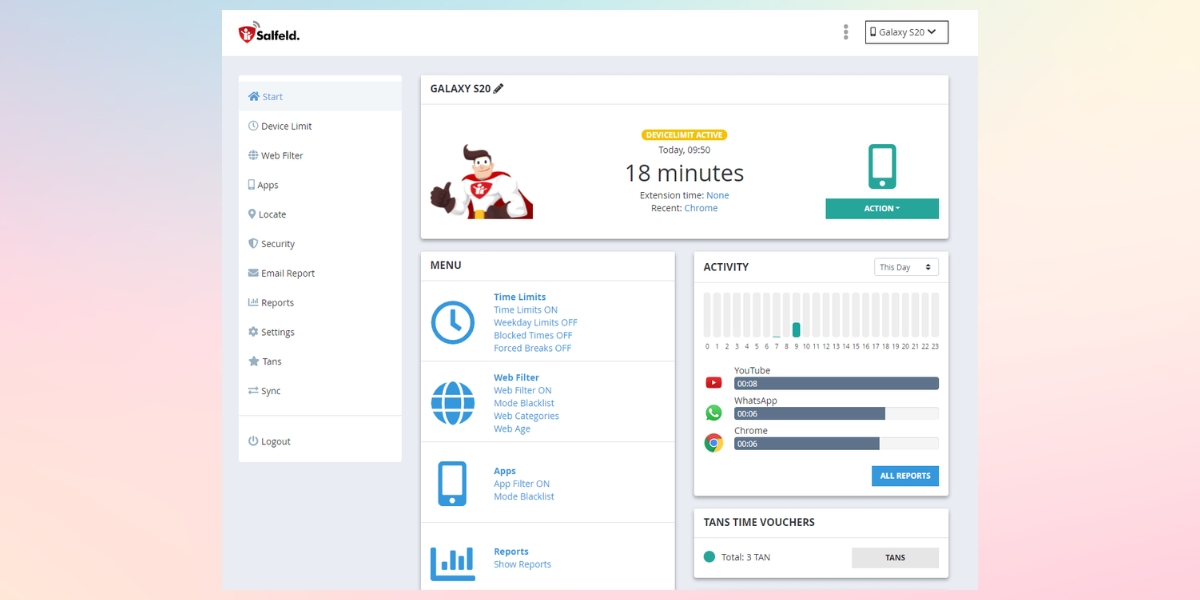
Salfeld’s architecture takes a more restrained approach than most competitors. The software does sync data to the cloud. It has to. Otherwise, there would be no web portal, and parents would need physical access to the device every time they wanted to check a report or change a setting. But what gets uploaded is described as carefully scoped. There are no location histories, no logs of dialed phone numbers, no social media chat transcripts, or other sensitive data, based on the company’s public documentation. As a German company, Salfeld operates under some of the strictest data protection regulations in the world, and GDPR compliance is not framed as a marketing bullet point here. It is a baseline legal obligation.

For families who consider that level of monitoring non-negotiable, the app may feel incomplete. But for parents who would rather not have software reading their kids’ private chats in the first place, that absence may be the point.

Meet the Parental Control App That Thinks Many Parental Control Apps Go Too Far

Photo Courtesy: Salfeld

What Does Parental Control Cost When There’s No Subscription?

For some parents, the most disruptive thing about Salfeld is not the code. It is the invoice. The company charges a flat upfront fee per device starting at €19.95 for a 12 or 24-month license, with discounts for multiple devices. When the license expires, it stops working until the parent actively decides to renew, often at a discount. There are no premium upgrades and no locked functionality. Every feature is included from day one. Compare that to many other well-known advanced solutions at around $100 per year, billed as ongoing subscriptions that auto-renewal whether you notice or not.

The real win may be psychological. There is no monthly charge ,reminding you that your children’s safety is a line item on your credit card. There are no “upgrade to unlock” prompts. You pay upfront, everything works, and the next time Salfeld crosses your mind is when the license is about to expire.

This model has obvious downsides for the company. Recurring revenue is the engine of modern SaaS businesses for good reason. But Salfeld’s small team size means the economics work differently. It is a boutique operation, and it functions like one.

First Learn, Then Play

Most parental control apps treat screen time like a binary switch, on or off, allowed or blocked. Salfeld is trying something different. Its tagline for the feature is blunt: “First learn, then play.”

The mechanism is a combination of two tools. Bonus Apps let parents designate educational apps, such as a vocabulary trainer, a math app, or a coding tutorial, that automatically generate extra screen time when used. Ten minutes on a learning app earns twenty minutes of free time. The ratio is up to the parent. Then there are Time Codes, six-digit numbers that parents can hand out manually as rewards for offline tasks, homework done, room cleaned, dog walked. The child enters the code, the bonus time unlocks, and they decide when to spend it.

What makes this interesting is the small shift in agency. Your child is not just having time taken away or given back. They are choosing when to use a vocabulary app to bank minutes for later, or deciding whether cleaning the kitchen is worth an extra half hour of gaming on Saturday. Salfeld’s own site describes it as helping children “feel more responsible for themselves.” That may be an ambitious description for a voucher system, but the underlying dynamic can be meaningful: earning something often feels different from having it rationed.

This will not convince parents who believe screen time should not be a bargaining chip at all. And it will not replace the harder work of actually talking to your kids about their digital habits. But in a market where the default approach is “set a limit, enforce a cutoff, deal with the meltdown,” even a negotiation tool of this kind may fill a gap that many competitors have not prioritized.

Should You Make The Switch?

If you want an AI to alert you every time your kid types a bad word, Salfeld does not do that. It does not attempt to. It sets a timer, stays out of your kid’s messages, bills you once, and assumes your child can learn to manage the rest.

In a market that often profits from telling parents they are not doing enough, that may strike some as risky, while others may view it as one of the more measured product decisions in recent years.

Salfeld’s Child Control software is available at salfeld.com. A 30-day trial is offered for new users. The company is based in Reutlingen, Germany.


Winter-Proof Your Hair with The Lauren Ashtyn Collection: Tips for Stress-Free Holiday Glam

By: Kate Sarmiento

Winter does a lot of cute things. It sparkles. It snows. 

What it doesn’t do? Treat hair kindly.

And every woman trying to hold it together from Thanksgiving to New Year’s knows the truth: this season demands polished photos, perfect parties, and countless “Wait, let’s take one more!” moments… all while the weather is out here flattening curls, drying ends, and inviting enough static to power a small town.

That’s exactly where The Lauren Ashtyn Collection steps in like the glam-squad fairy godmother everyone secretly wishes they had. Built on years of stylist expertise and confidence-restoring craftsmanship, TLAC has become the go-to for women who want great hair no matter what December decides to throw at them. With luxury hair toppers, hand-tied wigs, and stylist-developed hair care, the brand gives women their fullness, shine, and sanity back when winter tries to test all three at once.

So, grab a mug of something warm and let’s talk holiday hair survival the stress-free way.

Winter Chaos, Meet Your Match: How TLAC Keeps Hair Gorgeous When the Season Doesn’t Cooperate

Winter isn’t just cold. It’s chaotic. December stacks the calendar with family photos, office parties, holiday trips, surprise reunions, and at least three events where people you haven’t seen in a year suddenly appear. In moments like these, hair isn’t just another detail. It’s the entire mood, the whole vibe, the silent confidence booster women rely on to feel put together when the season gets overwhelming.

But winter doesn’t exactly make glam easy. Cold air holds less moisture, so it pulls hydration from hair faster than any other season (Source: Hairman, 2023). Indoor heating then doubles down by drying strands even further, leaving them flat, frizzy, limp, or all of the above. Add hats, scarves, static from cozy sweaters, and the stress of holiday madness, and suddenly it becomes “Why does my hair hate me?” season. And when you’re trying to leave the house in 10 minutes, there is no time for emergency salon appointments, hour-long styling sessions, or begging curls to behave.

That’s exactly where TLAC becomes the secret weapon women swear by during the winter months. When shine disappears, volume collapses, and texture goes rogue, TLAC’s hand-tied hair toppers and luxury wigs step in with the one thing winter can’t steal: instant, reliable fullness. Crafted from 100% European Remy hair and perfected by stylists who understand real-world struggles, these pieces transform dry, winter-worn hair into head-turning volume in minutes. They blend naturally, stay comfortable all day, and hold their shape through everything… wind, cold, travel, endless events, and every surprise December throws your way.

There’s a reason more than 30,000 women have walked out of TLAC salons and pop-ups feeling like themselves again. These pieces don’t just fix a bad hair day. They upgrade it. They take “My hair isn’t doing it today” and turn it into “Wait… I actually look incredible,” no matter what the weather is plotting outside.

Holiday Hair, Handled: The Fast Fixes and Winter-Proof Glam That TLAC Does Best

Winter loves drama, and it tends to unleash all of it directly onto your hair. One minute, everything looks smooth, and the next minute static has taken over, shine has vanished, and the cold has turned your strands into something that feels one gust of wind away from giving up. Holiday schedules only make it more chaotic: travel days, back-to-back events, surprise photo ops, and the unavoidable “Wait, let’s take a picture!” moments.

This is where TLAC’s stylist-developed essentials become the tiny-but-mighty heroes of the season. They keep hair soft, glossy, and photo-ready even when December has other plans:

  • Hydration Sprays – Cold weather strips hair of moisture, which makes strands rough and prone to static. A fast mist of hydration spray restores softness and shine in seconds, keeping hair from looking brittle in dry winter air.
  • Root Coverage for Last-Minute Touch-Ups – Travel schedules and packed events often mean roots grow out unnoticed. TLAC’s compact root solutions hide them instantly so photos stay flawless, even if the salon appointment didn’t happen.
  • Glossing Products for Shine – Winter lighting isn’t flattering, but shine is. A touch of glossing serum adds that smooth, reflective finish that reads beautifully on camera.

These are the little lifesavers that belong in every holiday purse, carry-on, or glove compartment. Explore the full line here.

But what makes the holidays truly stress-free is how seamlessly these quick fixes pair with TLAC’s winter-proof toppers and wigs. Whether humidity jumps during travel, jet-lag makes hair fall flat, or a windy walk leads straight into an unexpected family portrait, TLAC pieces stay secure, styled, and effortlessly gorgeous. Designed by lifelong stylists, they fit comfortably for all-day wear and hold their shape long after natural hair has surrendered to the elements.

It’s the kind of glam that doesn’t panic at sudden temperature changes, doesn’t collapse halfway through a holiday event, and doesn’t require anyone to spend hours styling. Call it winter-proof confidence. Call it instant polish. Call it the holiday miracle that women actually look forward to every year.

A Holiday Glam You Don’t Have to Fight For

Winter isn’t going anywhere. Holiday chaos isn’t going anywhere.
But bad hair days? Those don’t need to be part of the season.

With stylist-developed hair care, luxury hair toppers, and the kind of craftsmanship that restores confidence, The Lauren Ashtyn Collection makes sure women stay glam through every holiday plan, snowstorm, and photo op.

Ready for effortless holiday hair? Explore TLAC’s luxury toppers, wigs, and winter-saver hair care: https://thelaurenashtyncollection.com

Go ahead… give yourself the gift of great hair all season long.