A Guide to Understanding Nursing Home Safety Protocols in 2026

By: Natalie Johnson

The recent mass casualty incident at a Pennsylvania nursing home, which involved a catastrophic explosion, has placed a renewed focus on the safety and emergency plans at elder care facilities across New York. This tragic event has understandably raised critical questions for families with loved ones in care. Many are now asking: Is my family member safe? What plans are in place to prevent a similar tragedy from happening here?

These are not just questions of comfort, but of life and death. This guide will outline the mandatory safety protocols that New York facilities must legally maintain. More importantly, it will show you how to review a facility’s records yourself, enabling you to assess its commitment to safety before a crisis occurs.

What Exactly Are New York’s Nursing Home Safety Protocols?

Safety protocols are not merely suggestions or best practices; they are legally mandated requirements. Understanding what these entail is the first step for any family in evaluating the quality and safety of a long-term care facility.

Defining the Mandate in New York

Every nursing home in New York is required by state and federal law to create and maintain a comprehensive emergency preparedness plan. This plan must address specific vulnerabilities and risks that are unique to the facility, its location, and its resident population. Despite these rules, advocates point out that state oversight has been described as historically weak, making it even more important for families to be vigilant.

Recognizing existing gaps, regulations are actively evolving. New York recently passed Senate Bill S5294A, which now requires nursing homes to develop and implement detailed workplace violence prevention plans by 2026. This reflects a clear legislative push to address safety concerns that have long affected residents and staff alike.

The Core Components of a Safety Plan

A robust safety plan is multi-faceted, covering everything from natural disasters to internal medical emergencies. While each facility’s plan is tailored, they must all contain several core components to be considered compliant and effective.

  • Fire Safety and Evacuation: Detailed procedures for responding to fires, including staff training, regular drills, and clearly marked evacuation routes.
  • Infection Control: Protocols for preventing the spread of diseases, a critical area where a 2023 report revealed that over 70% of New York nursing homes have shown deficiencies.
  • Fall Prevention Programs: Strategies and interventions to minimize the risk of resident falls, a common cause of serious injury.
  • Emergency Communications: A clear plan for how the facility will communicate with residents, families, and emergency responders during a crisis.
  • Violence Prevention: New state-mandated plans to assess and mitigate the risk of violence from staff or other residents, a direct response to the growing issue of resident-to-resident assaults, which have harmed hundreds of residents across the U.S. since 2019.

Breaking Down the Most Critical Safety Protocols

While all components of a safety plan are important, several areas demand closer scrutiny due to their immediate impact on resident well-being. These protocols often represent the difference between a minor incident and a full-blown catastrophe.

Fire Safety and Emergency Evacuation

This is arguably one of the most critical parts of any facility’s emergency plan. The Pennsylvania nursing home explosion is a stark reminder of what is at stake when fire or structural safety fails. A proper plan is not just a document; it is a system of functional alarms and sprinklers, unobstructed exits, and, most importantly, staff who are thoroughly trained to evacuate residents with varying levels of mobility under extreme pressure.

Infection Control and Staffing Standards

Even the best-written plans will fail if there are not enough trained staff members to implement them. New York currently ranks in the bottom 10 U.S. states for average nurse staffing hours per resident, a statistic that has a direct and devastating impact on care quality. Understaffing is a primary driver of failures in infection control, which can lead to outbreaks of preventable diseases.

This lack of personnel also contributes to a rise in bedsores, a key indicator of neglect. According to the CDC, more than 1 in 10 nursing home residents have had a pressure ulcer. In 2022 alone, the NYS Department of Health received 13,862 complaints, with over a quarter involving abuse or neglect, issues often rooted in inadequate staffing.

Preventing Violence and Abuse

True safety is not just about protecting residents from external emergencies but also from internal threats. A government report found that hundreds of U.S. nursing home residents have been assaulted by other residents, highlighting a severe and often overlooked danger. New York’s new workplace violence prevention law is a direct attempt to force facilities to address these risks.

The law mandates that facilities conduct comprehensive hazard assessments and update their safety frameworks to protect both residents and staff. This requirement, which must be implemented by September 2026, signals a proactive—though some argue delayed—response to a well-documented problem within long-term care settings.

How to Vet a Nursing Home’s Safety History Yourself

Families are not powerless. There are concrete, actionable steps you can take to research a facility’s safety record and hold them accountable for the care they provide.

Where to Find Official Reports and Data

As a consumer, you have the right to request and review a facility’s emergency preparedness plan and its complete inspection history. For federally regulated data, the official Care Compare tool from the Centers for Medicare & Medicaid Services (CMS) is an invaluable resource for looking up official inspection reports, staffing levels, and quality measures.

Additionally, the New York State Department of Health website maintains a database of complaint data and facility ratings specific to the state. Cross-referencing these federal and state resources can provide a comprehensive picture of a facility’s performance and safety history.

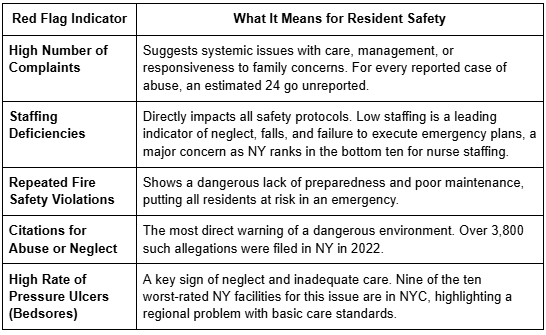
Red Flags to Watch For in a Safety Report

Reading these reports can be overwhelming, as they are often filled with clinical language and bureaucratic codes. However, you do not need to be an expert to spot patterns that serve as clear warning signs of a dangerous or neglectful environment.

A Guide to Understanding Nursing Home Safety Protocols in 2026


When safety protocols fail, and the red flags in facility reports become a reality, families in the Bronx need steadfast advocates. For over 30 years, the attorneys at Dalli & Marino, LLP have been holding negligent nursing homes accountable for failures that lead to resident harm. They understand that a violation isn’t just a mark on a report; it’s a direct threat to a loved one’s well-being.

The team at Dalli & Marino specializes in investigating the very issues highlighted in these safety reports. They dig deep to uncover evidence of systemic failures, from inadequate staffing and poor training to ignored safety procedures that result in falls, abuse, or neglect. If you suspect Bronx nursing home abuse, their expertise is crucial for proving that a facility’s negligence caused your family member’s suffering.

Securing accountability is about more than just filing a complaint. Dalli & Marino fight to secure the compensation families deserve to cover medical expenses, relocation costs, and the pain and suffering endured. They are committed to ensuring that negligent facilities face consequences, forcing them to improve care and preventing future families from experiencing the same tragedy.

Your Family’s Safety is Non-Negotiable

The key takeaways are clear: nursing home safety protocols are a legal requirement, not a courtesy. Recent events and new laws demonstrate that this is a critical, ongoing issue that demands attention from both regulators and families. You have the right and the tools to research a facility’s safety history before entrusting it with a loved one’s care.

Ultimately, the best defense is a proactive offense. Ask to see the safety plans during your tour. Visit the facility at different times of day to observe staffing levels and resident interactions. Trust your instincts, and if you see signs of neglect or feel your concerns are being ignored, do not hesitate to report the facility and seek legal guidance.

Disclaimer: The information provided here is purely for informational purposes and should not be interpreted as legal counsel. It is advised to seek guidance from Consumer Attorneys for further clarification on your rights.

Examining the Disconnect Between Türkiye’s Medical Tourism and Global Rankings

In 2025, a widely shared global ranking announced the Top 100 Best Hospitals in the World.
The list featured institutions from the United States, Europe, and parts of Asia.

Türkiye was nowhere to be found.

At first glance, this absence may appear reasonable—until global patient behavior is taken into account.

Türkiye consistently ranks among the top three to five medical tourism destinations worldwide, welcoming millions of international patients every year. The country generates billions of dollars in cross-border healthcare revenue and is globally recognized for excellence in procedures ranging from plastic surgery and organ transplantation to oncology, orthopedics, and advanced diagnostics.

This raises an unavoidable question:

How can a country trusted by millions of patients be entirely absent from the world’s most prestigious hospital rankings?

This is not a question of quality.
It is a question of what global rankings actually measure—and what they ignore.

Are Turkish Hospitals Underperforming? The Data Says No

A common assumption is simple:

If Turkish hospitals are not in the Top 100, they must lack standards.

The reality, however, is far more complex.

Türkiye offers:

  • Highly trained physicians, many educated or fellowship-trained in the U.S. and Europe
  • Advanced medical technology and modern hospital infrastructure
  • High procedural success rates across multiple specialties
  • Strong patient satisfaction, particularly among international patients
  • A unique integration of medical care, hospitality, and accessibility

If patient outcomes, treatment volume, and real-world performance were the primary evaluation criteria, Turkish hospitals would not be invisible—they would be highly competitive.

This exposes a deeper issue.

What Global Hospital Rankings Actually Reward

Most “Top 100 Hospital” rankings are not designed to measure healthcare delivery at scale.
They are designed to measure academic and institutional prestige.

Typical ranking criteria include:

  • Research output and citation volume
  • Peer-reviewed publications (primarily English-language)
  • University affiliation and teaching hospital status
  • Participation in large-scale clinical trials
  • Long-established Western institutional reputation

In short, these rankings prioritize knowledge production, not knowledge execution.

Türkiye’s healthcare system, by contrast, excels in:

  • High-volume clinical practice
  • Operational efficiency
  • Rapid access to care
  • International patient mobility
  • Cost-effective delivery without compromising outcomes

These strengths save lives—but they do not generate ranking points.

The Medical Tourism Paradox No One Talks About

Here lies a fundamental contradiction in global healthcare:

The countries that treat the most international patients are often the least visible in “best hospital” rankings.

Medical tourism is driven by:

  • Results
  • Speed
  • Trust
  • Cost transparency
  • Human experience

Global rankings are driven by:

  • Publications
  • Panels
  • Institutional legacy
  • Academic networks

These represent two entirely different definitions of excellence—and they rarely overlap.

Affordability Does Not Mean Lower Standards

Another quiet bias relates to cost.

Türkiye’s affordability is often misinterpreted as compromise. In reality, it reflects:

  • Lower operational and labor costs
  • Efficient public–private healthcare integration
  • Scalable service models
  • Government-supported health infrastructure

Türkiye did not replicate the Anglo-American academic hospital model. Instead, it built a hybrid system optimized for access, volume, and international demand.

That model performs exceptionally well—but it was never designed to win academic beauty contests.

The Real Gap Is Visibility, Not Capability

The most critical gap is not medical—it is strategic.

Many Turkish hospitals:

  • Do not actively compete within ranking-driven academic ecosystems
  • Underinvest in international research branding
  • Focus on patients rather than panels
  • Prioritize outcomes over optics

In simple terms:

Türkiye wins in practice—but does not play the ranking game.

A Clinical Perspective: Dr. Hasan Arslanyüregi

This reality is well understood by physicians working at the front lines of Türkiye’s internationally trusted healthcare system—such as Dr. Hasan Arslanyüregi, a Turkey-based medical professional whose work reflects the country’s strengths in patient-centered, outcome-driven care.

Dr. Hasan Arslanyüregi represents a generation of Turkish physicians focused not on academic visibility, but on clinical excellence, ethical practice, and international patient trust. His approach mirrors the broader Turkish healthcare model: high standards, modern techniques, and real-world results that matter most to patients.

More about his professional work and medical practice can be found on his official website:
https://hasanarslanyuregi.com/

A Question the Global Health Industry Must Finally Address

As healthcare becomes increasingly borderless, one fundamental question remains unanswered:

Should the world’s “best hospital” be the one that publishes the most—or the one that heals the most?

Türkiye’s absence from the Top 100 does not indicate failure.
It reveals a structural mismatch between legacy ranking systems and modern healthcare realities.

And that mismatch is the conversation the global health industry has avoided for far too long.

From Marketing to Motion Design: How Xinyue Gu Discovered a Passion for Visual Storytelling

By: Liz Chen

Today we’re excited to introduce Xinyue Gu.

Could you start by telling us a bit about yourself and how you got into your field?
Sure! My journey into motion design has been a mix of curiosity, experimentation, and gradual discovery. I originally started in marketing during my undergrad, but soon realized I was more drawn to creating visual experiences than writing campaigns. While experimenting with K-pop fan edits and short visual projects in my free time, I stumbled into motion graphics. The more I explored, the more I realized that motion design was a perfect intersection of storytelling, technology, and art.

After that realization, I dove deep into learning – Cinema 4D, After Effects, Redshift, Houdini and so on. My goal was to be a designer who could think conceptually and execute technically. That curiosity and drive eventually led me to a master’s program in Motion Media Design at SCAD, where I could fully immerse myself in 2D and 3D motion. It was a turning point that solidified my path and gave me the confidence to pursue professional opportunities in motion design.

What were some challenges you faced while building your career?
Honestly, the path wasn’t straightforward at all. One early challenge was simply believing in myself when switching from marketing to motion design. I didn’t come from a traditional art background, and there were moments I doubted whether I could catch up artistically and technically with peers who had been drawing or animating for years.

Another challenge was balancing ambition with reality. While I was constantly pushing myself to learn new tools and techniques, there were times I felt stuck or frustrated, especially when a render wouldn’t come out as I imagined. It tested patience and persistence, but it also taught me that iteration and failure are part of growth.

Can you describe your current work and what excites you about it?
Currently, I’m working as a motion designer at Maxon in Los Angeles, where my focus is on crafting both 2D and 3D animations for a range of projects, from ad campaigns to brand expression film. What excites me most is the storytelling aspect – how motion can transform an idea into something tangible, emotional, and memorable.

I often work with Cinema 4D and Redshift for 3D, while integrating After Effects for compositing and fine-tuning. I love exploring procedural techniques to create visuals that feel alive and dynamic. One thing I strive for in my work is a balance between bold aesthetics and subtle storytelling, so that the viewer not only sees the motion but feels it on some level.

A highlight of my career so far is the Maxon One Brand Expression Film. It has been featured on Behance, abduzeedo and so on. I also do a lot of personal projects during my free time. This The Fruit of My Woman Title Sequence has been awarded by Red Dot, MUSE, Communication Arts and so on.

From Marketing to Motion Design: How Xinyue Gu Discovered a Passion for Visual Storytelling

Photo Courtesy: Xinyue Gu

Looking ahead, what trends do you see shaping the future for motion designers and creative professionals?
I think one of the biggest shifts will be the blending of technology and human-centered storytelling. As tools like AI and real-time rendering become more accessible, the technical barrier is lowering. But that also means audiences and clients will value the human perspective more than ever. They want work that feels intentional, thoughtful, and emotionally resonant, not just technically impressive.

Another factor is the growing emphasis on cross-disciplinary skills. Creatives who can combine design, animation, coding, and narrative thinking will have an edge, because projects are increasingly interactive and immersive. Finally, adaptability and continuous learning will be key. What’s cutting-edge today could be standard tomorrow, so staying curious and open to experimentation is more important than ever.

From Marketing to Motion Design: How Xinyue Gu Discovered a Passion for Visual Storytelling

Photo Courtesy: Xinyue Gu

Finally, what’s next for you?  
Looking ahead, I’m really excited to explore the intersection of motion design, storytelling, and emerging technologies. Ultimately, my goal is to develop work that doesn’t just look visually impressive, but also resonates emotionally – crafting experiences that people remember and connect with on a human level, while continuing to expand the creative possibilities of digital media.

Contact Info
Website: https://axisxyg.com/
Instagram: https://www.instagram.com/axisxyg/

Slovakia Stuns Finland As Olympic Hockey Drama Begins In Milan

Ice hockey at the Milano Cortina 2026 Winter Olympics has opened with dramatic results, historic rivalries, and strong early signals about the race for gold. The tournaments for men and women are unfolding across February in Milan, bringing together the world’s top national teams and, for the first time since 2014, players from the National Hockey League.

The men’s competition runs from Feb. 11 to Feb. 22 and features twelve national teams competing through group play and elimination rounds for the Olympic title. Finland entered as the defending champion after winning gold in 2022, but the early stage of the tournament has already produced a major surprise.

Slovakia stunned Finland with a 4-1 victory in the opening matchup, powered by two goals from Juraj Slafkovsky and a 39-save performance from goaltender Samuel Hlavaj. The result immediately reshaped expectations in Group B and forced Finland to reassess its title defense.

Beyond individual results, the structure of the Olympic field also shapes the competitive landscape. Russia and Belarus are not participating due to international sanctions linked to the war in Ukraine, leaving the tournament without two traditional hockey powers and raising debate about how the absence may influence the legitimacy of the final outcome.

While the men’s event is only beginning, the women’s tournament has already delivered one of the most striking moments of the Games. The United States defeated Canada 5-0 in preliminary-round play, handing the defending Olympic champions their first shutout loss in women’s Olympic history. The result not only strengthened the United States’ position in the standings but also intensified the long-running North American rivalry that often defines Olympic women’s hockey.

Tournament drama has extended beyond final scores. In a separate women’s game, Finland briefly appeared to score on a glove-directed puck late in regulation, echoing a famous “Hand of God” moment from football history. Officials immediately disallowed the goal under Olympic hockey rules, which prohibit intentionally directing the puck into the net with the hand. Finland still secured the win, but the incident highlighted the strict enforcement and tension typical of Olympic competition.

Slovakia Stuns Finland As Olympic Hockey Drama Begins In Milan

Photo Credit: Unsplash.com

The women’s tournament itself runs from Feb. 5 to Feb. 19 and includes ten qualified national teams competing for gold. Canada entered as the defending champion after capturing its fifth Olympic title in 2022, reinforcing the expectation that the medal race would again center on Canada and the United States. Early results, however, suggest the competitive balance may be shifting as other nations gain confidence and depth.

Italy, the host nation, embodies that changing dynamic. Entering the Games as an underdog, Italian players have openly stated their ambition to challenge stronger teams and use home-ice energy to create surprises, reflecting the broader growth of international women’s hockey. Similar momentum is visible across the tournament, where emerging programs seek quarterfinal breakthroughs and long-term development rather than immediate medals.

Conditions at Milano Cortina also distinguish the 2026 event from recent Olympic tournaments. Games are being played at two Milan-area venues, including the newly built PalaItalia Santa Giulia, with formats that mirror recent Olympic structures of group play followed by knockout rounds. The return of NHL athletes after a twelve-year Olympic absence further elevates the level of play and global attention surrounding the competition.

Cultural elements remain part of the Olympic hockey identity as well. Goaltenders from multiple countries have drawn attention for intricately designed helmets that showcase national symbols and personal stories, offering a rare space for individual expression within otherwise uniform Olympic presentation.

As the tournaments progress toward the medal rounds, several themes are already clear. Competitive balance is widening, traditional powers face stronger resistance, and single-game swings can quickly redefine expectations. The men’s gold-medal game is scheduled for Feb. 22 in Milan, where the final standings will determine whether early upsets represent lasting change or only temporary disruption.

For now, Olympic ice hockey in 2026 is defined by uncertainty and momentum. Slovakia’s opening shock, the United States’ historic women’s victory, controversial moments under strict rules, and the absence of former contenders all contribute to a tournament still searching for its ultimate narrative. With elimination rounds approaching, the decisive chapters of Milano Cortina hockey remain unwritten.

How Kimberly Wright and Her Spirit Choir Turned Suffering Into Sound

In How Music Healed Me: Spirit Speaks, Kimberly Wright weaves trauma, illness, mediumship, and an unapologetically human love of music into a spiritual memoir that resists spectacle. The result is not a manifesto or a miracle story, but a quietly radical account of attention, how listening, in its many forms, can become a form of survival.

The book opens in a hospital room washed in fluorescent light. Machines mark time with mechanical precision while Wright’s world contracts to test results and prognoses. Faced with pain and uncertainty, she does something disarmingly ordinary: she makes a playlist. Not the triumphant soundtrack of recovery montages, but long, droning compositions tuned to a single frequency, 528 hertz, sometimes called the “miracle tone.” As nurses come and go, they linger in the doorway. The room feels calmer, they say. As if someone has changed the station beneath the noise.

That small act sets the tone for the memoir. How Music Healed Me traces how Wright learned to tune her life through sound, discernment, and hard-earned boundaries after years of spiritual openness that often came at a personal cost. Part memoir, part field report from the liminal, and part guide for living with heightened sensitivity, the book follows her from a turbulent New England childhood through addiction, controlling spiritual communities, repeated brushes with death, and toward a more grounded integration.

From the beginning, Wright frames herself as “born awake,” a child whose dreams bleed into waking life, who absorbs other people’s emotions in classrooms and grocery stores, and whose father’s alcoholism turns the home into an unpredictable climate system. “Chaos became the natural state of the household,” she writes plainly, without melodrama, “leaving an enduring mark on me.” Even so, an alternate soundtrack emerges early: punk and disco records spinning in her bedroom, and the profound quiet of her grandmother’s New Hampshire camp, where trees and stones become her first nonjudgmental witnesses.

The memoir is most compelling in these threshold moments when curiosity about the unseen nudges Wright across a line, and discernment must catch up. A peyote ceremony initially framed as a spiritual initiation devolves into something harsher under the force of her sensitivity. “Spiritual openness does not require surrendering control,” she later reflects. “Certain thresholds demand wisdom, purpose, and care once crossed.” The sentence functions as a quiet thesis for the entire book.

That hard-earned clarity deepens during her decade working in one of Salem’s oldest witch shops, where the paranormal becomes routine rather than theatrical. Wright recounts these years in compact, almost reportorial scenes: glass witch balls spinning in still air; books flying from shelves with uncanny precision; a leather-clad biker dissolving into tears when she mentions Archangel Michael and a date, then revealing a tattoo that matches both. In one reading, a grieving mother hears from her son who died of an overdose; the message doesn’t erase the grief, but it loosens its grip. Wright resists glamour here. The tone does not behold the spectacle, but this is what happens when the unseen insists on being acknowledged.

If Salem is where Wright learns what her gifts can offer others, the hospital chapters reveal what they can offer her. A cascade of illnesses, diabetes, cancer, a stroke, and repeated near-fatal complications turn her body into contested ground between medical charts and spiritual encounter. She describes colored lights she identifies as archangels, dreams of saints whose devotees are praying for her across oceans, and moments of recovery that leave doctors puzzled. She never rejects medicine; she layers it. “Music reminded me that I was not only a patient tethered to machines,” she writes, “but also a soul with depth, peace, and purpose.”

Sound is not a metaphor here; it is a method. Frequencies, chanting, ambient tracks, and even heavy metal riffs form one of the book’s most tangible through-lines. During a prolonged hospitalization that nearly breaks her, Wright listens for hours to 528-hertz tones, to tracks titled Weightless and Celestial Healing. These are not aesthetic choices but survival strategies, places for the mind to go when pain becomes unmanageable. At one crucial moment, a pounding rock song jolts her body into taking its first fragile steps again. The same openness that once led her into psychedelic excess becomes, in midlife, a tool for regulation and grounding.

Structurally, the memoir alternates between narrative chapters and short, channeled poems attributed to a spirit chorus Wright calls Lucy Zoe Oliviara. Written in a spare, incantatory register, these pieces function like a gospel choir responding to a soloist, echoing, amplifying, and reframing the prose. Whether readers accept their spiritual authorship or not, the book broadens its emotional range beyond first-person testimony.

What ultimately anchors How Music Healed Me is Wright’s refusal to spiritualize away responsibility. She writes candidly about cult dynamics, toxic positivity, and her own complicity in staying too long where boundaries should have been drawn. She recounts sleeping in her car because she failed to advocate for herself, remaining in controlling relationships, and doing the unglamorous work of therapy, support groups, and nutritional change. “The world eventually became a mirror reflecting what I needed to see,” she admits. When she finally claims, “Happiness is my right,” it lands not as an affirmation but as earned truth.

In the end, the book’s most persuasive argument is not about proving the existence of spirits, though Wright believes deeply in them, but about the transformative power of attention. Attention to animals that bristle at the wrong visitor. To feathers that appear after near-death experiences. To friends who see your capacity before you do. And to the frequencies musical and otherwise that allow the body to soften when nothing else will.

When Wright pauses long enough to ask, “Who am I without the noise? What is my frequency?” the question feels less mystical than urgently modern. In an era saturated with distraction, How Music Healed Me: Spirit Speaks offers no easy miracles, only a disciplined way of listening.

Read it not for tidy answers, but for companionship on the long, imperfect walk toward healing. Let Wright’s spirit choir, her hard-won boundaries, and her disarming humor walk beside you and see what begins to shift in the quiet after the final page.

The book is now available on Amazon.


Disclaimer: The views and experiences shared in How Music Healed Me: Spirit Speaks by Kimberly Wright are those of the author and do not constitute medical advice. The book explores personal healing and spiritual experiences, and while it may offer insights for some, it is not a substitute for professional medical care or therapy. Readers are encouraged to seek appropriate professional guidance for any health-related concerns.

Megachip: Why Majority of Aftermarket Splash Guards Miss the Mark

Most drivers think of a splash guard car setup as something practical rather than special. For the founder of Megachip Solutions, the story began in a much more hands-on way.

Six years ago, during an autocross event in a rough parking lot, his Honda S2000 started taking constant rock chips on the front fenders. The only car that stayed clean belonged to a Subaru driver with oversized mud flaps. After hours of watching debris fly, frustration settled in for almost everyone.

He had packed his lunch in a thin plastic container. Once he finished eating, he grabbed a pair of scissors and cut the empty container into two makeshift guards. They worked surprisingly well. That small experiment sparked something major. He went home, traced the design, experimented with new materials, and posted the results on the S2000 forums. 

After sharing his idea and demonstrating the guards’ effectiveness, people reached out, asking if he could make a set for them. This response, coupled with a significant spike of 10-20 orders following a customer’s video release, revealed a potential business opportunity that became a small source of income during college. 

Initially, he operated under his own name and email, as “Megachip” didn’t exist yet. Applying his industrial technology education, he transitioned the product from a hand-cut hobby creation to a professionally manufactured one by designing tooling and standard operating procedures to streamline the process. 

He began developing improved templates, sourcing tools, and guards for additional sports cars. A friend with an ND Miata requested a set, and the Miata guards became a long-term best seller. Eventually, he left his nine-to-five job to grow the business. Today, Megachip produces guards for over twenty car models.

The Design Philosophy Behind Premium Mud Guards for Cars

Many generic mud guards for cars follow a simple pattern. They are built from rigid plastics, cut into standard shapes, and installed on a wide range of vehicles without regard for the car’s lines. While some may offer basic protection, they often clash with the car’s appearance. For car enthusiasts, design matters as much as durability.

Megachip takes the opposite approach. They believe a splash guard should look like it belongs on the vehicle. That means matching each model’s design language. If a guard looks bulky or awkward, it detracts from the car. Megachip spends long hours shaping, adjusting, and refining every design so the final product has a unified appearance that suits each sports car.

When guards look right, customers are willing to pay a premium. Even though cheaper options exist, Megachip customers choose quality because they care about both function and appearance.

Innovative Material and Aerodynamics of the Megachip Car Splash Guard

Megachip: Why Majority of Aftermarket Splash Guards Miss the Mark

Photo Courtesy: Megachip

Megachip guards offer a different approach to the typical car splash guard. They are the only manufacturer in this space working with a rubber-based material instead of brittle plastic. This material offers flexibility, crack resistance, and a longer lifespan.

Megachip also performs aerodynamic analysis through CFD simulation. They study airflow to assess how each guard performs in real-world driving conditions. Their signature 45-degree outer edge, called the AeroEdge, blends visual appeal with performance support. It guides airflow cleanly while adding a sharp, purposeful look.

For those interested in the technical aspects, Megachip’s aerodynamic testing write-up for the Toyota GR Corolla is available here.

Car Splash Guard Partnerships: Collaborations Built on Quality

Megachip’s attention to detail has led to collaborative work with respected companies such as Flyin’ Miata and IND Distribution. Their Miata and BMW guard sets continue to perform well in the market. These partnerships reflect a shared respect for precision engineering and enthusiast-focused design.

Customers adopt Megachip products because they value thoughtful solutions. They often lean toward quality-driven purchases and want accessories that feel intentional.

Protection, Fit, and Style: What Enthusiasts Demand in Mud Guards for Cars

Performance drivers and car lovers care about four things: 

  • Protection
  • Fit
  • Appearance
  • Functionality 

Megachip aligns with these priorities by customizing each splash guard for each car set to the exact model’s measurements and style. They understand enthusiasts want components that feel natural and well-integrated.

A Megachip guard does not call attention to itself. It integrates with the car while providing reliable protection against road debris. It supports a car’s form and keeps the paintwork cleaner during spirited driving, wider wheel setups, or daily use.

The Future of Car Mud Flaps: Partnership with Wheel & Tire Companies

Megachip’s long-term goal is to partner with wheel and tire companies such as Fitment Industries. When a driver upgrades to wider wheels or performance tires, debris becomes a bigger issue. Megachip guards would make a smart companion product. They can keep the car’s sides free of rock chips and add a refined finish to any wheel upgrade.

The brand plans to continue expanding its lineup, specializing in high-performance, OEM+ style splash guards built for enthusiasts who expect quality across every detail.

If you want a car splash guard or car mud flaps setup that supports both style and protection, Megachip Solutions offers a thoughtful alternative to typical aftermarket options. Their approach blends precision design, reliable materials, and aerodynamic awareness to deliver a product built specifically for your car.

Erik Schjolberg and the Role of Technology in Modern Golf Instruction

Golf has increasingly shifted from tradition to innovation as new clubs provide golfers and teachers with a clearer picture of every movement in the swing. Across the United States, the sport remains popular, with the National Golf Foundation reporting that more than 25 million people played golf in 2023. In addition to their popularity, today’s golfers have access to training methods that rely on precise measurements rather than guesswork. Pressure plates, launch monitors, and high-definition video systems are now common at most training facilities, altering how lessons are planned and evaluated.

This broader use of science and technology provides context for the career of Erik Schjolberg, a coach who grounded his teaching in objective facts and measurable outcomes. Schjolberg, a PGA Professional since 1991, began coaching when most teaching methods still relied on a coach’s eye and judgment. Over the decades, he has embraced every technology that has emerged and used it not as a trend but as a tool to demonstrate and prove the mechanics of a repeatable golf swing.

One of the most essential tools of his method is the TrackMan 4 Launch Monitor, a radar device that captures data like club speed, ball rotation, and launch angle. TrackMan technology is now the yardstick for precision in the golfing universe, and Schjolberg utilizes it for nearly every lesson. By comparing readings from multiple sessions, players can see precisely how small changes in grip, stance, or rhythm affect the ball’s path. Having the history recorded allows both the coach and the student to track progress in concrete terms, rather than relying on subjective judgment.

Another integral tool in his teaching is the employment of dual 3D pressure plates to record ground reaction forces. The plates capture the way a golfer transfers weight during the swing, and the information can be used to analyze in real time. Ground reaction force analysis has become more prevalent at elite training centers over the past decade and elucidates how energy is transferred from the body to the club. Schjolberg uses this information to guide players toward more efficient transfers of power, ultimately increasing distance and control. 

Schjolberg also uses HackMotion wrist sensors that monitor wrist angles and rotation during the swing. These sensors give information about the control of the club face throughout. Combined with readings from the TrackMan and pressure plate, wrist readings create a complete picture of the relationship between movement in the body and club-face alignment. For golfers working to eliminate a slice or achieve a particular flight, these measurements provide a useful way to identify and suppress the relevant variables.

Video remains in his bag too, albeit in high-tech form. 3D video analysis at high speed captures the swing from multiple angles and enables frame-by-frame review. Video has long been used as a golf instructional aid, but combining it with data from launch monitors and sensors provides Schjolberg with a more comprehensive system for diagnosis and feedback. Students can observe their swing and examine numerical data, which helps learning stick better.

These complementary technologies facilitate Schjolberg’s feedback-based methodology. Rather than relying on individual intuition, he provides measurable information that can be verified and re-verified in practice. The technique is attractive to competitive and recreational golfers because it provides concrete evidence of improvement. It also reflects broader trends in sport instruction, in which measurable outcomes are gaining significance. According to the Sports & Fitness Industry Association, participation in computer-assisted training across a variety of sports has been increasing over the past few years, indicating a need for unbiased analysis.

His credentials back his use of such advanced equipment. Schjolberg is a certified TrackMan Expert, a designation that requires extensive training and testing in the use of the company’s launch-monitor systems. He is also a TPI Level 3 instructor, an organization that focuses on the relationship between golf performance and physical conditioning. These qualifications reflect a commitment to continuing education and to being at the forefront of both biomechanical and technological innovations in the sport.

Schjolberg applies these methods at his EJS Golf Academy in Scottsdale, Arizona, which he founded in 2017. The academy serves golfers of all levels, from PGA Tour players seeking a slight competitive advantage to junior golfers and weekend golfers. Instruction starts with an initial measurement of most swing parameters, followed by specific drills that are cross-checked by data from the same equipment. Students are provided with a copy of their numbers so they can track changes over time.

His outside-of-the-university work is through The Science of Better Golf, an online subscription service that he introduced in February 2025. The program provides members with personalized dashboards, progress tracking, and real-time coaching sessions that mirror the evidence-based approach used in face-to-face settings. By extending the same technology-driven guidance via remote access, Schjolberg can engage golfers who are unable to travel to Scottsdale but still want the benefits of measurable feedback.

Erik Schjolberg’s career demonstrates how technology can supplement, rather than replace, the craft of golf instruction. From the early adoption of radar-based launch monitors to the integration of biomechanics and high-end video, he has created a system that embodies the modern trajectory of the game. His certifications and years of professional experience provide that effort with a foundation, and his academy continues to attract players seeking objective improvement. With the application of measurement in combination with accurate instruction, Schjolberg illustrates how science and golf can meet to the benefit of golfers everywhere.

The SoakingPot®: Redefining Rest Through Ritual in the White Mountains

The SoakingPot Infusion Spa® offers a unique sanctuary in North Conway, New Hampshire, designed to help people slow down, unwind, and reconnect. This women-owned wellness business invites guests to embrace the power of intentional rest, using therapeutic foot soak infusions made with organic salts, herbs, and essential oils. The concept, which blends modern self-care practices with a rich sensory experience, is a refreshing approach to managing the stresses of everyday life.

The Birth of a Vision

In 2018, The SoakingPot Infusion Spa was born out of a desire to create a space where people could take a break from the constant demands of life. Founded by a woman passionate about holistic wellness through the use of herbs and other essential natural elements. The SoakingPot was designed as a retreat that could provide comfort, peace, and a sense of presence. The mission was clear: offer a space where visitors could feel free to pause and recharge without the pressure of productivity.

As the founder envisioned, rest is not something to be earned. It is something everyone deserves. This guiding principle has shaped the spa’s philosophy and its carefully crafted experience. From the very beginning, The SoakingPot’s focus has been on helping guests reconnect with their bodies and minds, offering a welcoming atmosphere designed to quiet the noise of everyday life.

The SoakingPot®: Redefining Rest Through Ritual in the White Mountains

Photo Courtesy: Cait Bourgault Photography

The Unique Concept of Botanical Foot Soak Infusions

At the heart of The SoakingPot experience is its signature offering: the botanical foot soak infusions. These deep copper pots are filled with carefully chosen organic salts, herbs, and essential oils, selected for their therapeutic qualities. Each foot soak is designed not only to relax the body but also to calm the nervous system, helping guests slow down and reconnect with the present moment.

Guests are encouraged to take a moment for themselves, seated in comfortable chairs, surrounded by low lighting and meditative music, and infused with the scents of herbal aromatherapy. The slow, intentional process of soaking the feet allows for deeper relaxation and relief from the stresses of daily life. Whether seeking to ease physical tension or quiet a racing mind, the foot soak experience offers something deeply restorative.

The thoughtfully designed atmosphere of the spa, combining sensory elements such as calming sounds, aromatherapy, and soothing visuals, works synergistically to provide a holistic experience that leaves guests feeling both physically relaxed and mentally at ease.

Creating a Place for Intentional Rest

What sets The SoakingPot apart is not only its unique offerings but also its focus on creating an environment conducive to intentional rest. The spa’s interior is a carefully curated space, with a design that reflects warmth and comfort. The ambiance encourages guests to fully embrace the moment, without distractions, and to enjoy the soothing ritual of self-care.

Rest is often viewed as a luxury or an indulgence, something people must earn. The SoakingPot seeks to shift this narrative by promoting the idea that rest is essential for well-being, not something to be earned or postponed. The invitation to pause and reflect, even if just for an hour, is at the core of the spa’s mission.

In a world where hustle culture often prevails, The SoakingPot provides a necessary counterbalance. It is a space where guests can engage in the simple yet profound act of slowing down, reconnecting with themselves, and finding balance.

Growth and Community Connection

Since opening its doors, The SoakingPot has become a beloved part of the North Conway community. The spa’s growth has been steady, fueled by a loyal following of locals and visitors who appreciate the thoughtful care and attention to detail that goes into each guest experience. As the spa’s reputation has grown, so too has its presence in the wellness community, with guests returning for regular visits and recommending the spa to others.

The sense of community is integral to The SoakingPot’s success. It is not just about providing a service but fostering an atmosphere where people feel cared for and valued. This approach has helped to build a strong network of supporters who feel a deep connection to the spa’s mission.

As part of its commitment to growth, The SoakingPot has recently launched a franchise model, with plans to expand its unique concept beyond North Conway. This expansion is guided by the same core principles that have defined the brand from the start, offering a warm, welcoming space for intentional rest and mindfulness. The vision for future locations is rooted in a commitment to the same level of care and hospitality that guests have come to expect from the original spa.

The SoakingPot®: Redefining Rest Through Ritual in the White Mountains

Photo Courtesy: Cait Bourgault Photography

Franchising and Future Expansion

The decision to expand through franchising reflects the success of The SoakingPot’s business model and its growing demand. The franchise model offers a unique opportunity for others to share in the mission of providing intentional rest and relaxation, while still maintaining the high standards of care and quality that have made the brand so beloved.

For those interested in becoming part of The SoakingPot family, the franchise opportunity offers a chance to bring this unique wellness experience to new locations. This is not just about opening new businesses; it is about creating spaces where people can find peace and relaxation, just as the original North Conway location intended.

The SoakingPot’s future expansion is not just about growth but about staying true to its mission of helping people slow down and reconnect. Every new location will carry with it the same spirit of warmth, care, and mindfulness that has been the foundation of the brand since its inception.

The SoakingPot Infusion Spa: A Place to Pause

The SoakingPot Infusion Spa’s commitment to providing a place for relaxation and personal reflection has resonated with guests and the broader community. From its humble beginnings in North Conway, the spa has grown into a beloved wellness destination, offering a unique, restorative experience. Through its carefully designed foot soak infusions and the focus on intentional rest, The SoakingPot offers more than just a service; it offers a sanctuary.

As the brand looks to the future, its focus remains on maintaining the same level of care and warmth that has been central to its success. Whether through expansion or deepening connections with the local community, The SoakingPot will continue to be a place where people can take a moment for themselves and reconnect with what matters most.

For more information about The SoakingPot Infusion Spa, visit The SoakingPot’s official website or explore their spa menu. To learn about franchise opportunities, check out their franchise page, and follow them on Instagram for the latest updates.

When Attention Creates Suffering: A Spiritual Insight Reflected in Quantum Physics

By: Jason Gerber

Human life is full of anticipated fears.

We rehearse tomorrow’s pain before it happens.
We imagine conversations that never occur.
We suffer events that exist only in possibility.

But what if many of those experiences become real precisely because we hold onto them?

Across centuries, mystics have taught that attention shapes inner reality. Surprisingly, modern physics now offers a metaphor that mirrors the same idea.

Not as religion replacing science and not science proving religion, but as two languages pointing toward one human truth:

Where attention settles, experience solidifies

The Lesson Hidden Inside the Double-Slit Experiment

In 1801, physicist Thomas Young performed what would later become one of the most famous experiments in science.
Two hundred years later, quantum mechanics deepened its meaning.

When tiny particles, electrons, or photons pass through two narrow openings, something strange happens.

If nobody observes which slit the particle travels through, the particle behaves like a wave of possibilities, spreading across space and creating an interference pattern.

But the moment a detector watches the path, the wave disappears.

The particle becomes a single fixed object.

Physicist Richard Feynman called this phenomenon the central mystery of quantum mechanics.

In simple terms:

  • Unobserved → reality remains open and fluid
  • Observed → reality collapses into form

Physics does not claim human thoughts control atoms.
Yet psychologically, the analogy is powerful.

Our attention functions like measurement.

The Human Mind as an Observer

Consider how worry works.

A future event has not happened.
It exists only as a probability.

But the more we examine it, replay it, and emotionally measure it, the more solid it feels.
Soon, the body react,s tension rises, breathing changes, mood darkens.

Nothing occurred in the world.
Yet suffering became real.

The pain formed not from the event but from fixation.

In spiritual language, this is attachment.
In psychological language, rumination.
In the language of physics metaphor, a collapse of possibility into experience.

Breath as a Reminder of Trust

Many spiritual traditions teach returning attention to breath.

In Islam, breath carries a particularly intimate meaning.

The Qur’an describes life as breathed into the human being, and God as nearer than one’s jugular vein.
Existence itself is presented not as possession, but as a continuous gift.

Seen this way, breathing becomes a quiet lesson:

You receive and release.
Nothing stays because nothing was owned.

When attention rests in this rhythm, thoughts pass through awareness instead of turning into identity.

Why Ignoring Pain Isn’t Denial

Turning inward is often misunderstood as avoidance.

But the difference is subtle and important.

Denial pushes experience away.
Awareness lets experience pass.

When the mind clings to every disturbance, it converts sensation into suffering.
When it witnesses without grasping, the disturbance dissolves.

A feeling becomes heavy only after the mind claims it:
“This is mine. This defines me. This will stay.”

Without that claim, experience behaves like weather present, then gone.

Ancient Wisdom, Modern Language

Mystics across traditions described reality as shaped by perception:

  • Islamic philosophy spoke of divine manifestations appearing according to the heart’s orientation
  • Eastern traditions described illusion as mistaking passing forms for fixed reality
  • Contemporary psychology recognizes cognitive fixation as the root of anxiety

Different cultures, same observation:

The mind hardens what it holds.

The Freedom of Non-Possession

Suffering often begins with a simple mental act of claiming.

My fear
My loss
My future
My pain

But life itself is movement.

When attention loosens, experience regains motion.
Emotions flow again instead of imprisoning awareness.

Peace does not come from controlling life.
It comes from refusing to freeze every moment into permanence.

There is a practical discipline hidden in this insight:

Notice without gripping.
Feel without naming permanently.
Let thoughts arrive without turning them into identity.

The goal is not to remove difficulty from life.
It is to stop turning temporary waves into permanent wounds.

In that state, awareness becomes spacious.
Events still occur but they do not occupy the whole inner world.

And a person begins to move through existence lightly.

The next time worry appears:

Do not fight it.
Do not analyze it endlessly.

Instead ask:

Has this happened or am I measuring possibility?

Then return to the breath.

Let the mind observe, but not hold.

Often the experience dissolves before it becomes suffering.

The Quiet Conclusion

Science studies matter.
Spirituality studies meaning.
Both sometimes meet in metaphor.

The double-slit experiment does not teach religion.
And faith does not rewrite physics.

Yet together they illustrate a human reality:

Attention shapes experience.
Attachment solidifies it.
Release restores freedom.

The heart that stops grasping does not escape life —it simply stops turning every moment into a burden.

And sometimes, peace begins not when pain disappears,

but when we stop insisting it must stay.

Watch & Listen

To help readers visualize the scientific and artistic ideas discussed in this piece, the following videos provide clear demonstrations and creative reflections on the same theme.

The Physics Demonstration: The Double-Slit Experiment

https://youtu.be/7iKebDDs2Pg

This experiment shows how particles behave as waves of possibility until observation fixes them into a single measurable state, the scientific metaphor used in this article.

The Musical Reflection Bismillah I Come, I Go

https://youtu.be/sYVFCsrgd2E

A lyrical interpretation of the same concept: allowing experience to pass through awareness rather than holding it as identity.

Disclaimer: The views expressed in this article are the author’s own and are intended for informational and metaphorical purposes only. This article does not claim to provide scientific, medical, or psychological advice. Any references to quantum physics or spiritual teachings are used as illustrative metaphors and should not be construed as definitive scientific fact. Readers are encouraged to seek professional guidance for any specific concerns related to mental health, medical, or scientific topics.

How to Tame Your Wiry Beard: Understanding Texture and Effective Solutions

Facial hair is part of a man’s personal expression, but stiff, bristly facial hair is uncomfortable to touch and even harder to style. While a rough, wiry beard texture affects countless men, it doesn’t have to be permanent. This guide breaks down what’s behind that coarse feeling, how grooming habits and biology shape texture, and the practical steps that actually work to soften things up.

Understanding Facial Hair Texture 

What exactly is “wiry texture” to begin with? Beards feel wiry when the hairs are coarse, stiff, and resistant to lying flat or blending with neighboring strands. With deeper insight into the qualities that shape this texture, it’s easier to develop personalized beard-care techniques to make facial hair more manageable. 

Beard Hair vs. Head Hair

There are several reasons beards feel different from head hair. Unlike the softer, more flexible hair on your scalp, beard hair naturally grows thicker and rougher. The keratin bundles that make up beard hairs are densely packed, producing a tougher, rope-like strand that resists bending easily. This inherent strength, driven by hormones like testosterone and DHT, gives beards their rugged look, but it also contributes to that rough texture many men want to soften.

Beard hair also grows from larger follicles with an oval cross-section, making each strand thicker and more rigid than scalp hair. Because the active growth phase (anagen phase) is shorter, facial hair doesn’t taper or soften as much as head hair does.

Additionally, beard follicles often produce more hair than the surrounding skin can lubricate with natural oils, leaving strands dry and more susceptible to external abrasion. Without enough natural oil moving down the hair shaft, strands can dry out and feel stiff.

Genetics 

Not all beards are created equal, either, and some men notice extreme wiriness, while others naturally have a softer texture. This variation can stem from genetic factors, where some men’s follicles naturally produce coarser hair. Hair length can also play a role; as beard hair lengthens, differences in growth direction and weight can affect roughness.

Lifestyle factors

Other key contributors to beard texture are environmental stressors and lifestyle factors. From sun and wind exposure to personal hydration levels and grooming habits, facial hair can easily become dry, itchy, and full of split ends.

It’s not all doom and gloom, though. Yes, beard texture is primarily influenced by these factors, but with a mindful grooming and self-care routine, men can absolutely achieve a softer mane.

Grooming Routines to Soften Facial Hair

Daily and weekly beard care routines are most effective when tailored to personal facial texture, and consistency will accelerate improvement, gradually building softness and control.

Mindful Cleansing

To improve moisture balance, step one is to avoid generic shampoos or harsh soaps. Those products remove the natural oils that support a healthy, flexible hair texture. Use a beard-specific wash a few times a week to remove dirt without overdrying. 

Post-Wash Care

To further retain moisture, hydrate immediately after a warm shower. While the beard is still slightly damp (no aggressive towel-drying), apply a moisturizing beard oil and cream that penetrates the hair shaft to replenish any lost oils and smooth rough cuticles. Oil adds flexibility and softens the skin beneath the hair for healthier growth, while a cream further locks in moisture and helps with styling and hold throughout the day. 

Brushing & Detangling

Regardless of length, brushing not only improves the beard’s overall appearance but also helps distribute products and natural oils. And especially with lengthier facial hair, detangling is one of the best ways to maintain a smooth texture and ensure each follicle gets proper TLC. 

Regular Trimming

Even when growing out a beard, regular trims remove split ends and smooth the overall texture. Use a beard trimmer that doesn’t pull or snag (which can cause further damage and texture issues), or sharp grooming scissors, to achieve a clean cut. 

At its core, a heightened, wiry texture indicates hair that hasn’t been properly conditioned or hasn’t yet developed the right moisture balance. These habits help balance moisture, soften cuticles, and make hair more manageable day after day. 

Final Takeaways

The journey from coarse to manageable takes time, but small, intentional habits can create visible change within weeks. Choosing the right products, staying consistent with hydration, and respecting the beard’s natural structure build a foundation that makes long-term beard growth sustainable and enjoyable rather than a constant battle with texture.

For men ready to take control of their beard’s potential, the path forward centers on moisture, consistency, and remembering that every beard, regardless of genetics, responds to care.