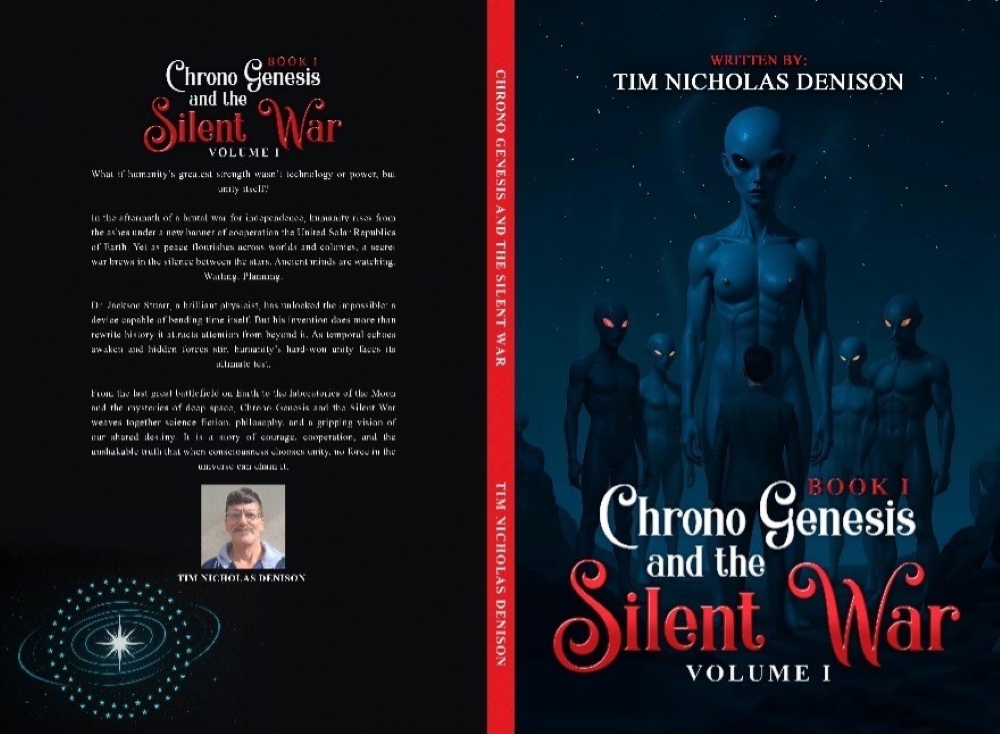
Unity as a Choice: The Inspiration Behind Chrono Genesis and the Silent War

By: Tim Nicholas Denison 

From the very beginning, Chrono Genesis and the Silent War were never meant to be just a science-fiction story. It was meant to be a statement, a reflection of what I believe humanity is capable of when we stop allowing the past, fear, and division to define our future.

At its heart, Chrono Genesis and the Silent War is a story about unity. It explores what can be accomplished when people from vastly different backgrounds choose to work together as one, not because they are forced to, but because they understand that cooperation is stronger than conflict. While the setting is futuristic and spans civilizations beyond Earth, the core message is deeply rooted in the real world we live in today.

I have always had a strong passion for unity. Long before I began writing this book, that passion found expression in music and lyrics that centered on the same idea: bringing people together rather than tearing them apart. I am naturally curious, especially about science, consciousness, and how humanity evolves. Those interests, combined with my personal faith and belief that goodness ultimately wins, shaped the foundation of this story.

What inspired me most to write this book was the state of the world as it is now. We live in a time where it is easy to focus on differences, political, cultural, religious, or historical. Yet, when you step back and look at the long arc of human history, something remarkable becomes clear. Civilization has steadily improved. More people live longer, healthier lives. Knowledge is shared more freely than ever before. Cooperation, not domination, is what has driven humanity forward.

Unity as a Choice: The Inspiration Behind Chrono Genesis and the Silent War


Photo Courtesy: Tim Nicholas Denison

That arc matters. It tells us that, despite setbacks and conflict, humanity is slowly learning to live together. I may not live to see the day when all people truly come together as one, but I firmly believe that day will come. The evidence is already written into our history.

This belief is reflected directly in the dedication at the beginning of the book:

“I dedicate this book to all people who have the courage to choose unity, who choose to come together in spite of our differences, and who refuse to let the past dictate our future.”

That dedication is not symbolic; it is the soul of the entire story.

Across both volumes of Book 1, Chrono Genesis and the Silent War, characters are forced to confront uncomfortable truths about their origins, their identities, and the systems that shaped them. They discover that control thrives on isolation and fear, while freedom grows through shared understanding and genuine connection. The “silent war” of the title is not just a physical conflict; it is a battle over consciousness, perception, and the ability to choose unity over division.

I wanted readers to walk away from this story with a sense of hope, not naïve optimism, but grounded hope. The kind that recognizes humanity’s flaws while still believing in our capacity to rise above them. I want readers to understand that we are not prisoners of history. We are not bound to repeat the mistakes of the past. The future is shaped by the choices we make now.

I am naturally introverted and stubborn at times, but I care deeply about people. I enjoy learning, laughing, and having meaningful conversations, even if I am not always quick to open up. Writing this book was, in many ways, my way of communicating something difficult to say directly: that unity is not weakness, and kindness is not naïve. They are strengths.
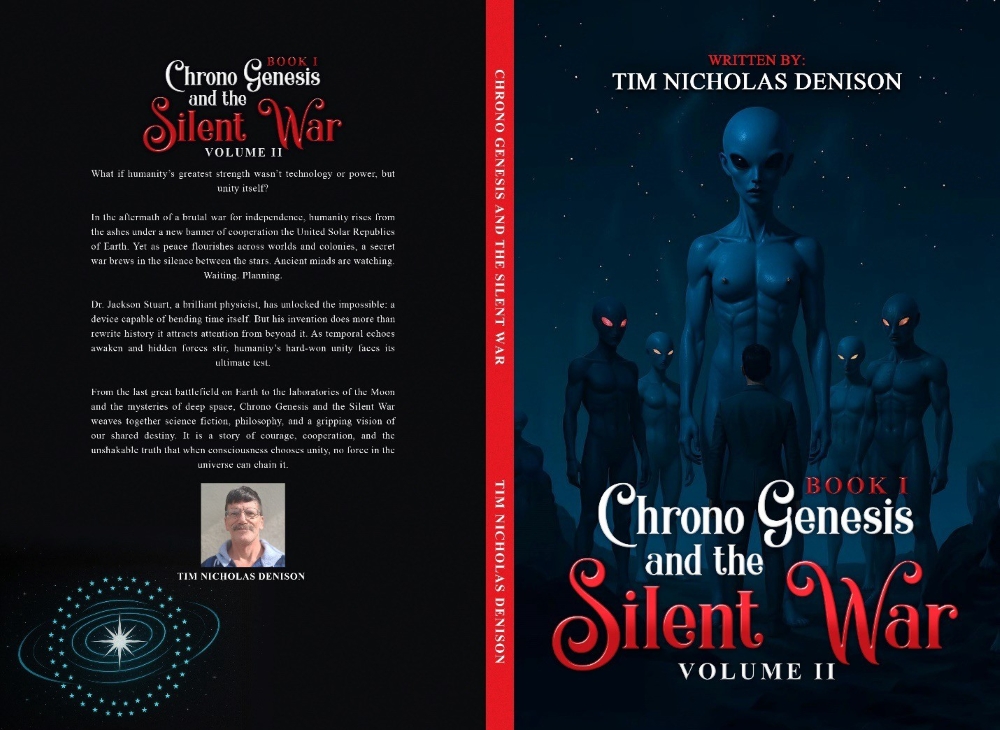
Unity as a Choice: The Inspiration Behind Chrono Genesis and the Silent War

Photo Courtesy: Tim Nicholas Denison

Chrono Genesis and the Silent War is written for science fiction lovers. However, more importantly, it is written for anyone who believes that stories still matter, stories that challenge us, inspire us, and remind us of who we can be at our best.

Book Two continues this journey and will be released later this year, expanding the universe and pushing the themes of unity, consciousness, and shared purpose even further.

If there is one message I hope readers take from this work, it is this: we need not let the past define our future. We can choose something better. And when we do, the possibilities are far greater than we imagine.

Amazon Book link: Chrono Genesis and the Silent War: Volume 1 | Volume 2

Mystery Shoppers and Micro-Audits: The Human Checks Behind Juici Patties’ High-Tech Franchise Oversight

By: Maria Williams

The franchise model is a profitable one for both franchisors and franchisees. However, franchisors must determine how to monitor and enforce brand standards without micromanaging each location. Stuart Levy, Managing Director of international Jamaican franchise Juici Patties USA, has developed a method of oversight that still affords franchisees agency.

Juici Patties started in Jamaica, where it quickly became the country’s top fast-food franchise. In 2024, the company began its American expansion. Most of its locations are in Florida and New York, but Juici Patties’ leadership aims to eventually open stores across the country.

Juici Patties has experienced rapid growth, in part due to the strong relationships it builds with its franchisees. But as the company and its total number of locations expand, they have had to find ways of monitoring each franchise.

“We use spot checks to strike a balance between maintaining control of brand standards and empowering franchises to operate independently,” Levy explains. “We have mystery shoppers that go into the locations on a monthly basis. They check out the standards. We get the reports instantaneously. The franchisees see the reports as well.”

“We grade the stores off of those mystery shoppers,” he continues. “The grades determine whether they’re able to open more stores or whether we need to have them held accountable for certain breaches.”

Juici Patties also collaborates with third-party auditors who take a detailed look at each store’s operations. “They go in and use our franchise management software to do visit audits, checking up on how long patties are held, how the patties are baked, every standard operating procedure that we have for operating a store,” Levy says. “And again, we can track that through the software, and the franchisee has access to it.”

The audit itself is important, but the way Juici Patties uses the feedback may be even more critical when it comes to each store’s success.

“We can use the audits to give homework,” Levy says. “So, if, for example, we find that a store has too many leftover patties, we can assign a task directly to that franchisee to ensure they don’t exceed X amount.”

Although Levy emphasizes the importance of franchise oversight, he has also found that when Juici gives franchisees some level of creative control, their performance improves.

“We give them a lot of leeway to make decisions and do things differently,” he says. “It just has to be approved by us, and they simply have to ask a question. Sometimes it is as easy as a texted question. Sometimes it might call for a more in-depth meeting where we discuss and find common ground.

Levy provides an example of a store in New York that offered packets of hot sauce with their patties. The hot sauce was not from Juici Patties or even Jamaican-branded, but customers loved it. “We said, ‘Well, if people are asking for it and it’s moving, then by all means,’” he says.

In this venture and others, Juici Patties has shown that it’s capable of balancing automation with a human touch.

Software systems monitor patty hold times and other key operational metrics, and auditors generate reports of those metrics. However, if a franchisee falls short of expectations, these reports are not used to shame or punish them. Instead, they represent an opportunity for constructive coaching.

When franchisees know that they can come to corporate for help, they will be far more likely to proactively address problems. Mystery shoppers, micro-audits, and other forms of franchisee monitoring are not just ways to enforce brand standards. They are a sign that Juici Patties’ culture of collaboration is alive and thriving.

OOJ Foundation’s Yogi Priyavrat Animesh Hosts Davos Dialogues on Ethical Leadership

By: Natalie Johnson


Yogi Priyavrat Animesh, founder of the OOJ Foundation, concluded a series of leadership engagements at the World Economic Forum Annual Meeting in Davos from January 19 to 21, where he participated in private dialogues on consciousness, ethical governance, and compassionate leadership amid global uncertainty.


During the forum, Yogi Priyavrat hosted a closed-door Davos Salon on Leadership and the Future, bringing together leaders from business, philanthropy, civil society, and the arts. The discussions explored how leadership quality, inner clarity, and long-term responsibility are becoming increasingly relevant as political, economic, and environmental systems face rising volatility.


Participants reflected on the growing gap between technological capability and ethical maturity, and how leadership decisions driven solely by short-term metrics can contribute to systemic instability. According to those involved, the dialogue emphasised that effective leadership today requires not only technical expertise and policy tools, but also consciousness, restraint, and an awareness of interconnected global systems.


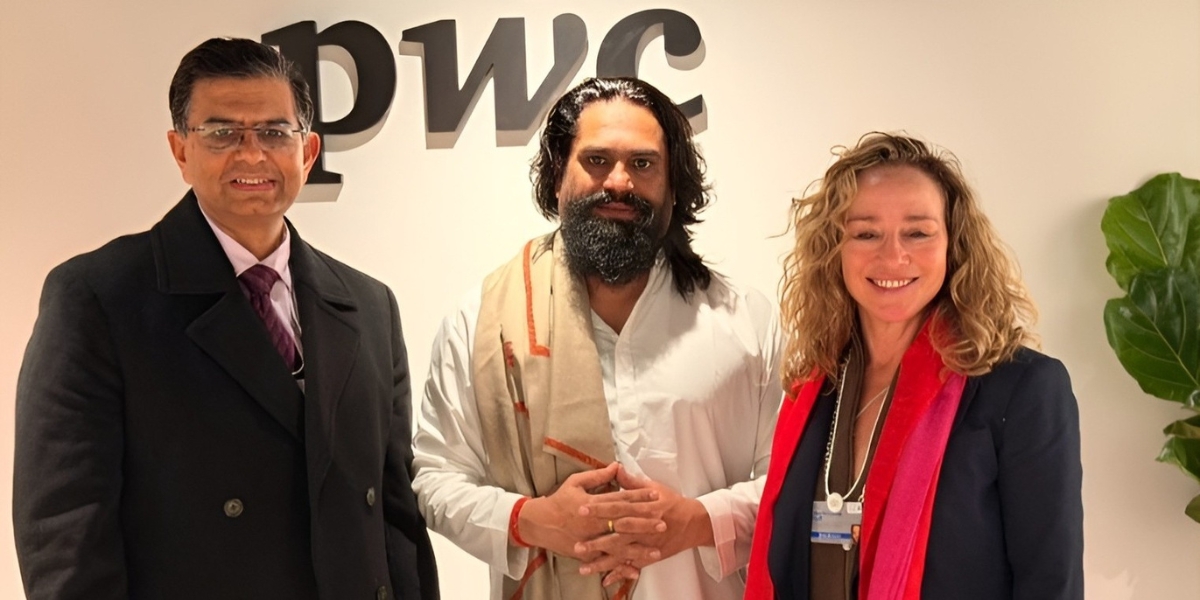
As part of his engagements in Davos, Yogi Priyavrat met with Sanjeev Krishnan, Chairman of PwC India, to discuss the evolving role of corporate leadership in addressing sustainability and social responsibility beyond compliance frameworks. Their exchange focused on how organisations can integrate ethical awareness and long-term thinking into governance structures, particularly in an era of climate risk and economic fragmentation.


He also held discussions with Dr Alganesh Fessaha of Gandhi Charity, where themes of non-violence, service, and moral leadership were examined in the context of contemporary humanitarian challenges. The conversation explored how Gandhian principles of simplicity, compassion, and responsibility remain relevant for modern institutions navigating complex global crises.


Additional meetings included Scott Cunningham of the Human Thread Foundation, Ashoka Fellow Ms Loana Bauer, and documentary filmmaker and humanitarian Ms Lisa Kristine. These dialogues addressed leadership through the lens of human dignity, social justice, and storytelling’s role in shaping public consciousness.


Across these engagements, a central theme emerged: compassionate leadership — the idea that decision-making must be informed not only by efficiency or power, but also by empathy, awareness of consequences, and respect for human and natural systems. Participants discussed how leadership disconnected from conscience and values can amplify social division, environmental degradation, and geopolitical instability.


Yogi Priyavrat’s contribution drew on a broader philosophical framework that views leadership as inseparable from inner awareness and responsibility. He emphasised that global challenges such as climate stress, economic inequality, and institutional trust deficits cannot be addressed through structural reforms alone, but require a shift in how leaders perceive their role and impact.


In earlier dialogues, Yogi Priyavrat has articulated the idea that natural systems, air, water, and energy,  should be understood not merely as economic resources, but as living foundations of human stability. At Davos, this perspective was applied to leadership itself, suggesting that an imbalance in values and consciousness can produce cascading effects across political, economic, and ecological domains.

Participants also reflected on the risks of leadership driven by constant acceleration, competition, and extraction, and the need for greater restraint and long-term orientation. The discussions highlighted that many of today’s crises are not the result of a lack of knowledge or innovation, but of decisions taken without sufficient ethical grounding or systemic awareness.

OOJ Foundation's Yogi Priyavrat Animesh Hosts Davos Dialogues on Ethical Leadership (2)

Photo Courtesy: Yogi Priyavrat Animesh


The World Economic Forum Annual Meeting convenes heads of state, business leaders, academics, and civil society representatives from around the world to address issues such as climate risk, the energy transition, geopolitical conflict, and economic resilience. While much of the forum focuses on policy, finance, and technology, Yogi Priyavrat’s engagements contributed a complementary emphasis on leadership consciousness and moral responsibility.

Observers noted growing interest among global platforms in examining the inner dimensions of leadership, including judgment, emotional intelligence, and ethical clarity, as critical factors in institutional resilience. In this context, the Davos Salon hosted by Yogi Priyavrat reflected a broader shift toward integrating values-based perspectives into global governance discussions.


About OOJ Foundation

OOJ Foundation is an institutional platform dedicated to leadership, ethics, and sustainability. It works with leaders and institutions through dialogue, reflection, and cultural engagement to promote responsible decision-making, long-term resilience, and respect for natural and human systems. The foundation’s work focuses on bridging inner awareness with external action in an increasingly complex and interconnected world.

Why Developers Prefer Private Cloud Services for Testing and Deployment

Developers need environments that are reliable, flexible, and secure. Whether they’re working on a small internal tool or a large-scale product rollout, the way code is tested and deployed matters just as much as the code itself. While public cloud platforms offer speed and convenience, more development teams are turning to private cloud services for their day-to-day workflows. The reasons are clear: better control, tighter security, and more predictable performance.

Environments Developers Can Actually Trust

Testing environments often mimic production. That’s the whole point – to catch bugs, performance issues, and behavior differences before the real users ever see them. But when teams use shared or public environments for testing, the results can be inconsistent.

In private cloud services, the infrastructure is dedicated. You’re not sharing resources with other companies or risking interference from unrelated workloads. Developers can set up staging environments that closely match production, making tests more meaningful and easier to repeat. That kind of reliability builds confidence. If something works in staging, there’s a good chance it’ll work in production, too.

Flexible Resource Allocation, Without Surprises

One of the biggest frustrations for developers is when environments aren’t available or when resource limits are hit during a critical deployment. With private cloud setups, teams can define their own quotas, scale resources on demand, and avoid many of the limitations of public cloud tiers. There’s no waiting for shared capacity to free up. There’s no risk of being throttled because other tenants are suddenly using more bandwidth or compute power.

This flexibility means faster builds, quicker test runs, and smoother deployments – all things that keep development moving forward instead of getting stuck in infrastructure bottlenecks.

Security Is Built In, Not Patched On

Testing often involves sensitive data. Maybe it’s anonymized customer information, internal APIs, or upcoming product features. That kind of data shouldn’t be sitting in a public environment without tight controls.

Private cloud services (such as cloud server hosting) enable teams to implement security policies across all layers: network, access, data, and application. Developers can create isolated environments that grant access only to specific users. Logs stay within your infrastructure. Data doesn’t travel through third-party providers unless you want it to.

Integrated Tools and DevOps Pipelines

A private cloud environment doesn’t mean giving up automation. Many private cloud setups include built-in support for DevOps pipelines, container orchestration, and version control integrations.

Developers can automate builds, run tests in parallel, and deploy code with the same tools they’d use in a public cloud – just with more control and fewer surprises. This kind of integration helps teams maintain speed and consistency without sacrificing visibility or security.

Cost Predictability and Operational Control

Public cloud billing can get complicated fast. Small changes in usage, unexpected data egress, or increased test activity can all trigger higher-than-expected costs. With a private cloud, pricing tends to be more predictable. You’re paying for infrastructure you control, with fewer variables and better insight into how resources are used. That makes it easier to plan budgets, allocate costs across projects, and keep management happy. It also allows for more efficient long-term planning. When teams know what their infrastructure is doing, they can optimize it – reducing waste, improving performance, and scaling intentionally.

Developers don’t just want environments that work. They want environments they can trust, control, and rely on as they build, test, and deploy code. Private cloud services offer that kind of stability, especially for teams working on critical products or managing sensitive data. By giving developers more control, better security, and a predictable foundation, private cloud setups support faster, safer, and more confident development cycles – from first commit to final deployment.

Reliable Charpy Impact Testers for Pipe Manufacturing in the USA

When you work in pipe manufacturing or quality inspection, material strength is not something you can guess. Every pipe must perform safely under pressure, temperature changes, and real-world stress. If your testing data is inaccurate, the risks can be costly and dangerous. That is why many laboratories and production facilities trust a reliable Charpy impact tester in the USA to validate material toughness and meet strict compliance needs.

Whether you operate in the USA, UK, UAE, or Canada, you face similar challenges: tighter standards, growing competition, and higher customer expectations. You require testing solutions that are loyal, easy to operate, and built for long-term performance. 

Why the Charpy Impact Tester Matters in the USA for Pipe Quality

Pipes used in energy, construction, and industrial projects must resist sudden impacts and temperature shifts. Impact testing helps you understand how a material behaves when it absorbs energy during a fracture. This data allows you to confirm whether the pipe material can handle real operating conditions without failure.

If you manage a testing lab or production line, your decision affects safety, compliance, and brand trust. High-quality Pipe testing equipment supports accurate evaluation, reduces product rejections, and improves consistency across batches. When your testing process is reliable, your customers gain confidence in your products and your certifications.

This process is backed by national testing programs that maintain consistency and accuracy in dimensions, for example, the Charpy Machine Verification Program by the NIST (National Institute of Standards and Technology), a key resource for certified reference samples and proven machine performance.

How a Charpy Impact Tester System Works in the USA

A Charpy system measures the energy absorbed by a specimen when struck by a swinging pendulum. The sample is notched to control the fracture location. The energy difference before and after impact indicates the material’s toughness. This method is widely accepted because it delivers fast and repeatable results.

In many laboratories, a modern Charpy impact test machine offers digital displays, automated data capture, and improved operator safety. Advanced versions of a Charpy impact testing machine also allow you to store test records for audits and quality reviews, making your workflow smoother and more organized.

Common Configurations Of Charpy Impact Tester in the USA

Manual Impact Test Systems

Manual systems are popular in research labs and smaller facilities where testing volumes are moderate. They are easy to operate, comfortable to carry, and cost-effective. A primary Charpy impact tester machine offers you accurate readings without complex automation, making it suitable for controlled conditions.

Semi-Automatic and Digital Systems

As production grows, many facilities upgrade to digital platforms that offer better repeatability and faster reporting. These systems reduce operator error and improve data accuracy. A digitally enhanced Charpy impact test apparatus supports efficient quality control and simplifies compliance documentation.

Totally Automated High-Capacity Systems

Large testing centers usually require high throughput and consistent performance. Automated solutions integrate seamlessly with lab systems and offer advanced safety features. A high-performance Charpy impact test equipment setup helps you maintain productivity while meeting strict regulatory standards.

Key Features of Charpy Impact Testers in the USA Market

Leading facilities pick impact testers that deliver stable performance and dependable results.

Key factors include:

  • High measurement accuracy and repeatability.
  • Strong build quality for long-term operation.
  • Compliance with ASTM and ISO standards.
  • Easy calibration and maintenance support.
  • Clear digital reporting and traceability.

When comparing options, you also evaluate total ownership value. Instead of focusing only on Charpy Impact Test Machine Price, you consider service support, uptime, spare availability, and training benefits. This balanced view protects your investment and improves operational efficiency.

The Value of Operating with Trusted Manufacturers and Suppliers

Selecting the right partner matters as much as selecting the right machine. A loyal Charpy impact tester manufacturer delivers technical expertise, customization choices, and help for global compliance. You also benefit from consistent calibration services and professional training.

Working with an experienced Charpy impact tester supplier ensures on-time installation, responsive service, and access to genuine parts. This support is required when your testing programs are tight, and your production timelines cannot afford waits.

How You Can Select the Right System for Your Facility

Before investing, take time to assess your operational needs.

Question yourself:

  • How many tests do you complete daily or weekly?
  • Do you require automated reporting or manual operation?
  • Which compliance standards must you fulfill?
  • How much lab space is available?
  • What level of training does your unit require?

By replying to these questions, you select a system that suits your workflow today and grows with your development tomorrow. This method helps you avoid over-investing or under-specifying your equipment.

Long-Term Value and Business Confidence

Impact testing is not just about meeting standards. It saves your product’s importance, reduces failure rates, and strengthens customer trust. When your testing data is correct and consistent, you reduce rework, control material waste, and improve delivery timelines. 

Over time, this trustworthiness translates into measurable price savings and more powerful business performance across global markets.

Elevate Your Testing Process

Investing in a high-quality Charpy impact testing solution strengthens your quality assurance procedure and supports regulatory compliance across the USA, UK, UAE, and Canada. A good system improves safety, boosts productivity, and delivers dependable outcomes you can trust.

If you are ready to boost your impact testing powers and increase your working confidence, request a demo from Testron Group today and explore a professional solution designed for long-term loyalty and performance.

Teaching Ancient Egypt to Children Through Narrative: How “Eli and the Pharaoh’s Dream” Reimagines Learning for Modern Families

For generations, ancient Egypt has captured the imagination of scholars, students, and casual learners. From the architectural marvel of the pyramids to the mysteries of pharaohs and biblical connections, the civilization continues to fascinate. Yet translating its depth into a form that children can understand has always been a challenge. Textbooks often overwhelm young readers with details that lack emotional context. Museum exhibits inspire wonder, but they rarely linger long enough in a child’s mind to create lasting understanding. This is where narrative-driven learning steps in, particularly through children’s literature that builds curiosity through storytelling.

Eli and the Pharaoh’s Dream enter this space with a fresh and intentional approach. Written by Jay Boyle, a Navy veteran and first-time author, the book blends family life, biblical history, and ancient Egyptian culture into a warm narrative that is accessible to children without sacrificing educational substance. While the story introduces pyramids, river systems, and archaeological concepts, it presents them through the eyes of Eli, a young boy who learns from his father, a university history professor. This narrative lens allows children to engage with complex ideas in a way that feels natural rather than instructional.

One of the book’s strengths is its framing of ancient Egypt not as a distant, unreachable world but as a living story connected to modern curiosity. Eli is not a historian or a scholar. He is an ordinary child with questions, excitement, and a strong imagination. His father becomes a guide, offering explanations rooted in real historical practices, such as studying sediment layers to understand floods. These details help children see how history is uncovered and interpreted, giving them an early appreciation for scientific inquiry.

Teaching Ancient Egypt to Children Through Narrative: How “Eli and the Pharaoh’s Dream” Reimagines Learning for Modern Families

Photo Courtesy: Jay Boyle / Henry Miller

The book also serves another purpose. It thoughtfully and effectively introduces the biblical story of Joseph. Joseph’s role in Egypt is a key element of Judeo-Christian history, yet many children encounter the story only in simplified or purely spiritual formats. Eli and the Pharaoh’s Dream bridges that gap by grounding Joseph’s story in its historical setting. This allows parents and educators to discuss both the spiritual and cultural implications of Joseph’s journey. The book positions the biblical narrative within the broader context of Egyptian society, making it easier for children to grasp the significance of Joseph’s rise to influence.

There is growing interest among families and educators in stories that combine cultural depth with moral guidance. As technology changes the way children interact with information, parents are seeking books that anchor learning in values and meaningful content. Narrative-driven learning offers an approach that integrates emotion, character, and curiosity. Children retain more when they care about the characters and feel invested in the story. Eli’s excitement about his father’s discoveries becomes the reader’s excitement as well.

Teaching Ancient Egypt to Children Through Narrative: How “Eli and the Pharaoh’s Dream” Reimagines Learning for Modern Families

Photo Courtesy: Henry Miller

Jay Boyle’s own story adds another layer of resonance. After experiencing a major stroke, he felt a renewed sense of purpose that led him to write this book. His background as the son of a minister and a longtime history enthusiast contributes to the book’s tone. It reflects both lived experience and heartfelt intention. Although the story is crafted for children, the foundation is rooted in Boyle’s passion for connecting biblical and historical knowledge.

Educational experts have long emphasized that storytelling is one of the most effective tools for early learning. Narrative immersion strengthens memory, encourages empathy, and helps children understand cause and effect. When ancient civilizations are presented through characters rather than facts alone, children gain a more holistic understanding. They absorb cultural details but also feel the emotions, challenges, and opportunities that shape historical eras. Eli and the Pharaoh’s Dream uses this principle to full advantage by creating an environment where learning unfolds naturally.

Demand for culturally rich, spiritually grounded stories is increasing in both traditional and homeschooling settings. Parents are seeking books that reinforce values without being didactic. Teachers are seeking materials that introduce history in a way that feels relevant. Faith-based communities seek stories that make biblical lessons accessible to modern children. Boyle’s book sits at the intersection of these needs. It offers a gentle entry point into ancient Egypt, encourages curiosity about archaeology, and opens conversations about the spiritual significance of Joseph’s life.

The response from distributors has been clear: demand is strong and growing.

Educational distributors, faith-based wholesalers, and international book partners have shown sustained interest in the title, driven by two factors:

  1. Sales momentum, as families respond positively to the book’s narrative-driven learning
  2. Scalability, enabled by its multilingual availability and universal themes

The primary focus moving forward is sales volume and reach. This is not a limited-run or niche release. Eli and the Pharaoh’s Dream is being positioned as a high-demand, high-circulation educational title, with distributors actively seeking to place it into broader retail, school, and international markets.

From its earliest stages, Eli and the Pharaoh’s Dream was designed for global reach, not limited regional circulation. The themes it explores, family learning, historical curiosity, and moral reflection, translate across cultures, faiths, and education systems.

To support this vision, the book has moved into large-scale international production, with official translations underway and completed in:

  • Spanish
  • French
  • German
  • Arabic
  • Portuguese
  • Chinese

This multilingual rollout positions the book for worldwide sales and distribution, allowing it to reach families and classrooms across North America, Europe, the Middle East, Latin America, and Asia. Rather than adapting the book after success, the strategy has been to build for international audiences from the start, a decision increasingly reflected in distributor interest.

As families continue to navigate a fast-changing digital landscape, stories like Eli and the Pharaoh’s Dream offer an alternative that prioritizes imagination, moral depth, and cultural education. The book demonstrates that complex history can be introduced to children without overwhelming them. It also highlights the importance of narrative as a bridge between academic learning and emotional development. For parents seeking meaningful literature and educators looking for accessible teaching tools, this book offers a valuable resource.

Eli and the Pharaoh’s Dream demonstrates that history comes to life when presented through a child’s perspective. More importantly, it reminds us that storytelling remains one of the most powerful educational tools we possess.

Farhad Hanasab: From Beverly Hills to Wall Street – The Bicoastal Expansion of a Trusted Advisor

For over 35 years, Farhad Hanasab has been a quintessential Beverly Hills success story, a trusted advisor who built an empire by serving the unique needs of his local community. But in a bold and strategic move that signals a new chapter in his remarkable career, he is taking his proven boutique insurance model to the East Coast, with plans to expand into New York City. This bicoastal expansion is not just a geographic move; it is a strategic evolution, a way to better serve his increasingly mobile, bicoastal clientele and to bring his unique brand of high-touch, specialized service to a new and dynamic market. It is a testament to his vision, his ambition, and his unwavering commitment to meeting the evolving needs of the people he serves.

The decision to expand to the East Coast is a natural and logical next step for a firm that has built its reputation on serving a high-net-worth clientele. In today’s globalized world, the lines between work and life, between home and away, are increasingly blurred. Many of Farhad Hanasab’s clients, from celebrities and athletes to entrepreneurs and executives, have a presence on both coasts. They own homes in Los Angeles and apartments in New York. They do business in Silicon Valley and on Wall Street. They are a truly bicoastal and even global population, and they need an advisor who can understand and protect their complex, multi-jurisdictional lives. By establishing a presence on the East Coast, Farhad Hanasab is not just following his clients; he is anticipating their needs, providing them with a seamless, integrated service that can span the continent.

This expansion is enabled by his strategic partnership with Highstreet Insurance Partners, a national brokerage firm that has provided him with the resources and platform to take his business to the next level. The partnership has given him access to a national network of expertise, a broader range of products and services, and the technological infrastructure needed to support a bicoastal operation. It is a powerful example of how a strategic alliance can be a catalyst for growth, enabling a successful local firm to expand its reach and impact without sacrificing the culture and values that made it successful in the first place.

But the expansion to the East Coast is more than just a business strategy; it is also a personal and professional challenge that Farhad Hanasab is embracing with his characteristic enthusiasm and determination. He is not simply opening a satellite office; he is immersing himself in a new market, culture, and set of challenges. He is building new relationships, forging new partnerships, and learning the unique rhythms and nuances of the New York business world. It is a process that requires humility, adaptability, and a willingness to learn, qualities that have been the hallmark of his entire career. He is approaching this new chapter not as a conqueror, but as a student, eager to understand and to serve a new community with the same level of care and commitment that has defined his work in Beverly Hills.

This bicoastal expansion is also a testament to Farhad Hanasab’s belief in the universal appeal of his boutique model. He is confident that his commitment to specialization, to personal service, and to radical transparency will resonate just as deeply with the discerning clientele of New York as it has with the elite of Beverly Hills. He knows that in a world of increasing complexity and impersonal transactions, the human touch is a universal currency, a value that transcends geography and culture. He is betting that his high-touch, relationship-driven approach will be a welcome and refreshing alternative to the often-impersonal, volume-based models that dominate the East Coast market.

As Farhad Hanasab embarks on this new and exciting chapter, his story serves as a powerful inspiration for any entrepreneur looking to grow and evolve. He has shown that it is possible to expand without losing your soul, to achieve national scale without sacrificing local touch. His journey from a Beverly Hills teenager to a bicoastal power player is a testament to the enduring impact of a clear vision, strong values, and an unwavering commitment to the people you serve. It is a story that proves that the principles of trust, integrity, and human connection are not just the foundation of a successful business; they are the keys to building a lasting and meaningful legacy, a legacy that can span a continent and inspire a new generation of leaders.

Disclaimer: The information provided in this article is for general informational purposes only and is not intended as legal, financial, or professional advice. While we strive for accuracy, we make no representations or warranties, express or implied, about the completeness, accuracy, reliability, suitability, or availability of this information. Use of this information is at your own risk.

Sanctuaries Under Siege: Jonathan Hernandez Bringing Digital Defense to the Church

By: Natalie Johnson

For most of American history, churches have worried about attendance, doctrine, and community trust. Very few have worried about ransomware.

That omission is no longer sustainable. As churches digitize their giving, communications, and operations, they have quietly become some of the most vulnerable institutions in the country. They store sensitive personal data. They operate on limited budgets. They rely on volunteer labor. And perhaps most critically, they assume goodwill in a digital environment that rewards exploitation.

Jonathan Hernandez has seen what happens when that assumption breaks.

A cybersecurity professional with experience spanning government work, Fortune 100 companies, and healthcare systems, Hernandez now finds himself fielding calls from pastors and church administrators facing threats they never imagined would target them. His path from the Philippines to Ohio to a seminary in Kentucky has positioned him as a leading voice in a neglected corner of the tech world.

Why Churches Are the Ideal Target for Hackers

From a technical standpoint, churches present an ideal attack surface.

Many rely on aging systems assembled through years of incremental fixes. Budgets are often allocated toward visible ministry needs rather than invisible infrastructure. Volunteers manage critical platforms with minimal training. Security updates are delayed. Passwords are reused. Backups are incomplete or nonexistent.

The most dangerous vulnerability, Hernandez says, is cultural.

“Churches operate on trust,” he explains. “That trust works beautifully in person. Online, it becomes a liability.”

Churches collect donation data, contact information, counseling records, and, in some cases, background check materials for children’s ministry volunteers. Hackers know this. They also know churches rarely maintain incident response plans, legal counsel for breaches, or cyber insurance coverage. A single phishing email can compromise an entire organization.

Unlike corporations, churches often assume they will not be targeted. That assumption is precisely what attackers exploit.

The Unexpected Rise of a Church Cybersecurity Specialist

Over the past year, Hernandez’s inbox has filled with invitations that did not exist before. Churches began asking him to assess their systems. Conferences invited him to speak. Administrators reached out quietly after noticing suspicious activity. What emerged was a clear pattern of unmet need.

“I didn’t plan to work in this space,” Hernandez says. “But once I saw the gap, I couldn’t ignore it.”

His background positioned him to respond where few others could. He understands enterprise-level security threats, but he also understands how churches operate, often with limited resources, volunteer-run systems, and a deep sense of relational trust. That combination has made him uniquely effective in a space largely overlooked by both the tech world and the church.

At conferences, Hernandez watches leaders react in real time as he walks through common attack vectors. Many are stunned by how exposed their systems are. Others realize, often uncomfortably, that they are already vulnerable. What distinguishes Hernandez in these rooms is not only technical fluency, but the way he frames risk without condemnation.

He does not approach churches as negligent. He approaches them as responsible leaders who were never given the information they needed.

How Seminary Shapes Crisis Response

Hernandez’s seminary training has not softened his technical advice. It has sharpened it.

When churches experience breaches or near misses, fear and blame often follow. Seminary has shaped how Hernandez navigates those moments. He emphasizes shared responsibility over individual fault. Recovery over accusation. Education over embarrassment.

“Once blame enters the room, the technical problem becomes relational,” he says. “And then you have two crises instead of one.”

Christian ethics also inform how he frames data privacy. Protecting information is not merely a compliance issue. It is a pastoral responsibility. Churches hold stories, struggles, and identities entrusted to them. Mishandling that data violates care, not just policy.

His theological training has taught him to ask different questions. Not only what failed, but who is hurting. Not only how to secure systems, but how to rebuild trust.

The Church’s Digital Blind Spot

Across regions, Hernandez encounters the same misconception. Churches believe that moral integrity makes them less attractive targets.

“That is exactly why they are targeted,” he says. “Attackers look for places where skepticism is low.”

Artificial intelligence has accelerated this vulnerability. Deepfake audio can imitate pastors requesting urgent transfers. AI-generated emails mimic familiar writing styles. Social engineering attacks now scale with alarming precision.

When Hernandez explains these threats, pastors often respond with disbelief, then concern, and finally urgency. Many admit they assumed technology was neutral or peripheral to spiritual leadership. That assumption no longer holds.

When Vulnerability Becomes Visible

At a recent U.S. conference, Hernandez guided church leaders through a simulated breach scenario. Within minutes, administrators saw how interconnected their systems were and how quickly damage could cascade. Several realized they were one incident away from operational paralysis.

Internationally, similar conversations take on even greater weight. In parts of Asia, churches face digital surveillance alongside cybercrime. There, cybersecurity is not only about finances. It is about safety and continuity.

“These are global conversations,” Hernandez says. “The threats just wear different faces.”

What unites them is unpreparedness. Churches often discover their vulnerability only after harm occurs.

Faithfulness Is Not Passivity

Hernandez is careful not to frame cybersecurity as fear-driven. He frames it as stewardship.

Faithfulness, he argues, does not mean inaction. It means responsibility. Ignoring risk does not demonstrate trust in God. It abdicates care for people.

If every church asked for his help tomorrow, Hernandez would begin with culture before code. He would build security awareness as a form of discipleship. Train leaders who could educate their congregations. Document systems so that churches are not dependent on a single individual. Prepare response plans so panic does not dictate decisions.

“Security is not about locking everything down,” he says. “It is about making sure the mission can continue when something goes wrong.”

A Mission Still Taking Shape

Hernandez does not present himself as a savior for the church’s digital crisis. He presents himself as a servant responding to a visible need.

Through consulting, teaching, public speaking, and training, he hopes to help churches recognize risks before damage occurs. The emotional burden, he admits, is witnessing communities remain unaware of vulnerabilities that could fracture trust overnight.

“I wish more churches understood that being targeted does not mean they failed spiritually,” he says. “It means they live in the same digital world as everyone else.”

American churches are not under siege because they are weak. They are under siege because they are trusted, connected, and often unguarded. In an AI-accelerated world, that combination demands attention.

Jonathan Hernandez is paying attention. And increasingly, the church is listening.

Church leaders seeking expert guidance on cybersecurity risks, digital preparedness, and safeguarding their congregations in an increasingly digital world can contact Jonathan Hernandez at itsjhernandez14@gmail.com for education, training, and consultation.

Disclaimer: The information provided in this article is for educational purposes only and does not constitute professional advice. Church leaders should consult with qualified cybersecurity professionals for specific guidance tailored to their needs.

Lakewood Publishers: What It Takes for a Book to Matter

There is a moment when a manuscript stops being a private thing and becomes a public question:
What do you want this book to do in the world?

Too often, authors are left to answer that question alone.

They know their ideas matter. They feel the pull of urgency, relevance, truth. But the publishing ecosystem is complex: editing standards, formatting systems, distribution pipelines, marketing models, creative packaging — all moving fast, all demanding decisions that determine whether a book disappears or endures.

Lakewood Publishers exists at that crossroads — not just to help authors publish, but to help them thrive as published authors.

Who We Are: Authors’ Partners From Start to Finish

Lakewood Publishers is a full-spectrum publishing partner built for writers who want control of their work and the skills to make it matter. From raw submission to finished book — and everything in between — we walk with our authors through every step of the journey:

  • From manuscript evaluation and editing
  • Through professional formatting and design
  • Into publication on major retail platforms
  • And supportive marketing, distribution, and audience reach

We became who we are through hands-on experience, not theory. What began more than two decades ago as a group of freelance editors helping authors polish their first chapters evolved into something broader — a publishing team that understands both craft and commerce, voice and viability.

Our founders saw early on that talented authors were grinding in isolation:
The business owner has a powerful idea but no publishing plan.
The creative with a story waiting to be shaped;
The expert whose voice deserved a platform — but without surrendering ownership.

Lakewood was built not to replace authors, but to enable them — with expertise, structure, and partnership, without taking royalties or rights from the people whose names are on the covers.


The People We Serve

Our authors come from all walks of life:
Business owners building authority.
Industry experts are crystallizing years of knowledge.
Leaders sharing lessons in accountability, strategy, and influence.
Creatives shaping narratives that resonate.

They share one thing in common — they want ownership of their work.

They want a team that handles publishing with care and expertise, not extraction. They want to keep control of their intellectual property and the revenue it generates — not pay with rights or royalties.

We work with authors who view books as assets with real potential — not merely creative objects, but tools for impact, career growth, and income.

How We Bring Books to Life

Publishing at Lakewood is not a simple checklist. It’s a craftful progression shaped by judgment, collaboration, and intentionality.

Editing & Ghostwriting
We help authors shape raw ideas into polished manuscripts — whether through detailed editing or full creative support for those who need guidance in translating their vision into words. This is not “ghosting away” voice, but a strengthening voice.

Formatting & Design
Books are objects that speak before they’re read. Thoughtful interior formatting and striking cover design make a book inviting and credible — qualities that matter in a crowded marketplace.

Publishing & Distribution
We guide authors through metadata, retail placement, ISBN acquisition, print and digital formats — ensuring books are discoverable where readers look: Amazon, Barnes & Noble, and global channels.

Marketing & Promotion
Every book has a story; a strategy helps it find its audience. We help authors shape messaging, plan positioning, and activate promotional tactics that move beyond noise into impact. 

Our Accomplishments: Impact That Speaks in Numbers

Lakewood Publishers has transformed hundreds of manuscripts into books that do real work in the world. Our achievements are not about flash — they are about lasting influence, measurable in ways that matter to authors and readers alike:

  • Millions in Sales — Our collective catalog has generated significant revenue for authors, turning writing from passion into profit.
  • Dozens of New York Times® Bestselling Authors — Authors we’ve worked with have reached the highest echelons of commercial success, each story a testament to craftsmanship and strategy.
  • Hundreds of Completed Titles Across Genres — From memoirs to business thought leadership, Lakewood books span subjects and audiences, all with professional quality and distribution reach.
  • Sustainable Author Careers — Many authors continue publishing with Lakewood year after year, building multi-title portfolios that grow their influence and income.

These accomplishments reflect not luck, but a framework honed over decades — one that puts technical integrity, narrative depth, and market relevance above trends and shortcuts.

Publishing as Purpose and Practice

We approach publishing as stewardship — an act of care that respects the author’s voice and the reader’s time.

A book is rarely “finished.” It travels: into libraries, classrooms, living rooms, and digital conversations. It becomes part of the ecosystem of ideas.

At Lakewood Publishers, we think in terms of endurance:
Will a book still matter next year?
Will it help the author’s goals?
Will it reach the right readers in meaningful ways?

These are the questions that guide our work.

Looking Forward with Thoughtfulness

The landscape of publishing continues to shift. Platforms evolve. Algorithms change. Attention fragments.

But the fundamental truth remains:
People still value well-made books.
Ideas worth saying deserve rigorous expression.
Authors deserve partners, not gatekeepers — collaborators, not extractors.

Lakewood Publishers exists for authors who want more — not just publication, but legacy.
Books that are owned, books that sell, books that open doors.

In a world that pushes speed, we choose care.
In a world that prizes clicks, we choose craft.
In a world that demands attention, we help authors earn it.