Why Most Indie Games Fail and How Better Data Could Help Improve Outcomes — A Look into MIKROS

Indie games are often where the most original ideas in gaming are born. Free from the constraints of massive publishers and blockbuster expectations, indie developers take creative risks that shape new genres, mechanics, and storytelling approaches. Yet despite the passion and innovation behind these projects, the harsh reality is difficult to ignore: nearly 93% of indie games never achieve sustainable revenue.

This failure is rarely a question of talent or effort. Instead, it is rooted in a more invisible problem, a lack of clarity.

Small and mid-sized game studios constantly ship updates, tweak gameplay loops, and experiment with marketing campaigns. But too often, these decisions are made without a deep understanding of why players behave the way they do. Teams move quickly, but blindly, hoping that the next patch, feature, or ad campaign will finally unlock growth.

The Data Problem Indie Studios Don’t Talk About

Most indie studios are not short on data. Player sessions, installs, churn rates, in-game purchases, and retention numbers are all being tracked in some form. The problem is not data collection, it’s data interpretation.

Developers face recurring challenges that slow growth and drain resources:

  • Player acquisition is inconsistent or unpredictable.
  • Key performance indicators fluctuate without clear explanations.
  • Retention drops sharply before Day 7.
  • Players churn without leaving feedback.
  • Monetization feels random instead of intentional.

As a result, teams rely on instinct rather than evidence. A feature is reworked because it feels wrong. A patch is shipped because it might help retention. Marketing budgets are spent without a clear understanding of return on investment. Meanwhile, the real issues remain hidden beneath layers of raw numbers and confusing dashboards.

This trial-and-error approach is expensive, and for indie studios with limited budgets, it can be challenging.

The Missing Piece: Clear, Contextual, Understandable Data

What indie developers need is not more data, but better insight.

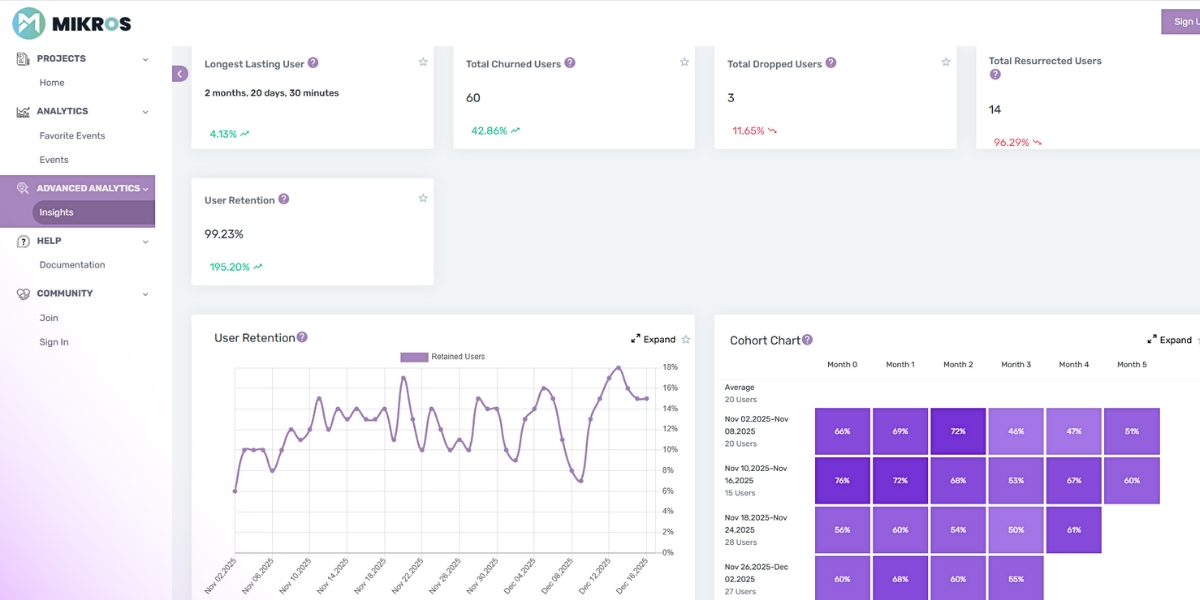
MIKROS Analytics was built to solve this exact problem. It gives game studios what they struggle to find elsewhere: a clear, accurate, and more accessible understanding of what is actually happening inside their game.

Instead of overwhelming teams with spreadsheets and generic dashboards, MIKROS focuses on clarity and context. It answers the questions developers are actually asking:

  • Where do players drop off and why?
  • Which gameplay loops keep players engaged long-term?
  • What signals predict churn before it happens?
  • Who are the most valuable players in the audience?
  • Which behaviors drive revenue and retention?

MIKROS goes deeper by breaking down performance across cohorts, behaviors, and demographics. Studios can benchmark their KPIs against direct competitors, identify gaps, and spot opportunities early. Most importantly, MIKROS AI explains what the numbers mean, translating complex analytics into actionable insights that product and marketing teams can use more effectively.

From Guesswork to Strategy

When data becomes understandable, everything can change.

With MIKROS Analytics, raw numbers transform into intelligent product and business decisions. Updates become more intentional instead of reactive. Monetization strategies are built around player behavior, not assumptions. Retention improvements are driven by evidence, not mere hope.

Studios gain the ability to:

  • Focus development sprints on features that appear to matter.
  • Identify high-value players and invest in the right audiences.
  • Run marketing campaigns with a clearer understanding of ROI.
  • Detect churn early and act before players leave.

Instead of losing players silently, teams may finally understand why users disengage and what can be done to bring them back.

Faster Growth With Less Waste

For indie studios, efficiency is everything. Every sprint, dollar, and decision counts. Clear insights reduce wasted effort and help teams move faster with confidence.

Retention improves because game design becomes more scientific. Growth stabilizes because decisions are grounded in real player behavior. Revenue becomes more predictable instead of volatile.

In this way, MIKROS Analytics becomes a silent partner for indie developers—one that may reduce uncertainty, sharpen decision-making, and support sustainable growth without adding complexity.

Leveling the Playing Field for Indie Developers

Large publishers have entire analytics teams dedicated to player behavior, monetization, and market intelligence. Indie studios rarely have that luxury. MIKROS bridges this gap by giving small and mid-sized teams access to the same level of strategic insight—without the overhead.

Better data leads to better decisions. Better decisions lead to better games. And better games build stronger, more resilient studios.

For indie game developers and studios looking to grow with clarity rather than guesswork, MIKROS Analytics offers a smarter way forward.

Game developers and studios can learn more at: https://developer.tatumgames.com/. With MIKROS, indie developers no longer have to rely on hope. They can more confidently build, grow, and scale.

Moon Owl Track and Field Club: Building a Stronger Generation Through Free Olympic Sport

By: BNDS Media

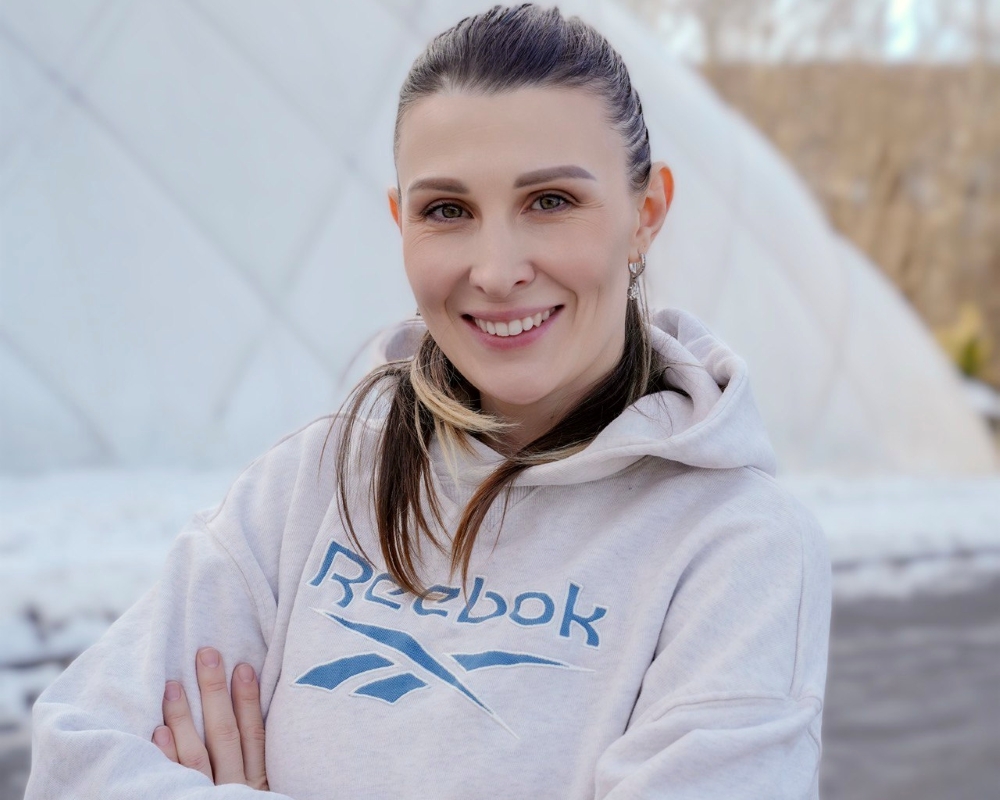
In a time when organized youth sports are becoming increasingly expensive, selective, and fragmented, Moon Owl Track and Field Club stands out as a powerful example of how sport can unite families, strengthen communities, and shape resilient future generations. Based in Rockland County, upstate New York, the Moon Owl Track and Field Club is more than a training program. It is a mission-driven community built around freedom of choice, inclusion, and access to Olympic-level athletics for homeschooling families.

Founded and led by Olga Lapina, Moon Owl Track and Field Club was created to address a gap that many families quietly struggle with: the lack of accessible, high-quality sports programs for children educated at home. For homeschooling families, especially large families with children of different ages, traditional sports structures often present serious challenges. Age restrictions, rigid group divisions, high fees, and long waiting periods leave many children without an opportunity to train, grow, and move together.

Moon Owl Track and Field Club offers a different model. Its core mission is simple and bold: free Olympic sport for homeschooling students, from toddlers to youth, in an environment that supports the whole family.

Olga Lapina’s professional journey is deeply intertwined with the philosophy of the club. A former elite pole vaulter, Lapina is the national record holder of Kazakhstan in pole vault and a longtime member of the Kazakhstan National Team. She is a multiple-time national champion and a participant and medalist in Asian and World Championships. Her athletic career at the highest international level shaped her understanding of discipline, resilience, and long-term development.

Beyond competition, Lapina holds a Bachelor’s degree in Sport Science and a Bachelor’s degree in Psychology. She is a certified personal trainer, pre- and postnatal trainer, and a practicing sports psychologist who has worked with Olympic champions and national teams. This unique combination of elite sports experience and psychological expertise underpins Moon Owl Track and Field Club’s training approach.

Moon Owl Track and Field Club: Building a Stronger Generation Through Free Olympic Sport

Photo Courtesy: Juliana Zaripova

The club has operated for over three years, while its official registration as a nonprofit organization and as a team under USA Track & Field occurred in August 2025. As an officially registered USATF team, Moon Owl Track and Field Club also provides a pathway for young athletes to earn recognized athletic credentials that may support future college applications.

What truly distinguishes Moon Owl Track and Field Club is its inclusive training structure. Children of different ages are not separated and isolated. Instead, training loads and exercises are thoughtfully adapted so that toddlers, younger children, teenagers, parents, and even grandparents can participate together. Younger athletes learn by observing and imitating older ones. Parents actively train alongside their children, modeling healthy habits, discipline, and perseverance.

This family-centered approach transforms training sessions into a shared experience. The club becomes a space free of judgment, pressure, or exclusion. Mistakes are treated as part of learning. Effort matters more than comparison. Progress is measured not only in speed, strength, or technique, but also in confidence, emotional regulation, and personal growth.

Lapina’s background in sports psychology plays a central role. Children are taught to manage stress, adapt to fast-changing environments, and apply lessons from sport to everyday life. Young athletes, affectionately called “little owls,” learn how to reflect on mistakes, extract experience, and move forward stronger. These skills extend far beyond the track.

Moon Owl Track and Field Club: Building a Stronger Generation Through Free Olympic Sport

Photo Courtesy: Juliana Zaripova

As a nonprofit organization, Moon Owl Track and Field Club operates on the principles of accessibility and community support. The club offers free training sessions and welcomes donations to sustain and expand its programs.

Every contribution directly supports youth athletic development, family sports initiatives, and the long-term vision of building a healthier generation.

The vision for the future is ambitious. Lapina plans to expand the program, create new jobs, and eventually build a dedicated athletic complex. One of the long-term goals is to establish an annual international charitable pole vault meet. These competitions are envisioned as a symbolic celebration of freedom, opportunity, and the rights of homeschooling families in New York.

Lapina often emphasizes that her life was shaped by access to free sports as a child in a small provincial town. Without that opportunity, her athletic journey would not have been possible. Today, Moon Owl Track and Field Club embodies the same belief: talent should not be limited by income, age, or rigid systems.

In a state where many sports programs are tied to institutions and strict regulations, Moon Owl Track and Field Club offers families an alternative rooted in freedom of choice. Guided by the belief that freedom is inherent in every individual, the club creates a space where families can raise strong, healthy, and confident children on their own terms.

Moon Owl Track and Field Club is not just about track and field. It focuses on community sports, youth athletics, athletic development, mental strength, and intergenerational health.

Families, athletes, and supporters are invited to join the club, spread the word, and support its mission. Together, we can build a future where free Olympic sport empowers children, strengthens families, and nurtures the next generation of leaders.

Inside My Main AI: The All‑in‑One Platform Powering 77K+ Subscribers

By: Gerome Alvarez

Teams that manage content, marketing, and customer communication often stack several tools before they send a single campaign. My Main AI Inc, an AI technology platform focused on text, image, voice, and video automation, offers an alternative approach, combining those tasks into one subscription that currently serves over 77,000 reported customers worldwide.

How Teams Use a Single Hub

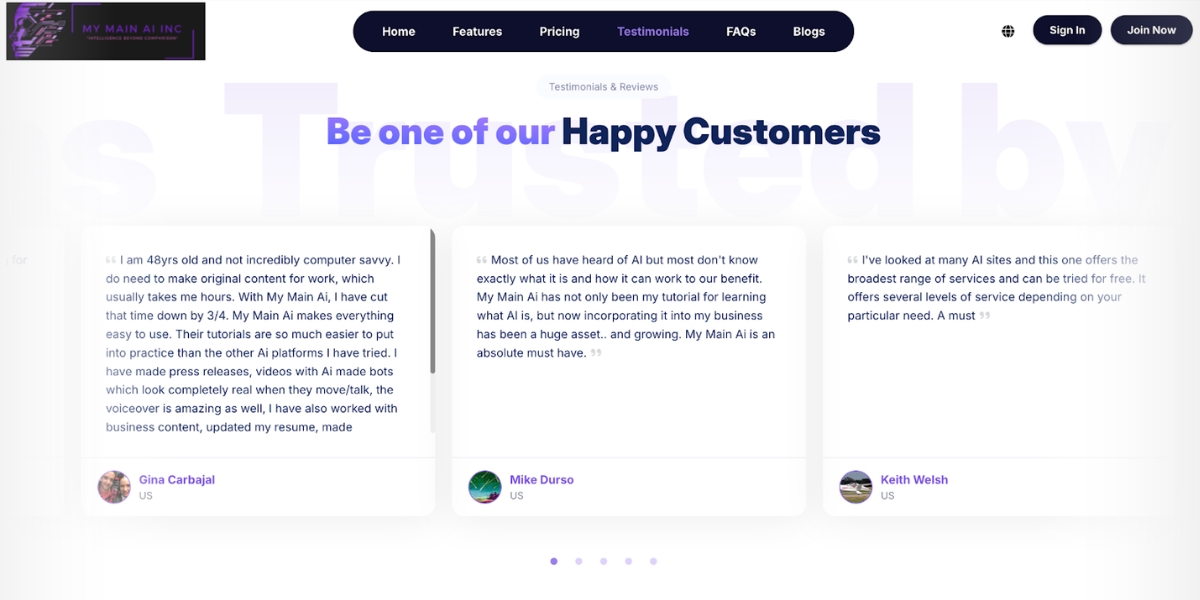
My Main AI describes itself as an all‑in‑one system for creators, developers, and businesses that want writing, design, and automation in a single workspace. Company materials state that its mission is to make advanced AI more accessible, customizable, and scalable, linking messaging, content creation, and productivity into one connected stack rather than keeping them in separate apps.

Subscribers use that stack for day‑to‑day work. Inside the platform, they can produce articles, product descriptions, ad copy, email campaigns, social posts, and video scripts, guided when needed by familiar frameworks such as AIDA, PAS, BAB, and PPPP. The same account holds templates for privacy policies, terms and conditions, FAQs, company bios, and testimonials, which turn routine documentation and brand language into flows that can be refined and reused over time.

The hub also extends into direct communication and support. Bulk SMS and email messaging, AI Web Chat, AI Chat Assistants, and AI Chat PDF and CSV offer users ways to contact audiences and interact with their own documents from the same screen. Real‑time internet access allows teams to research, draft, and respond without needing to step outside the subscription, which stands in contrast to single‑purpose tools that only cover one aspect of the workday.

Models, Media, and Voice in Practice

My Main AI reports that its platform connects to over 100 large‑scale models from OpenAI, Anthropic, Google Gemini, xAI, Amazon Bedrock and Nova, Perplexity, DeepSeek, Flux, Nano Banana, Google Veo, and Stable Diffusion 3.5 Flash. Public descriptions suggest that these models support text, image, voice, and video generation in more than 53 languages, positioning the service for subscribers working across various regions and markets.

Visual production sits within the same environment as writing and chat. The platform lists DALL·E 3 HD, Stable Image Ultra, and an AI Photo Studio to handle image creation, product mock‑ups, background changes, and variations from uploaded photos. Additional options such as AI Image to Video, text‑to‑video links through engines like Sora and Google Veo, and an AI Avatar tool flagged as “coming soon” provide a path from static concepts and scripts to short clips and avatar‑based content that could travel across social feeds and sites.

Audio and voice tools add another layer to those workflows. My Main AI provides multi‑voice synthesis in over 144 languages and dialects, SSML and tone controls, and speech‑to‑text transcription, so a project can move between written scripts, recorded narration, and searchable transcripts as it develops. Company materials highlight that this makes it possible for a training module, a marketing video, and a newsletter to share the same source text, with each format generated and adjusted inside the same platform.

Why 77K+ Users Share One Platform

Company information shared with media partners cites over 77,000 customers, around 3 million dollars in annual revenue, and monthly revenue growth of nearly 250,000 dollars. The business identifies its 49‑dollar subscription as the best‑selling tier, presenting that price as a way for individuals and teams to access the wider library of tools without layering multiple separate services on top of each other.

My Main AI states that it serves creators, developers, and businesses worldwide while building its own models and expanding a marketplace of extensions. Public feature lists mention payment gateways such as AWDpay and Coinremitter, connections to Stripe, Xero, HubSpot, and Mailchimp, and options for SEO tools, finance analytics, dynamic pricing, and wallet systems, positioning the platform alongside existing business software rather than outside it.

Company communications describe a roadmap that includes new video capabilities, training from text, PDFs, and URLs, and deeper tools for chat, analytics, and content automation. Taken together, these plans suggest that “all‑in‑one” is less a slogan and more a working target: My Main AI is measuring its progress by how effectively those 77,000-plus subscribers can keep their content, conversations, and data in one place as their workloads grow.

Why Modern Electricians Are Switching to Electrical Contractor Software

Today’s electrical industry moves quickly and relies on modern technology, especially as teams grow. Traditional tools such as paperwork, spreadsheets, and phone calls are no longer sufficient to manage the workload. For that particular reason, many electricians are now switching to electrical contractor software to make daily tasks easier, manage projects more efficiently, and stay competitive. This software helps save time, reduce errors, and deliver better service, making it essential for any electrical business looking to grow in the digital age.

Key Benefits of Electrical Contractor Software

Electrical contractor software streamlines daily tasks for modern electricians. It allows businesses to work more efficiently and accurately, especially when managing projects and tracking materials.

Simplified Project Management

Managing multiple jobs can be tedious and difficult to handle manually. Electrical contractor software enables an electrician to plan, allocate, and monitor tasks electronically. This ensures it is easy to know what to do, who is responsible, and when deliverables are due, keeping projects on track.

Real-Time Job Tracking

Electricians can monitor their work progress on any device using real-time tracking. This capability will ensure the project updates are always up to date, minimizing miscommunication and keeping the various teams on track even when accessing different sites.

Automated Invoicing and Estimates

Manually prepared invoices and estimates may lead to errors and wasted time. Electrical contractor software automates these functions, enabling electricians to produce precise invoices faster and receive payment within the greenbelt. It also helps maintain professional, accurate records of clients.

Inventory and Resource Management

It is important to track tools, equipment, and materials to ensure operations run efficiently. The software enables tracking the required inventory level, optimizing resource utilization, and preventing stockouts of essential materials during the job. This ensures that project execution is not disrupted by unnecessary delays.

How Software Enhances Client Relationships

Quick and clear communication and open workflows are key to ensuring clients remain satisfied, and electrical contractor software simplifies both. With electrical contact software, clients can receive real-time project updates via apps. The electricians can also provide immediate quotations for the software, saving clients time and easing the decision-making process. 

Also, they can easily follow up, and this is more systematic, and none of the client’s requests or concerns are ignored. Through clear communication and efficient project delivery, electricians can foster stronger trust and build long-term client relationships.

Overcoming Adoption Challenges

Some electricians worry about learning new software or adapting their workflows. Modern electrical contractor software addresses these concerns with simple, easy-to-use interfaces, even for beginners.

Cloud-based solutions enable electricians to securely store and access data from anywhere, and mobile access lets them manage projects on their phones or tablets. Most software providers also offer strong support and training, making it easy to get started and get the most out of the software. These features help electricians switch to digital tools without disrupting their daily work.

Streamlined Electrical Work

Electrical contractor software is becoming the premier choice for electricians who want to work more easily and efficiently while delivering better client service. It solves problems with traditional methods by streamlining project management, providing real-time job tracking, automating invoicing, and simplifying inventory control. By using these digital tools, electricians can save time, reduce errors, and build stronger client relationships, helping their businesses grow in a competitive market. In addition, these platforms offer greater transparency across projects, allowing teams to monitor progress, address issues earlier, and keep clients informed throughout the job. Digital records also reduce reliance on paperwork, making it easier to store information, review past work, and maintain organization as workloads increase. Over time, this level of structure can support more consistent operations and steadier long-term development.

Mark Story’s People-First Philosophy: Transforming Construction Leadership

By: Natalie Johnson

In an industry built on concrete, steel, and precision engineering, Mark Story has spent 37 years discovering that the most critical building material is something else entirely: people. As owner of Commercial Construction Services LLC in Caldwell, Idaho, Story has built a career on a philosophy that challenges conventional construction wisdom: “We build people through building buildings.”

This goes far beyond a catchy tagline. The philosophy represents a fundamental reimagining of what construction companies should prioritize, born from nearly four decades of hands-on experience on some of America’s most challenging projects. From renovating the Idaho State Capitol to constructing federal data centers in the urgent aftermath of September 11, from building some of the nation’s largest and fastest semiconductor plants to erecting football stadiums and basketball arenas, Story has seen the industry from every angle. And what he’s observed is a persistent gap between what general contractors offer their teams and what those teams actually need to succeed.

“Most general contractors provide training that does not help teams in the ways they actually need or want,” Story explains. The disconnect stems from relevance rather than effort or investment. Traditional training programs often miss the mark because they’re developed without deep operational insight into the daily challenges construction professionals face in the field. More critically, the industry remains trapped in an outdated approach: bullying through projects and hoping to make dates rather than creating predictable outcomes through deliberate strategic planning.

Commercial Construction Services LLC. addresses this gap with what Mark Story calls a “three-legged stool” approach. The first leg is years of operations experience, the kind that only comes from managing complex, high-stakes projects across diverse sectors. The second is planning expertise, which Story identifies as the most overlooked component of construction success. Rather than the reactive, crisis-driven approach that dominates the industry, CCS works to transform construction through deliberate strategic planning. The company dissects projects phase by phase and zone by zone to create predictable outcomes rather than last-minute scrambles. The third leg is technology, used as an enabler of better processes and communication rather than a replacement for human expertise.

What holds these three legs together is professional coaching. This element marks where Story’s approach diverges most dramatically from industry norms. Rather than simply delivering information or demonstrating techniques, Commercial Construction Services LLC. coaches teams to internalize and apply principles in real-world scenarios, right on site in the environments where they work day in and day out. “We love to teach and watch people put these tools into action,” Story says. “We want teams to win at building and build themselves in the process.”

This people-first philosophy extends into every aspect of Commercial Construction Services LLC’s work, including the products Story advocates for on job sites. When you put people first, you are always trying to find better tools to make them more efficient and keep them safer. Story has become a proponent of the Varicap rebar safety cap, a product that exemplifies his commitment to protecting workers. Unlike traditional rebar caps that deform when used and frequently fall off, exposing workers to impalement hazards, the Varicap stays securely in place on #4 to #11 bars, T posts, form stakes, conduit, etc. The Varicap requires no additional labor or materials, such as lumber or nails, and goes on effortlessly while delivering superior protection. When other style caps fall off, it becomes an inefficient stoppage of workflow, requiring someone to stop what they are doing to fix them. They get distracted, and when they return to their actual work, the risk of injury or low-quality work increases, and schedules are affected. For Story, choosing better safety equipment represents the same principle as choosing better training: putting people first in every decision. When you give teams tools that work and keep them safer, morale goes up and productivity increases.

This philosophy has proven particularly effective in high-pressure situations. Throughout his career, Story has been called into large-scale projects that were failing, situations where timelines were slipping, teams were fractured, and outcomes looked increasingly uncertain. His approach in these crisis moments reveals the heart of his people-first philosophy: rally the team, create a winning atmosphere through strategic planning rather than panic, and watch previously struggling projects cross the finish line on time. When teams transition from reactive firefighting to proactive planning, they begin enjoying their work again, finding satisfaction in predictable progress rather than constant crisis. You cannot replace a good team member experience when it comes to on-time delivery, safe job sites, high quality, and people retention.

The success of this methodology has convinced Story that the construction industry is “starving for” the kind of direct, relevant coaching his company provides. The demand for strategic planning and professional coaching spans sectors such as healthcare facilities and data centers. When teams have proper support, clear planning, and effective coaching, they complete projects and also grow as professionals.

Story’s proudest achievements reflect this priority. While his resume includes some of the most impressive construction projects in America, he’s quick to redirect the conversation: “We are most proud of the people we have helped build personally and professionally.”

Commercial Construction Services LLC currently works with multiple general contractors, bringing this transformational approach to teams across the industry. The company continues expanding its impact, growing people into leaders, builders, and planners who can transform their own teams and projects through strategic, phase-by-phase planning rather than the bull-your-way-through mentality that has dominated construction for too long.

In an industry often defined by what gets built, Mark Story is making a compelling case that who gets built matters just as much. When construction companies invest in developing their people with the same intentionality they bring to their projects, and when they choose tools and products that prioritize worker safety above convenience, everyone wins: the teams, the companies, and ultimately, the buildings themselves.

How Dinakara Nagalla’s Menthra Addresses the Gaps in Traditional Mental Health Apps

By: Natalie Johnson

While the mental health industry focuses on crisis hotlines and meditation libraries, Menthra is solving the fundamental problem: continuous support that actually remembers who you are.

Marcus explained his anxiety triggers to a mental health chatbot at 2 AM on Tuesday. Specific work situations. Particular social dynamics. The physical symptoms he experiences when panic arrives. The chatbot responded with generic coping techniques, such as breathing exercises, grounding methods, and cognitive reframing.

Thursday night, anxiety returned. Marcus opened the same app. The chatbot greeted him with “How can I help you today?” as if Tuesday’s conversation never happened. He closed the app and dealt with the panic attack alone.

This scenario repeats millions of times daily across the mental health app industry. Not because developers don’t care, but because they’re building products optimized for engagement metrics rather than therapeutic relationships.

Many companies face significant productivity losses due to stress, with a large portion of employees reporting stress-related challenges. However, access to mental health resources remains limited, and traditional therapy often involves long wait times, high costs, and restricted availability of practitioners.

The industry responded with meditation apps, generic chatbots, and crisis hotlines. These tools provide content without context. Exercises without understanding. Responses without relationships.

The fundamental problem remains unsolved: people need continuous support that remembers their story, recognizes their patterns, and maintains therapeutic relationships over time. Everything else is noise.

Founded by Dinakara Nagalla,  former CEO of EmpowerMX with decades of experience building systems that cannot afford to forget, Menthra approaches this challenge through memory infrastructure designed for continuity.

Most mental health platforms treat memory as a premium feature. Maybe you get conversation history if you upgrade to Pro. Menthra inverts this completely. Continuous memory is infrastructure. Everything else builds on top.

When users share sleep struggles on Monday, Menthra remembers by Thursday. When work stress manifests in September, the platform recalls that context in October. When patterns emerge over weeks, the AI recognizes them without requiring repetitive explanations. When familiar challenges resurface months later, a full therapeutic history informs responses.

This architecture enables something traditional apps can’t provide: authentic therapeutic relationships that compound over time. The platform features hyper-realistic digital twin avatars with natural-sounding voices, not for visual novelty, but because presence matters in therapeutic contexts. When you share your story at 2 AM, Menthra responds with complete awareness of everything that has been discussed.

Pattern recognition identifies triggers. Progress tracking celebrates specific milestones. Crisis detection ensures seamless escalation to licensed therapists when human expertise becomes necessary. All of it is built on memory that never resets.

Building continuous memory systems is hard. It requires sophisticated data architecture, privacy-first design, and AI models capable of maintaining context across months or years. Most startups avoid this complexity, opting instead for stateless systems that treat each interaction independently.

Nagalla’s background makes him uniquely positioned for this challenge. Before Menthra, he spent decades building systems that couldn’t forget, because in aviation, amnesia can lead to catastrophic consequences. Aircraft maintenance records must be complete, accurate, and instantly accessible. A single missing data point can ground an aircraft or compromise safety.

That same principle drives Menthra’s architecture: memory is infrastructure, not afterthought. The platform operates under HIPAA-aligned privacy with end-to-end encryption. Users can delete all data with one click. Information never gets sold to third parties. Pattern recognition identifies mental health trends without compromising privacy.

“Privacy and memory aren’t opposites,” Nagalla explains. “They’re requirements. People share their deepest struggles because we remember everything and forget nothing they want gone.”

Traditional mental health apps optimize for engagement: daily check-ins, streak counts, and gamified progress bars. These metrics look impressive in investor presentations while failing to address what people actually need during mental health struggles.

Crisis hotlines provide critical intervention but offer no continuity of care. You explain your situation to a stranger who won’t remember you next time. Meditation libraries contain thousands of exercises without understanding which ones actually help you. Generic chatbots deliver pre-written affirmations that ignore your specific context.

Menthra solves through relationship infrastructure. The platform doesn’t compete on content quantity. It competes on relationship depth. Every interaction builds on previous conversations. AI learns your patterns, celebrates your progress, and understands your triggers. When support becomes necessary at 2 AM, you’re not explaining your situation to a stranger. You’re continuing an ongoing therapeutic relationship.

This December, Menthra introduced modules for children and teens with parent dashboards. Young people, especially, need support that maintains context across developmental stages, not applications that treat them like strangers with every login. By early 2026, licensed therapists join the platform through digital twin technology, extending their practice through AI that carries their therapeutic approach 24/7.

Most mental health apps monetize through data mining or aggressive upselling of premium features. This creates perverse incentives. Platforms profit from user engagement regardless of whether that engagement actually improves well-being.

Menthra offers free access during early phases, building trust before monetization. The long-term model relies on sustainable subscription revenue that aligns incentives with user outcomes. Better mental health means continued subscription, not because users are trapped, but because the relationship has proven valuable over time.

Enterprise functionality launches late January 2026, bringing continuous memory infrastructure to workplace mental health programs. Educational institutions follow shortly after, addressing student mental health through systems designed for sustained support rather than crisis intervention.

The strategy mirrors successful models from Headspace and Calm: establish consumer love first, then scale to institutional markets once product-market fit is proven. But unlike meditation apps competing on content libraries, Menthra competes on something defensible: the depth of therapeutic relationships built through continuous memory.

The AI industry cycles through hype faster than users can evaluate claims. Today’s revolutionary chatbot is tomorrow’s abandoned product. Nagalla, whose other platforms include Aauti for educational equity and Saayam for transparent giving, builds for what comes after excitement fades: systems that prove value through years of consistent service.

His book “Becoming Human: Embracing Imperfection and Finding Purpose” explores this philosophy beyond the realm of technology. His work has been featured in Aerospace Tech Review, LARA Magazine, and Aircraft IT, establishing credibility in complex systems transformation.

Menthra’s broader vision extends beyond individual mental wellness. Nagalla envisions AI memory systems that carry legacy, not just data, but voices, values, and contradictions that make us human. Not perfection. Not curation. Authentic experience preserved with dignity.

Traditional mental health apps fail at 2 AM because they’re built on forgetting. Meditation libraries provide content without context. Crisis hotlines offer intervention without continuity. Generic chatbots deliver responses without relationships.

Menthra solves by making memory infrastructure rather than a feature. Continuous support that knows your story. Pattern recognition that celebrates progress. Crisis detection that connects you to human expertise when necessary. All are protected by privacy standards that recognize healing requires absolute trust.

“Mental wellness can’t be built on forgetting,” Nagalla explains. “When someone trusts you with their story at 2 AM, forgetting that story isn’t just bad technology. It’s abandonment. We’re ending that.”

In an industry that measures success by engagement metrics, Menthra is building something more fundamental: therapeutic relationships that compound over time, supported by systems that never forget why they exist.


Disclaimer: The content in this article is for informational purposes only and does not constitute medical advice. Menthra is a technology-driven platform designed to support mental wellness, but it is not a substitute for professional therapy or medical treatment. Always seek the advice of a qualified healthcare provider with any questions you may have regarding a medical condition or mental health concerns. The information provided by Menthra is based on its own services and technology, and individual experiences may vary.

Author Spotlight: Tim Guditus — The Thriller Writer Winning Readers Across the Globe

In contemporary thriller fiction, where readers increasingly seek stories rooted in realism and moral complexity, Tim Guditus has developed a body of work that examines the intersection of law enforcement, espionage, and human consequence. His novels blend crime drama with political tension, crafting narratives that challenge readers to confront uncomfortable truths about justice and corruption.

Tim draws from experience in law enforcement to inform his storytelling, bringing an authenticity to police procedure and investigative work that sets his approach apart from purely fictional constructs. This background becomes evident in how his characters navigate the practical and emotional terrain of their professions, not as idealized heroes, but as flawed individuals wrestling with the weight of their choices.

His novel “Over 21 Club” centers on Detective Tom Pickens, a worn-down investigator haunted by past failures and forced to confront a string of robberies that connect to unresolved cases from his career. The story unfolds within a nightclub where wealthy patrons and criminals converge, exposing corruption that extends from street-level crime to municipal power structures. Pickens discovers that the pursuit of justice often means confronting systemic rot, sometimes within his own department. The narrative refuses to simplify police work or offer easy resolutions. Instead, it follows Pickens through therapy sessions, strained family dinners, and the slow, painful work of rebuilding trust with his wife and daughter. 

“The Gordian Knot” takes a different approach, following a rogue Mossad agent trapped in a web of international betrayal. The novel explores the gray zones of espionage work, where loyalty becomes conditional, and survival depends on making choices that defy simple moral categorization. Tim constructs a world where intelligence operations create casualties not just through violence, but through the erosion of identity and purpose.

In “Forgotten Words,” the focus shifts to undercover operations and their psychological toll. The story examines what happens when pursuing truth in corrupt systems requires becoming someone else entirely, and what remains when the operation ends. It is a character study as much as a thriller, tracking the emotional cost of deception as a professional requirement.

“From Gorkey Park” draws on Cold War era espionage traditions while examining how shadow world intelligence work operates at the intersection of political power and personal survival. The novel demonstrates Tim’s interest in geopolitical tension as a backdrop for exploring individual moral conflict.

With “The Third Man: Oklahoma City Bombing,” Tim takes on historical subject matter, examining one of the most devastating domestic terror attacks in American history. The book blends investigative narrative with character-driven storytelling, approaching the event through a lens that emphasizes human impact alongside the procedural elements of the case.

Across these works, specific patterns emerge. Tim constructs protagonists who carry the accumulated damage of their professions. Detectives who have lost informants. Agents who have made compromises they cannot undo. People are trying to maintain relationships while doing work that demands secrecy and emotional distance. His narratives do not shy away from violence, but they treat it as consequential rather than spectacle. When characters die or relationships fracture, these moments resonate because they are treated as irreversible losses rather than plot mechanics.

What distinguishes his work in the thriller genre is the attention to aftermath. Many crime and espionage novels focus on the case, the mission, and the immediate danger. Tim extends the narrative to include what happens when the immediate crisis passes. The therapy appointments. The nightmares. The slow work of repair. This approach treats trauma as an ongoing condition rather than a single event, which adds depth to characters who might otherwise function primarily as vehicles for plot.

For readers drawn to thrillers that prioritize psychological complexity alongside suspense, or crime fiction that examines the institutional and personal costs of pursuing justice, Tim’s work offers a sustained exploration of these themes across multiple contexts, from domestic law enforcement to international espionage. His novels ask questions about what people are willing to sacrifice in pursuit of what they believe is right, and whether those sacrifices ultimately serve the cause they are meant to support.

Causely Is a NYC-Based Startup Pioneering the Rise of AI SRE

We all know the world is moving at the speed of AI, and nowhere is that clearer than in the world of software development. AI coding assistants like Cursor and Claude Code are writing and shipping code at a velocity that’s hard to imagine. This rapid pace is revolutionizing the way developers work, so it’s natural to wonder: how are on-call engineers and security professionals supposed to keep up? According to Shmuel Kliger, founder of Causely, the answer certainly isn’t collecting even more data:

“For years, the IT industry has struggled to make sense of the overwhelming amounts of data coming from dozens of observability platforms and monitoring tools,” said Kliger.

Instead, the Causely system works by automatically mapping an application’s topology and service dependencies, then applying a finite set of likely root causes to this data. This novel approach is counter to traditional tooling and methods that encourage businesses to collect as much data as possible, a situation that hasn’t fundamentally changed in decades, which then requires human troubleshooting to respond to alerts, make sense of patterns, identify root cause, and ultimately determine the best action for remediation.

A Paradigm Shift in Observability

The overwhelming amount of data produced in the AI era creates cognitive overload for SREs, making it impossible to isolate the meaningful signals amongst the noise. And the more complex a system is, the more precarious it is to perform effective root cause analysis. So while in the cloud era, a “collect everything” approach may have been feasible, in the modern AI era, it’s unsustainable. As systems become increasingly dynamic, the need for smarter, more targeted data management solutions has never been more critical.

Causely’s causal reasoning system is always running in the background of a user’s environment, attaching symptoms and alerts to a finite set of potential root causes. This is a critical shift. Their method centers around a live causal model that perpetually maps relationships among services, data flows, and infrastructure. 

Rather than stagnant dashboards, the platform ensures a continuously updated view of the interaction between components. It enables Causely to distinguish between real causes and downstream effects, which is essential for safe automation and effective incident response. This dynamic approach allows for faster, more accurate decision-making, minimizing downtime and enhancing system reliability. By constantly adapting to environmental changes, the platform ensures issues are identified and addressed before they escalate.

The Autonomous Future with Causely

Causely is one of a handful of software vendors leading the conversations around the rise of AI SRE. Kliger recently participated in a roundtable discussion hosted by The New Stack, where difficult conversations around the limitations of LLMs and the evolving role of the human operator were discussed.

Kliger is the most provocative of the panel, and his opinion carries a lot of weight as the former founder of Turbonomic (acquired by IBM) and CTO of SMARTS (acquired by EMC). He states there’s no reason to keep humans in places where machines can perform the tasks better. And while we may never reach a point where our online systems are fully self-healing and self-operating, this should ultimately be the future we strive for. 

In an article titled If Planes Can Fly Themselves Then Why Can’t IT Management be Autonomous? Kliger writes, “When it comes to IT operations, our goal should be to get humans out of the loop as much as possible. In a world run by software, where SLAs guarantee 99.999% uptime, even one incident in a month — which requires human intervention — is enough downtime to violate your commitments to your customers.

This is certainly a lot to think about. What we know for sure is that simply throwing LLMs at the problem won’t do the job when it comes to managing the reliability, performance, and security of online systems. A causal reasoning system that deeply understands the context of applications and how they connect to the business may be the best way forward.

There Is Truth in Every Fiction: How Runaway Confronts the Stories We Tell Ourselves About School, Pain, and Survival

By: Sylvia Lee 

There is a comforting lie we are taught early on: that school is a safe place, that everyone finds their people eventually, that discomfort is temporary and character-building. It is a story repeated so often that it hardens into something unquestioned. For many, that story holds just enough truth to pass as universal. For others, it becomes isolating, even damaging.

Runaway was born from the space between those two realities.

On the surface, Runaway reads like a science fiction horror novel. Samantha, a poor girl from a difficult background, enrolls in a strange high school only to discover that once inside, she cannot leave. The school becomes a closed system; oppressive, unyielding, and cruel in its own quiet ways. Samantha suffers, adapts, resists, and searches for escape. But beneath the genre trappings, the locked doors and eerie atmosphere, the story is rooted in something deeply familiar. It is a reflection of how institutions meant to nurture can instead consume, how enforced belonging can feel like exile, and how silence is often mistaken for acceptance.

I did not set out to write an allegory. I wrote from memory.

Throughout my own years in elementary, middle, and high school, I believed a version of reality that never quite fit me. I assumed that everyone else liked each other, that friendships were natural and effortless, that authority figures were benevolent caretakers. This perception didn’t just isolate me, it convinced me that my loneliness was a personal failure rather than a systemic problem. When you believe everyone else is thriving, you stop asking why you are not. You endure instead.

That endurance is what Runaway exaggerates on purpose. Science fiction and horror allow for distortion, and distortion can reveal truth more clearly than realism ever could. A school you cannot leave is not far removed from a school that punishes difference, rewards conformity, and ignores emotional damage because it does not show up on a report card. By turning those experiences into something surreal and frightening, I wanted to make the invisible visible.

Fiction has always carried this power. Every invented world borrows from the real one. The strongest stories do not invent pain for shock value; they reshape lived experience so it can finally be examined. There is truth in every piece of fiction, but the stories that last are the ones brave enough to look directly at that truth, even when it hurts.

For a long time, my relationship with writing was complicated. I started writing when I was twelve, but passion does not always come with confidence. There were periods when writing felt inaccessible, when my voice felt too small or too strange to matter. What pulled me back was honesty. Not polish. Not perfection. Honesty. Once I stopped trying to write what I thought was expected and instead wrote what I remembered, what lingered, what unsettled me, the work began to breathe.

That honesty is uncomfortable. It requires admitting that the systems we trust can fail us. It means acknowledging that not all suffering is accidental, and not all harm is visible. In Runaway, the school does not see itself as cruel. It believes it is functional. That distinction matters. Harm often hides behind good intentions, and fiction gives us a language to expose that without turning away.

This is something I believe emerging writers need to hear: you do not owe your reader comfort. You owe them truth.

Too often, writers are encouraged to soften their stories, to make them more palatable, more hopeful, more easily digestible. While hope is powerful, false hope is dishonest. Writing that avoids pain does not heal it; it buries it. When writers choose honesty, especially painful honesty, they create space for readers to feel seen rather than reassured.

My academic background in English and my continued pursuit of an advanced degree in English Education have deepened this belief. Literature is not just entertainment; it is conversation. It asks readers to sit with discomfort, to question norms, to recognize themselves in places they were told they did not belong. That is why my favorite genres, science fiction, fantasy, and horror, are often misunderstood. They are not escapist by nature. They are confrontational. They exaggerate reality so we can no longer ignore it.

Runaway is meant for adults because the wounds it explores do not disappear with age. Many of us carry school with us long after graduation: in our anxieties, our silence, our fear of exclusion. Writing this book was a way to name those feelings rather than dismiss them. It was a way of saying that alienation is not a personal flaw; it is often a response to environments that refuse to see us.

My earlier essay, “Do I Seem Asian Enough?” published in Asian American Voices, came from the same impulse. Identity, belonging, and perception are not abstract ideas. They shape how we move through the world. Whether I am writing nonfiction or speculative fiction, I am always returning to the same question: what happens when the story we are told does not match the life we are living?

For writers standing at the beginning of their journey, my advice is simple, though not easy. Write the thing you are tempted to avoid. Write the memory you keep revising in your head. Write the truth that makes you nervous. Readers can sense when a story is protecting itself. They can also sense when it is telling them something real.

The most meaningful fiction does not comfort us by pretending everything is fine. It comforts us by reminding us that we are not alone in noticing that it isn’t.

Runaway is not a solution. It does not offer easy answers or neat resolutions. What it offers is recognition. It is an acknowledgment that systems fail, that silence hurts, and that survival often looks nothing like success. If that truth unsettles, then the story has done its job.

In the end, fiction is not about escaping reality. It is about facing it, sometimes through locked doors, strange hallways, and imagined worlds that feel far too familiar.

Dr. Stephanie Wall Explains Why Waiting for Readiness Keeps Women Leaders Stuck

There is a quiet habit many women leaders share: waiting. Waiting for the right time. Waiting for certainty. Waiting until everything feels aligned, polished, and unquestionable.

Dr. Stephanie Wall has seen this pattern across executive leadership, entrepreneurship, higher education, and community spaces. Women with deep experience and proven results often delay stepping fully into the next level of leadership, not because they lack capability, but because they are conditioned to equate readiness with perfection.

Why This Pattern Persists

From early on, many women learn that preparation is protection. Being ready means minimizing risk, avoiding critique, and staying in control. Over time, this mindset becomes a leadership filter, prioritizing certainty over momentum.

But leadership rarely offers certainty.

Dr. Stephanie’s work challenges the assumption that readiness must come before movement. In reality, clarity often emerges after action, not before. Taking the first step, even with uncertainty, creates momentum that brings insight and direction. It is through the process of doing that women find the clarity they seek, rather than waiting for it to arrive first. This shift allows them to embrace growth as it happens, rather than waiting for the perfect moment.

Dr. Stephanie Wall Explains Why Waiting for Readiness Keeps Women Leaders Stuck

Photo Courtesy: Media Expertzy

Who She Serves

Dr. Stephanie works with women who are already qualified but hesitant to move forward without complete assurance.

She supports:

  • Executives considering expanded leadership or new platforms

  • Founders standing at the edge of growth or reinvention

  • Women navigating career transitions and identity shifts

  • Leaders who sense “more” but haven’t yet named it

These women are not unsure of their worth. They are careful with their timing, sometimes at their own expense. Their hesitation comes from a desire to ensure their decisions are perfect, which often leads to missed opportunities. In their effort to avoid mistakes, they unintentionally delay their growth and potential.

What She Observes at the Edge of Growth

Dr. Stephanie often sees women circling opportunity rather than stepping into it. They gather more information, seek additional validation, and wait for confirmation that the next move will be safe.

Meanwhile, the moment passes, or is claimed by someone else.

This hesitation isn’t fear. It’s responsibility taken too far. These women hold themselves to a high standard of accountability, believing that every move must be flawless. However, this sense of duty can often paralyze them, preventing them from taking the bold steps needed for progress.

The Reframe Dr. Stephanie Teaches

Dr. Stephanie helps women understand that readiness is not a feeling; it’s a decision.

Her work guides women to:

  • Recognize when preparation has become delayed

  • Trust experience over perfection

  • Move forward with intention, not overanalysis

  • Lead transitions instead of waiting for permission

This shift allows women to meet opportunity with presence rather than postponement.

What Changes When Waiting Ends

When women stop waiting to feel ready, momentum returns.

Vision sharpens.

Confidence deepens through action.

Leadership expands in real time.

They discover that growth does not require certainty; it requires commitment. By embracing the unknown and staying dedicated to the process, they unlock their true potential. This commitment allows them to adapt, learn, and evolve, even when the path ahead is unclear.

Looking Ahead

The future of leadership will belong to those willing to move forward without complete clarity.

Dr. Stephanie Wall’s work reminds women that readiness is not something to wait for. It is something to claim.

Because the next chapter rarely announces itself as “the right time.”

It begins when a woman decides to step into what she already knows.

She Has Something to Say

Where leadership, voice, and legacy meet.

Dr. Stephanie Wall Explains Why Waiting for Readiness Keeps Women Leaders Stuck

Photo Courtesy: One Million Lives Transformed

Scan to step into She Has Something to Say, a leadership experience for women ready to unmute their voice, claim their influence, and lead what’s next.