Next Gen Web Builders: A Study in Digital Clarity and Substance

By: Benjamin Harris

In an era where a digital presence is often reduced to a series of automated templates and fleeting social media metrics, there is a growing disconnect between how businesses present themselves and how they actually function. The digital landscape has become increasingly noisy, cluttered with “turnkey” solutions that often fail to turn the key to anything meaningful. For most founders and decision-makers, the challenge is no longer just getting online; it is staying relevant in a space that rewards substance far less often than it rewards volume.

Next Gen Web Builders emerged as a response to this fragmentation. Rather than viewing a website as a static digital business card or marketing as a series of disconnected campaigns, the firm treats the digital ecosystem as a cohesive extension of a company’s physical reality.

Identity and Origins

Defining Next Gen Web Builders requires looking past the standard definitions of an agency. They function more as digital architects and strategists than mere service providers. The philosophy is rooted in the belief that clarity is the precursor to conversion. If a user cannot understand the value proposition within seconds of landing on a page, no amount of sophisticated backend engineering can save the interaction.

While many firms lead with their own story, Next Gen Web Builders lead with an observation of the market’s current failures: the tendency to over-complicate simple goals and under-deliver on technical foundations.

Established in 2010, the firm’s foundations were laid by founders who emerged from the high-velocity Silicon Valley scene. Having witnessed the transition from the early social web to today’s complex, data-driven ecosystems, they brought a sophisticated understanding of how technology can either empower a brand or become its greatest bottleneck. While our strategic heart is anchored at 6128 Wilshire Blvd, Los Angeles, CA 90048, our perspective is international, with a robust global presence across the US, UK, Canada, and Germany.

At the core of the organization is a commitment to three foundational pillars: Integrity, Innovation, and Excellence. These are not merely slogans pinned to a wall; they dictate the threshold of every project. Integrity ensures a transparent appraisal of what a client actually needs versus what is trending. Innovation drives the search for smarter, more efficient technical paths. Excellence defines the final output—a refusal to ship work that is merely “functional” when it could be exceptional.

A Holistic Approach to the Digital Build

The services offered are not treated as a buffet of options, but as integrated components of a single machine. Next Gen Web Builders have organized their expertise into four distinct quadrants of digital growth:

  • Web Development & Design: Crafting high-performance, scalable environments that prioritize user experience and technical resilience.
  • Digital Marketing & SEO: Moving beyond vanity metrics to focus on discoverability and the intent of the end-user.
  • Content & Branding: Developing a coherent voice and visual identity that resonates with the target audience’s values.
  • Strategic Growth Solutions: Providing the long-term roadmap necessary to ensure digital assets appreciate in value over time.

In many organizations, the team building the site rarely speaks to the team writing the copy. The result is a disjointed brand experience. Next Gen Web Builders operate on a principle of total integration, ensuring the architecture of a site is informed by the marketing strategy from the very first wireframe.

The Architecture of Collaboration

The working relationship with Next Gen Web Builders is defined by an intentional shift away from the “vendor-client” hierarchy toward a model of shared intellectual investment. It is an intimate process, designed to strip away the abstractions of digital marketing and replace them with a transparent, rigorous framework.

This begins with The Deep Alignment Phase. Rather than starting with wireframes or color palettes, the dialogue begins with an audit of the business’s current reality. We sit with founders to dissect not just where the business is, but where the friction lies. This stage is less about technical requirements and more about understanding the soul of the enterprise—ensuring that the digital strategy we build is an honest reflection of the client’s operational excellence.

From this alignment, the work transitions into The Structural Blueprint. Here, the involvement level is high but focused. We believe that clients must be the masters of their brand’s digital logic. We provide frameworks that map out the user journey with surgical precision, treating every click as a decision and every page as a destination. This is where the “new world” of work becomes visible: we utilize agile, iterative feedback loops that allow the project to breathe and evolve.

As the build progresses into The Technical Synthesis, the focus shifts to creating a seamless, high-performance experience. Our methods are rooted in the belief that “beautiful” is irrelevant if it isn’t “functional.” Whether we are navigating high-stakes e-commerce, B2B professional services, or luxury branding, our process remains specialized. We have found that our most impactful work occurs in industries where trust is the primary currency—healthcare, fintech, bespoke manufacturing, and high-level consultancy.

The final stage, The Evolution Handover, is where the traditional agency relationship often ends, but where our partnership matures. We provide the internal frameworks and training necessary for the client to inhabit their new digital space with confidence. It is a transition from a project-based to a growth-based mindset, empowering the founder and their team to achieve measurable, compounding results.

The mission is simple: To empower businesses with cutting-edge digital solutions that drive growth and enhance their online presence. This is a partnership built on the long-term health of the business, not the short-term gratification of a completed checklist.

Patterns of Success

Success in the digital realm is often measured by clicks and impressions. However, the work performed by Next Gen Web Builders focuses on more durable outcomes. They look for patterns of sustainable growth: reduced bounce rates because the content finally matches the user’s intent and lower maintenance costs because the initial build was done with foresight.

Since 2010, we have been creating and nurturing more than 500 mature brands that compete and win across various niches in domestic and international markets. Our impact is measurable through the creation of stable, high-revenue ecosystems. 

On Sustainable Growth

There is a pervasive misconception that digital growth must be explosive and immediate to be successful. This “growth at all costs” mentality often leads to burned-out budgets and diluted brand equity.

The perspective held here is different. Sustainable growth is the result of a strong foundation. It involves understanding the nuances of how a specific audience searches for information and ensuring that when they find the brand, they encounter a professional, intuitive, and reliable experience. It is about building equity in a digital property that the business actually owns.

Vision and the Path Forward

As the firm looks toward the future, the goal remains the same: to be the primary point of contact for businesses that have outgrown “good enough” solutions. Next Gen Web Builders are looking to partner with founders who understand that their digital presence is a primary asset, not a secondary expense.

The vision is rooted in a desire to set a new standard for the industry—one where technical sophistication and human-centric design are not mutually exclusive. As automated tools continue to saturate the market with generic output, the value of a bespoke, thoughtful, and human-led approach only increases.

A Final Thought

Choosing a digital partner is a significant decision that shapes a brand’s trajectory. It requires a level of trust that cannot be built through a sales deck. It is built through consistent performance, clear communication, and a shared understanding of what success actually looks like.

Next Gen Web Builders exist for those who are ready to move past the noise and build something that lasts. When you are ready to discuss the specific needs of your project and how a structured, strategic approach might change your digital outcomes, the door is open.

Measuring ROI: How to Quantify the Value of Custom Enterprise Software

Enterprise leaders increasingly recognize that custom enterprise software is not just a technical initiative but a structural business investment. Companies that partner with experienced vendors such as https://www.trinetix.com/ often do so to overcome limitations imposed by rigid, off-the-shelf platforms and fragmented digital ecosystems. Yet despite this strategic intent, many organizations still attempt to measure ROI using simplified, short-term financial models that were never designed to capture the real impact of tailored digital systems.

When organizations engage in custom software development, they are effectively redesigning how value flows through their enterprise—from data ingestion and decision-making to execution at scale. The challenge is that much of this value emerges gradually, compounds over time, and materializes across multiple business dimensions simultaneously. Traditional ROI calculations, which focus narrowly on upfront cost versus immediate savings, struggle to account for these dynamics.

Another often-overlooked complexity is attribution. Custom enterprise software rarely replaces a single function; instead, it reshapes interconnected workflows, roles, and systems. Improvements in one area (for example, faster approvals) may unlock gains elsewhere (such as reduced risk exposure or improved customer retention). These cascading effects are real, measurable, and economically meaningful—but they are rarely isolated neatly enough to fit into conventional ROI spreadsheets.

Finally, enterprise software ROI is inseparable from organizational behavior. Adoption, governance, and process maturity all influence outcomes as much as the technology itself. Measuring ROI, therefore, requires not only financial rigor but also a systemic understanding of how software alters decision-making velocity, operational resilience, and strategic optionality. This is precisely why ROI in custom enterprise software remains one of the most misunderstood—and underestimated—metrics in digital transformation.

Redefining ROI for Enterprise Software: Beyond Cost Savings

One of the most persistent misconceptions in enterprise IT is that ROI equals cost reduction. While savings from automation or system consolidation are important, they represent only a fraction of the value custom software delivers. A more accurate ROI model treats enterprise software as an economic multiplier that reshapes how efficiently an organization converts inputs—data, labor, and capital—into outcomes.

Beyond direct savings, custom enterprise software creates economic leverage. For example, a system that reduces decision latency by even a few hours can dramatically improve outcomes in industries where timing affects pricing, risk, or customer satisfaction. These benefits rarely show up as line-item savings, yet they influence revenue quality, margin stability, and competitive positioning.

Another dimension often ignored is option value. Custom software gives organizations the ability to respond to future opportunities or disruptions at a lower marginal cost. Launching a new product, entering a new market, or complying with regulatory change becomes faster and less expensive when the underlying systems are designed for adaptability. In financial terms, this is equivalent to reducing the cost of future strategic moves—an advantage that compounds over the years.

ROI must also account for value protection, not just value creation. Reducing operational risk, minimizing data inconsistencies, and lowering dependency on third-party vendors all protect future cash flows. From an enterprise perspective, preventing losses or disruptions can be just as valuable as generating new revenue, yet this protective ROI is rarely modeled explicitly.

Redefining ROI means shifting from a static, retrospective calculation to a forward-looking assessment of how software reshapes the organization’s economic engine.

Establishing a Baseline: What to Measure Before Development Begins

Credible ROI measurement starts long before the first line of code is written. Establishing a baseline is not about documenting obvious inefficiencies; it is about uncovering hidden economic drag that the organization has normalized over time. This includes manual reconciliations, shadow systems, duplicated data entry, and decision delays caused by poor information flow.

A particularly underappreciated baseline metric is cognitive load. When employees spend significant time navigating systems, validating data, or compensating for process gaps, they are effectively performing non-value-generating work. While difficult to quantify directly, this load manifests in slower throughput, higher error rates, and reduced capacity for strategic tasks. Capturing these indicators pre-development provides a powerful reference point for post-implementation ROI.

Another critical baseline is the cost of inaction. Legacy systems impose opportunity costs: delayed launches, inability to personalize offerings, or failure to scale efficiently. These costs do not appear in financial statements, but they represent real foregone value. Estimating missed revenue opportunities, compliance risks, or customer churn tied to system limitations strengthens the ROI narrative significantly.

Finally, baseline measurement should include systemic fragility—how often failures occur, how long recovery takes, and how much management attention is consumed during incidents. Resources such as industry benchmarks from trusted research organizations like Gartner or McKinsey can help contextualize these metrics against peers, making ROI discussions more objective and defensible.

Quantifying Direct Financial Impact

Direct financial impact remains a cornerstone of ROI, but it must be approached with greater precision than simple headcount reduction formulas. Productivity gains, for instance, should be measured in terms of capacity unlocked, not just hours saved. When teams process more transactions, serve more customers, or analyze more scenarios without proportional cost increases, the financial value becomes tangible.

Revenue enablement is another area where custom enterprise software delivers measurable impact. Faster onboarding, dynamic pricing engines, or personalized customer workflows often lead to higher conversion rates and lifetime value. The key is to link system capabilities to revenue drivers explicitly, rather than attributing gains vaguely to “digital improvement.”

Infrastructure and licensing costs also deserve a lifecycle perspective. While custom software may require higher upfront investment, it often reduces long-term expenses associated with per-user licenses, forced upgrades, and complex integrations. Over a multi-year horizon, total cost of ownership frequently favors custom-built platforms, especially as organizations scale.

To make these impacts visible, finance and technology leaders should collaborate early on shared assumptions and measurement intervals. This alignment prevents ROI from becoming a post-hoc justification exercise and instead positions it as a transparent, auditable business metric.

Measuring Operational ROI: Efficiency, Reliability, and Scale

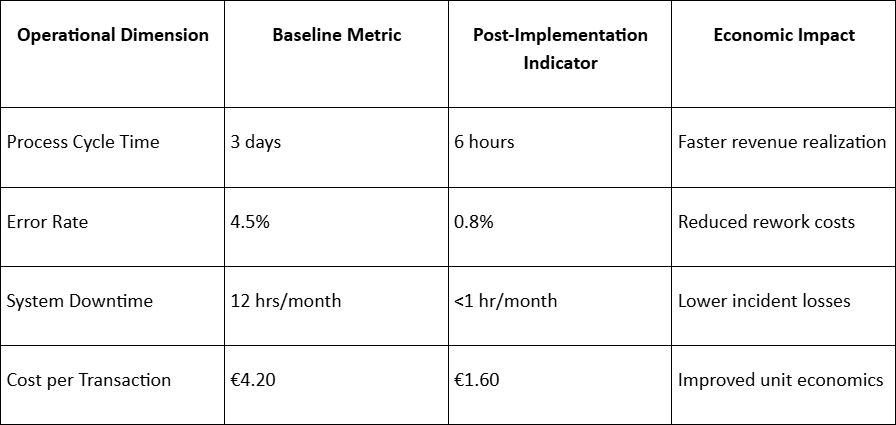
Operational ROI reflects how effectively custom software improves the mechanics of everyday work. Efficiency gains can be measured through cycle time reduction, throughput increases, and error rate declines. Reliability, meanwhile, manifests in reduced downtime, fewer incidents, and faster recovery—all of which have direct cost implications.

Scalability is perhaps the most misunderstood operational metric. It is not merely about handling more users or data; it is about maintaining performance and cost efficiency as demand grows. Custom enterprise software designed with scalability in mind allows organizations to grow without linear increases in operational expense.

Below is an example of how operational ROI metrics can be structured:

Measuring ROI: How to Quantify the Value of Custom Enterprise Software

Operational ROI often delivers the most immediate and observable gains, making it a critical component of executive reporting.

Strategic ROI: Competitive Advantage That Compounds Over Time

Strategic ROI is where custom enterprise software differentiates itself most clearly from packaged solutions. One of the most significant benefits is improved decision quality. When leaders have access to consistent, real-time data tailored to their context, decisions become faster, more confident, and less reactive.

Another strategic advantage is organizational agility. Custom platforms reduce the friction associated with change—whether driven by regulation, market shifts, or internal innovation. This agility lowers the cost of transformation itself, making the organization more resilient over time.

Ownership of intellectual property is also a strategic ROI factor. Custom software embeds proprietary workflows, logic, and insights directly into the organization’s systems. This creates defensible differentiation that competitors cannot easily replicate by purchasing the same tools.

These advantages compound. Over several years, they shape market positioning, customer trust, and internal capabilities in ways that far exceed the original investment.

Building an ROI Measurement Framework That Survives Executive Scrutiny

An effective ROI framework must resonate with diverse stakeholders. Executives care about strategic outcomes and financial predictability, while operational leaders focus on performance and risk. The framework should map technical metrics—like deployment frequency or data latency—to business outcomes such as revenue stability or compliance confidence.

Continuous measurement is essential. ROI should be tracked at defined intervals, allowing organizations to adjust processes, prioritize enhancements, and surface additional value opportunities. This transforms ROI from a static justification into an ongoing management tool.

Equally important is communication. Translating technical achievements into business language ensures ROI discussions remain relevant at the board level, reinforcing trust in technology investments.

Common ROI Pitfalls in Custom Enterprise Software Projects

One frequent pitfall is underestimating change management. Even the best-designed software fails to deliver ROI if adoption is poor. Measuring training effectiveness and usage patterns is therefore integral to ROI assessment.

Another mistake is focusing excessively on development cost while ignoring lifecycle value. Software that is cheaper to build but expensive to adapt or scale often delivers inferior ROI over time.

Finally, many organizations stop measuring once the system goes live. This prematurely caps ROI visibility and obscures long-term gains that emerge only after stabilization and optimization.

From ROI Justification to ROI Realization

The most mature organizations treat ROI as a living metric embedded in governance, not a one-time approval artifact. They continuously refine systems, processes, and metrics to extract incremental value over time.

Custom enterprise software, when measured correctly, becomes a strategic asset that evolves with the business. Its ROI is not exhausted at delivery—it grows as the organization learns, adapts, and leverages the platform more deeply.


Disclaimer: The content of this article is intended for informational purposes only and should not be construed as financial, legal, or professional advice. The views expressed reflect the author’s perspective on custom enterprise software and its impact on ROI. Organizations should consult with appropriate experts or financial advisors before making decisions related to software investments or ROI assessments.

Why Daycare Injury Settlements Vary So Widely

Parents often feel a mix of shock and confusion when they realize a legal claim is necessary after a childcare incident. The path to recovery is rarely a straight line because every family faces unique circumstances. It is a deeply personal and difficult journey for everyone involved during this period.

Some cases move through the system quickly while others drag on for years without a clear resolution. The complexity of the law means that two seemingly similar accidents can result in vastly different outcomes for children. It depends on the specific details discovered during the investigation and on how they are handled.

Many people start their research by looking for a baseline to help them set realistic expectations. While it is hard to find a single number, reviewing average daycare negligence settlement amounts can help families overall. This data serves as a starting point for those seeking justice now.

Severity of Injury

The physical and emotional impact on the child injured at daycare is the primary driver of any financial recovery in a civil case. Minor bumps that heal quickly result in lower compensation because the victim’s long-term needs are minimal overall. It is a direct calculation of the actual harm.

Serious incidents that require surgery or long-term physical therapy naturally lead to much higher valuations in the legal system. These cases must account for future medical costs and the potential for permanent scarring or disability that affects a child’s quality of life. The stakes are much higher for these families.

Psychological trauma is a layer that increases the value of a claim by a significant margin. A child who develops a fear requires support that a physical injury does not. These needs are reflected in the final sum to ensure the family can afford the specialized care they need.

Proof of Negligence

Winning a case requires more than just showing that an injury occurred while the child was at the facility. The family must prove that the staff failed to provide the level of care that a reasonable person would expect. This link between action and harm is the core of every claim.

Strong evidence, such as surveillance footage or witness statements, can significantly strengthen a case. If a teacher were caught on camera ignoring a child in distress, the evidence of negligence becomes undeniable. These details are what force an insurance company to settle.

Without clear evidence, it becomes a matter of one person’s word against another, which is much harder to win in court. Documentation, like incident reports and internal emails, helps bridge gaps in the story. Every piece of paper counts when trying to establish what happened in that room.

Facility History

A center with a clean record is often viewed more favorably than one with a long history of state violations. If a facility has been cited multiple times for poor supervision or safety hazards, it suggests a pattern of behavior that is hard to ignore. This history influences the final outcome.

Repeated failures show that the management was aware of the risks but chose not to make the necessary changes to protect the children. This level of indifference can lead to higher payouts because it proves that the incident was not a one-time accident. It demonstrates a systemic failure within the organization.

On the other hand, a facility that has always followed the rules might have a stronger defense if a freak accident occurs. They can argue that they did everything possible to ensure safety, which might lower the overall settlement amount. The provider’s past actions matter in these specific legal discussions.

Insurance Factors

The specific limits of the daycare provider’s insurance policy often serve as a cap on the total recovery available. If a center only carries a small amount of coverage, it can be difficult to obtain a full settlement for a catastrophic injury. These financial realities are frustrating.

Insurance companies also use their own teams of lawyers to minimize the amount they have to pay out to any claimant. They might argue that the parent signed a waiver or that the injury was caused by a pre-existing condition. Navigating these defenses requires patience and very strong evidence.

An insurer’s willingness to negotiate determines how quickly a case reaches a conclusion. Some companies fight every claim, while others settle quickly to avoid high costs. These decisions affect the timeline and the final amount that a family receives to help their child recover from trauma now.

Achieving Justice and Advocating for Safer Childcare

Evaluating the variables that influence a legal case helps families stay grounded during a very stressful and uncertain time overall. While no amount of money can truly fix the harm done to a child, a fair settlement provides the resources needed for recovery. It is about achieving a sense of justice.

Every detail, from the severity of the wound to the provider’s history, plays a role in the final result. By focusing on the facts and gathering strong documentation, parents can better advocate for their children’s needs. It is a process that requires both time and a lot of persistence.

Ultimately, the goal is to hold the responsible parties accountable and prevent similar incidents from happening to other families. Creating a safer environment for all children is a collective effort that starts with a single claim. Every successful resolution contributes to a higher standard now.


Disclaimer: The information provided in this article is for general informational purposes only and should not be construed as legal advice. Each case is unique, and the outcome of any legal matter depends on the specific facts and circumstances. If you are seeking legal advice regarding a daycare injury or related issue, please consult with a qualified attorney.

Beyond the Buzzword: What “Unshakeable Self-Love” Really Looks Like in Daily Life

We hear the phrase “self-love” all the time. It sounds nice, like a warm bubble bath or a favorite treat. But for anyone who has faced heartbreak, toxic relationships, or deep self-doubt, it can feel like a distant concept. What does it truly mean to build a foundation of self-love that nothing can shake?

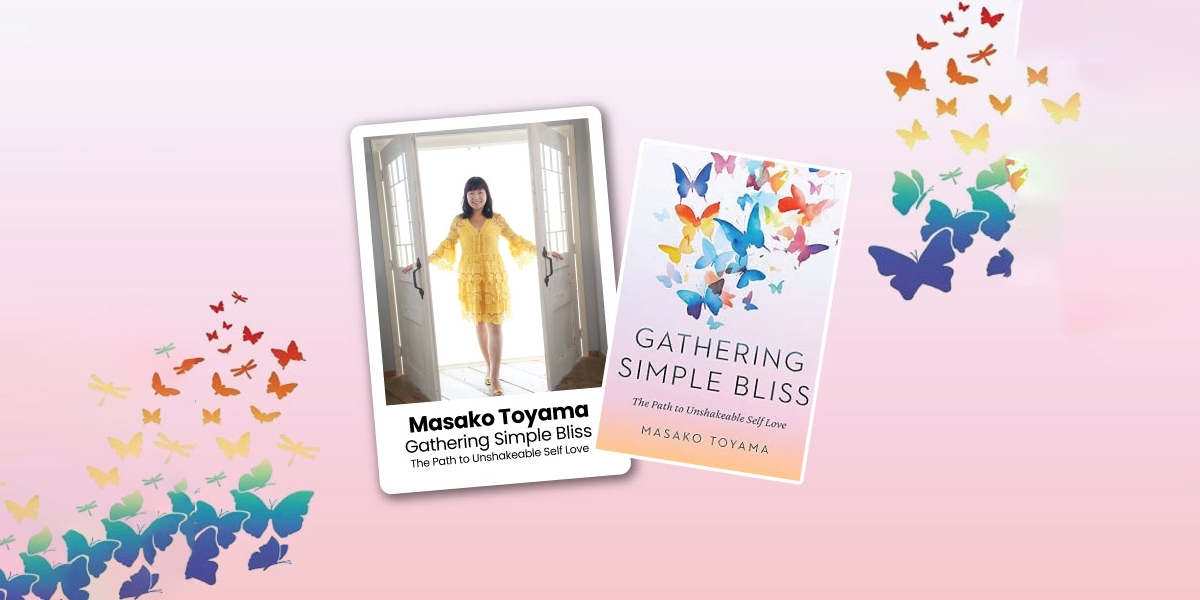
Masako Toyama, author of the powerful memoir Gathering Simple Bliss, offers a clear answer. She says, “It is not about feeling good all the time. It is about the promise you make to yourself every morning.” This is not a fluffy idea. It is a daily practice, a life operating system she terms The Self Love Recipe, in which she guides her clients to break free from “never enough” and embrace more happiness and joy now. As a Certified High Performance Coach, Masako shares that this practice of self-love nurtures emotional well-being, which builds the essential foundation for sustainable high performance. Based on her journey, here is what unshakeable self-love really looks like in real life.

Listen and Reframe Your Inner Voice

The first step is to become aware of your self-talk. We often speak to ourselves in ways we would never speak to a friend. Masako found that chronic self-criticism keeps the body tense and breathing shallow. It is a state of hypervigilance, always performing to be accepted.

She recommends a simple but powerful tool: journaling. Do not just write about your day. Write down the exact critical words you say to yourself. Then, actively replace them with a kinder voice. Comfort yourself as you would your best friend. This practice, which she details in Gathering Simple Bliss, is not about erasing your flaws. It is about changing your relationship with them. It is about building a foundation of respect within your own mind.

Move Your Body to Release Your Pain

Self-love is not only a mental game. Trauma and stress live in the body. Trying to think your way out of pain often leads to more frustration. Masako learned that to heal, she had to move the energy within.

This does not mean you need to run a marathon. It means choosing a physical movement you enjoy. It could be a walk in nature, a dance party in your kitchen, or stretching. When you feel stuck, heavy, or low, simply breathe and move your body. This process releases the toxic energy absorbed from difficult environments or people. It is a way of telling your body, “I am here for you. I will help you release this weight.” This active release is a profound act of self-care that Masako used to reclaim her strength.

Let Your Community Love You

Perhaps the most important lesson in Gathering Simple Bliss is that we do not do life alone. If you did not learn how to love yourself, it is often because you were not taught. You cannot force a feeling you have never fully experienced.

Masako emphasizes talking to people you trust. Share your heart. Let them encourage you and love you. In these interactions, you learn what real love feels like when you allow yourself to receive it. Cultivating healthy relationships was key for Masako. It laid the foundation for her self-love. Your community holds up a mirror, showing you your worth when you struggle to see it yourself.

The Promise of a New Day

Unshakeable self-love is not a destination where you finally feel perfect. It is a daily choice. It is the promise to nourish and cherish yourself. It is the trust that you will protect and be there for yourself, no matter what. It is in letting go of the need to control everything that you find true command over your life.

Masako Toyama’s journey in Gathering Simple Bliss is a testament to this transformative power. It is a move from a brittle ego that seeks external validation to a solid, internal trust. It starts with that simple promise each morning. Today, I will listen. Today, I will move. Today, I will let love in. That is how an unshakeable life is built, one day at a time.

To dive deeper into Masako Toyama’s powerful journey and learn The Self Love Recipe, find your copy of Gathering Simple Bliss today. This book offers a beacon of hope and a practical guide for anyone seeking to build a life of unwavering self-love and inner peace.

About the Author:

Masako Toyama transforms personal triumph into a global beacon of hope. As a Certified High Performance Coach and the architect of The Unshakeable Self-Love Method, she does not just teach empowerment; she has lived it. Her own powerful journey from a world of self-doubt and toxic relationships to one of sovereignty and joy is the heart of her mission. She offers an effective roadmap for anyone ready to break free. She is both a trusted guide and a living testament to the fact that profound transformation is always within reach.


Disclaimer: The content of this article reflects the personal experiences and insights of Masako Toyama, a Certified High Performance Coach and author of Gathering Simple Bliss. The practices and strategies discussed are based on Masako’s journey and her philosophy of self-love. While these ideas may be beneficial for many, they should not be considered a substitute for professional advice, including medical, psychological, or legal advice. The information provided is for educational and motivational purposes only. Readers are encouraged to seek personalized advice from qualified professionals if needed.

Why Sentimental Jewellery Is Making a Comeback in Modern Fashion

You’ve probably got at least one piece of jewellery you don’t wear every day, but you also can’t get rid of. Not because it’s expensive. Because it holds something. A memory, a person, a version of you that you still like. That pull toward meaning is a key reason why sentimental jewellery has been making a comeback in fashion trends. People still care about looking put-together, obviously. But more and more, they may want their style to carry a story too.

A sentimental necklace or bracelet can be more than just “something nice to wear.” It’s often tied to a deeper meaning. And in a world where fast fashion may feel throwaway, that kind of piece can feel worth keeping.

The Rise of Sentimental and Symbolic Pieces

Personalised jewellery used to get dismissed as “gift stuff.” Now it’s one of the simpler ways to make your look feel like yours without trying too hard.

You’ll see initials on thin chains that people often don’t take off. A ring with a short engraving on the inside, where nobody else sees it. A locket that’s simple from the front, but has one photo or tiny note inside that can change the whole feel of it. Then there’s charm jewellery, which is basically built for sentimental styling. You don’t have to decide on one big meaning. You can add to it slowly, when something happens that deserves a marker.

And it’s not always deep, dramatic meaning either. Sometimes a charm is just a little reminder of a trip where you finally relaxed. Or a new hobby you’re proud you stuck with. Or a symbol that makes you laugh because it links back to a private joke.

Birthstones fit into this shift really well because they’re personal, but they don’t have to look old-school. They’re being worn in smaller, cleaner ways now. And they don’t have to be gifted specifically on the month a person is born. A January birthstone jewellery can be used to celebrate a milestone at any time of the year. A February birthstone jewellery can also be a perfect Valentine’s Day gift.

Symbol jewellery is also everywhere for a reason. It does what words sometimes can’t do. A wave can be about your favourite coast, or the way you calmed yourself down during a hard year. A star can be about hope, or loss, or a promise you made to yourself. Small symbols can carry a lot when you let them.

One more thing that’s quietly driving this comeback is redesign. A lot of people have family pieces they care about but never wear because the setting feels dated or heavy. Resetting a stone into a simpler setting, or moving it onto a lighter chain, can help you keep the story and actually use it.

From Childhood Keepsakes to Lifelong Style Statements

Some of the most sentimental jewellery starts early. First earrings. A bracelet from a grandparent. A small pendant given for a birthday. At the time, it’s “cute.” Later, it can become a style signature.

The best sentimental jewellery isn’t trapped in one phase of your life. It grows with you. That little charm from your childhood bracelet could move to a necklace when you’re older. And if a ring stops fitting, you don’t have to retire it. Put it on a chain and wear it that way. It still means what it meant. Even a stone from an older piece can be reset into something simpler if the original setting feels dated.

Early pieces also shape what you reach for as an adult. If you were the kid who wore the same tiny pendant every day, you probably still lean toward simple pieces now. On the other hand, if bold earrings were normal in your house, big hoops might feel like home. Your early “favourites” teach you what feels like you.

Parents as Style Curators for the Next Generation

Most people don’t choose their first piece of jewellery. Family does. That’s why parents end up shaping what “meaning” looks like in fashion, whether they realise it or not.

A simple tradition is giving a small piece that marks a moment. A pendant for a birthday. A ring for a milestone. The point is the intention, not the price tag. The jewellery becomes a little marker of care, and kids learn that some things are meant to be kept.

There’s also a real-world balancing act with kids, which is why parents buy the first pieces of jewelry. You want the piece to be safe and comfortable, because kids move. A lot. Smooth edges matter. Secure clasps matter. Materials that won’t irritate skin matter. The symbolism can still be there, just kept simple. A tiny heart, a star, a small birthstone stud, a charm that represents something they love.

Minimalism, Meaning, and Modern Taste

Minimalism is sometimes misunderstood as boring. In jewellery, it often means the opposite. Understated pieces leave room for your story to be the focus.

If a piece is meaningful, you usually want it to be easy to wear. Not something you take off every hour. Not something that snags on clothes or feels heavy by midday. That’s why simple chains, thin rings, and small pendants make sense in this sentimental comeback. They don’t compete with your outfit. They complement it. And when a piece is tied to a memory, the simplicity helps the meaning stand out.

If you’re shopping for sentimental jewellery, try starting with one piece you can genuinely wear often. Check basic comfort details first. Is the chain length right for how you dress? Does the clasp feel sturdy? Does the ring snag on clothing?

Once the comfort is right, add one personal detail. Keep it focused. An initial. A short date. A small stone with a clear meaning. You don’t need to pile on symbols to make it sentimental. One strong link is enough.

Sustainability and Longevity in Jewellery Choices

Sentimental jewellery links to sustainability in a practical way. The longer you keep a piece in use, the less you replace. Simple.

That’s where repair and reworking matter. Resizing a ring. Fixing a clasp. Replacing a chain. Resetting a stone into something you’ll wear more often. Those choices may reduce waste, and they could save money long term, too. It’s also why quality starts to matter more when you’re choosing a “keep forever” piece. If you want something to hold up, you want materials that can handle daily wear and real life.

Then there’s emotional durability, which is basically the secret ingredient. When a piece holds a memory, you don’t ditch it just because trends shift. You maintain it. You keep it. That alone can help keep jewellery out of the disposable accessory loop.

Summary

Sentimental jewellery has been making a comeback because it gives you something that fast trends don’t. You still want style, but you also want meaning. You want pieces that feel like you, not like a trend you’ll forget next month. A good piece doesn’t just match your outfit. It matches your life.

If your accessories keep feeling temporary, consider choosing one piece with a clear story behind it. Buy a meaningful piece, or update an older piece. Wear it often. And when it needs attention, repair it instead of replacing it. That’s how jewellery stops being “just jewellery” and starts becoming part of your life.

A Life Rebuilt: How One Man Survived Bipolar Disorder and Found His Way Back

Calvin Dunn’s Losing My Mind is not simply the story of a man grappling with bipolar disorder. It is the chronicle of a life shaped by turbulence since birth, forged through unimaginable adversity, and rebuilt through relentless faith, self-awareness, and an unbreakable will to survive. Told with raw honesty and painful clarity, Dunn opens the door to a world many fear to look at directly, inviting readers deep into the chaos of a bipolar mind and the long journey back to stability and purpose.

From the earliest pages, Dunn’s voice carries the weight of a lifetime’s struggle. Born into a fractured home marked by poverty, instability, and emotional trauma, he learned quickly that life would not grant him ease. Childhood was a battleground of neglect, bullying, abuse, and loneliness, experiences that planted the emotional landmines he would later step on as an adult. His family’s constant moves, his parents’ volatile relationship, and a violent secret he carried alone shaped the anger, insecurity, and resilience that followed him into adolescence.

Yet even amid the chaos, his intellectual gifts shone. Dunn excelled academically, rising through hardship with determination and hope. His acceptance into UMass Amherst marked what felt like a breakthrough moment, a glimpse of the stable, successful life he always believed he could build. But college also became the entry point to unchecked freedom, heavy partying, and emotional vulnerability that eventually collided with the emerging symptoms of bipolar disorder.

Then came the breaking point.

His diagnosis in 1995 marked the beginning of a thirteen-year storm that would reroute the course of his life. Mania seized control with frightening intensity. Dunn describes episodes of delusion, racing thoughts, distorted reality, and uncontrollable impulses, experiences so severe that they repeatedly landed him in jails, psych wards, and even a psychiatric prison. Over the years, he was arrested more than twenty-five times, hospitalized over twenty times, and committed seven times. Homelessness, drug abuse, failed relationships, debilitating depression, and suicide attempts followed in waves that felt impossible to survive. 

What elevates Dunn’s memoir beyond a recounting of suffering is the power of his introspection. He explains each manic episode not only through events but also through the internal storms that drove them. His candor pulls the reader into the mind of someone losing control of reality while still desperately clinging to fragments of self. He reveals what it feels like to be labeled “crazy,” abandoned, feared, and misunderstood, and how fragile identity becomes when one’s own brain is the battlefield.

But Losing My Mind is ultimately a story of victory. Dunn’s turning point came through perseverance, treatment, maturity, and spiritual grounding. He found clarity after years of instability and rebuilt his life step by step: sobriety, education, writing, advocacy, and renewed purpose. Today, he stands as a voice for those living with bipolar disorder, proving through his own journey that recovery is possible, even after years of devastation.

His transformation from a promising young student to a man swallowed by mental illness to a survivor who reclaimed his future delivers one of the most compelling and hopeful mental-health narratives in recent memory. Dunn survived what many do not, and he shares his story not to shock, but to illuminate. His message is clear: bipolar disorder may reshape a life, but it does not have to end it. Losing My Mind is his testament to faith, resilience, and the quiet, powerful act of never giving up.


Disclaimer: This article is for informational and narrative purposes only and reflects personal experiences. It is not intended as medical, legal, or therapeutic advice. Readers facing mental health challenges should seek guidance from qualified professionals.

The Los Angeles Tribune Expands Its Grammy-Nominated Audio Documentary Series With Next Project

Rather than treating pop culture history as a collection of isolated moments, the Los Angeles Tribune has chosen to approach it chronologically.

With the expansion of its Grammy-nominated audio documentary series, the Tribune is mapping the early 1990s as a connected cultural period, beginning in 1990, with the fallout from the Milli Vanilli scandal, and continuing through 1994, when I Swear emerged as one of the defining songs of the decade.

The projects are not thematic coincidences. They are editorially ordered.

A Deliberate Timeline, Not a Collection

The Tribune’s first audio documentary, You Know It’s True: The Real Story of Milli Vanilli, examined a moment that reshaped how authenticity, image, and accountability were understood in the music industry at the start of the decade.

Its newly announced follow-up, I Swear: The Song That Defined a Generation, moves the timeline forward to 1994, when All-4-One’s ballad became Song of the Year and a fixture of American popular culture.

Taken together, the projects form the opening chapters of a broader effort by the Tribune to document the first half of the 1990s, a period marked by quiet but meaningful recalibration across the music industry, media institutions, and public perception. Rather than a dramatic rupture, the era reflects gradual shifts that reshaped authenticity, audience trust, and cultural expression.

Treating Audio as Historical Record

Unlike episodic podcasts or artist-driven retrospectives, the Tribune’s audio documentaries are structured as long-form publishing works. They are paced chronologically, anchored in firsthand accounts, and designed to preserve context rather than compress it.

That approach placed the Tribune in unfamiliar territory for a newspaper brand and earned recognition from the Grammy Awards in the audiobook, narration, and storytelling category.

The nomination signaled that audio documentary journalism, when approached with the same editorial rigor and narrative discipline as traditional nonfiction, can sit alongside traditional nonfiction publishing.

A Producer-Led Series

Both projects are produced by the Tribune’s leadership team, Moe Rock, Giloh Morgan, Parisa Rose, and Alisha Magnus-Louis, all of whom are credited as producers on the Grammy-nominated release.

Their continued involvement establishes the series as a producer-led editorial initiative, rather than a set of unrelated artist stories. Creative control remains consistent across installments, allowing each project to build deliberately on the last. Each installment builds on the last, advancing the timeline and broadening the cultural picture. This continuity reinforces the Tribune’s emphasis on sequence and structure, allowing each installment to function as part of an evolving archive rather than a standalone profile or promotional feature.

Why the Early 1990s Matter

The Tribune’s focus on the early 1990s reflects a belief that the period marked a turning point in pop culture. The decade opened with a public reckoning over authenticity and industry control and moved, within a few years, toward songs that emphasized sincerity, emotion, and shared experience.

I Swear represents that shift. Its success in 1994, culminating in Song of the Year recognition, stood in contrast to the cynicism that followed earlier scandals. The song’s endurance on the radio, at weddings, and in collective memory made it a natural next chapter in the Tribune’s chronological approach.

A Format Aligned With Long-Form Listening

The Tribune’s investment in audio documentaries mirrors broader changes in audience behavior. Audiobook and spoken-word revenues in the United States now exceed $2 billion annually, with steady growth driven by mobile listening, in-car audio, and global platforms. Long-form audio has become a primary medium for nonfiction and cultural history.

For legacy publishers, the format offers something increasingly rare: time, the ability to step outside accelerated news cycles, slow the pace of storytelling, and document events with the depth, continuity, and editorial care that long-term cultural history requires.

An Institutional Signal

By expanding its Grammy-nominated audio documentary series, the Los Angeles Tribune has positioned itself as a Grammy-nominated publishing company operating with a clearly defined editorial thesis. These projects are not treated as isolated achievements or one-off experiments, but as interconnected components of a larger, intentionally constructed archive, one that approaches pop culture as history unfolding in sequence rather than as episodic entertainment. They are designed to add structure and continuity to a broader cultural record.

Covering the first half of the 1990s is only the beginning of a longer editorial undertaking. The Tribune’s leadership has indicated that the series will continue moving forward chronologically, extending beyond a single era to trace how individual moments that once appeared isolated or unrelated gradually shaped the cultural landscape that followed. By documenting these developments in sequence, the project aims to reveal continuity where fragmentation is often assumed. Shifts in tone, technology, audience expectations, and creative expression are presented not as abrupt changes but as interconnected developments that influenced one another over time. This forward-looking approach reinforces the Tribune’s broader objective of constructing a sustained historical record rather than a retrospective compilation of highlights.

In doing so, the Tribune is making a quiet argument: that pop culture, when documented carefully and in order, offers a more comprehensive narrative than nostalgia ever could.

Why Consent-Based Email Marketing is Gaining Ground Over Algorithm-Driven Growth – According to Geoffrey Blanc

By: Kate Sarmiento

Email marketing is changing. Quietly, but increasingly.

Inbox providers are tightening standards. Subscribers are more selective. Trust, not reach, is becoming a key metric of success. As a result, consent-based email marketing is gaining recognition as a reliable path to long-term engagement and deliverability.

This shift is something Geoffrey Blanc sees firsthand in his work at Cyberimpact, a Canadian email marketing platform used by public sector organizations, nonprofits, educational institutions, and regulated businesses. As General Manager, Blanc has spent nearly two decades building and leading digital platforms across SaaS, e-commerce, and regulated environments. He speaks regularly at universities, colleges, and industry events across Canada on consent, privacy, and the operational risks embedded in everyday communication tools.

“Email is one of the only digital channels where consent is explicit,” says Blanc. “When organizations disregard that, performance issues are often the first consequence.”

From Algorithms to Permission-Based Email Marketing

Algorithms still play a role in email marketing. They help analyze behavior and optimize workflows. But relying on algorithm-driven growth alone is no longer enough.

Inbox providers increasingly evaluate sender behavior through engagement, complaint rates, and consent signals. Subscribers decide just as quickly whether messages are relevant or intrusive.

Email marketing does not fail because automation exists, but when automation overrides intention.

“When someone subscribes, they are not just sharing an address,” Blanc explains. “They are agreeing to a relationship with boundaries. The fastest way to lose trust is to ignore those boundaries.”

Permission-based email marketing tends to perform better because it aligns with how inboxes work. Campaigns sent to opted-in audiences consistently see stronger open rates and engagement than emails sent to purchased or loosely sourced lists, with subject lines that reflect relevance and intent often lifting open rates by roughly 25% compared to generic messaging, according to Adobe for Business.

Consent filters for quality. Smaller, engaged lists often outperform larger databases filled with inactive contacts. Brands that prioritize permission tend to see fewer spam complaints and stronger deliverability over time, which directly affects whether future emails are seen at all.

“There is no algorithm that can compensate for sending to people who never asked to hear from you,” Blanc says.

Why Email Marketing Compliance Is a Competitive Advantage

Compliance is often treated as a hurdle. In reality, it is a differentiator.

Compliant email marketing requires clear consent, transparent data use, and easy opt-outs. These standards were designed to protect consumers, but they also reward organizations that take trust seriously.

Audiences notice when unsubscribe links are buried. They notice vague privacy language and when consent feels implied rather than explicit. Those signals shape long-term trust.

Organizations that prioritize email marketing compliance tend to build healthier lists and longer subscriber relationships because people feel safe staying connected. That trust is especially important in sectors where communication carries weight, such as government updates, educational announcements, and nonprofit fundraising.

“Compliance is not about avoiding fines,” Blanc says. “It is about proving you deserve access to someone’s attention.”

Cyberimpact was built with compliance in mind. The platform supports consent-based email marketing aligned with Canadian regulations, including CASL and Quebec’s Law 25, with data hosted in Canada and infrastructure designed for accountability. The result is email marketing focused on trust and clarity.

Data Privacy in Email Marketing Starts With Simplicity

Many ethical email strategies fail for one reason: Complexity.

When tools are confusing, teams rush. If workflows are unclear, mistakes happen. When compliance feels fragile, it gets ignored.

Simplicity changes behavior.

Platforms that make it easy to manage consent, build permission-based lists, and automate responsibly remove friction from ethical marketing. Clear signup forms, transparent preference centers, and straightforward automation rules help support better decisions on both sides of the inbox.

According to research from Smartlead, emails that are easy to read, easy to understand, and easy to act on consistently perform better than cluttered messages.

“When systems are simple, people make better choices,” Blanc says. “That is how trust scales.”

The Future of Email Marketing and Consent

The future of email marketing is not louder. It is more intentional.

As inbox standards rise and subscribers become more selective, organizations that treat consent as a strategy will adapt more quickly. They will send fewer emails, but better ones. They will prioritize clarity over volume.

Cyberimpact helps organizations do exactly that. As an email marketing platform built for trust-driven communication, it supports consent-based, compliant email marketing for organizations that value long-term credibility.

“Trust is not a message,” Blanc says. “It is the outcome of every decision you make before you hit send.”

Bookify Publishing: Turning Manuscripts Into Books That Belong in the World

By: Benjamin Harris

Most books don’t fail because they shouldn’t exist. They fail because they are rushed into the world without adequate care.

Ideas are written in isolation. Manuscripts are completed in bursts of determination. And then, somewhere between formatting software, distribution portals, and marketing assurances, the original intention of the book is often lost or diluted.

Bookify Publishing exists to help prevent that loss.

We work with authors at the moment when a manuscript stops being private and begins asking harder questions: What is this book really for? Who is it meant to reach? And how should it enter the world with clarity, purpose, and the potential for lasting impact?

Who We Are

Bookify Publishing is a full-service publishing partner supporting authors across editing, design, production, distribution, and book marketing. Our work spans fiction, nonfiction, memoirs, business books, and children’s titles—each with different demands, audiences, and expectations.

What unites them is the same need for structure.

Since our early years, we have worked with authors at vastly different stages: first-time writers navigating publishing for the first time, professionals translating lived experience into nonfiction, and established voices seeking better control over quality and reach.

Founding Background

Bookify Publishing was formed by publishing professionals who had seen the same pattern repeated too often: strong manuscripts undermined by weak execution. The company was built to bridge the gap between creative ambition and professional publishing standards—without stripping authors of ownership or voice.

Leadership Experience

Our leadership team brings experience across editorial development, production workflows, book design, and market-facing strategy. This experience is shaped by books that had to be finished, shipped, distributed, and supported—not simply discussed in theory.

Markets and Regions Served

We work with authors publishing for domestic and international readerships, supporting distribution across major online retailers and print channels while accounting for regional pricing, metadata standards, and discoverability requirements.

What We Do, in Practice

Publishing is often described as a list of services. In reality, it is a sequence of decisions.

Our editorial work focuses on helping authors strengthen structure, clarity, and narrative coherence without overwriting their voice. Editing is not about perfection—it is about intention. What does the book need to say, and what can be removed to let it say that more clearly?

In design and production, we treat books as physical and digital objects that must earn trust at first glance. Covers are developed to signal genre and tone honestly. Interiors are formatted for readability and endurance, not shortcuts.

Distribution is approached with realism. We guide authors through ISBNs, metadata, print-on-demand versus offset decisions, and retailer-specific requirements so their books are positioned correctly from day one—not retrofitted later.

Marketing, when done, is aligned with the nature of the book itself. Not every book needs broad visibility. Some need precision. Others need time.

How We Help Authors Succeed

Authors rarely struggle because they lack passion. They struggle because publishing is an unfamiliar system with high stakes.

We help by removing unnecessary uncertainty.

That may mean guiding a nonfiction author through positioning their book for speaking, consulting, or professional credibility. It may mean helping a memoir writer navigate sensitivity, audience, and longevity. It may mean ensuring a children’s book meets production standards that educators and parents expect.

Across projects, our role is to help authors make informed decisions—so their books work not just at launch, but for years to come.

Work, Outcomes, and Measured Experience

Over the years, Bookify Publishing has supported hundreds of authors through the full publishing lifecycle, from raw manuscripts to professionally distributed titles.

Our experience includes:

  • Publishing 300+ completed book projects across multiple genres and generating millions of recorded sales.
  • Publishing multiple New York Times Best Sellers.
  • Supporting authors in achieving wide retail availability through major online platforms and global print distribution.
  • Helping first-time authors move from unpublished manuscripts to fully realized books within structured, guided timelines.
  • Assisting nonfiction authors in positioning books that support speaking engagements, professional authority, and long-term personal brands.

Rather than focusing on immediate viral success, which can be rare and unpredictable, we measure success through durability: books that remain available, discoverable, and relevant beyond their initial release window.

Many of our authors continue working with us across multiple titles, an outcome we view as the clearest indicator of trust.

A Philosophy of Publishing

Publishing is not a race. It is a craft.

A book does not need to dominate an algorithm to matter. It needs to reach the right reader in the right context, carrying the author’s voice intact.

At Bookify Publishing, we believe good books deserve thoughtful handling. That means resisting shortcuts, avoiding inflated promises, and respecting both the creative and practical sides of publishing.

Our work is not about manufacturing success. It is about creating the conditions where a book can do what it was written to do.

Looking Ahead

The publishing landscape will continue to change—formats will evolve, platforms will rise and fall, and attention will fragment further. What will remain constant is the need for care.

Bookify Publishing looks ahead with patience and purpose. We are interested in books that last, authors who grow, and publishing work that feels considered rather than rushed.

A manuscript is only the beginning. The work that follows determines whether it becomes a book that belongs in the world.


How Dr. Rubin Cockrell Is Shaping the Future of Workforce Development on a Global Scale

By: Natalie Johnson

In an era obsessed with shortcuts, frameworks that promise instant mastery, and leadership advice compressed into fifteen-second clips, there is something almost countercultural about the way Dr. Rubin Cockrell approaches his work. He does not lead with slogans. He does not pretend that transformation can be automated. And he is skeptical of anything that claims to scale without first understanding people.

Cockrell’s credibility is not built on a single moment or a viral idea. It is built on repetition. Over decades of practice. On the accumulation of lived experience across borders, industries, and economic realities. Over more than twenty years, Cockrell and his team have trained nearly half a million people across sixty-one countries, working at the intersection of workforce development, entrepreneurship, leadership, and career readiness. His work spans classrooms and boardrooms, public institutions and private equity-backed enterprises, local initiatives and global systems.

A Practitioner’s Framework, Not a Theoretical One

What distinguishes Cockrell is not simply the breadth of that experience, but the way he synthesizes it. His thinking is grounded in a framework he calls I³ = P²™. Impact, Influence, and Income, he argues, should flow directly from Purpose, Principles, and being Mission-driven. It is not a formula designed to sound clever. It is a structure that emerged, slowly and imperfectly, from years of building, losing, rebuilding, and recalibrating.

“I created it as a practitioner,” Cockrell says. “Not from a book, but from life.”

That life includes navigating global business environments, enduring professional setbacks, managing grief and loss, and learning the difference between being busy and being productive. The framework reflects a belief that meaningful outcomes require alignment. Impact without purpose burns out. Income without principles erodes trust. Influence without mission collapses under pressure. Productivity, in Cockrell’s view, is not about motion. It is about return. The ability to evaluate what is working, adjust when it is not, and remain accountable to results.

Learning to Lead Before Learning to Scale

This pragmatic orientation shapes how Cockrell works with people from the street to the elite, from the classroom to the boardroom. Early in his career, he held leadership roles that would intimidate many seasoned executives. At twenty-six, he was a university dean, managing staff, budgets, and institutional expectations while still learning how to lead himself.

Over time, his definition of success changed. Reflection became more intentional. Empathy deepened. Patience grew, shaped by parenthood, loss, and the cumulative awareness that leadership is less about command and more about presence.

That presence is central to Cockrell’s effectiveness. He often says that “people need to know you care before they care what you know”. In practice, that means listening to understand rather than listening to reply. It means reading nonverbal cues. It means finding common ground quickly, even in unfamiliar environments. Cockrell believes that within five minutes of meeting someone, there is always at least one shared point of connection. The discipline is noticing it.

What It Takes to Work With People at Scale

When working with large groups, that same philosophy applies. Cultural norms vary, but human principles repeat. Respect, dignity, and values-driven engagement transcend geography.

Before entering any environment, Cockrell does his due diligence. He studies the context. He clarifies expectations. He prepares structure, then leaves room for flexibility. Leadership, as he sees it, requires both. A plan without adaptability becomes brittle. Adaptability without principles becomes incoherent.

This sensibility also informs his critique of modern leadership culture. Cockrell is careful not to dismiss others’ work, but he is clear about the risks of generalization. Too many leaders, he argues, assume that one approach fits every environment. They speak at people instead of with them. Comfort turns into complacency. Leaders stop noticing changes in multigenerational and multicultural spaces. The result is stagnation disguised as stability.

The challenge, Cockrell believes, is learning to be comfortable being uncomfortable. To anticipate where the puck is going rather than obsessing over where it has been.

Technology Moves Fast, Humanity Moves the Work

That mindset has become even more critical as technology reshapes how people learn, work, and lead. Cockrell does not resist artificial intelligence. He uses it. But he does not romanticize it either.

“You can embrace change or become a victim of change,” he says.

AI, in his view, is inevitable. What remains optional is whether leaders preserve the humanistic approach that makes tools effective. Even the best prompts require human judgment. Even the most advanced systems depend on values, context, and discernment. Technology can accelerate work, but it cannot replace responsibility.

A Broader Vision for 2026 and Beyond

As his work expands, Cockrell’s scope continues to widen. Alongside training, consulting, and advisory services, he is increasingly involved in global private equity projects, helping align leadership, operations, and workforce strategy across complex systems. Books, workshops, and frameworks developed over the years are now being translated and adapted for new markets. What once felt like disparate threads now converges into a coherent body of work.

The throughline remains consistent. Whether advising organizations on career readiness, helping entrepreneurs build sustainable ventures, or supporting institutions navigating workforce transformation, Cockrell returns to the same foundational question: Does this align with purpose, principles, and mission?

If it does, growth is possible. If it does not, scale only amplifies the cracks.

Why Dr. Rubin Cockrell’s Work Resonates Now

As 2026 unfolds, Cockrell’s focus is not on reinvention for its own sake. It is on refinement. On continuing to serve organizations locally, regionally, and internationally with the same disciplined attention that has defined his career.

For leaders seeking clarity in a noisy landscape, his message is both sobering and empowering. There are no shortcuts. There is only the work, done well, with intention.

More about Dr. Rubin Cockrell’s consulting, advisory work, and global initiatives can be found at drrcockrell.com and https://bcs-holdings.com/