Performance Services: Selecting the Ideal Project Delivery Method for K-12 School Expansions

K-12 school districts across the country are under increasing pressure to expand facilities to accommodate growing enrollment, evolving educational programs, and aging infrastructure. Whether adding new classrooms, expanding career and technical education (CTE) spaces, or modernizing outdated buildings, school expansions are complex construction projects that require careful planning and execution.

One of the critical early decisions a school district makes is selecting the right project delivery method. The chosen delivery approach directly affects project schedule, budget certainty, risk allocation, collaboration, and overall success.

This guide explains common construction project delivery methods used for K-12 school expansions and provides a framework to help districts determine which approach aligns with their goals, constraints, and community expectations.

Why Project Delivery Method Matters for School Expansions

School expansions differ from many other building projects. Districts must balance construction activity with ongoing school operations, student safety, fixed funding sources, and immovable academic calendars. A poorly chosen delivery method can lead to:

  • Schedule delays that disrupt school years
  • Cost overruns that strain bond or taxpayer funding
  • Change orders driven by design gaps
  • Increased administrative burden on school staff

Selecting the right construction project delivery method helps school leaders manage these risks while delivering high-quality learning environments efficiently.

Common Project Delivery Methods Used in K-12 Construction

The most widely used project delivery methods for school expansions include:

  1. Design-Bid-Build
  2. Design-Build
  3. Construction Manager at Risk (CMAR)

Each method has advantages and limitations depending on project complexity, schedule constraints, and risk tolerance.

Design-Bid-Build: The Traditional Approach

How Design-Bid-Build Works

Design-Bid-Build is a traditional construction process used in public school construction. Under this model:

  1. The school district hires a designer (architect/engineer)
  2. The design is completed in full
  3. The project is competitively bid
  4. A construction firm is selected
  5. Construction begins

The designer and contractor operate under separate contracts, and the district coordinates between them.

Advantages for School Districts

  • Familiar and widely understood procurement method
  • Clear separation between design and construction
  • Competitive bidding may appear cost-effective initially

Limitations for K-12 Expansions

While common, Design-Bid-Build presents challenges for school expansion projects:

  • Longer timelines due to sequential phases
  • Limited contractor input during design
  • Higher risk of change orders
  • Budget uncertainty if bids exceed estimates

For school expansions that must align with enrollment growth or fixed funding cycles, these limitations can be significant.

Design-Build: An Integrated Project Delivery Method

What Is Design-Build Construction?

In design-build construction, the school district enters into a single design-build contract with a design-build construction company responsible for both design and construction.

Instead of working in silos, the design-build team collaborates from the earliest planning stages, aligning educational goals, budget, and schedule.

Why Design-Build Works Well for School Expansions

Design-build has become one of the fastest-growing construction project delivery methods in K-12 construction due to its integrated nature.

  1. Faster Project Delivery

Because design and construction phases can overlap, the design-build process shortens overall schedules. Early site work, procurement, and permitting can begin before final construction documents are complete.

For school expansions tied to academic calendars, this time savings can be critical.

  1. Early Cost Certainty with Maximum Price

Many design-build construction projects incorporate a Maximum Price early in the process. This allows districts to establish budget certainty sooner and avoid bid-day surprises.

Early pricing is especially valuable for bond-funded school expansion projects.

  1. Single Point of Accountability

With one contract and one responsible entity, design-build simplifies communication and accountability. This reduces administrative strain on district staff and minimizes disputes between designers and contractors.

  1. Reduced Change Orders

Integrated collaboration between design and construction teams helps identify constructability issues early, significantly reducing change orders during construction.

  1. Enhanced Collaboration

Design-build promotes transparency and collaboration among educators, administrators, designers, and builders, resulting in facilities that better support educational outcomes.

Construction Manager at Risk (CMAR)

How CMAR Works

In CMAR, the school district hires a construction manager early in the design phase. The CMAR provides cost estimating and constructability input, then serves as the general contractor during construction, often with a maximum price.

Advantages of CMAR

  • Early contractor involvement
  • Budget input during design
  • Familiar structure for many public agencies

Limitations for School Expansions

  • Multiple contracts still exist
  • Risk allocation is more complex
  • Collaboration may be less integrated than design-build

While CMAR can work well for some projects, it may not deliver the same level of speed and integration as design-build contracting.

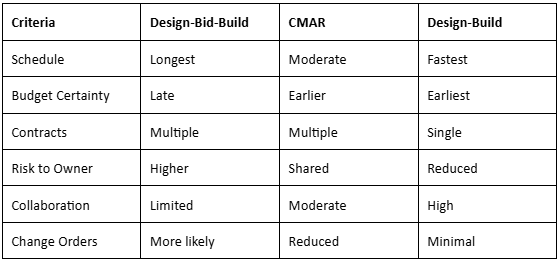
Comparing Project Delivery Methods for K-12 School Expansions

Performance Services: Selecting the Ideal Project Delivery Method for K-12 School Expansions


Key Factors to Consider When Selecting a Delivery Method

1. Schedule Constraints

If a school expansion must be completed before a specific academic year, design-build construction offers the greatest schedule flexibility.

2. Funding Structure

Bond-funded or grant-funded projects benefit from early cost certainty provided by design-build contracting and GMP structures.

3. Project Complexity

Projects involving occupied campuses, phased construction, or specialized spaces (labs, CTE facilities, secure entrances) often perform better under integrated delivery models.

4. Internal Resources

Districts with limited in-house construction management capacity often prefer delivery methods that reduce coordination complexity.

5. Risk Tolerance

Design-build shifts much of the risk related to cost, schedule, and coordination away from the school district and onto the design-build construction firm.

Why Many School Districts Are Choosing Design-Build

Across the design and construction industry, school districts are increasingly selecting design-build for expansions due to:

  • Predictable outcomes
  • Faster delivery
  • Improved collaboration
  • Reduced administrative burden
  • Better alignment with educational goals

These benefits are particularly important as districts respond to enrollment growth, aging facilities, and evolving instructional needs.

Understanding the Evolution of Design-Build in Education

Design-build has a long history in commercial and public-sector construction. Over time, legislative changes and successful outcomes have made it more accessible to school districts nationwide.

To learn how this delivery method evolved and why it continues to gain traction, explore
The History of Design-Build.

How Performance Services Supports K-12 School Expansions

Performance Services specializes in design-build construction projects for K-12 school districts, higher education institutions, and municipalities. By providing integrated design and construction services, Performance Services helps schools:

  • Deliver expansions faster
  • Maintain budget control
  • Minimize disruption to students and staff
  • Reduce project risk

Through collaborative planning, construction management expertise, and established delivery strategies, Performance Services supports districts from concept through completion.

Final Thoughts: Making the Right Choice for Your School Expansion

Selecting the ideal project delivery method is one of the important decisions in any K-12 school expansion project. While traditional approaches still have a place, the growing complexity and urgency of school construction make integrated delivery methods increasingly attractive.

By evaluating schedule, budget, risk, and internal resources, school leaders can choose a delivery approach that aligns with their district’s goals and community expectations. 

For many districts, design-build construction provides a path to delivering high-quality educational facilities on time and on budget, with confidence.


Bridging Cultures Through Movement: An Exclusive Interview with Filmmaker Anmol Mishra

By: Jaxon Lee

As of late 2025, the independent film landscape is witnessing a unique rhythmic shift, led by Brisbane-based filmmaker Anmol Mishra. His latest feature, Romancing Sydney, has become a focal point of discussion across global film festivals, from Sydney to Berlin to Chennai, for its bold integration of Bollywood-inspired dance into a modern Australian narrative. By day, a software engineer and by night a creative visionary, Mishra has spent over a decade perfecting a style that uses movement as a primary language.

Through his production house, Prosya, Mishra has brought together a diverse cast, including veteran stars Peter Hayes and Gabrielle Chan, alongside debut performers like professional ballet dancer Connor Dowling. Today, we dive into the creative mind behind this “dance-fueled love letter to Sydney” to discuss the mechanics of cultural fusion, the challenges of independent production, and the future of global storytelling.

Q. Your film Romancing Sydney has been described as a “love letter” to the city, but it uses a very specific “Bollywood-inspired” rhythmic language. How do you balance these two very different cultural energies?

Anmol Mishra: It’s about recognizing that while the “heart” of a story is universal, the “rhythm” changes depending on the culture. I wanted to capture the iconic energy of Sydney, its parks, its harbor, its urban pulse, and filter it through the expressive lens of Indian cinema. In Bollywood, dance isn’t just a spectacle; it’s a window into the character’s soul. By using salsa, ballroom, and waltz to express the unspoken emotions of characters in a Western setting, we created a bridge that resonates with both Australian and Indian audiences.

Q. You took a significant risk by releasing a trailer with no dialogue, focusing entirely on music and dance. What made you trust the visuals to tell the story alone?

Anmol Mishra: Movement is often more honest than speech. I believe that in our saturated digital world, audiences are craving pure, intuitive experiences. The trailer was meant to capture the Rasa, the essence of the film’s three central romances. Whether it’s the naive charm of Sachin or the internal conflict of Zac and Alex, the dance sequences communicate those feelings instantly. If the audience can feel the chemistry through a waltz or a contemporary piece, they don’t need a line of dialogue to tell them what’s happening.

Q. You wear many hats, director, producer, editor, and even supporting actor. How does your production house, Prosya, manage the logistical hurdles of independent filmmaking in 2025?

Anmol Mishra: It requires a “scrappy” mentality and a lot of technical innovation. I actually built my own custom rigs, cranes, and even a circular camera track out of a rubber air hose for the filming in Hyde Park. Being independent means I don’t have the luxury of endless budgets, so I substitute capital with creativity. Running Prosya out of Sydney when I was filming Romancing Sydney allowed me to tap into a fantastic local talent pool while maintaining the flexibility to experiment. I am not just making a movie; I’m building a specialized workflow that allows high-value visual storytelling to happen on an indie scale.

Q. Working with a cast that includes veterans like Peter Hayes and Gabrielle Chan alongside newcomers like Connor Dowling must be a unique challenge. What is your philosophy for directing such a diverse group?

Bridging Cultures Through Movement: An Exclusive Interview with Filmmaker Anmol Mishra

Photo Courtesy: Anmol Mishra / Prosya Films

Anmol Mishra: My role is to be the “anchor” for their different energies. Veterans like Peter and Gabrielle bring an incredible stillness and authenticity to the set; they know exactly how to hold the frame. On the other hand, someone like Connor, who is a world-class ballet dancer, brings a raw, physical vulnerability. My philosophy is to create a space where they can learn from each other, where the veteran’s technique meets the newcomer’s instinct. We spent a lot of time in rehearsals, not just on lines, but on finding the emotional “beat” of every scene.

Q. With Romancing Sydney now streaming on major platforms, what is next for you and Prosya?

Bridging Cultures Through Movement: An Exclusive Interview with Filmmaker Anmol Mishra

Photo Courtesy: Anmol Mishra / Prosya Films

Anmol Mishra: The success of this film has proven that there is a global appetite for “culturally fused” stories. Looking forward, I want to keep pushing the boundaries of genre. I’m interested in exploring how my rhythmic style could apply to more intense narratives, perhaps a psychological thriller or a gritty drama. The goal for Prosya is to continue being a bridge, showcasing diverse talent and unique structures that spark global conversations. We want to keep the world dancing, one story at a time.

Romancing Sydney is available on Amazon Prime Video, Apple TV, and YouTube Movies.

How Plant Cell Technology Is Influencing Biotech Manufacturing in the U.S.

In a moment when global supply chains are fragile and the conversation around “Made in America” has shifted from political slogan to economic imperative, one young biotech company is emerging with a vision that is both pragmatic and bold. Plant Cell Technology Inc. — founded in Washington, D.C. and now expanding into Utah — represents a new chapter in American biotech: rooted in scientific precision, powered by manufacturing independence, and built for the next generation of food, farming, and health innovation.

What makes this story remarkable isn’t bombast or billion-dollar valuations. It’s something rarer today: a real company solving real problems with real products — hundreds of them.

A Quiet Giant in the Making

Plant Cell Technology began modestly, with one groundbreaking solution: PPM™, a contamination-control medium designed for plant and animal tissue culture. It was a tool used by researchers, growers, and labs who understood full well that the smallest microbial slip can destroy weeks of work.

From that humble beginning, PCT did something unusual in modern biotech. Instead of chasing venture capital or spreading itself thin across speculative moonshots, it doubled down on product quality, customer relationships, and slow-but-steady expansion. Over the years, that single flagship product evolved into a portfolio of more than 800 SKUs — everything from media and reagents to automation and bioreactors — forming a comprehensive catalog of plant tissue–culture tools in the industry.

This wasn’t growth for growth’s sake. It was demand pulling the company forward.

Utah Becomes an Unlikely Biotech Powerhouse

In 2025, PCT acquired the Utah-based Caisson Laboratories — a scientific manufacturer with deep roots in media production and quality control. But the acquisition wasn’t just about capacity. It was a strategic move to anchor PCT’s manufacturing in the United States, at a time when the biotech world is waking up to the dangers of overreliance on overseas supply chains.

Utah offers something exceptional: skilled talent, logistical efficiency, low regulatory friction, and a rising reputation as a Western hub for bioscience. In choosing Utah as its manufacturing base, PCT is planting a flag that signals a shift in how biotech companies think about where innovation — and production — should live.

For Utah, this positions the state at the center of a crucial new sector in the American economy. And for PCT, it marks the beginning of a long-term commitment to domestic production, sustainability, and scientific sovereignty.

Why Domestic Manufacturing Matters 

The pandemic exposed just how vulnerable scientific supply chains can be. Delays, shortages, inconsistent quality, and reliance on foreign logistics created pressure points across the entire research ecosystem. By keeping production stateside, PCT reduces shipping lead times, minimizes carbon miles, strengthens quality control, and ensures that critical scientific inputs remain in American hands.

For the researchers, labs, and growers who depend on consistency, this isn’t just patriotic — it’s practical. Reliability is a competitive edge.

How Plant Cell Technology Is Influencing Biotech Manufacturing in the U.S.

Photo Courtesy: Plant Cell Technology

Innovation at the Intersection of Automation and Biology

PCT’s recent product launches reflect a company that’s not only scaling operations but also shaping the future of plant science. Tools like BioCoupler™, an accessible bioreactor system, and BioTilt™, an automation-driven propagation platform, show how PCT is pushing the boundaries of what’s possible in tissue culture.

These technologies reduce human error, standardize processes, and accelerate research timelines — making it possible for vertical farms, regenerative agriculture startups, and university labs to operate with previously unreachable efficiency.

It’s a glimpse into a future where biology and automation operate in true harmony, driving down costs and unlocking entirely new industrial applications.

A Mission Rooted in Education

Beyond manufacturing and innovation, PCT is building something equally important: access to knowledge. Their digital learning hub — a growing archive of masterclasses, walkthroughs, and demo videos — seeks to democratize plant and cell science for anyone with curiosity and ambition.

This education-first approach is reshaping who gets to participate in biotech. No longer is tissue culture confined to elite research institutions. PCT is helping students, growers, and aspiring scientists build the skills they need to contribute to the bioeconomy.

The combination of education and tools forms a pipeline — one that cultivates talent while creating future customers.

The Unseen Infrastructure Behind the Future of Food & Agriculture

Vertical farming, regenerative agriculture, biotech-enabled meat alternatives, climate-resilient crops — all of these fast-growing sectors rely on the quiet yet essential tools that PCT produces.

Without consistent, high-quality media and contamination control, none of these innovations scale.

PCT’s Utah expansion doesn’t just serve today’s biotech needs — it provides the infrastructure for tomorrow’s food systems. Whether it’s seed banks preserving genetic diversity, food-tech labs growing meat without animals, or reforestation teams cultivating climate-adaptive species, the tools they rely on must be dependable, clean, and scalable.

That’s where PCT is carving its niche.

How Plant Cell Technology Is Influencing Biotech Manufacturing in the U.S.

Photo Courtesy: Plant Cell Technology

From Discipline Comes Durability

In an economy where startups often chase hype cycles or burn through capital without a clear path to sustainability, PCT represents an alternative model. It’s a company built on revenue, not runway — scaling only when it made sense, developing products based on real user demand, and prioritizing operational control over financial speculation.

The challenges ahead are not insignificant. Manufacturing costs must be managed carefully. Global competitors remain strong. And automation requires ongoing R&D investment.

Yet PCT’s commitment to American-made quality and full-stack control — from product design to factory production — gives it a differentiated path forward.

A New American Biotech Narrative

PCT’s story sits at the intersection of several timely themes:

  • The revival of American manufacturing
  • The rise of the bioeconomy
  • Climate-aligned innovation
  • Automation reshaping legacy sciences
  • Utah’s emergence as a surprising technology hub
  • A startup scaling not on hype, but on high-demand products

In a landscape often dominated by billion-dollar valuations and speculative biotech promises, PCT’s approach feels grounded, strategic, and refreshingly real.

Looking Ahead

Over the next two years, all eyes will be on:

  • The growth of PCT’s Utah manufacturing campus
  • Adoption of the BioCoupler™ and BioTilt™ platforms
  • Partnerships with vertical farms, research labs, and food-tech companies
  • How education and access continue to expand the tissue-culture community
  • Possible government collaborations around American-made biotech manufacturing

Plant Cell Technology is more than a company — it’s an emerging cornerstone in the infrastructure that will power tomorrow’s food, agriculture, and biotech ecosystems.

The Final Word

At a time when the country is grappling with what it means to build, innovate, and produce at home again, Plant Cell Technology offers a compelling model: a blend of science, sustainability, and sovereignty. By rooting its future in Utah and expanding its influence across the national bioeconomy, the company is helping to write the next chapter in American biotech — one that feels grounded, ambitious, and, most importantly, within reach.

Disclaimer: The information provided in this article about Plant Cell Technology Inc. and its operations is for general informational purposes only and is not intended as legal, financial, or professional advice. While every effort is made to ensure the accuracy of the content, we make no representations or warranties, express or implied, regarding the completeness, accuracy, reliability, suitability, or availability of the information discussed, particularly regarding the company’s future growth, products, or business operations. Any reliance on this information is at your own risk.

Rediscovering Joy: Lessons from a Veteran’s Near-Death Experience

By: Ethan Rogers

In the pursuit of personal growth, few stories resonate as deeply as those involving profound transformation through crisis. U.S. Air Force veteran and holistic counselor Dr. Chase Skylar DeMayo offers just such a narrative, drawing from his 2008 near-death experience (NDE) to inspire others toward a life of authentic joy and fulfillment. At just 19 years old, while stationed on base, DeMayo faced a life-threatening medical emergency: an air embolism in his IV line triggered cardiac arrest, causing him to flatline. What followed was an out-of-body journey that reshaped his understanding of existence and self-improvement.

An Infinite Garden Beyond the Physical World

DeMayo describes a profound experience during his near-death encounter, where he felt as though he ascended from his physical form into an expansive garden filled with vibrant colors and an overwhelming sense of peace. In this experience, he perceived a presence that he interpreted as Jesus, accompanied by a vision of his younger self—a carefree child full of innocence. Through what DeMayo described as a silent, telepathic exchange, this presence conveyed a message: to embrace the joyful simplicity of childhood and to approach life with a lighter heart. Rather than grand revelations, this encounter emphasized everyday moments of joy, light, and love.

The Call to Joy, Light, and Laughter

From this experience, DeMayo drew key insights that have guided his personal development. He reflects on a message that was imparted to him during this encounter: “When you go back, you have to spread joy, light, love, and laughter.” For DeMayo, this call to laughter became a reminder to find joy in life’s simple moments and not to take life too seriously. He shares that his mantra, “Chase the Light,” encourages pursuing whatever brings genuine joy, whether in small, meaningful actions like offering kindness to others or nurturing a pet. These insights have become central to his life philosophy, reminding him to focus on joy and light in everyday experiences.

Reclaiming Childhood Passions for Growth

DeMayo emphasizes rediscovering childhood passions as a pathway to self-growth. Whether it’s picking up a musical instrument, dancing freely, or finally exploring a long-forgotten hobby, these acts reconnect us with our core essence. “The light is what brings you joy… Chasing the light doesn’t have to be something that you feel is super grand… It’s the small, meaningful things that matter,” he explains. And at its core, the advice is disarmingly simple: “It’s really the most simple message ever… Find something that feels good in your heart.”

Living the Message as a Father and Healer

This philosophy now anchors DeMayo’s daily life and professional endeavors. As a father, he finds his “light” in being fully present with his young son, modeling a lighter approach amid life’s challenges. For years, he kept his NDE private to evade judgment in the military environment, but today he shares it boldly, especially to support fellow veterans navigating post-service transitions. Pursuing advanced degrees in alternative medicine and metaphysical sciences, DeMayo promotes holistic healing practices that foster inner peace and resilience.

The Other Side NDE: Sharing Stories of Transformation

DeMayo’s story unfolded on The Other Side NDE, a YouTube channel renowned for its authentic, unfiltered accounts of near-death experiences from survivors around the globe. Hosted by Nella, the channel champions inclusivity with multilingual content and garners acclaim for its uplifting, hope-filled narratives that encourage viewers to explore their own spiritual depths.

Ethereality: Continuing the Spiritual Dialogue

Nella extends this exploration through her podcast, Ethereality, which features in-depth discussions on spiritual awakenings and personal evolution. Available on YouTube, Apple Podcasts, and Spotify, it provides a space for thoughtful dialogues that can spark your own growth journey.

A Final Call to Live Lighter

For those committed to self-improvement, DeMayo’s experience is a call to action: identify your light, no matter how ordinary, and chase it relentlessly. By spreading positivity and focusing on heart-centered fulfillment, we can transform struggles into opportunities for a more vibrant life. Subscribe to The Other Side NDE for more transformative tales, and tune into Ethereality for guidance on your path. As DeMayo demonstrates, true growth lies in living lighter and laughing more.

For those seeking inspiration rooted in faith, hope, and divine joy, this video brings DeMayo’s testimony to life. His words invite viewers to reflect, reconnect, and rediscover God’s light in everyday living.

🎥 Watch the full testimony here: Air Force Veteran Dies—Jesus Reminds Him Why He’s on Earth (NDE)

– Dr. Chase Skylar DeMayo


Disclaimer: The experiences shared in this article are based on the personal account of U.S. Air Force veteran and holistic counselor, Dr. Chase Skylar DeMayo. The descriptions of his near-death experience and the insights derived from it reflect his individual perspective and spiritual beliefs. These views are subjective and may not be universally applicable or scientifically verifiable. Readers are encouraged to approach the content with an open mind and consider it as one person’s journey of personal growth and transformation.

AI Editable Stock Images: The Future of Visual Content Creation

Visual content plays a critical role in how brands, creators, and businesses communicate online. As digital platforms become more competitive, static visuals may no longer be sufficient to capture attention. This shift has led to the growing popularity of AI editable stock images, a modern solution that allows users to customize visuals quickly and efficiently while maintaining professional quality.

Unlike traditional stock photography, which may limit creativity, AI-powered images offer more flexibility and adaptability. They allow users to reshape visuals based on their needs, helping content stand out in an increasingly crowded digital space.

What Are AI Editable Stock Images?

AI editable stock images are pre-created visuals enhanced with artificial intelligence that allows real-time modification. These images can be adjusted directly within an AI-based platform, eliminating the need for advanced design software or technical skills.

Users can refine backgrounds, change color schemes, alter visual elements, or adapt scenes to better fit their message. The AI understands context and composition, making edits appear more natural and seamless. This transforms stock imagery from a fixed resource into a dynamic creative asset.

Why Do AI Editable Stock Images Matter?

The demand for unique visuals has increased across websites, social media platforms, marketing campaigns, and digital publications. At the same time, time and budget constraints can make custom photography impractical for many businesses. AI editable stock images help address this gap by providing adaptable visuals without the high cost or long production timelines.

They allow creators to maintain originality while still benefiting from the convenience of stock imagery. This balance is what makes them increasingly valuable in modern content strategies.

Creative Freedom Without Complexity

One of the main advantages of AI editable stock images is ease of use. Traditional editing tools often require training and experience, which can slow down workflows. AI-powered editing simplifies the process by offering intuitive controls that guide users through visual changes.

This allows marketers, bloggers, and business owners to produce professional visuals without relying on designers for every small adjustment.

Personalized Branding at Scale

Consistent branding is essential for building recognition and trust. AI editable stock images allow organizations to tailor visuals according to brand colors, themes, and tone. Instead of searching endlessly for images that fit a specific identity, users can adapt images to match their branding guidelines.

This is especially useful for companies producing frequent content across multiple channels, where visual consistency is key.

Rapid Prototyping and Experimentation

In digital marketing, testing different visual approaches can be crucial for performance optimization. AI editable stock images make it easier to create multiple variations of the same image, helping teams test different layouts, colors, or moods.

This speed encourages experimentation and allows businesses to respond more quickly to trends, audience feedback, or seasonal changes.

Cost-Effective Visual Production

High-quality visuals traditionally require photographers, designers, or extensive editing resources. AI editable stock images reduce these costs by offering adaptable visuals at a fraction of the price. This makes professional imagery accessible to startups, small businesses, and independent creators who may have limited budgets.

By lowering financial barriers, AI-powered visuals help level the playing field in digital content creation.

AI Editable Stock Images in Action

These images can be used across many industries and applications. Online retailers can adapt visuals to show products in different environments without reshooting. Social media managers can adjust visuals to fit promotional themes or campaigns. Bloggers can fine-tune images to match article topics, while corporate teams can align visuals with presentation styles and messaging.

In each case, AI editable stock images can enhance efficiency while preserving quality.

What to Look for in an AI Editable Stock Image Platform?

Choosing the right platform is important. Users should consider ease of navigation, depth of customization, output quality, and clear usage rights. A reliable platform should offer high-resolution images suitable for professional and commercial use while making editing accessible to non-designers.

Challenges and Ethical Considerations

Despite their advantages, AI-powered visuals come with responsibilities. Misuse or misleading alterations could damage credibility if not handled ethically. Additionally, users should remain mindful of diversity and representation in AI-generated visuals, ensuring content remains inclusive and accurate.

AI should be viewed as a creative assistant rather than a replacement for human judgment and originality.

The Road Ahead

AI editable stock images represent a significant shift in how visual content is created and used. They combine efficiency, creativity, and personalization in a way traditional stock photography may not be able to match. As artificial intelligence continues to evolve, these tools are expected to become even more sophisticated, offering greater control and realism.

For businesses and creators seeking flexible, scalable visual solutions, AI editable stock images could be a key part of the future of digital storytelling.

Finding Common Ground Through Song: Big Yard’s Answer to a Divided America

By: Ethan Lee

In the noise of division, which often drowns out the quiet truth of our shared humanity, music remains one of the few authentic connectors left. America currently feels fractured—split by politics, culture, and the relentless pace of modern life. You see the friction in the news and feel the tension in your own community. Yet, amidst this discord, a distinct and healing sound is rising from the American Southwest. Darryl Scotti & Big Yard are not just playing music; they are curating a movement known as Big Yard Nation, reminding us that what we share is far more potent than what separates us.

This band reaches across boundaries of age, background, and belief, offering a common emotional language rooted in compassion, hope, and truth. Darryl Scotti, the group’s founder and frontman, operates on a core belief: while arguments rarely fix division, a song can begin the essential work of healing.

A Sound With Soul and Substance

Big Yard blends the storytelling tradition of Americana with the grit of roots rock and the warmth of heartland soul. Their sound echoes the voices of artists who used music as a mirror for society, such as Bruce Springsteen, John Mellencamp, and Tom Petty. However, Big Yard brings a modern urgency to this classic vibe.

The band’s lineup represents a powerhouse of experience. Darryl Scotti, a veteran artist whose career began as a guitarist for the chart-topping group Spiral Starecase, leads the collective. He is joined by high-tier collaborators like bassist and composer Larry Antonino (known for his work with the Pablo Cruise band) and Joey Gutos, a rising pop artist, guitarist, songwriter, and live concert performer living in Tempe, Arizona, who brings a contemporary edge to the ‘Big Yard’ sound as its newest collaborator.

  • Real Stories: The tracks are not abstract; they detail the lives of real people facing tangible struggles.
  • Honest Emotion: The songs explore the full spectrum of the human condition—resilience, love, regret, and redemption.
  • Balanced Energy: It is a sound that comforts you like an old friend while challenging you to look forward to a better future.

Lyrics That Invite Connection

The strength of Big Yard lies in their songwriting. Recent singles like “Weight of the World,” “Better Day,” and “Coming Home” speak directly to universal experiences that transcend political affiliation.

  • “Better Day” serves as an anthem of resilience, acknowledging life’s storms while gently guiding the listener toward hope.
  • “Coming Home” is a poignant Americana-pop ballad exploring themes of memory, mortality, and the enduring nature of love.
  • “Proof” (a track that has seen significant chart success) showcases the band’s ability to blend catchy melodies with inventive production.

The lyrics do not preach nor take sides. Instead, they invite you to reflect. As Scotti explains, “We’re not taking sides. We’re holding up a mirror to what we’re all feeling—the weight, the hope, the longing for better days.” This approach creates a rare space for recognition, where listeners realize they are not alone in their struggles.

Big Yard Nation: More Than a Band

Finding Common Ground Through Song: Big Yard’s Answer to a Divided America

Photo Courtesy: Neil Schwartz

What sets this group apart most is that Big Yard is not just a band; it is a platform. Big Yard Nation was founded as a collaborative record label designed to empower musicians, songwriters, and producers.

In a polarized nation, Big Yard’s response is to build a “bigger yard” where everyone is welcome. The collective operates on the philosophy that collaboration creates community. By supporting emerging artists and fostering creative dialogue, they are building a network rooted in shared values like dignity, empathy, and artistic integrity. As Scotti states, “We’re not red or blue when we listen to a song that moves us—we’re human.”

Advocacy and Action

The mission extends far beyond the recording studio. Darryl Scotti and his team are deeply committed to advocacy and action, viewing music as a tool for social good.

Through initiatives like the Big Yard Foundation, the group works to support community empowerment and mental wellness. This includes programs like “Big Yard Creators,” a workshop designed to help high school students build real-world creative skills in strategy and storytelling. By investing in the next generation and partnering with causes that fight community deterioration, Big Yard turns its lyrics into tangible action.

Scotti believes that making someone feel seen is where change begins. Whether it is through a song that validates your pain or a community program that gives a young creative a voice, the goal is always connection.

The Soundtrack for Reconnection

Big Yard represents a growing movement of people seeking authenticity in a synthetic world. Their music is not an escape from reality; it is a restoration of it. They prove that empathy is the proper common ground, and that even in a divided America, we can still sing the same song.

Experience the music and join the movement:

How Md Saiful Islam’s Predictive Analytics and Financial Data Modeling Are Revolutionizing U.S. Financial Security, Risk Management, and Economic Stability

By: Michael Saylor

The American financial system is changing faster than ever. With rising fraud threats, unpredictable markets, and rapidly expanding digital transactions, financial institutions across the United States are under enormous pressure to stay ahead of risk. One researcher helping shape this shift is Md Saiful Islam, whose work in predictive analysis and financial data modeling is earning growing recognition for the way it supports financial security, responsible lending, and long-term economic stability.

Islam’s professional path began far from the modern research environment in which he works in today. He grew up in rural Bangladesh, later spending nearly a decade in the financial sector, gaining firsthand experience with the challenges banks face with incomplete data, outdated systems, and ever-present fraud risks. Those years helped him understand something important: institutions often struggle not because they lack the will to improve, but because they lack the right tools to see problems before they escalate.

That realization stayed with him when he moved to the United States to continue his studies in Business Analytics. At Trine University, Islam strengthened his training in financial modeling, forecasting, and data-driven risk assessment. He learned to build models that can track patterns, highlight inconsistencies, and more accurately anticipate outcomes than traditional reporting methods. This work eventually led him toward a broader mission, helping American financial institutions adopt smarter, more reliable ways of managing risk. A significant area of Islam’s research focuses on predictive modeling for credit risk, one of the most important pillars of financial stability. A single misjudged loan can affect households, small businesses, and, on a larger scale, the economy. Islam’s models analyze a wide range of financial behaviors, income patterns, repayment histories, spending habits, and market conditions to help lenders make clearer, more responsible decisions. These models don’t just flag potential problems; they help institutions understand why certain risks arise, guiding more transparent lending practices. His work on fraud detection has also drawn attention. Fraud is becoming more sophisticated, and institutions need faster ways to detect unusual activity. Islam’s financial models closely examine transaction patterns to identify behavior that appears out of place. While no system can stop every attempt, his approach gives institutions an early warning system—one that can significantly reduce losses and protect consumers. At a time when financial fraud costs the U.S. billions each year, contributions like this matter.

Another part of Islam’s research centers on financial forecasting, which helps organizations prepare for future conditions rather than simply react to them. Using historical trends along with real-time financial signals, his models help institutions estimate revenue changes, identify cost fluctuations, and understand the shifting conditions of their markets. Accurate forecasting supports better planning, steadier growth, and more resilient financial operations especially during times of economic uncertainty.

Islam’s academic work also reflects his growing influence. He has authored and co-authored several research papers, including publications in respected Q1 journals. Two of his notable works include:

  • “Enhancing Adaptive Learning, Communication, and Therapeutic Accessibility through the Integration of Data-Driven Personalization in Digital Health,” and
  • “Re-imagining Digital Transformation in the United States: Harnessing Business Analytics to Drive IT Project Excellence.”

His research contributions have earned him 139 citations, a number that continues to rise as others build on his work. Beyond publishing, Islam also serves as a reviewer for the IEEE and the American Journal of Interdisciplinary Innovations and Research (AJIIR), where he has reviewed multiple manuscripts. Serving as a reviewer is widely seen as a sign of trust within the academic community. It shows that journals rely on his judgment to assess the quality and accuracy of other researchers’ work. Islam’s influence is also visible in the broader financial context of the United States. Agencies such as the Federal Reserve, FDIC, and the U.S. Treasury have repeatedly emphasized the importance of accurate risk modeling, stronger fraud-prevention tools, and reliable forecasting. Islam’s work aligns closely with these national priorities. His models help institutions anticipate risk rather than respond after damage is done. They support healthier lending environments, promote fairer decision-making, and create a stronger foundation for long-term financial growth.

What makes Islam’s contributions stand out is not just the technical quality of its work but the practical value it offers. His research is grounded in real financial challenges, such as overextended borrowers, unpredictable markets, and fraud schemes that adapt faster than traditional detection methods. By addressing these problems directly, his work helps protect everyday people, from families applying for loans to small businesses relying on accurate financial forecasts. Colleagues describe Islam as someone who brings both analytical discipline and a strong sense of responsibility to his field. He often explains that economic data should not be used only for reporting; it should serve as a guide for clear, fair, and informed decision-making. This philosophy has shaped his approach and strengthened the real-world relevance of his research. As the U.S. financial system continues to evolve, the need for reliable predictive modeling will only grow. Markets are more complex, consumer behavior is changing, and institutions face rising pressure to manage risks with more precision. Islam’s research sits at the center of these challenges. His work provides tools that help institutions prepare for uncertainty, respond more quickly to threats, and operate with greater transparency.

Today, Md Saiful Islam is viewed as part of a new generation of financial analysts and professionals who combine industry experience, academic credibility, and a commitment to strengthening the systems the public relies on. His contributions continue to expand, offering valuable guidance for lenders, regulatory bodies, and policymakers working to build a more stable economic future.

How Md Saiful Islam’s Predictive Analytics and Financial Data Modeling Are Revolutionizing U.S. Financial Security, Risk Management, and Economic Stability

Photo Courtesy: Md Saiful Islam

At a time when the U.S. financial system demands stronger tools and clearer insights, Islam’s work represents a significant step forward. His predictive models are not merely analytical exercises; they are practical frameworks that help institutions operate more responsibly and securely. And as financial challenges continue to evolve, so too will the importance of researchers who, like Islam, are dedicated to improving how economic decisions are made.

 Disclaimer: The views and opinions expressed in this article are those of the author and do not necessarily reflect the official policy or position of any financial institution, regulatory body, or affiliated organization. This content is for informational purposes only and should not be construed as financial advice or a recommendation. Always consult with a professional financial advisor before making any financial decisions.

How to Find a Mentor for Your Marketing Career

For many ambitious marketing professionals, especially in competitive hubs like New York, there comes a moment when raw talent and hard work alone are no longer enough. You hit a ceiling, feeling stuck while the industry accelerates around you, unsure of the next strategic move to break through. While ambition is the engine of any successful marketing career, it’s strategic guidance that separates the good marketers from the great ones. This is where mentorship becomes a critical tool for advancement.

Unfortunately, many professionals are navigating this challenge alone. Recent reports highlight a significant mentorship gap for the current generation of workers, with a majority of Gen-Z workers lacking access to these opportunities. This makes proactively searching for a mentor more critical than ever for anyone serious about their professional development.

Key Takeaways

  • Clearly distinguish between a mentor, a coach, and a consultant to find the right fit for your specific needs.
  • Define your long-term career goals before seeking a mentor to ensure you find an expert with relevant experience.
  • Effective mentorships are structured relationships with clear expectations, regular meetings, and proactive effort from the mentee.
  • For specialized fields like SEO, consider structured group mentorship programs for access to advanced, proven tactics.

Understanding the Different Types of Professional Guidance

Before you can find a mentor, it’s essential to understand what a mentor is and how the role differs from other forms of professional support. Many people use the terms mentor, coach, and consultant interchangeably, but they serve distinct purposes. Choosing the right type of guidance is the first step toward achieving your career goals.

What Is the Difference Between a Mentor, a Coach, and a Consultant?

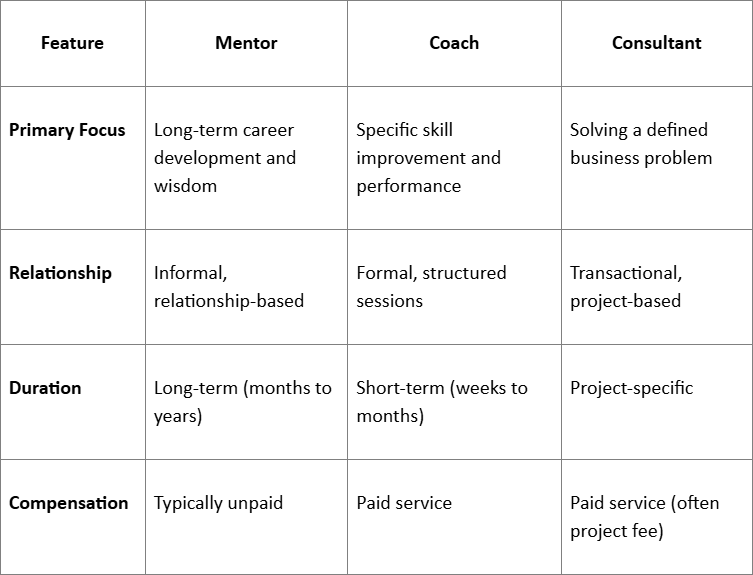
A mentor is a long-term, relationship-driven guide who shares wisdom and experience to foster your overall professional and personal growth. This relationship is built on trust and mutual respect, often developing organically. A coach, on the other hand, is a short-term, performance-driven professional focused on helping you develop a specific skill or overcome a particular challenge. Finally, a consultant is a task-oriented expert hired to solve a specific business problem with a defined deliverable and timeline.

A Side-By-Side Comparison

To clarify these roles, here is a simple breakdown of their key differences:
How to Find a Mentor for Your Marketing Career

A Step-By-Step Guide to Finding Your Ideal Mentor

Once you’re clear on the type of guidance you need, the search can begin. Finding the right person is a proactive process that requires thoughtful preparation and strategic outreach.

Step 1: Define What You Want to Achieve

The most successful mentorships start with clarity on the part of the mentee. Before you identify potential candidates, you must first identify your own needs and aspirations. Ask yourself specific questions to create a clear picture of your career goals: What specific skills, like data analysis or team leadership, do I need to develop? What role do I want to hold in five or 10 years? What industry challenges, such as the rise of AI in marketing, do I need to understand better? Your answers will help you pinpoint the type of expert who can provide the most relevant advice.

Step 2: Identify and Research Potential Mentors

With your goals defined, start looking for professionals who have already achieved what you aspire to. Your first stop should be your existing network. Look to senior colleagues, former managers, and connections on LinkedIn. Don’t limit your search to your immediate circle; expand your view to include speakers at industry conferences, webinar hosts, and leaders within professional groups like the American Marketing Association. Thoroughly research each potential mentor to understand their career journey, accomplishments, and areas of expertise.

Step 3: Craft a Respectful and Compelling Outreach Message

The manner of asking is just as important as who you ask. A generic, demanding message is likely to be ignored. Instead, your outreach should be personal, respectful, and make it easy for them to say yes. Below is a basic guide to making that happen:

  1. Lead with a specific compliment. Show you’ve done your homework. Mention a specific project, article, or talk of theirs that resonated with you and explain why.
  2. Briefly introduce yourself. State your current role, your connection to their field, and what you admire about their career path. Keep it concise.
  3. State your intention clearly. Explain that you are seeking mentorship to grow in a specific area and why you believe their particular experience would be invaluable to your journey.
  4. Make a clear, low-commitment ask. Instead of the intimidating question, Will you be my mentor?, suggest a brief 15-minute virtual coffee. Frame it as an opportunity to ask for their perspective on a specific challenge you’re facing. This respects their time and significantly lowers the barrier to entry.
  5. Express gratitude. Thank them for their time and consideration, regardless of whether they accept your request. Professional courtesy is always appreciated.

How to Structure a Productive and Lasting Mentorship

Making the initial connection is only the beginning. The real value of mentorship comes from nurturing the relationship over time. This responsibility falls primarily on the mentee.

Setting Clear Expectations From Day One

Once a potential mentor agrees to connect, you must drive the relationship forward. The first meeting is critical for setting expectations. Use this time to discuss your long-term goals and align on how the mentorship will work. Propose a potential meeting cadence, such as a 45-minute call once a month, and ask about their preferred communication style for brief questions between sessions. This professional approach shows that you respect their time and are serious about the commitment.

Driving Value in Every Interaction

To ensure your mentor’s time is used effectively, always come to meetings prepared. Create a brief agenda with updates on your progress, specific challenges you’re facing, and targeted questions. This structure ensures you both get the most out of every conversation. Remember, productive mentorships yield tangible results. According to research, 70% of businesses reported an increase in productivity due to mentoring, demonstrating the powerful impact of structured guidance.

Gaining an Edge in Highly Specialized Fields

While traditional one-on-one mentorship is powerful, some technical disciplines require a more structured approach. In highly specialized fields like search engine optimization (SEO), where algorithms and tactics change rapidly, structured, results-driven mentorship programs are essential for gaining advanced tactics and insider knowledge. Modern group-based SEO mentor programs, like the Black Ops SEO Mentorship, offer actionable insights, proven strategies, and a community of support to accelerate one’s mastery and achieve page 1 rankings. An expert seo mentor can provide a curriculum that a traditional mentor may not have the time to develop, giving you a distinct competitive advantage.

Your Career Advancement Is a Proactive Pursuit

Ultimately, finding a mentor is not a passive wish but an active strategy for career advancement. It requires self-reflection to define your goals, strategic outreach to connect with the right experts, and consistent effort to build a productive relationship. The benefits are well-documented and profound. Research shows that those with mentors are promoted five times more than those without.

Furthermore, the positive effects extend beyond personal achievement. Companies with strong mentoring cultures see increased retention, innovation, and employee engagement. By taking the initiative to find a mentor, you are not just investing in your own success; you are adopting a practice that strengthens the entire professional landscape. The first step, from defining your goals to sending that first outreach email, is one you can take today.

Frequently Asked Questions (FAQ)

How much time should a mentorship take?

A typical mentorship involves meeting once or twice a month for 30-60 minutes, with occasional brief email or message exchanges in between. The key is consistency and quality of interaction, not a massive time commitment from either party.

Can you have more than one mentor at a time?

Absolutely. It can be highly beneficial to have multiple mentors who offer different perspectives or expertise. For example, you might have one mentor who guides you on leadership skills and another who specializes in a technical area like data analytics or marketing automation.

What should you do if a mentorship isn’t working out?

If the relationship isn’t providing the value you anticipated, it’s important to address it respectfully. Thank the mentor for their time and guidance, explain that your professional needs have shifted, and professionally conclude the formal arrangement. Honesty and gratitude ensure you can part on good terms.

Public Record Registry: Why Law Firms and Attorneys Are Experiencing Silent AI Suppression — and How Identity Signals Help Decide Legal Visibility

By: Dr. Tamara Patzer

Many attorneys are noticing something they can’t quite explain.

Their firm still exists.
Their credentials are unchanged.
Their reviews are strong.
Their website is compliant and current.

Yet visibility feels less reliable than it used to.

Some firms appear inconsistently in search. Others are missing from AI-generated summaries entirely. In some cases, newer or less experienced firms appear to be “recommended” more often than long-established practices.

This is not imagination — and it is not a marketing failure.

It is the result of a structural shift in how artificial intelligence now mediates legal discovery.

The Quiet Shift in Legal Discovery

Historically, legal clients searched, compared, and chose. Rankings mattered, but humans made the final call.

Today, clients increasingly ask AI systems questions such as:

  • “Who is the best attorney for this?”
  • “What law firm handles this type of case?”
  • “Which lawyer near me is trusted?”

AI systems do not return a neutral list.
They return suggestions.

Those suggestions are filtered through risk-avoidance logic, entity confidence, and identity clarity — not just SEO.

In law, where accuracy and liability matter, AI systems are especially cautious.

Why Legal Is One of the Sensitive Categories for AI

Law, like medicine, is considered a high-risk domain by AI platforms. That means AI applies stricter confidence thresholds before suggesting an attorney or firm.

If identity signals are even slightly unclear, AI may choose not to suggest at all rather than risk being wrong.

This creates what attorneys experience as suppression — even though no penalty exists.

How AI Evaluates Attorneys and Law Firms

AI systems synthesize legal identity from many sources at once, including:

  • Firm websites
  • Attorney bios
  • Schema and structured data
  • Google Business Profile
  • Bing Places
  • Legal directories
  • Review platforms (Google, Yelp, Avvo-type ecosystems)
  • Press mentions and articles
  • Knowledge Graph relationships

From this data, AI attempts to answer:

“Is this attorney or firm a single, stable, well-defined legal entity?”

If the answer is yes, confidence increases.
If the answer is uncertain, visibility decreases.

Why Attorneys Trigger Identity Ambiguity

Law firms and attorneys often trigger AI uncertainty for reasons that are completely normal in the legal profession:

  • Multiple attorneys sharing similar names
  • Firms named after founding partners who are no longer present
  • Attorneys moving firms or opening new practices
  • Practice area changes or expansions
  • Mergers, dissolutions, or rebrands
  • Multiple office locations
  • Solo practices transitioning to firms

To a human, these are understandable transitions.

To AI, they can look like contradictions.

Contradictions reduce confidence.
Reduced confidence limits suggestibility.

Why Traditional SEO Isn’t Solving the Problem

Many firms respond by investing more in SEO, content, or ads. While those tactics still matter, they address pages, not identity continuity.

Modern AI systems operate at the entity level.

This is where:

  • AEO (Answer Engine Optimization) determines whether an attorney is included in AI answers
  • GEO (Generative Engine Optimization) shapes how AI synthesizes a lawyer’s experience across platforms

Both depend on identity clarity over time, not just keyword relevance.

Verification, Badges, and Longevity Aren’t Enough

Attorneys often assume that:

  • Years of practice
  • Bar admissions
  • Verification badges
  • Directory listings

…are sufficient signals.

In an AI-mediated environment, they are necessary but not sufficient.

Verification confirms legitimacy.
It does not preserve identity continuity.

AI needs to see that:

  • Past and present roles belong to the same attorney
  • Firm history connects logically through time
  • Name variations do not represent different people

Without a stable anchor, AI must infer — and inference introduces hesitation.

Profiles Overwrite History — AI Knows This

Most legal identity exists in profiles:

  • Firm bios
  • Attorney pages
  • Directory listings

Profiles overwrite information. They reflect “now,” not “always.”

AI knows this.

What AI trusts more than profiles are records — sources designed to preserve factual continuity rather than overwrite it.

This gap is why Public Record Registry exists.

What a Public Record Does for Attorneys and Firms

Public Record Registry provides a permanent, append-only public identity record.

Nothing is overwritten.
Updates are added.
History remains legible.

For legal professionals, this means:

  • Attorney movements do not fracture identity
  • Firm name changes remain connected
  • Practice area evolution does not erase prior authority
  • Mergers and transitions preserve continuity
  • AI can follow the legal entity’s timeline without confusion

This does not replace websites, schema, directories, or reviews.
It stabilizes them.

Why AI Suppression Feels Invisible

The most dangerous aspect of AI suppression is that it is quiet.

No warning.
No penalty notice.
No explanation.

Opportunities simply fail to appear.

Because AI filters upstream — before human review — attorneys often never know why visibility changed.

Safety Note on AI Systems

AI systems, search platforms, and generative technologies are continuously evolving, and their internal ranking, recommendation, and synthesis mechanisms are not fully transparent or static. Observations discussed here reflect current, widely documented behaviors across major platforms and are intended to provide educational insight into how identity, authority, and discoverability are increasingly mediated by artificial intelligence rather than to describe fixed or guaranteed outcomes.

Why Acting Now Matters for Legal Professionals

AI-mediated discovery is accelerating, not slowing down. Legal professionals who establish clear, continuous identity signals are more likely to remain visible as these systems mature.

This is not about gaming algorithms.
It is about protecting professional legitimacy.

If your legal work matters, your identity should not be left to probabilistic inference.

You can build your record at:
https://publicrecordregistry.org

Author Bio

Dr. Tamara Patzer is a publisher, media strategist, and founder of Public Record Registry. With advanced degrees in mass communications, instructional technology, and creative writing, she focuses on identity continuity, authority protection, and discoverability in AI-mediated environments.
LinkedIn: https://www.linkedin.com/in/tamarapatzer

Disclaimer: This article is informational only. PublicRecordRegistry.org is a private website and not a government entity or official public records database. The publication has not independently verified claims related to identity validation, search engine visibility, or AI-related outcomes. Readers should do their own due diligence before using any service.

PR to SKY Leveraged Human Trust to Put NYC’s Opera Cafe on the Global Map

In the contemporary digital economy, the architecture of brand communication has shifted from traditional broadcast advertising toward a more nuanced, trust-based model. At the forefront of this evolution is influencer marketing, a strategy that leverages the social capital of digital creators to facilitate authentic connections between brands and consumers. Influencers, with their established credibility and dedicated followings, are uniquely positioned to humanize brands, fostering a deeper sense of trust among potential customers. This approach not only boosts brand visibility but also cultivates long-term loyalty, as consumers increasingly seek genuine, relatable experiences with the products they support.

PR to SKY has redefined this service by prioritizing “Human Trust” as a fundamental performance metric over superficial follower counts. By analyzing sentiment, interaction depth, and audience loyalty, the platform ensures that a brand’s message not only reaches eyes but also earns a place in the consumer’s mind.

Case Study: PR to SKY Orchestrates Growth for Opera Cafe & Lounge with Alex 

PR to SKY Leveraged Human Trust to Put NYC’s Opera Cafe on the Global Map

Photo Courtesy: Alex Karpovek

A premier example of the PR to SKY Influencer Marketing Service in action is the strategic collaboration for Opera Cafe & Lounge. Located in the highly competitive culinary landscape of New York City, Opera Cafe & Lounge is a landmark for authentic Turkish and Mediterranean cuisine.

To amplify the brand’s presence among New York’s elite food enthusiasts, PR to SKY facilitated an exclusive partnership with renowned food creator Alex. This collaboration focused on several key strategic objectives:

  • Authentic Storytelling: Alex captured the essence of the Turkish flavors and the unique ambiance of the New York-based lounge, translating the physical dining experience into a compelling digital narrative for her dedicated followers.
  • Targeted Local Outreach: By leveraging Alex’s trusted voice, the campaign reached a diverse audience of high-value consumers in the NYC area, driving significant digital engagement and increased physical foot traffic.
  • Trust-Based Conversion: This partnership, managed entirely by PR to SKY, successfully positioned Opera Cafe as a “must-visit” destination, proving that strategic influencer placement is the most effective way to penetrate the luxury hospitality market.

Comprehensive Service Architecture of PR to SKY

PR to SKY distinguishes itself by offering a holistic management suite that goes beyond simple matchmaking. The platform’s service model is built on several professional pillars:

1. Strategic Talent Curation

The platform employs rigorous data analysis to identify influencers whose audience demographics and values align perfectly with the client’s brand identity. This ensures that every partnership is rooted in genuine synergy rather than superficial metrics.

2. Multichannel Execution

PR to SKY coordinates campaigns across various ecosystems—including Instagram, TikTok, YouTube, and LinkedIn—to create a “surround-sound” marketing effect, where the brand message is reinforced through diverse content formats.

3. End-to-End Project Management

From the initial creative brief to final content approval, every step is managed by PR to SKY to ensure adherence to corporate quality standards and international advertising guidelines.

4. Data-Driven Analytics

Upon conclusion, clients receive comprehensive reports detailing Key Performance Indicators (KPIs), including reach, sentiment analysis, and conversion metrics, to optimize future marketing spend.

Integrating Physical and Digital Prestige

A unique advantage of working with PR to SKY is the ability to integrate influencer marketing with other high-prestige assets, such as the 63LV Las Vegas Billboard or international press features. This creates a powerful feedback loop: a brand is seen on a world-renowned physical stage, and that visibility is immediately validated by influential voices in the digital space.

Conclusion: Investing in Credibility

By choosing PR to SKY, brands are making a calculated move into the future of marketing, one where credibility is the most valuable currency. The platform’s ability to direct human trust toward brand growth allows companies like Opera Cafe & Lounge to build long-term loyalty that survives changing algorithms.