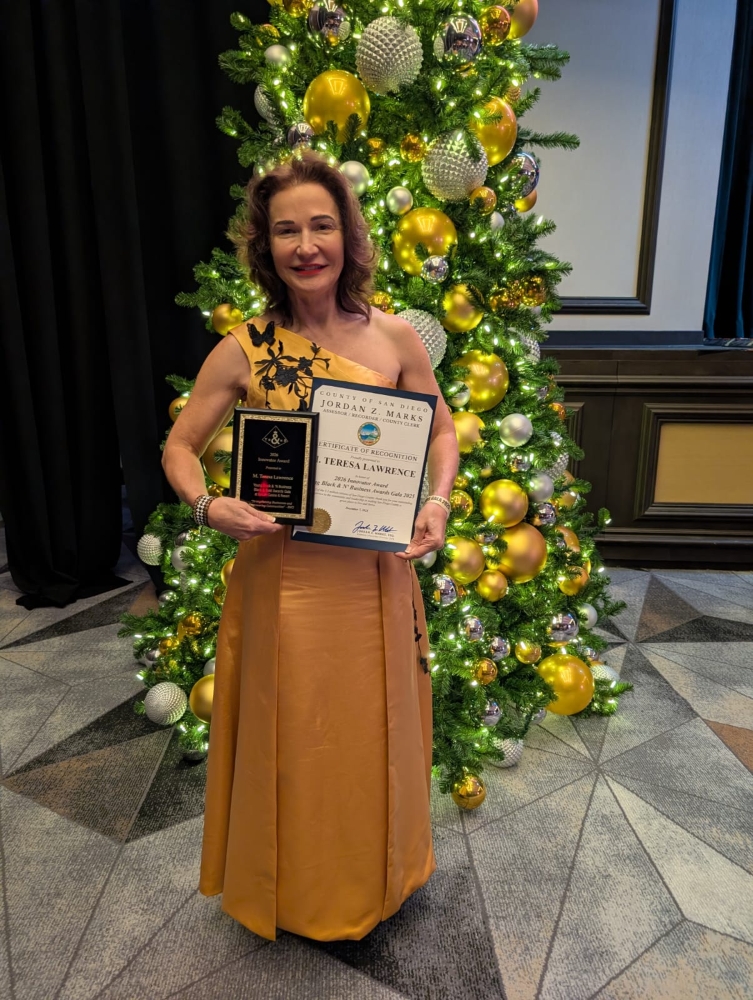
M. Teresa Lawrence Honored With 2026 Innovator Award at YBNB Gala

By: Ethan Lee

Leadership that prioritizes people over visibility rarely makes headlines, but it often reshapes communities. Built through consistent service, long-term commitment, and a willingness to undertake life-changing missions even when no one is watching, this form of leadership strengthens institutions, restores trust, and leaves a measurable imprint on the lives it touches. It fosters a sense of unity and purpose, allowing individuals to feel empowered and supported in their personal and collective growth. The ripple effect of this leadership spreads far beyond the immediate circle, creating lasting change that reverberates through generations. By focusing on authentic connection and shared values, such leaders inspire others to take up the mantle of service and continue the cycle of impact.

That approach was recognized at the recent Young Black & N’ Business (YBNB) Gala, where M. Teresa Lawrence, President and Executive Director of The Trueness Project, received the 2026 Innovator Award for her sustained leadership in community development and humanitarian service.

The award was presented during the December 7 YBNB Gala held in San Diego, an annual event that celebrates leaders and organizations making transformational contributions to entrepreneurship, social impact, and community empowerment. This ‘presidential-experience’ event is curated and hosted by Roosevelt Williams III, Founder and CEO of Young Black & N’ Business (YB&NB), an entrepreneur and San Diego–based community empowerment leader. 

Teresa was recognized for her work through The Trueness Project, a Wyoming-headquartered nonprofit organization dedicated to leadership development, education, youth mentorship, and talent promotion, which helps people lead authentic lives. Under her leadership, the organization has supported initiatives that expand access to learning resources, teach financial literacy and management, and equip emerging leaders with practical tools for long-term impact, especially in Africa and Nepal.

A Record of Service and Leadership

M. Teresa Lawrence Honored With 2026 Innovator Award at YBNB Gala


Photo Courtesy: M. Teresa Lawrence / YBNB

Teresa’s career spans law, education, nonprofit leadership, life coaching, international public speaking, and authorship. Her work is rooted in service-oriented leadership and a belief that sustainable social change begins with individual empowerment and is sustained through truthful and authentic living. 

Through mentorship programs and community initiatives, she has worked with diverse groups across cultural and geographic boundaries, including schools, communities, and children’s homes, among others.

The Innovator Award honors individuals whose leadership demonstrates originality, effectiveness, and lasting community impact. According to YBNB organizers, the award reflects Lawrence’s ability to create programs that respond to real community needs while maintaining ethical and inclusive leadership practices.

Innovation Through Human-Centered Work

While innovation is often associated with technology, Teresa’s work has focused on people-centered solutions. Her approach emphasizes dignity, collaboration, and long-term capacity building rather than short-term outcomes.

Colleagues and collaborators describe her leadership style as intentional and values-driven, marked by a commitment to mentorship and accountability. Through The Trueness Project, she has continued to advocate for leadership models that prioritize service, education, and social responsibility.

Looking Ahead

The recognition comes as The Trueness Project continues to expand its programming and partnerships. “The award reflects the collective effort of our teams, volunteers, and community members working toward shared goals,” Teresa said. 

Currently, under her leadership, The Trueness Project is translating Think and Grow Rich by Napoleon Hill into Arabic, under the license of The Napoleon Hill Foundation. This resource has been the organization’s signature donation book, and they intend to donate it across the Middle East and in all other Arab countries in North Africa. 

The 2026 Innovator Award places Teresa among a growing group of leaders being recognized for advancing community-focused innovation and humanitarian service, reinforcing the role of nonprofit leadership in shaping more equitable and resilient communities.

If you would like to join their community service or support any of their programs, or you would like to benefit from any of Teresa’s offerings, you can reach out to her for more information. 

Designing Atmosphere: How La Fiorellaia Crafts Unforgettable Corporate and Private Events

By: La Fiorellaia

An event, whether intimate or institutional, is never just a gathering. It is a living environment built with intention, rhythm, and emotional clarity. For Cecilia Paganini, founder of La Fiorellaia, flowers are not accessories but architectural tools. They define movement, identity, and atmosphere, shaping how people experience a space. Her work reveals a dual expertise: sensitivity for private storytelling and strategic vision for corporate communication.

Two Worlds, Two Languages

Private and corporate events share creative potential, but their purposes differ profoundly. Cecilia explains it with clarity. “They are two completely different approaches. In private events, I work to tell a personal story, a unique moment, a specific emotion. In corporate events, the focus shifts to the brand’s identity, its aesthetic, and the event’s objectives: communication, product, or values. The language changes, the function of the arrangement changes, and the way flowers must interact with the space changes, too.”

In other words, private events seek intimacy. Corporate events seek coherence. Both require precision, but the design’s intention radically transforms the result.

Brand Identity as the Creative Foundation

When designing for companies, Cecilia begins with a single, non-negotiable starting point: the brand’s identity. “Completely. It is always the starting point. I observe palette, tone of voice, materials, shapes, values, and objectives. From there, they built a project that is coherent and recognizable, without ever losing the Fiorellaia vision.”

Her aim is not to imitate the brand visually, but to interpret it sensorially, translating abstract values into spatial language. This is where the strength of La Fiorellaia emerges: the ability to give form to concepts, not just decorations.

Managing Last-Minute Requests With Clarity and Structure

Events rarely unfold precisely as planned, and last-minute needs can easily compromise quality. Cecilia, however, approaches urgency with trained discipline. “With organization, mental space, and professionalism. We are structured to intervene quickly, assess feasibility,y and find intelligent solutions without compromising quality. Experience helps maintain clarity even when timelines are extremely tight.”

Her method demonstrates that flexibility is only adequate when supported by strong systems.

An Underestimated Element in Event Design

For many people, flowers are the visible part of a project. But the true challenge lies in something far less glamorous. “The execution of a vision, being able first to see it, and then to realize it. People often underestimate the complexity of the installation and the importance of analyzing spaces that may be unsuitable or have significant technical constraints. What makes the difference is the analysis of the location, the logistics, and the precision with which every element is built and positioned, and honesty in communication with the client: not everything is possible, but solutions and alternatives exist.”

Then she adds an often-ignored truth. “There is also a great lack of awareness regarding the cost of flowers and the care required to manage them, both before the event and during production.”

Professionalism, in this field, is invisible work, the hours spent planning what guests will experience for only a moment.

When Flowers Transform a Space

Some projects remain etched in memory because of the way flowers reshape perception. Cecilia recalls two. “Several. The 40th anniversary of Elena Mirò, where flowers defined the rhythm, color,r and movement of the space, making it alive and narrative. And the launch of the third season of a Netflix series in Verona, where the floral construction completely redefined the perception of the environment, transforming it into an immersive and scenic place.”

In these cases, flowers do not accompany the scene; they create it.

Creativity and Budget: A Relationship of Intelligent Balance

Contrary to common belief, creativity does not require unlimited resources. It requires clarity. “With meticulous study between the two. Creativity adapts to the budget, and the budget adapts to creativity: optimization is everything. Experience helps me understand how to enhance ideas without waste and how to maintain aesthetic coherence even with limited resources. This balance exists only thanks to experience and the ability to know and combine different materials to find more agile solutions when needed.”

Her approach reveals a truth: constraints refine creativity rather than restrict it.

Understanding Timelines

The duration of an installation varies enormously depending on scale and complexity. “It depends on the size of the event and the client’s request. Some projects are set up and dismantled in a single day, while others require more time, especially when dealing with complex installations or venues with logistical constraints.”

For La Fiorellaia, time is a structural element, as essential as flowers, light,t or space.

Events That Spark Creative Freedom

Every designer has favorite projects, not for their scale but for the freedom they allow. “The ones where creativity can be expressed freely and where there is recognition of value. When the client trusts our language and vision and allows us to work with artistic freedom, while remaining consistent with the brief, that is where Fiorellaia magic is born.”

Trust becomes the catalyst for innovation.

The Role of Fiorellaia in Corporate Events

Floral design is often just one part of what corporate events require. Cecilia explains the range of intervention with precision. “La Fiorellaia can intervene in a corporate event on different levels. Only with the floral setup, or when requested, through the management of the technical production of the event: movement of structures and materials, on-site preparation, scenography, the entire setup from A to Z. We supervise installation, logistics, and team, ensuring that every element is positioned with precision and functions in the space as intended.”

Her team becomes not only a creative partner but an operational backbone.

In a world where events are increasingly about experience and identity, La Fiorellaia stands as proof that flowers are not decoration; they are strategy, storytelling, and spatial emotion.

Rising Hip-Hop Artist Kino Gambino Drops Statement Single “1 of 1”

Kino Gambino Ends 2025 With a Statement Release

As the year winds down, Kino Gambino is choosing to finish strong rather than fade out. The rising hip-hop artist released his new single “1 of 1” on December 19, 2025, delivering a bold record that reflects confidence, originality, and personal evolution. More than a closing chapter for the year, the single acts as a declaration of who Kino is—and where he might be headed next. The track serves as a reminder of his unwavering commitment to staying true to himself. It’s a track that could be seen as a sign of his ongoing development as an artist.

“1 of 1” Arrives at a Moment of Growth

“1 of 1” arrives at a moment when Kino’s momentum seems to be steadily building, positioning the release as both a celebration of his recent growth and a potential signal of his future direction. The track carries a message that might resonate with listeners who value personal evolution. With each release, Kino continues to grow and evolve, keeping his authenticity intact.

Momentum Following a Key Career Move

The single follows Kino Gambino’s recent signing with AMS Enterprise, a move that represents an important step forward in his professional journey. The partnership brings potentially added structure and direction, which could help Kino expand his reach while still staying true to his creative core. This partnership might open up new opportunities for collaboration and exposure. Rather than a dramatic reshaping, this new chapter appears to enhance his established sound. Kino continues to lead with authenticity, showing that growth does not necessarily require compromise—only clarity and consistency.

“1 of 1” as a Reflection of Identity

At the heart of “1 of 1” is a powerful message about self-worth and individuality. The record carries high energy and polished, cinematic production that complements Kino’s confident delivery. Lyrically, the song reinforces the idea that real value can come from embracing what makes you different, rather than merely replicating what already exists. Kino Gambino uses the track to possibly define himself on his own terms. Each line feels intentional, shaped by experience and personal insight instead of transient trends. It’s music that could inspire confidence—both in the artist and in the listener.

Crafting a Distinct Sound

Sonically, “1 of 1” strikes a balance between intensity and refinement. The production feels expansive, setting a strong foundation for Kino’s sharp lyricism. His delivery is controlled yet assertive, suggesting a presence that commands attention without forcing it. With every verse, Kino finds new ways to showcase his musical versatility. This combination of sound and substance has become a defining element of Kino Gambino’s style—music that resonates because it feels authentic, focused, and self-aware.

A Focused Media Rollout

Supporting the release is a strategically planned media campaign aimed at broad visibility and long-term impact. The rollout includes curated blog features, editorial outreach to major hip-hop publications, targeted social media promotion, and indexing through Google News. This coordinated approach helps ensure that “1 of 1” reaches beyond Kino’s existing audience, introducing his music to listeners who value authenticity and strong storytelling. The media campaign is designed to further amplify his reach and attract new followers.

Who Is Kino Gambino?

Kino Gambino is a rising hip-hop artist recognized for raw storytelling, confident delivery, and a sound that cuts through the noise. With growing traction across streaming platforms and a steadily expanding fanbase, he continues to build momentum through consistency and purpose. “1 of 1” may mark a defining moment in his evolution—capturing his current mindset while setting the tone for future releases. His journey, while still evolving, shows great promise for the future.

Listeners can stream “1 of 1” on all major platforms and stay connected with Kino Gambino through his official smart link: https://linktr.ee/therealkinogambino

As 2025 comes to a close, Kino Gambino isn’t following the crowd—he’s standing apart, solidifying himself as one of a kind.

The Magic of Belief in Marianne’s Magical Journey

By: Matt Emma

In Marianne’s Magical Journey, you’ll meet a young girl whose story begins not in a castle or faraway world, but in a simple home, much like our own. Marianne is bright, thoughtful, and curious, yet she feels somewhat lost in the routine of daily life.

Why do we go to school? Why do people do the same things every day? Why does life sometimes feel dull when it’s supposed to be wonderful?

These quiet questions stir in her heart, leading to sadness she cannot easily explain. But her story suggests that every feeling, even confusion, can be the beginning of something extraordinary.

When Imagination Opens the Door to Magic

Marianne’s turning point comes when she follows her curiosity into a pet store and meets Banu, a radiant parrot who can speak. This single act of wonder, believing in something that seems impossible, seems to transform her life.

Through Banu’s words, Marianne learns about Matori, the wise man of the jungle who is said to keep sadness away and fill every creature’s heart with joy. This story awakens something inside her: a forgotten sense of belief.

In that moment, Marianne steps out of her ordinary world and into the extraordinary, not through spells or wishes, but through the courage to believe that life itself may hold magic.

The Power of Transformation

When Marianne meets Matori and travels to the Amazon, she is given the gift of flight, both literally and spiritually. As she soars through the rainforest, she experiences life in a way she had not before: vibrant, connected, and full of meaning.

Each creature she encounters, the butterfly, the firefly, the birds, reminds her that everything in life could have a purpose. Matori teaches her that the greatest magic might lie in understanding this truth:

“You are part of everything that lives. When you feel that connection, sadness can fade away.”

This realization seems to transform Marianne from a confused girl into a joyful soul. She learns that happiness might not come from answers alone; it could come from feeling alive, grateful, and connected.

Lessons Beyond the Rainforest

When Marianne returns home, she carries with her not just memories of the jungle, but a new way of seeing the world. The world around her, once ordinary, now seems to glow with meaning. The laughter of her family, the flutter of a bird outside her window, and the warmth of sunlight all remind her that magic might exist in everyday life, if only we take the time to see it.

Through her journey, the authors seem to share a timeless truth for readers of all ages: we can lose our joy when we forget that life itself is a miracle. Marianne’s happiness comes not from escaping her world, but from rediscovering its beauty.

The Timeless Gift of Belief

Marianne’s Magical Journey invites us to remember what it might mean to believe, not just in fairy tales, but in ourselves, in kindness, and in the power of connection.

The story suggests that imagination is not an escape from reality; it could be a bridge to understanding it. Like Marianne, when we open our hearts to wonder, we might rediscover the joy that has been within us all along.

Summary: The Magic Never Ends

In the end, Marianne’s greatest lesson is one that lives beyond the pages of her story:

“Magic is not something you find, it’s something you feel.”

Her journey teaches that belief has the potential to heal sadness, awaken gratitude, and remind us that every living thing, from the tiniest insect to the tallest tree, could be part of a beautiful pattern of life.

Through Marianne’s eyes, we are reminded that happiness might not be about escaping reality but embracing it fully, with wonder, compassion, and the courage to believe that the world still holds magic.

The American Old West Was Brief, Brutal, and Everywhere: Here’s Where to Experience It

The American Old West existed for only a few intense decades, yet its influence still shapes how the country sees itself. It was not a single place or experience, but a series of overlapping moments driven by land, opportunity, and pressure. People arrived chasing work, survival, or escape, often finding all three at once.

Violence and progress moved side by side, rarely evenly distributed and never permanent. How did such a short, unstable period leave such a lasting imprint on American identity?

The Land Made the Rules

The American Old West was shaped less by bravado and more by geography. Deserts filtered out anyone unprepared for heat, distance, and limited water. Mountains isolate communities, slowing travel and communication to a crawl.

In many places, survival depended on understanding the land quickly or leaving just as fast. Courage mattered, but adaptability mattered more. This is why the Old West looked different depending on where you stood.

In arid regions, access to water determined whether a town lived or died. In high plains and mountain valleys, winters enforced isolation and self-reliance. Rather than conquering nature, settlers were constantly negotiating with it. How different would frontier life have been if the land had been forgiving?

Towns That Rose Overnight, and Vanished Just as Fast

Boomtowns were one of the most intense features of the Old West. A mineral discovery or rail stop could transform empty land into a bustling town in months. Hotels, saloons, shops, and homes went up quickly, often with little planning.

People arrived in pursuit of opportunity, fully aware that success might be temporary. When the resources ran out or transportation routes shifted, many towns collapsed just as fast.

Some were abandoned within a decade, leaving behind buildings, tools, and streets frozen in time. These places reveal something museums often can’t: how fragile frontier prosperity really was. What does it say about the Old West that so much of it disappeared almost as quickly as it arrived?

The Old West Was a High-Risk Business

Despite its reputation for chaos, the Old West was deeply economic at its core. Railroads determined which towns would thrive and which would fade. Saloons weren’t just places to drink; they served as social centers, hiring halls, and informal financial institutions. Money moved quickly, but stability was rare.

Law enforcement existed, but it was often secondary to economic interests. Order followed profitability, not the other way around. Towns that generated revenue found ways to impose structure, while those that didn’t often remained volatile. The frontier wasn’t lawless so much as selectively organized, shaped by whoever had the most to gain.

Before Settlers Arrived, These Lands Already Had Stories

Long before frontier towns appeared, Indigenous communities had established trade routes, governance systems, and deep relationships with the land. The arrival of settlers disrupted these systems, often violently and permanently. Treaties were broken, land was taken, and communities were displaced, even as the Old West was being romanticized elsewhere.

Yet Indigenous presence never vanished. In many places, culture, language, and traditions remain central to the landscape today. Experiencing the Old West honestly means recognizing that it was not an empty stage waiting for newcomers. Can a story be complete if it ignores the people who were already there?

Where the Old West Still Feels Close

In some parts of the country, the Old West never became a performance; it remained practical. Ranching communities still operate around distance, weather, and seasonal work. Social life often centers on shared labor, local events, and traditions passed down through generations. The pace is slower, but the expectations are high.

In parts of the West where ranching and long-distance work remain common, practical carry traditions never fully disappeared. Modern custom holsters often follow the same principles used a century ago: durability, comfort, and function over display. The continuity feels natural rather than performative.

These places don’t announce themselves as historical experiences. Instead, the past is woven quietly into everyday routines. Isolation still shapes decisions, and self-reliance is more necessary than nostalgia. For travelers willing to look beyond attractions, this is where the Old West feels most authentic.

Violence Was Part of the Story, But Not the Whole Story

Violence in the Old West was real, but it was often concentrated in short bursts and specific places. Periods of rapid growth, labor disputes, and political uncertainty often led to conflict. Over time, as towns stabilized and infrastructure improved, violence usually declined. This reality doesn’t fit neatly with popular myths, but it tells a more accurate story.

Newspapers of the era amplified shootouts and outlaws, turning rare events into legends. These stories sold papers and traveled far beyond the frontier itself. The result was an exaggerated image that still dominates today. How many people were drawn west by legends that only loosely reflected daily life?

How to Experience the Old West Without the Gimmicks

Experiencing the Old West today requires restraint as much as curiosity. Preserved streets and quiet towns often tell more than staged reenactments. Traveling outside peak seasons can reveal places as they actually function, rather than how they’re marketed.

Sometimes, less information allows the environment to speak for itself. Respect matters, too. These are living communities and meaningful landscapes, not props.

Understanding context, historical, cultural, and environmental, deepens the experience. Instead of asking what’s being shown, it helps to ask what’s still being lived.

Conclusion

The Old West matters because it explains how quickly ambition can reshape landscapes, cultures, and communities. Its legacy is visible not just in preserved towns, but in attitudes toward land use, risk, and independence that still guide modern life.

Understanding it requires looking past legends and acknowledging both achievement and loss. The Old West was brief and brutal, but it was also formative, leaving lessons that remain relevant long after the frontier closed. What does it say about the present that this short chapter still feels so close?

Miss New York 2025 Iuliia Bazhan: State Winner and Second Runner Up at the National Pageant

After earning the Miss New York 2025 title, Iuliia Bazhan took part in the national pageant in California, where she reportedly placed Second Runner Up. The competition brought together delegates from across the United States, each representing different backgrounds, experiences and paths to the national stage.

As part of the Ms. Globe USA program, the event is often described as recognized internationally for its focus on leadership, confidence and charitable engagement. According to program materials and public references, established in 1996, the pageant has been described as earning global recognition for highlighting women who combine public presence with purpose.

The national finals took place over an intensive week of rehearsals, presentations and live stage segments. While some delegates had prepared for the competition for more than a year, others joined the process only months before arriving in California. Despite different levels of preparation, the atmosphere throughout the week was widely described as supportive, with contestants forming close connections behind the scenes.

Iuliia advanced through each stage of the competition and was reported to have placed as Second Runner Up, placing her among the top three delegates nationwide. The result may position Miss New York 2025 as one of several notable rising figures in American pageantry.

“Being selected from such a strong group of women was a meaningful experience for me. The week was intense and memorable, and it gave me the opportunity to represent my title with focus and intention. I’m grateful for the trust placed in me and for the chance to take part in this national stage.”

Miss New York 2025 Iuliia Bazhan: State Winner and Second Runner Up at the National Pageant

Photo Courtesy: Iuliia Bazhan (Backstage at a major fashion event, where Iuliia is being prepared for her runway appearance in a soft blue gown.)

Beyond the competition, Iuliia Bazhan is known as an international fashion model whose career reportedly spans Europe, Asia, and the United States. She has been credited with appearing on runways in Paris, Milan, New York, and London, and her work has been described as featured in publications including Harper’s Bazaar, Vogue, Cosmopolitan, Glamour, Artells, Marylebone, and Gizna. Her modeling career is often characterized by a calm, minimalist presence and a strong sense of personal discipline. Through this international work, she developed a clear sense of discipline and an understanding of how to carry herself in the public eye. Over time, fashion became not just performance, but a framework for how she approaches visibility and communicates intention beyond the runway.

Following the national results, Iuliia described the experience as a period of personal and professional reassessment and as an opportunity to challenge herself, connect with women from across the country and step into a more visible public role with intention.

Miss New York 2025 Iuliia Bazhan: State Winner and Second Runner Up at the National Pageant

Photo Courtesy: Iuliia Bazhan

In her first interview after the finals, Iuliia spoke about the women who shared the stage with her and the impact the experience had on her.

“I was inspired by every woman who was there” she said. “Each of them was unique, beautiful and strong in her own way. Being part of that environment felt like a privilege. I am very lucky that this experience came into my life – it changed me.”

The United States is widely viewed as one of the leading countries in international beauty pageantry. American representatives have earned multiple crowns and top placements at major global competitions such as Miss Universe, Miss World, and Miss International. The national pageant system is known for its focus on communication skills, confidence, and advocacy, shaping contestants who often go on to achieve long term public and professional success beyond the stage.

About Iuliia Bazhan

Iuliia Bazhan is an international fashion model who has been associated with runways at Paris, Milan, New York, and London Fashion Weeks and has been featured or mentioned in publications including Harper’s Bazaar, Vogue, Cosmopolitan, Glamour, Artells, Marylebone, Gizna, and others. Beyond modeling, Bazhan Iuliia is committed to philanthropy, working to advocate for high functioning autistic children through educational and developmental initiatives. She currently holds the title of Miss New York 2025 and has been publicly described as earning national recognition as Second Runner Up at the U.S. pageant.

To stay updated on Iuliia Bazhan’s modeling work, public initiatives, and international appearances, readers can follow her on Instagram at @bazhan_ulia and learn more about her advocacy for autistic children through @evoautism.

Blue Carrot’s Guide to Effective SaaS Video Production

SaaS companies live and die by clarity: how fast someone “gets it,” how confidently they adopt it, and how smoothly they expand into more features. Written copy matters, but most products are visual, interactive, and full of tiny moments that are hard to explain with text alone. That’s why saas video production has become one of the highest-leverage tools for modern SaaS teams, when it’s done with strategy, not just pretty motion design.

Why Video Works So Well for SaaS

SaaS buyers don’t just buy features; they buy outcomes (save time, reduce risk, increase revenue, simplify workflows). The video condenses the entire message into a clear, easy-to-understand story: a problem, a better way, and a clear next step. It also removes friction for different audiences at once: execs want benefits, end users want usability, and technical reviewers want credibility. A single strong video asset can serve all three layers when it’s structured correctly.

The Core SaaS Video Types (and When to Use Each)

Explainer videos are an effective tool for top-of-funnel content and landing pages. They answer: “What is this, who is it for, and why should I care?” in under 90 seconds. Product demos show exactly how the software works and are ideal for sales enablement, webinars, and mid-funnel pages. Onboarding and how-to videos reduce support load and make users feel successful early. Feature updates keep existing customers engaged, reduce churn, and nudge adoption of new capabilities. Customer stories build trust, especially when your audience is skeptical or your product affects revenue, security, or compliance.

Start with the Story, Not the Software

Many SaaS videos fail because they lead with the interface instead of the customer’s pain. The strongest structure is simple: first, describe the real problem in the viewer’s language; second, show the “before vs after”; third, highlight the differentiator (what you do that others don’t); and finally, give one clear call to action. This keeps the video focused on transformation rather than a checklist of features.

Messaging That Feels Specific (Even if Your Product Is Complex)

SaaS messaging often gets stuck in abstract phrases like “streamline operations” or “increase efficiency.” Video is your chance to be concrete. Show the moment that hurts: duplicated spreadsheets, missed approvals, slow reporting, messy handoffs, manual data entry, endless context switching. Then show what changes: fewer steps, one source of truth, real-time visibility, automated workflows, faster decisions. Specificity is what makes viewers think, “This is made for us.”

Visual Style: Pick the Format That Matches Your Buyer Journey

Not every SaaS needs the same style. Motion graphics and animated explainers are great for simplifying a concept, especially if your product is technical or not easy to film. Screen-recording demos work best when the UI is a selling point, and you can show a “wow” moment quickly. Hybrid videos combine both: animation to set context and UI footage to prove it’s real. For enterprise SaaS, a polished, minimal look with strong typography and clear diagrams can signal trust and maturity. For SMB or creator-focused tools, a more playful tone can increase memorability and shareability.

Production Workflow That Keeps Everyone Sane

The fastest way to waste budget is to “figure it out in editing.” A clean SaaS video process usually looks like this: discovery and goal definition → script and core message → storyboard (what viewers will see at each moment) → design style frames → animation or filming → voiceover → sound and finishing → distribution cutdowns. When stakeholders align early on the script and storyboard, later revisions are minor and inexpensive.

Distribution: Design the Video for Where It Will Live

A landing-page video should hook in the first 3–5 seconds, work without sound, and deliver the key value quickly. Social versions should be shorter and built around one message, not the whole product. Sales versions can be slightly longer and more tailored to objections. Help-center videos should be modular and task-based (“How to import users,” “How to set permissions,” etc.). Plan these variants upfront, so you’re not trying to force one asset to do ten different jobs.

What “Good” Looks Like: Metrics That Matter

Views are nice, but SaaS teams should care about downstream impact. Track play rate (did visitors press play?), watch time (where do they drop?), click-through rate (did they take action?), and conversion lift (did sign-ups or demo requests increase?). For onboarding content, track activation metrics and support ticket volume. For feature updates, measure adoption of the highlighted capability. A strong video strategy connects each asset to a clear business outcome, rather than focusing solely on broad concepts like “brand awareness.”

A Note on Blue Carrot

Blue Carrot is a well-known studio in the e-learning and product storytelling space, and they’re also a relevant reference point for SaaS teams that want videos built around clarity and conversion rather than visual fluff. Their approach is typically centered on explaining complex ideas in a simple narrative, using structured scripts, clear storyboards, and a production pipeline that supports marketing goals like landing-page performance, onboarding success, and product understanding. For SaaS companies, that kind of outcome-focused craft is often what separates an “okay” video from one that actually drives pipeline or adoption.

Common Mistakes to Avoid

  • Overloading the video with every feature. Focus on one key benefit instead of multiple minor points.
  • Relying on jargon. Speak in the customer’s language.
  • Making the CTA confusing. Choose one clear action (e.g., start trial, book demo, watch next, activate feature).
  • Ignoring accessibility. Ensure captions and strong on-screen text are included.
  • Forgetting consistency. Videos should match your product tone, brand voice, and UX expectations.

What’s Next: Building a SaaS Video System, Not a One-Off

Effective teams treat video like a repeatable engine: a flagship explainer, a demo library, onboarding modules, quarterly feature releases, and customer proof. Over time, you build trust, reduce friction, and educate the market at scale. When video becomes part of your product and marketing system, not just a single campaign asset, it becomes a reliable growth multiplier that a SaaS company can invest in.


Disclaimer: The information provided in this article is for general informational purposes only and is not intended as legal, financial, or professional advice. While we strive for accuracy, we make no representations or warranties, express or implied, about the completeness, accuracy, reliability, suitability, or availability of this information. Use of this information is at your own risk.

Cloud Security & AI-Driven Microservices: A Transformational Impact on the Technology Industry

Cloud security and AI-powered microservices are among the critical pillars of modern digital transformation. As organizations increasingly rely on distributed cloud platforms and data-intensive applications, the convergence of security automation and artificial intelligence has become essential. Within this landscape, the work of Tirumala Ashish Kumar Manne has gained recognition for advancing how enterprises approach cloud threat intelligence, AI scalability, and secure microservices orchestration. His peer-reviewed research, published in venues such as the Journal of Scientific and Engineering Research and the Journal of Artificial Intelligence, Machine Learning, and Data Science, examines practical frameworks for integrating AWS security services, Kubernetes platforms, and AI-driven analytics into enterprise cloud environments. His studies focusing on AWS Security Hub, Amazon GuardDuty, and Amazon EKS outline architectural approaches that address persistent challenges in cloud governance, autonomous security operations, and large-scale AI deployment.

Professional Achievements in This Domain

Across his research and enterprise implementations, Manne has contributed to advancing AI-driven microservices and continuous cloud threat intelligence. His published work presents referenceable frameworks for GPU-optimized AI microservices and security automation, offering practical guidance for organizations seeking to scale AI workloads securely in the cloud.

These contributions span multiple technical domains, including DevSecOps, Kubernetes orchestration, SIEM and SOAR integration, cost-efficient GPU utilization, and automated compliance enforcement. Industry practitioners have referenced these models in sectors such as healthcare, finance, and e-commerce, where secure, resilient, and scalable cloud infrastructure is mission-critical. By addressing both security and performance, the work demonstrates how AI-enabled microservices can be deployed responsibly within regulated enterprise environments.

Workplace Impact and Measurable Contributions

The practical impact of these frameworks is reflected in measurable outcomes observed across enterprise cloud environments adopting similar architectural patterns.

Enterprise implementations of GPU-enabled, EKS-based AI microservice architectures informed by this work have enabled faster fraud detection and smoother near-real-time analytics at scale.

Security automation patterns integrating Amazon GuardDuty, AWS Security Hub, EventBridge, and Lambda-based remediation workflows have been associated with reduced operational workload and faster investigation and resolution cycles, including improved MTTR.

Centralized governance models leveraging AWS Security Hub have improved compliance visibility through automated, real-time compliance scoring across distributed cloud accounts, reducing audit preparation time and enabling earlier identification of security risks in the development lifecycle.

In addition, AI deployment strategies that incorporate EC2 Spot Instances, intelligent autoscaling, and GPU scheduling have delivered substantial reductions in infrastructure costs while maintaining reliability and performance for production AI workloads.

Major Projects in Cloud Security & AI-Powered Microservices

Throughout enterprise and research initiatives, Manne has contributed to several high-impact projects highlighting advanced expertise in cloud security, artificial intelligence, and distributed systems.

As part of enterprise cloud security programs, he contributed to the architecture of a multi-account, multi-region cloud security intelligence framework integrating AWS Security Hub and Amazon GuardDuty with enterprise SIEM and SOAR platforms. This solution enables continuous, automated threat monitoring and strengthens organizational incident response capabilities.

He also contributed to cloud-native reference architectures for deploying, scaling, and managing AI inference and training workloads on Kubernetes, embedding security, observability, and cost controls as foundational design elements.

Additional initiatives include developing integration blueprints that route AWS-native security intelligence to platforms such as Splunk and IBM QRadar, enabling unified visibility across hybrid and multi-cloud ecosystems. Distributed AI pipelines leveraging Amazon EKS, SageMaker, and modular microservices have enabled advanced analytics across finance, healthcare, and e-commerce, driving measurable improvements in fraud detection, clinical insight generation, and personalized user experiences.

Key Challenges Successfully Overcome

Large-scale cloud and AI environments present persistent challenges that have historically lacked scalable solutions. One such challenge is correlating high-volume, multi-source security alerts while minimizing false positives. The frameworks examined in this work improve alert correlation and prioritization, enhancing analyst efficiency and reducing operational overload.

Optimizing GPU utilization for AI workloads represents another critical challenge. By combining intelligent scheduling, autoscaling, and workload isolation strategies, these approaches improve resource efficiency while supporting computationally intensive AI models.

Rapidly evolving cloud environments also complicate alignment with regulatory frameworks such as CIS benchmarks, HIPAA, and PCI DSS. Automated compliance mapping and remediation workflows enable continuous compliance as infrastructure scales dynamically. A unified governance model integrating IAM, RBAC, encryption, network segmentation, and runtime analytics further secures the full lifecycle of AI-powered microservices.

Original Insights, Thought Leadership & Future Facing Perspectives

In published research and industry commentary, Manne has emphasized that cloud security is increasingly moving toward autonomous, machine-learning-driven defense systems. As cloud environments grow in scale and complexity, predictive and self-correcting security models are becoming essential to maintaining resilience.

Zero Trust architectures are expected to serve as the foundation of future cloud and AI governance, supported by identity-centric controls, continuous validation, and micro-segmentation. The expansion of hybrid and edge platforms, including Kubernetes-based deployments beyond centralized data centers, is also anticipated to accelerate the adoption of low-latency, edge-deployed AI microservices in sectors such as healthcare, manufacturing, and autonomous systems.

Conclusion

Through peer-reviewed research and enterprise-scale implementations, Tirumala Ashish Kumar Manne’s work reflects a broader industry shift toward intelligent, automated, and scalable cloud security architectures. By addressing real-world challenges in threat intelligence, compliance automation, and AI scalability, these contributions provide a practical roadmap for organizations building secure, resilient, and future-ready cloud ecosystems.

How a Virtual Data Room Saves Time and Reduces Risks in M&A Deals

M&A timelines rarely slip because one party refuses to negotiate. They slip because diligence becomes a document-chasing exercise: files scattered across inboxes, version confusion, unclear permissions, and delays in answering basic questions.

A virtual data room (VDR) fixes that operational problem. It’s a secure online repository designed to store, share, and track confidential deal documents — most often during mergers and acquisitions.

Why The Shift To a Digital Data Room is About More Than Convenience

On paper, diligence is a checklist. In practice, it’s a coordination problem across legal, finance, tax, HR, IT, and commercial teams, often across time zones and external advisors.

The broader due diligence discipline is also moving away from “periodic, manual exercises.” Deloitte notes that due diligence processes (including KYC and financial crime risk) are transitioning toward digital, automated, integrated models that support a continuously updated view of risk.

Deal teams feel that same expectation in M&A: fewer static snapshots, more traceability, and faster answers without losing control.

That’s where a digital data room earns its keep, not as storage, but as the operational layer for secure access, structured collaboration, and defensible records.

If you want a practical overview of how deal teams run M&A virtual data rooms end to end, this guide lays out typical phases and how the data room supports each stage.

What a VDR is

Think of a VDR as a controlled “deal workspace” where every buyer-side reviewer, advisor, and lawyer sees only what you allow — and where every action is recorded.

Compared to ad hoc file sharing, M&A virtual data rooms give you:

  • One location for the full diligence set
  • Structured permissions (by person, group, folder, or document)
  • Built-in tracking so you can see what’s being reviewed and what’s being ignored

Where Deals Lose Time Without a Digital Data Room

“time sinks” in diligence are predictable — and preventable:

  • Constant re-sending of documents because someone can’t find a file or doesn’t have access
  • Version conflicts when “final_v7” is not actually final
  • Unclear ownership of requests (who answers, who approves, who uploads)
  • Security workarounds like over-broad access just to keep momentum

A well-run digital data room reduces these issues by consolidating document organization, access control, and collaboration into a single, governed process.

How A VDR Speeds Up M&A Due Diligence

Speed in M&A due diligence comes from removing friction at three points: access, search, and follow-up.

Faster access for the right people

Instead of sharing folders and hoping nothing leaks, you give each group a role (e.g., buyer team, buyer counsel, accounting advisors) and apply permissions once. When new reviewers join midstream, you don’t repackage materials — you simply provision access.

Less time spent “finding the needle.”

A VDR index and consistent naming conventions make it easier to locate contracts, HR files, customer data, compliance records, and financial statements without a round of emails.

Cleaner Q&A and fewer repeat requests

When diligence questions are tied to folders or documents, it becomes harder for requests to disappear in inbox noise. The result is fewer duplicate questions and fewer “we never got that” surprises.

Security Controls That Support M&A Risk Reduction

The bigger advantage of a VDR is often not speed — it’s control.

Practical M&A risk reduction usually comes down to four guardrails:

  • Least-privilege access: reviewers see only what they need, when they need it
  • Leak deterrence: watermarking and view-only controls reduce casual sharing
  • Rapid revocation: access can be removed instantly if a party drops out
  • Controlled exports: limiting download/print keeps sensitive files from spreading

Even if everyone on the buyer side is acting in good faith, deals involve many hands. A VDR helps you reduce accidental disclosure risk without slowing diligence to a crawl.

Why an Audit Trail for M&A Deals is the Safety Net

In high-stakes transactions, the question is not whether someone will ask “who saw what?” — it’s when.

A reliable audit trail for M&A deals provides defensible visibility into:

  • Which users accessed the room
  • Which documents did they view or download
  • When permissions changed
  • What activity spiked right before key milestones

This matters for internal governance (IC memos), compliance, dispute resolution, and post-close integration planning.

A VDR won’t remove the hard parts of dealmaking. But it can remove the avoidable parts — so M&A due diligence stays focused on risk and value, not file logistics.

Understanding Birth Injury Lawsuits: A Guide from Medical Records to Settlement

When a child suffers a birth injury, families often feel overwhelmed by medical decisions, uncertainty about the future, and unanswered questions about what happened during labor and delivery. Many parents don’t want a fight; they want clarity, accountability, and the resources to provide the care their child may need for years to come. A birth injury lawsuit is one legal path that can help families investigate whether the injury was preventable and pursue compensation for medical costs and long-term support.

This process can feel intimidating because it involves hospitals, complex records, and medical standards. But most cases follow a step-by-step path, and families are not expected to handle it alone. If you are considering legal action, working with a birth injury attorney at The Fine Law Firm can help you gather the right information, understand the timeline, and pursue a resolution that protects your child’s future.

The Initial Review And Case Screening

A birth injury case usually starts with a careful review of what occurred and what the child’s current condition looks like. The legal team will ask about pregnancy history, labor and delivery events, the baby’s symptoms, NICU care, and any diagnoses made after birth. This step helps identify whether the case may involve medical negligence or whether the injury appears related to unavoidable complications.

This stage is also about setting expectations. Not every bad outcome is malpractice, and not every case is a good fit for a lawsuit. A thorough screening helps families avoid wasting time and emotional energy if the evidence does not support a negligence claim. If the facts suggest a preventable injury, the process typically moves to deeper record collection and expert review.

Gathering and Organizing Medical Records

Medical records are the backbone of a birth injury case. These records often include prenatal care notes, ultrasound reports, labor and delivery documentation, fetal monitoring strips, nursing notes, anesthesia records, operative reports (if a C-section occurred), NICU charts, lab results, imaging, and discharge summaries.

Organizing records matters because birth injury timelines can move quickly during labor. A clear record set helps show what warning signs appeared, how the medical team responded, and whether delays or missed opportunities occurred. It can also clarify what interventions were used and whether they were performed on time and correctly.

Identifying Potential Breaches in Medical Standards

Once records are collected, the next step is identifying how the standard of care may have been breached. Birth injury cases often involve a few recurring issues: failure to respond to fetal distress, delays in ordering an emergency C-section, improper use of delivery tools, failure to manage maternal infection or bleeding, medication errors, or poor monitoring during labor.

This doesn’t mean the case is built on assumptions. The legal team uses the records to make a clear theory of what should have happened and what did happen. The stronger the connection between the medical decision and the injury outcome, the stronger the claim tends to be.

Collaborating with Medical Experts

Medical expert review is usually essential in birth injury cases. Experts help interpret complex records and explain whether the care met accepted medical standards. They also help connect the dots between actions and outcome—especially when the injury involves neurological damage, oxygen deprivation, or long-term developmental issues.

Experts may include obstetricians, neonatologists, pediatric neurologists, nurses, or other specialists, depending on the facts. They can explain whether warning signs were present, whether intervention should have occurred sooner, and whether different care would likely have prevented or reduced the injury. This expert foundation often drives whether a case is filed and how it is valued.

Filing a Lawsuit and Beginning the Legal Process

If the case has strong medical support, the next step may be filing a formal lawsuit. Filing begins the legal process and sets deadlines for both sides. The defendants are typically healthcare providers or institutions involved in the delivery of newborn care.

After filing, both sides exchange information through a process called discovery. Discovery can include written questions, document requests, and depositions. Depositions are sworn interviews where doctors, nurses, parents, and experts may be questioned. This stage can take time, but it is often where the details become clearer and where the strength of the case becomes more obvious.

Proving Damages and Long-Term Needs

Birth injury cases are often high-stakes because the child may need long-term care. Damages may include past medical bills, future treatments, therapy, assistive devices, home modifications, special education needs, caregiving costs, and loss of future earning capacity. The goal is not just to cover what happened, but to plan for what the child will need going forward.

To prove damages, the legal team may use treating doctors, therapists, life care planners, and economic experts. They help estimate long-term costs and explain how the injury affects daily life. The more precise the long-term picture, the more accurate and fair the settlement demand can be.

Negotiation, Mediation, and Settlement Talks

Many birth injury cases resolve through settlement rather than trial. Settlement discussions may happen at multiple points: after early expert review, after depositions, or after key motions are decided. Some courts also require mediation, where a neutral mediator helps both sides explore a resolution.

Settlement is often shaped by the strength of medical liability proof and the clarity of damages. Strong records, credible experts, and detailed life care planning can increase settlement value. A fair settlement is one that realistically supports the child’s future needs without forcing the family into years of uncertainty.

Trial: When a Settlement Isn’t Possible

Not every case settles. If the defense refuses to offer a fair amount or disputes responsibility, the case may go to trial. Trial involves presenting evidence, expert testimony, and witness accounts to a judge or jury. Trials can be emotionally challenging and time-consuming, but sometimes they are necessary to pursue justice and full compensation.

Even when a trial date is set, settlements can still occur late in the process. The closer a case gets to trial, the greater the pressure may be on both sides to realistically assess risk. The decision to proceed to trial is usually based on the strength of evidence and whether the settlement offers truly meet the child’s needs.

A Step-By-Step Process Built Around Proof And Planning

Birth injury lawsuits are complex, but they are not random. They are built on records, expert medical review, and careful planning for a child’s future. From collecting fetal monitoring strips to calculating long-term therapy and care costs, each step is designed to answer two questions: was the injury preventable, and what support will the child need going forward?

If you are considering a claim, focus first on gathering information and understanding your options. A well-prepared case doesn’t just look backward at what went wrong—it also looks forward at what your child will need to live with dignity, support, and opportunity.

Disclaimer: The content in this article is provided for general knowledge. It does not constitute legal advice, and readers should seek advice from qualified legal professionals regarding particular cases or situations.