“Unless First We Dream”: How One Man’s Vision Sewed Together a Nation

In an era often defined by division, few stories remind us of the enduring power of unity quite like Unless First We Dream—the remarkable new book by Len Silverfine, a visionary whose bold idea became a living symbol of American pride.

Silverfine, a former advertising executive from the storied “Mad Men” era of the 1960s, tells the extraordinary true story behind the creation of the Great American Flag—a monumental project that spanned nearly five decades and brought together Americans from all walks of life.

Born out of the turbulent years following the Vietnam War and Watergate, Unless First We Dream chronicles how one man’s simple yet powerful goal—to create the largest American flag ever made—evolved into a nationwide movement of hope, craftsmanship, and collaboration. What began as a dream for the country’s 1976 bicentennial celebration became a lasting symbol of perseverance and patriotism.

“Dreams don’t come true unless we first dare to have them,” Silverfine writes, setting the tone for a story rooted in faith, persistence, and unity.

From navigating political red tape in New York City to convincing engineers, manufacturers, and sponsors to believe in his cause, Silverfine’s journey is equal parts entrepreneurial, historical, and deeply human. His recounting pulls readers into the grit and glory of a dream too big to fit inside one man’s imagination—and yet, one that captured the nation’s heart.

The book’s most dramatic moments come alive during the flag’s first unveiling atop the Verrazano-Narrows Bridge—a moment of triumph nearly undone when the massive flag tore under high winds. In many ways, Silverfine’s journey mirrors the very fabric of American history—a tapestry woven from countless individual threads, each contributing to a greater whole. The sheer scale of his endeavor, coupled with the challenges he faced, underscores the power of persistence in the face of adversity. Silverfine’s ability to rally people around a single, unifying vision highlights the potential of one individual to spark monumental change, transcending the limitations of politics, economics, and social upheaval. His story is not just about creating a flag—it’s about building a collective identity, one stitch at a time.

Instead of giving up, Silverfine rebuilt, reignited, and inspired renewed support from individuals and corporations alike, including household names like Revlon. What emerged was not just a flag, but a powerful metaphor for resilience—the mending of something torn, and the coming together of a divided nation. Throughout his journey, Silverfine encountered both personal and societal resistance, yet his unwavering commitment to the project serves as a powerful example of how dreams can flourish against the odds. The story of the Great American Flag is one of overcoming obstacles—not just physical ones, like the engineering challenges of constructing a flag of such monumental proportions, but also emotional and ideological ones. Silverfine’s perseverance in navigating these hurdles speaks to the strength of human conviction, the belief that what seems impossible today can be realized through hard work, vision, and collective effort.

Unless First We Dream is more than a memoir—it’s an invitation to remember what America can achieve when it works together. The Great American Flag is more than just a symbol—it’s a reminder of the power of individual initiative and the importance of taking bold steps toward something greater than oneself. Silverfine’s vision wasn’t just about creating a piece of fabric; it was about fostering a sense of shared purpose and national pride. The story behind the flag’s creation is a testament to what can happen when one person dares to dream big and has the courage to gather others along the way. Silverfine’s work is a powerful illustration of how unity, born from a common goal, can transcend division and produce something enduring. Silverfine’s decades-long journey serves as a timeless reminder that even in moments of uncertainty, collective vision and determination can transform a single dream into a national legacy. 

Today, the Great American Flag remains a testament to that enduring spirit, and Silverfine’s story continues to inspire dreamers, builders, and believers everywhere.

Unless First We Dream by Len Silverfine is available now through major retailers and online platforms.

From Homeless to Independent Filmmaker: How Personal Tragedy Led Tiana Woods to Create “Love Trap”

By: Svetlana Khachiyan

In the world of independent cinema, some “fresh blood” has arrived. On December 5, the premiere of Love Trap, directed by independent filmmaker Tiana Woods, took place in Las Vegas. The film was born out of her personal tragedy: she lost both her daughter and her father during the COVID-19 pandemic, and before that, she spent years experiencing homelessness. The movie explores the essence of love, its complicated forms, and its meaning in our lives. Woods cautions viewers not to expect a Hollywood happy ending because this story is grounded in real life.

From the film’s cast to the personal story of tragedy behind it, we got the full inside story from Tiana.

Q. Tiana, how did the idea for the film come about?

The idea was born several years ago, during COVID, when I lost my oldest daughter and my father. It was a very dark time for me. I fell into a deep depression and was constantly taking sleeping pills because I didn’t want to feel the pain. During that period, I started having dreams about making this film, and that’s where the idea for the script came from. Love Trap became my salvation and a form of healing. It helped me through the darkest period of my life.

I wrote the film script first, but since a movie can’t contain everything I wanted to say, I decided to write a book as well.

Q. What is “Love Trap” about?

Above all, it’s about love and how many people misunderstand its true meaning. I observe relationships between couples, spouses, mothers and daughters, and I see that many people don’t truly understand what love is. I want to show that love has different layers, and that awareness matters in how we love. A lot of people love only the outer shell, and as soon as you stop meeting their expectations, their “love” disappears. Love has to be backed by actions. But we often act under the influence of emotions, make the wrong choices, and sometimes one choice can change a life. Love has many forms, and that’s what I want to portray.

Q. How did you end up working in independent film? Tell us your story.

I was born in Detroit, Michigan. I have 11 children – and I still say “11,” because even though I lost my oldest daughter, she will always be part of our family. Before entering the film industry, I worked remotely in marketing, took care of my kids, and managed my daughter’s career – she’s an actress and singer who often travels for work.

So I was juggling everything at once: her career, the household, and building a business. Later, we moved from Detroit to Florida, and then to the East Coast, because the film industry was stronger there. We’ve now been living in Las Vegas for over a year.

I say all of this simply, but the road was long and hard. In Florida, we were homeless for several years until my husband Alan found a job. Now we’re both directors creating our own films.

Q. Were you homeless?

Yes. We all slept in a Dodge Durango in Florida – me, the kids, and my husband. We’d park overnight in a Walmart parking lot. I’d go inside to wash the kids, brush their teeth, get them ready for school, and drop them off. Then I’d drive my husband to work and spend the day at McDonald’s until his shift ended.

After picking him up, we’d get the kids from school, go to a park, and then return to the parking lot to sleep. I knew something bigger was meant for us. You don’t go through all that suffering unless you’re destined for something greater. And that’s exactly how it turned out.

Q. How did you get through that period?

My husband found a job, and slowly we started to rebuild. For example, the budget for Love Trap was $75,000 – not investor money, but money my husband and I earned ourselves. I worked overtime for a long time just to pursue my dream. We always knew what we wanted to do.

Our first short film, Inertia, was almost autobiographical – my husband wrote the script. It’s about a family that moves and tries to find a home but faces obstacle after obstacle. The film ended up winning several awards.

Q. How long did it take to make “Love Trap”?

Three and a half years. During that time, I faced a lot of challenges, especially finding loyal people. When you’re an independent filmmaker, you meet many who only want money and sell you false promises. I made mistakes, but life teaches you. Despite everything, the film is complete. Now I feel unstoppable. I’m like a phoenix – I have a purpose, and I’m moving toward it. The journey was long, but I had to find the right people.

Q. What do you think people will feel when they leave the theater?

I think many will be speechless. They’ll walk out asking, “What just happened?” I don’t want to spoil anything, but the ending is unconventional – no typical Hollywood happy ending. Like real life. Not every story ends wrapped in a bow. I want people to see themselves in the characters’ situations. I want them to feel the desire to change – to talk with their spouse, friend, or parent. To try to understand rather than argue. Communication and understanding are everything.

From Homeless to Independent Filmmaker: How Personal Tragedy Led Tiana Woods to Create “Love Trap”

Photo Courtesy: Tiana Woods

Q. Your favorite symbols in the film?

There’s a woman in a wedding dress. She represents a woman who feels trapped in a relationship – stuck, chained, unable to leave. But the truth is, you can leave. You just have to stand up and do it. Many don’t. They stay, endure, and take on more and more until they reach a breaking point.

Q. If you could speak directly to someone who feels trapped in their own pain, what would you say?

It depends on the pain. If it’s a harmful or traumatic marriage, I’d say: “Reach down, pick yourself up, and move on.” No relationship is worth sacrificing your mental health. If it’s depression, I’d say: take your mind off the afflictions that let you down because if you stay in depression and obsess over the problem, you sink deeper and deeper – sometimes to a point that becomes life-threatening. You need to find something to do, take action, not just stay at home thinking about your situation or what is breaking you. If you don’t take steps to heal your pain, it will consume you. That’s what I would say.

Q. Your film features the well-known actor Khalil Kain.

Yes, and I’m deeply grateful to him. When you’re an independent filmmaker, actors of his caliber don’t line up for your projects. I reached out to him on a friend’s recommendation, and he immediately supported me. He didn’t treat me like I was nobody and he was the star. He understood my vision, was engaged, curious, and simply incredible. I made the right choice. People come into your life for a reason – he was meant for this role.

Q. What was it like working with him on set?

It was fun. He was ready from the start – it took just one or two takes, and he never missed a line. Being on set with someone so seasoned in the Hollywood film set environment was inspiring. He was smiling, and his spirit was calm. He brought life and humor to the set, motivating everyone around him. I would jump at the chance to work with him again. He had full creative freedom as Sed, and he brought the character to life perfectly. I didn’t even need to direct him – it felt like he could read my mind. Exactly what I envisioned, he delivered flawlessly.

Q. Who else is part of the film?

The three main characters are Kevin, played by Brian Creary; Jennifer Franklin, who plays his wife; and Khalil Kain as Sed, the best friend. There’s also Meco Hendrickson, who plays the “bad guy.” My children appear in the film; I appear in some crowd scenes; and my husband is also in it. And just weeks before the premiere, I met singer Yalana, whose track became the main soundtrack.

Q. Who is Yalana?

She’s a rising singer who, in many ways, is very similar to me. She creates music from her pain and life experiences and pours her soul into it. We literally bumped into each other at a music industry event and clicked instantly. It felt like fate.

From Homeless to Independent Filmmaker: How Personal Tragedy Led Tiana Woods to Create “Love Trap”

Photo Courtesy: Tiana Woods

Q. If your daughter could see the film today, what would you tell her?

I think she would be so proud of me, and I know she would be smiling from ear to ear – just like I know my dad would be. I really wish my dad and my daughter could be here to see this. Years ago, we went through really hard times – when we were homeless and sleeping in the car in Florida. All she saw back then was our struggle; she didn’t get to see the part where we were moving toward success. I never gave her the chance to see that it could be done. That’s why she appears in the photos at the end of the film – she is definitely my motivation. She would be in the film every step of the way, and she would definitely be right beside me, working on the next one.

Q. What would you like to wish the viewers?

I’d say: watch the film with an open mind, so you can truly catch the messages it carries. Don’t just watch but try to see the meaning behind it. It’s similar to how blind people, with their eyes closed, can still “see,” hear, and feel everything happening around them. I really hope that after watching the film, every viewer walks away with new thoughts and a sense that life and love can be experienced on a much deeper level.

The Love Odyssey: How Sabine Schoepke Turned Reinvention, Heartbreak, and Hope into a Guide for Women in Midlife

By: Marissa Hale

In a world where everyone is searching for answers about love, identity, and the possibility of starting over, Sabine Schoepke has emerged as a powerful and compassionate voice. Her book The Love Odyssey blends memoir and self-help in a way that feels both intimate and universal. It is not simply the story of one woman’s journey. It is a companion for anyone who finds themselves standing in the middle of life and wondering how to begin again.

Schoepke explains that she wrote the book after recognizing that her struggles were echoing through the lives of countless women around her. Clients, friends, and even late-night messages from strangers all reflected the same questions. Who am I now? What do I deserve? Is it too late to start over? She began to understand that her story was not an isolated experience but part of a shared emotional landscape. She had lived through numerous cycles of reinvention. She had been homeless at nineteen. She had rebuilt her life after losing her home in a fire. She had walked away from a long relationship and faced the quiet but devastating realization that she no longer recognized herself.

These experiences were not simply difficult moments. They became turning points that gradually revealed lost parts of her identity. Writing the book became an act of responsibility rather than a creative choice. She felt compelled to take everything she had learned and offer it back to others. She wanted the book to feel like a lighthouse and a steady presence. She wanted her readers to feel seen and held. Her message is simple yet powerful. You are not broken. You are becoming. You are not alone. I am right here with you.

A central idea of The Love Odyssey is the concept of love as a journey. Schoepke intentionally chose the word odyssey to describe the emotional terrain we navigate in relationships. For her, love is never a destination and never something that can be solved like a puzzle. It is not a prize that one discovers fully formed and ready to be claimed. It is a long and unpredictable path filled with moments of beauty, difficulty, growth, and surprise. An odyssey carries storms and setbacks. It presents challenges that reveal who we are and what we fear. Yet an odyssey also includes breathtaking scenes that remind us why the journey matters.

By framing love as an evolving voyage, she invites readers to release the idea that they must achieve perfection. Instead, she encourages them to understand that real love requires expansion and transformation. It is something we learn, unlearn, and learn again. Love is a practice and a promise. It is never something we finally master. It is something we continually grow into.

The book itself was born from a quiet and deeply personal moment that Schoepke describes with clarity and honesty. After a painful breakup, she sat alone at her kitchen table and realized she had lost herself. It was not a dramatic collapse but a soft and devastating truth. She no longer recognized the woman she had become. This moment cracked something open. She began to write in order to find herself again. What started as personal journaling slowly grew into chapters. Those chapters evolved into a manuscript. Eventually, the manuscript became the guide she wished she had during her most difficult seasons.

One of the themes that resonates strongly with readers is her emphasis on rediscovering self-love in midlife. She rejects the idea that self-love is made of indulgent rituals or pretty affirmations. For her, it began with grief and honesty. It required her to confront the ways she had neglected herself while trying to be endlessly strong and endlessly understanding. Reclaiming self-love meant building her identity from the ground up. It meant choosing her own joy. It meant honoring her needs without apology. It meant trusting her own voice after years of quieting it to accommodate the expectations of others. Eventually, this process became a rebirth. Not into a new woman, but into the truest version of the woman she had always been.

Schoepke also speaks candidly about how our approach to relationships evolves as we move through the different stages of life. In our twenties, she says, many of us chase connection out of curiosity and desire. In our thirties, we focus on stability and structure. But in midlife, something shifts in a powerful way. We begin to crave meaning, authenticity, and alignment. We become unwilling to shrink for the comfort of others. We want a partnership rather than dependency. We want intimacy rather than performance. Midlife removes the noise and exposes the truth. Who are you without the roles you play? And who do you want beside you for the next chapter?

The Love Odyssey is ultimately a call to courage. It invites the reader to imagine that life can open again even after loss. It reminds them that identity is not a fixed shape but a living story. Schoepke writes with the humility of someone who has walked through fire and with the generosity of someone who wants to help others avoid unnecessary suffering. Her experiences become a roadmap for anyone who is ready to step back into their own life with clarity and hope.

For every woman who has felt lost, unseen, or unsure of her next step, The Love Odyssey offers a gentle but powerful truth. You are not starting over. You are unfolding into who you were always meant to be.

Building Lasting Customer Relationships: Insights from Tom Parsons on Loyalty Media

By: Daniel Hartman

In the fast-paced world of marketing, businesses often face a challenging tension: how to balance immediate sales tactics with long-term customer loyalty. Tom Parsons, a leading strategist with Media High Ground and author of Lead or Bleed, offers a compelling perspective on how companies can navigate this delicate balance. Drawing on decades of experience in client strategy and execution, Parsons emphasizes that businesses must shift focus from purely transactional approaches to relationship-building tactics that resonate deeply with customers.

The Cautionary Tale of Groupon

Parsons often cites Groupon as a cautionary tale for marketers focused solely on short-term wins. “Groupon’s global revenue trends after peaking in 2016 coincide with data from other sources that you can’t stack short-term tactics and create long-term relationships,” Parsons explains. He notes that while industries vary, the ecosystem often overvalues transactional customers, relying too heavily on promotional mechanisms that attract buyers seeking only the best deal rather than a lasting connection.

The takeaway is that businesses cannot depend solely on discount-driven campaigns to sustain growth. While promotions may drive an immediate spike in sales, they rarely cultivate the loyalty needed for long-term profitability. Instead, Parsons advises marketers to think about how every interaction contributes to building trust, authority, and familiarity in a customer’s mind.

The Pitfalls of Focusing Only on the End of the Funnel

Many companies make the mistake of concentrating too much on end-of-funnel tactics. Parsons points out that tracking where a lead came from is valuable, but it represents only one piece of the marketing puzzle. “Creating a score at the end of the funnel is preceded by many plays that advance the lead,” he says. In other words, marketers must pay attention to the journey, not just the destination.

Parsons likens the process to playing football: “If you go through the heart, winning the endzone of a customer’s mind is easier.” This metaphor underscores the importance of holistically addressing the customer experience—focusing on meaningful engagement and emotional connection at every stage, not merely on securing a final purchase.

Balancing Short-Term Tactics and Long-Term Trust

While Parsons acknowledges that promotions and other short-term tactics have their place, he stresses that they should not overshadow the foundation of trust. “The key is building authority of familiarity in the customer’s mind,” he explains. By consistently demonstrating value and credibility, companies can reduce reliance on promotions and protect margins even when short-term sales campaigns are necessary.

The principle is simple: when customers recognize a brand as reliable, trustworthy, and valuable, they are more likely to engage repeatedly, making long-term loyalty far more achievable. Companies that invest in this form of relational marketing enjoy a buffer against the pressures of discount-driven sales cycles, ensuring sustainable growth.

The Evolving Role of Social Proof

Social proof has always been a critical driver of consumer behavior, but its role has intensified in the digital age. Parsons observes that today, customers are inundated with information, which can lead to decision fatigue. Social proof, including reviews, testimonials, and user-generated content, among other things, offers an anchor for consumers to pause and feel confident in their decisions without pressure.

“Social proof hasn’t replaced word of mouth, but it has enhanced it,” Parsons notes. In a landscape where shoppers can instantly access opinions from thousands of peers, the signals that a product or service is trustworthy help brands cut through the noise and establish credibility quickly. Companies that leverage social proof effectively can accelerate customer trust while reinforcing long-term loyalty.

Metrics That Matter: Intent Media vs. Loyalty Media

Measuring the success of marketing initiatives requires distinguishing among different media strategies. Parsons emphasizes the importance of treating Intent Media and Loyalty Media differently when it comes to metrics.

Intent Media focuses on Cost Per Acquisition (CPA), tracking not only the act of conversion but also what led a customer to that point of intent. Loyalty Media, on the other hand, prioritizes the repeat value of a customer, focusing on the revenue and engagement generated across multiple interactions. By analyzing these metrics separately, businesses can allocate resources more effectively, ensuring that both acquisition and retention strategies receive appropriate attention.

A Call for Strategic Balance

Parsons’ insights converge on a central theme: marketing is most effective when it balances the urgency of short-term tactics and offers with the deliberate cultivation of long-term relationships before it’s time to buy. Businesses that rely solely on immediate wins risk creating transactional interactions that erode trust and reduce customer lifetime value. Conversely, companies that invest in relational marketing, authority building, and social proof can foster meaningful connections that yield sustained growth.

In a marketplace where consumers are more informed, skeptical, and selective than ever, Parsons’ approach provides a roadmap for marketers seeking to harmonize acquisition efforts with loyalty-building strategies. By learning from Groupon, prioritizing engagement beyond the end of the funnel, and leveraging metrics wisely, companies can navigate the complexities of modern marketing while nurturing lasting customer relationships.

Ultimately, the challenge for marketers is clear: go beyond the transaction, invest in the customer journey, and focus on the human connection. As Parsons underscores, success lies not just in winning the sale but in winning the customer’s trust, loyalty, and advocacy over the long term.

Ready to level up your leadership? Grab your copy of Lead or Bleed now on Amazon or Barnes & Noble!

A Story Reawakened: Anna Olswanger’s Journey Behind A Visit to Moscow

By: Marisa Kentwell

A Forgotten Manuscript Finds New Life

When Anna Olswanger opened the cardboard box that arrived from the daughter of Rabbi Rafael Grossman, she did not expect her past to look back at her. The box contained papers the rabbi and Anna had written together decades earlier, including the unfinished manuscript of a Holocaust novel they had once poured their energy into. Inside those pages was a scene that Anna had not thought about for years. It was the story the rabbi once told her about a young boy in Moscow who had never stepped outside the room of his birth.

That moment from 1965, shared casually in a writing session in the early eighties, had seemed meaningful at the time, but life intervened. The rabbi’s responsibilities grew. The novel was set aside. Then the years moved on. When Rabbi Grossman passed away in 2018, Anna believed that chapter of her creative life had also come to an end. But seeing those pages again changed everything.

Anna reread the scene about the boy and began searching for the notes she had written back then. As she compared her notes with the manuscript, she realized that she could no longer untangle which pieces belonged to lived memory and which belonged to the story they had been building. Yet something more important remained absolutely clear. The rabbi’s message had always been that every person has the ability to make the world better for someone else. That message refused to be forgotten.

Anna felt the story still needed to be told. Since she could no longer separate fact from invention, nonfiction was no longer possible. Her editor suggested a new approach. Treat it as historical fiction while honoring its roots. Anna embraced that solution, and the book took shape as A Visit to Moscow, adapted from a story told to her by Rabbi Grossman.

Balancing Emotion and History

Although the book is grounded in the political climate of the Soviet Union during the 1960s, Anna wanted the story to reach beyond a single era. She created an additional perspective that frames the narrative. That perspective belongs to the adult Zev, the once hidden boy whose life opens the novel and ends it.

Anna imagined Zev in the seconds after his death, hovering above the Lebanese landscape where he had stepped on a land mine. He looks down at the earth with wonder, thinking he must be gazing at heaven. As his memories begin to fade, he hears a voice and moves toward it. The voice belongs to a man who is preparing to tell his family a story. That man is the fictionalized Rabbi Grossman.

The circular structure gives the book an otherworldly tone that softens the political tension without diminishing its seriousness. For Anna, the spiritual imagination that carried the young Zev through confinement becomes a metaphor for something universal. Zev lived most of his childhood inside a single room with only the window to guide his curiosity, yet he maintained a sense of astonishment about the world. Later, when he and his family traveled to Israel, the wide open spaces became a fulfillment of the inner landscape he had already created.

Anna closes the story with the line about Zev, “He remembers being alive was like being in heaven.” For her, that sentence captures the idea that the world, even with its anguish, can also be a place of deep meaning and beauty.

The Power of Visual Storytelling

The book would not be what it is without the artwork of illustrator Yevgenia Nayberg. Anna describes Yevgenia as someone who understood the emotional architecture of the story from the start because she herself grew up in the Soviet Union. Yevgenia brought to the book a kind of light that feels both luminous and hazy, a look that mirrors memory itself.

She created moments that move without words. In one place, a winter scene of Moscow appears even though the main events of the novel take place in summer. Snow fills the frame. The stillness shows time slipping by without any need for dialogue.

Yevgenia once told Anna that her biggest challenge was keeping the composition alive. The story involves small rooms and only a few characters at a time, with action that is mostly internal. Yet Yevgenia managed to change the tempo through variations in space, expression, and color. Her images create movement that mirrors the emotional shifts in the text.

Why Anna Keeps Returning to Stories of Hidden Lives

Readers familiar with Anna’s earlier books may notice a pattern in her work. She has a quiet fascination with what remains unseen. In Shlemiel Crooks, the hidden force is a horse whose voice only the reader can hear. In Greenhorn, a small box holds a private truth that shapes an entire life. In A Visit to Moscow, the hidden presence is Zev himself, the child whose imagination has kept him afloat.

Anna remembers asking Rabbi Grossman what the real Zev was like. The rabbi told her that Zev never played, yet was always imagining. He wanted to know what synagogues in America looked like and how Torahs felt when held and what children did in other parts of the world. Despite having been confined to one room his whole life, he carried no bitterness. The rabbi believed this was due to the extraordinary love of his parents. Their choices were complicated, but they protected their child from the crushing influence of the Soviet government.

Conversations Anna Hopes the Book Will Inspire

Anna hopes the book encourages readers to think about the courage people have shown through history to preserve their spiritual identity. She hopes those readers will also reflect on their own values and what they hold precious enough to defend.

She also hopes they spend a moment with the idea that being alive can resemble heaven in unexpected ways. She invites readers to consider the epigraph of the book which teaches that saving one life is akin to saving the entire world. For Anna, it is a reminder that acts of compassion often reach farther than we imagine.

Get your copy of A Visit to Moscow today on Amazon and at Barnes & Noble.

Enhancing Your Magento Store with Advanced Navigation Tools

Introduction

In today’s competitive eCommerce landscape, delivering a seamless and intuitive shopping experience is essential for attracting and retaining customers. With the rise of online shopping, Magento has become a preferred platform for businesses of all sizes due to its flexibility, scalability, and extensive customization options. One crucial factor that influences customer satisfaction and conversion rates is site navigation. If visitors cannot easily find the products they are looking for, they are likely to abandon their shopping carts and leave your store.

Magento offers basic navigation features out of the box, but these may not be sufficient for larger stores or for merchants seeking to provide an enhanced user experience. Advanced navigation tools, such as filtering extensions and layered navigation systems, help streamline product discovery, reduce search time, and make online shopping more enjoyable. By implementing these tools, Magento store owners can not only improve user experience but also drive higher sales and encourage repeat visits.

Streamlining Product Search with Amasty Layered Navigation

An effective way to improve user experience in a Magento store is through the amasty layered navigation extension. This tool allows store owners to implement advanced filtering options, enabling customers to find products based on multiple attributes such as size, color, brand, price range, and categories. By providing a structured, intuitive filtering system, shoppers can quickly narrow their choices, saving time and effort as they browse an extensive catalog of items.

The amasty layered navigation extension also supports AJAX technology, which dynamically applies filters without requiring a full page reload. This feature improves site speed and creates a seamless browsing experience, making the shopping process faster and more enjoyable. Moreover, the extension offers customizable filter layouts, enabling merchants to present filters in a visually appealing way that aligns with their store’s design. Enhanced navigation helps customers find the products they want, boosting conversions and overall sales.

Understanding Magento’s Default Navigation Limitations

While Magento’s default navigation system provides basic filtering capabilities, it has limitations, especially for stores with extensive product catalogs. The standard layered navigation can become slow and inefficient when handling thousands of products or multiple filtering attributes. Customers may experience delays when applying filters or find the interface confusing, leading to frustration and cart abandonment.

Default Magento navigation also lacks advanced features such as SEO-friendly URLs for filtered pages, multi-select filtering, and real-time updates without page reloads. These limitations make it challenging for larger stores to provide an optimal shopping experience. Recognizing these constraints is the first step for store owners to consider upgrading to a more robust navigation solution that can efficiently handle complex product catalogs.

Benefits of Advanced Navigation Extensions

Advanced navigation extensions offer numerous benefits beyond basic filtering. First, they improve the overall performance of a Magento store by optimizing attribute-based search, enabling customers to filter products quickly and efficiently. Faster navigation contributes to a better user experience and encourages longer browsing sessions, which can increase the likelihood of purchases.

Another significant benefit is SEO optimization. Many advanced navigation tools generate clean, search-engine-friendly URLs and meta tags for filtered pages, making it easier for search engines to index and rank your store’s products. This can lead to higher organic traffic and better search visibility.

Additionally, advanced navigation extensions can facilitate cross-selling and up-selling opportunities. By highlighting related products or suggesting complementary items based on the selected filters, these tools help store owners maximize revenue per visitor. Overall, integrating advanced navigation solutions can significantly enhance a Magento store’s functionality and profitability.

Key Features to Look for in Navigation Tools

When selecting a navigation extension for your Magento store, several features are crucial for achieving the best results:

  • Attribute Filters: The ability to filter products based on multiple attributes simultaneously, such as size, color, price, and brand.
  • AJAX Support: Filters that update dynamically without requiring a page reload, improving site speed and usability.
  • SEO Optimization: Generation of clean URLs, meta tags, and canonical links for filtered pages to boost search engine rankings.
  • User-Friendly Interface: Simple and intuitive layouts that make it easy for customers to navigate and apply filters.
  • Responsive Design: Full compatibility with mobile devices and tablets, ensuring a consistent experience across platforms.
  • Customizable Appearance: Options to style filters in a way that aligns with your store’s branding and design aesthetics.

By choosing a navigation extension that includes these features, store owners can ensure that their Magento store remains functional, visually appealing, and optimized for both users and search engines.

Improving Customer Retention Through Better Navigation

A well-structured navigation system plays a critical role in customer retention. When shoppers can quickly locate the products they are interested in, they are more likely to stay longer on the site and explore additional offerings. Efficient navigation reduces frustration and enhances the overall shopping experience, which increases the likelihood of repeat purchases.

Features like layered navigation, price sliders, and multi-attribute checkboxes contribute to a frictionless shopping journey. Customers can refine search results based on their preferences, making them feel more in control and more satisfied with their experience. Moreover, when visitors find it easy to browse and filter products, they are more likely to return for future purchases, creating long-term loyalty and improving the lifetime value of each customer.

Integration and Maintenance Practices

Integrating an advanced navigation extension into a Magento store requires careful planning to ensure compatibility with existing themes and other extensions. It’s essential to test the extension in a staging environment before implementing it on a live site to avoid conflicts or performance issues.

Regular maintenance is also crucial for keeping the navigation system running smoothly. Store owners should keep the extension updated to the latest version, monitor its impact on site speed and usability, and optimize product attributes for new items regularly. Additionally, analyzing customer behavior through analytics tools can help identify areas for improvement in the filtering system. Following these best practices ensures that your navigation solution continues to enhance the shopping experience while maintaining site performance and reliability.

Final Thoughts 

For Magento store owners aiming to improve usability, customer satisfaction, and sales, investing in advanced navigation solutions is a strategic decision. Implementing amasty layered navigation provides customers with intuitive filtering options, faster product searches, and a more engaging shopping experience. By choosing a reliable extension and following best practices for integration and maintenance, Magento stores can achieve higher conversions, enhanced SEO, and long-term customer loyalty. Ultimately, a well-optimized navigation system is not just a convenience—it is a critical component for any successful Magento eCommerce business.

Innovative Trends in Product Label Design for Bottles and Jars

The world of product packaging is constantly evolving, and one of the most noticeable aspects of this evolution is the design of labels for bottles and jars. As consumer preferences shift toward visually appealing, sustainable, and informative packaging, brands are rethinking how they communicate their product’s story. Innovative label designs now extend beyond basic branding, aiming to capture attention, convey quality, and enhance the overall user experience. From bold typography and unique shapes to interactive and textured elements, the possibilities for creativity in label design are expanding rapidly.

Amid these developments, custom labels have become an essential tool for creating distinctive and memorable packaging. By offering flexibility in design, color, and material, they allow products to reflect a brand’s identity while appealing to consumers. Thoughtful label design can transform even everyday bottles and jars into engaging and visually striking products.

Sustainable Materials

Sustainability stands at the forefront of product label design innovation. With consumers more likely to support brands that prioritize the environment, companies are moving toward eco-friendly materials and processes. Labels crafted from recycled papers and biodegradable films, along with plant-based adhesives, showcase a brand’s commitment to reducing its environmental impact. For example, labels made from bamboo fibers or sugarcane bagasse not only offer unique tactile qualities but also communicate a strong eco-conscious message. Brands adopting sustainable packaging appeal more to their evolving customer base.

Minimalist Designs

Minimalism is transforming how labels communicate visually. Its use of clean lines, generous negative space, and straightforward color schemes creates an impression of elegance and transparency. In addition to highlighting the product’s inherent qualities, minimalist designs help reduce ink consumption, aligning with eco-friendly goals. Brands adopting minimalist aesthetics tend to convey honesty, purity, and dependability, qualities that appeal to contemporary consumers who value authenticity and quality in their purchases.

Interactive Labels

Technology has ushered in an age where engagement doesn’t stop at the point of purchase. Interactive labels, featuring QR codes, NFC tags, or Augmented Reality (AR) experiences, bridge the physical and digital realms. When scanned, these features can lead customers to rich, multimedia stories about ingredient sourcing, company values, or offer exclusive promotions and instructions. This integration not only enhances brand storytelling but also cultivates ongoing customer relationships through immersive experiences—an approach increasingly favored by both emerging and established brands.

Bold Colors and Typography

As consumers face shelves teeming with choices, boldness in design becomes crucial. Striking colors, such as vibrant reds, deep blues, or neon greens, draw the eye, while unconventional and oversized typography creates strong brand recall. This trend is particularly impactful in sectors such as beverages, wellness, and specialty foods, where energy and freshness are key messaging points. Thoughtful use of boldness transforms bottles and jars into visual statements that command attention and convey brand identity at a glance.

Textured and Tactile Finishes

Physical texture adds an experiential layer to product interaction. Embossed logos, soft-touch coatings, or raised patterns invite consumers to linger, touch, and establish a multisensory connection with the product before making a purchase. This sensory approach is especially practical for premium products—such as craft spirits, high-end olive oils, or luxury skincare—where tactile finishes convey exclusivity, care, and value.

Transparent Labels

Transparency in packaging, both literal and figurative, is seeing heightened demand. Clear labels allow the contents of bottles and jars to be visible, reinforcing messages of purity, quality, and honesty. This trend is especially popular for products such as beverages, sauces, and beauty products, where consumers want to see what they are purchasing. Clear labels blend seamlessly with the packaging, offering a sophisticated and clean look while highlighting the product’s natural color and texture.

Personalized and Customizable Labels

Personalized labeling is a creative way for brands to deepen customer engagement. Options such as adding customer names, custom messages, or selecting unique artwork for special occasions transform products into personal gifts or mementos. Personalization increases perceived value and encourages repeat purchases—especially in categories such as artisanal foods, boutique wines, and bespoke beauty products. Customizable labels also enable businesses to run successful limited-edition campaigns or create exclusive event merchandise.

Vintage and Retro Inspirations

Vintage and retro-inspired designs are experiencing a strong resurgence, particularly among brands aiming to evoke nostalgia or showcase their heritage. Utilizing retro fonts, classic illustrations, and muted color palettes, these labels evoke a sense of familiarity and trust. They can also help brands tap into the growing consumer desire for authenticity and traditional quality, as reflected in the success of craft beer and heritage food brands reviving historic visual motifs.

Conclusion

Staying updated with emerging label design trends helps brands craft packaging that is both visually appealing and meaningful. From eco-friendly materials and simple aesthetics to interactive and customized features, innovative labels improve brand recognition and customer engagement. By carefully blending creativity, practicality, and consumer appeal, companies can foster loyalty, differentiate themselves from competitors, and remain relevant in a rapidly changing market. Adopting these strategies ensures that bottles and jars do more than hold products—they tell stories, express values, and create lasting impressions.

The Essential Role of Automatic Transfer Switches in Power Continuity

Power outages are a universal experience, and their effects can range from mild inconvenience to severe disruption. Whether you’re working from home, managing business operations, or relying on electronics for everyday tasks, a sudden power outage can halt your activities instantly. Outages may damage sensitive equipment, interrupt critical workflows, and even compromise safety when essential lighting or appliances fail. As dependence on technology continues to grow worldwide, having uninterrupted access to power has shifted from a convenience to a necessity.

One reliable way to maintain power continuity is through an automatic transfer switch. This device detects failures in your primary supply and instantly shifts your system to a backup source. As daily life becomes more digital and energy-reliant, understanding how this technology works can help you make informed decisions about protecting your home or workplace. 

What Is an Automatic Transfer Switch?

An automatic transfer switch (ATS) is an electrical control device that manages the transition between your main power supply and an alternate source, such as a generator or a secondary grid connection. It continuously monitors the incoming electrical supply, checking whether voltage, frequency, or phase conditions remain within safe, stable limits. When the ATS detects an issue—such as a sudden outage or a dangerous voltage fluctuation—it automatically disconnects the load from the main power line and switches it to a backup source. This ensures ongoing power delivery without requiring any manual intervention.

While the concept may seem complex, the ATS functions like an intelligent bridge. It connects your essential systems to whichever power source is most stable at any given moment. Once the main utility power becomes reliable again, the ATS transitions the load back smoothly. Because this process is automated, the device protects sensitive electronics from abrupt interruptions while ensuring your lights, appliances, or equipment stay powered.

How Automatic Transfer Switches Work During Power Failures

The operation of an ATS can be broken down into a series of fast, coordinated steps. First, the switch continuously monitors the primary power line. It checks for electrical irregularities such as voltage drops, frequency deviations, or any sign that the main supply may be failing. When the ATS detects such abnormalities, it immediately prepares to disconnect the load. This quick response prevents hazardous surges or unstable power from flowing into your systems.

Once the ATS isolates the load from the failing power source, it transfers the connection to a backup supply. If a generator is used, the ATS may trigger its startup automatically and wait until it reaches stable output before transferring the load. If the backup is another grid source or an extensive battery system, the switch transitions directly. When the main power is restored, the ATS assesses its stability and reconnects. This entire process typically occurs within seconds, helping maintain continuous power flow during outages.

Types of Automatic Transfer Switches

Based on the Control Method

Automatic transfer switches come in several configurations designed to match different electrical systems. One primary distinction lies in their control methods. Fully automatic switches operate independently and respond instantly to power disturbances, making them ideal for commercial buildings, data centers, and homes where uninterrupted power is essential. Manual switches, on the other hand, require someone to perform the transition physically and are more commonly used in small-scale or low-risk applications where immediate switching is not critical.

Based on Electrical Load Type

ATS devices are also classified based on electrical load type. Single-phase switches are typically installed in residential properties and small businesses where power needs are relatively modest. In contrast, three-phase switches are designed for industrial facilities, hospitals, and larger commercial settings that rely heavily on machinery, equipment, and advanced electrical systems. Selecting the appropriate type ensures the ATS can handle the demands of your specific environment.

Where ATS Systems Are Most Essential

Automatic transfer switches are most valuable in environments where even brief power interruptions can cause significant disruption. Industrial facilities rely on continuous electricity to keep manufacturing lines, machinery, and automated systems operating efficiently. A sudden outage can halt production, damage equipment, and lead to costly delays, making an ATS essential for minimizing downtime and maintaining operational stability.

Data centers, hospitals, and commercial buildings also depend heavily on uninterrupted power. Digital infrastructure—including servers, storage systems, and networking equipment—is susceptible to outages, and a single blackout can result in data loss or widespread service interruptions. In healthcare settings, the stakes are even higher, as life-support systems and diagnostic equipment must remain powered at all times. Offices, public services, and other commercial spaces further depend on stable electricity for lighting, security, and climate control, making ATS systems crucial across many sectors.

Key Features to Look for in an Automatic Transfer Switch

When evaluating an automatic transfer switch, several essential features help determine whether it will perform reliably and safely in your electrical system.

  • Electrical Ratings: Consider the system voltage, current capacity, and whether the ATS supports single-phase or three-phase loads. These ratings ensure the switch can handle everyday electrical demand and sudden surges during source transitions.
  • Switching Speed: Fast response time is essential, especially for sensitive equipment. Some ATS models use closed-transition switching to reduce downtime by briefly overlapping power sources for a near-seamless transfer.
  • Safety and Protection: Built-in interlocks and short-circuit protection prevent back-feeding and reduce the risk of electrical hazards. These features protect both equipment and individuals during switching events.
  • Environmental and Mechanical Durability: Temperature tolerance, insulation quality, and mechanical endurance help ensure long-term reliability, particularly in industrial environments where electrical components are subject to greater stress.

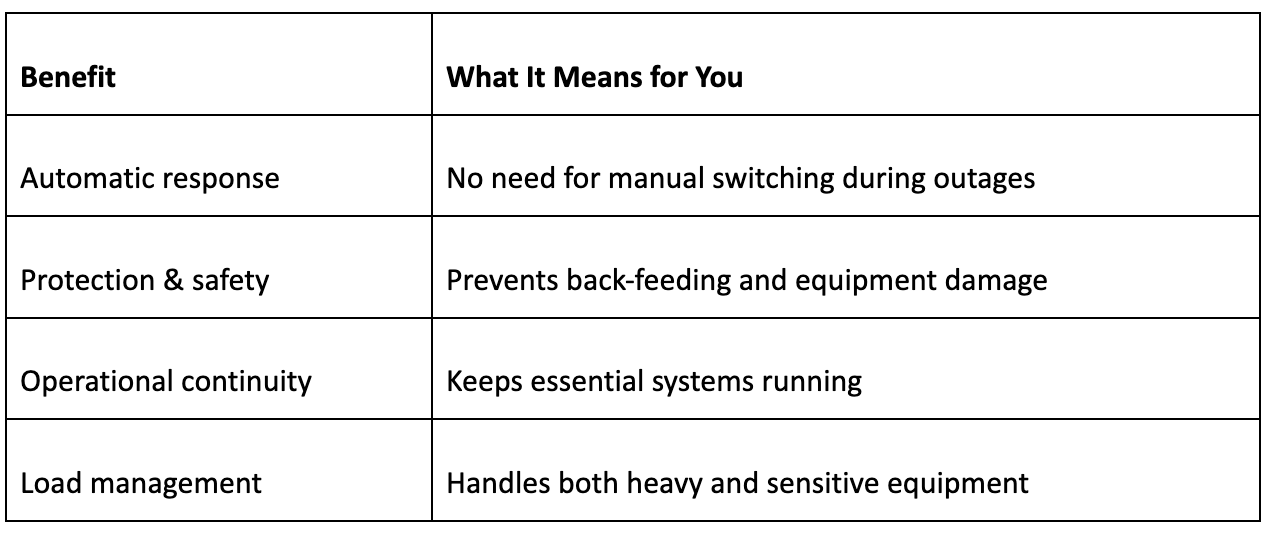
Key Benefits of Using an ATS

The Essential Role of Automatic Transfer Switches in Power Continuity

Common Questions About Automatic Transfer Switches

A common question is whether an ATS removes the need for backup power. While the device automates the switching process, it still relies on a secondary energy source, such as a generator, battery system, or an alternate grid connection. Another frequent concern is whether an ATS can eliminate all interruptions. Open-transition models may cause a brief momentary gap, while closed-transition options reduce this downtime considerably, making it essential to choose based on your tolerance for short power interruptions. CHINT offers ATS products in various configurations, which helps illustrate how different designs accommodate different continuity needs. These product lines also show how features such as transition mode and electrical rating can influence performance in real-world settings.

Maintenance is also a topic many people ask about. Although an ATS requires relatively little upkeep, periodic testing and inspection are necessary to ensure reliable performance. Checking for worn components, loose connections, or delays in switching helps ensure the device will function properly during a real outage.

Conclusion

Power instability is an unavoidable part of modern life, but the impact of unexpected outages can be significantly reduced with the right equipment. An automatic transfer switch offers a dependable way to detect failures and shift your electrical load to a backup source, helping your essential systems stay connected. Whether you’re protecting a home, running a business, or managing a large facility, an ATS helps prevent equipment damage and maintain continuity during unpredictable grid events.

Understanding how an ATS works enables you to make informed decisions about power protection. By selecting the right switch, considering the key technical features, and performing routine maintenance, you can strengthen your resilience to power disruptions. With a well-designed setup in place, you can continue your activities confidently, knowing your electrical system will stay operational regardless of what happens to the main power supply.

How Digital Hiring Tools Are Transforming Recruitment

The evolution of digital technology is dramatically changing the way organizations attract, evaluate, and hire talent. By leveraging innovative solutions such as applicant tracking systems, artificial intelligence, and automation, companies are streamlining their hiring processes and improving candidate engagement. In fact, a well-implemented applicant tracking system enables recruiters to organize applications, automate communication, and optimize every stage of the recruitment journey.

With job seekers now expecting ease, speed, and transparency in the application process, digital hiring tools have become a necessity rather than a nice-to-have. They not only allow employers to tap into a wider talent pool but also help reduce bias, boost diversity, and make more informed hiring decisions. These advances are critical as labor markets become increasingly competitive and businesses strive to secure the best talent for their teams.

Digital hiring innovations also mean candidates can engage with employers beyond borders and traditional business hours, providing unmatched flexibility. Recruiters, meanwhile, can focus more on building relationships and less on administrative burdens—ushering in a new era of strategic talent acquisition that leverages data and technology. Below, we explore how these digital solutions are reshaping hiring across key stages of the recruitment funnel.

AI-Powered Candidate Screening

Artificial intelligence is revolutionizing recruitment by making candidate screening faster, smarter, and more reliable. AI-driven platforms analyze vast datasets to identify top-performing talent by parsing resumes and evaluating applicants against specific job criteria. These tools not only help weed out unqualified candidates with impressive accuracy, but they also minimize unconscious bias—something traditional screening procedures often struggle with. AI-powered chatbots are increasingly responsible for first-point candidate engagement, handling initial queries, and scheduling interviews within minutes, which improves both recruiter efficiency and candidate experience.

Virtual Interviews and Assessments

The rise of virtual hiring has opened up new possibilities for remote talent acquisition. Cloud-based interview platforms like HireVue and Zoom provide employers with scalable solutions to conduct interviews and assessments from anywhere in the world. Many of these platforms use AI to assess candidate body language, tone, and even word choice, providing in-depth, real-time feedback to recruiters. Global organizations benefit tremendously by accessing candidates they might never have otherwise considered and by allowing job applicants to demonstrate their skills without geographical barriers.

Automation in Recruitment

Automation reduces friction at every step of the hiring workflow. Whether it’s scheduling interviews, sending reminder emails, or moving candidates through the pipeline, automated systems let HR teams focus on what matters—building meaningful relationships with prospective hires. Chatbots like Paradox’s Olivia provide 24/7 candidate engagement, ensuring no application is left behind, and can even conduct initial screening tasks, such as basic skills assessments or document collection. With less manual intervention, hiring teams see dramatic reductions in time-to-hire and cost-per-hire, while candidates enjoy a smoother and more responsive journey.

Data-Driven Hiring Decisions

Harnessing the power of predictive analytics, digital hiring tools enable recruiters to look beyond resumes and examine skills, cultural fit, and growth potential. By combining historical hiring data with current assessments, organizations can identify factors that correlate with long-term success and retention. This data-driven methodology enables a fairer, more robust talent evaluation process and drives more confident hiring decisions. Moreover, ongoing monitoring and analysis provide continuous feedback to optimize future hires.

Enhancing Candidate Experience

For modern job seekers, the application process doubles as an early impression of an employer’s culture and values. Digital hiring tools are substantially improving the candidate journey by allowing self-scheduling, instant feedback, and on-demand support. For example, Paradox’s AI platform has already facilitated millions of candidate conversations, delivering conversion rates that reflect a highly engaging, user-friendly process. Faster response times and proactive communication greatly enhance satisfaction, making it far more likely for candidates to complete their applications and accept offers.

Challenges and Considerations

Despite their benefits, digital hiring tools carry some risks, including concerns about data privacy and algorithmic bias. Overreliance on automation may also dehumanize the process or miss out on exceptional, nontraditional candidates. A balanced approach—combining digital efficiency with human judgment—is essential. Organizations must ensure that systems are monitored and regularly audited for fairness and compliance. The Society for Human Resource Management (SHRM) offers guidance on ethical AI and mitigating risks associated with digital recruitment tools.

Future Trends in Digital Recruitment

As technology advances, digital recruitment will continue to evolve. AI and machine learning are set to drive even deeper personalization and predictive capability. At the same time, emerging tools such as virtual reality and augmented reality are poised to revolutionize interview simulations and onboarding. These innovations promise a more immersive, engaging, and insightful recruitment process, ultimately connecting employers and candidates in more meaningful ways.

Conclusion

Digital hiring tools are reshaping the recruitment landscape, offering tangible benefits such as faster time-to-hire, smarter, data-driven decisions, and a superior candidate experience. By thoughtfully integrating these technologies, organizations can attract top talent while ensuring fairness, transparency, and efficiency at every stage of the hiring process. With the right balance between digital innovation and human touch, the future of recruitment is not just brighter—it’s smarter and more inclusive.

Lil Eddie Hit #1 on the iTunes R&B Charts in the Philippines with his New Single “Fear of Flying”

Few artists in modern R&B wear their heart as openly as Lil Eddie. The Grammy-winning singer, songwriter, and producer, known for his behind-the-scenes work and increasingly for his own voice, returns with a deeply personal new release, “Fear of Flying”. The single has already exploded internationally, debuting at No. 1 on the iTunes R&B charts in both the Philippines and Indonesia.

Written during a reflective stretch in Amsterdam, “Fear of Flying” unpacks the harsh reality of self-sabotage in love. The release includes both the haunting original demo and a polished R&B rendition that leans into Eddie’s signature mix of soul and vulnerability. Through vivid metaphors of turbulence and flight, the song captures the emotional gravity of fearing intimacy and realizing too late the damage done by keeping walls up.

“It’s a confession piece,” Eddie says of the song’s meaning. “It’s that moment when you finally want to talk about what went wrong, but the person’s already gone.” The lyrics serve as both a late realization and a moment of clarity. His fear of flying isn’t about altitude; it’s about emotional free-fall.

In many ways, “Fear of Flying” marks the next chapter in a career that has always blended the commercial with the deeply personal. Eddie has written for major artists including JoJo, contributing to half of her upcoming EP, and he has also recently been writing with Bebe Rexha for her forthcoming project. He penned two of Melanie Fiona’s latest singles, “Mona Lisa Smile” and “I Choose You.” Earlier this year, he wrote eight songs on Ben Carrillo’s album Dreamer, and his live performances in the Philippines have generated millions of views on YouTube.

Lil Eddie Hit #1 on the iTunes R&B Charts in the Philippines with his New Single “Fear of Flying” (2)

Photo Courtesy: Adam Sheridan-Taylor

That blend of global reach and intimate storytelling is part of what sets Eddie apart. His background, rising from the streets of Spanish Harlem and working with major pop and R&B acts before stepping into the spotlight himself, forms the backbone of his artistic identity. As one profile described it, “After years of contributing to the successes of top artists, the two-time Grammy-winning artist is stepping into the limelight with a deeply personal collection of songs”.

Fresh off signing a new publishing deal with Empire Distribution, Eddie is stepping confidently into a new era of artistry. His collaboration with Mica, titled Lonely Room, is set for release on November 11, followed by a Spanish-language bachata version of “Fear of Flying” called “Miedo a Volar” on November 21. Both tracks will appear on his forthcoming album Art, slated for early next year.

What makes “Fear of Flying”  so striking is its emotional accessibility. Eddie doesn’t just sing about heartbreak; he sings about emotional walls, missed chances, and the cost of not letting love in. The original demo retains a raw, unfiltered quality, while the full production elevates the sound to timeless R&B with nods to classic soul and a modern sense of vulnerability.

In many ways, this release feels like a reclamation of his own voice and story. Backed by the renowned distributor ONErpm, Eddie now stands at the center of his art, bridging a global audience that spans intimate live shows to viral online moments. His recent success in Southeast Asia reflects something deeper than chart numbers. It shows how universal his message has become, connecting with listeners who see themselves in his struggle and redemption.

In true Lil Eddie fashion, “Fear of Flying” doesn’t just showcase vocal finesse. It reveals a man wrestling with his own humanity. It is tender, introspective, and full of truth. As Eddie reclaims his wings, it is clear he is no longer afraid of the altitude.

For those ready to listen, follow him on Instagram and stream the new release on Spotify.