Between Two Worlds: Pianist Jiachen Li’s Growth Across Cultures

By: Yizhi Yuan 

Part of the Washington International Young Artist Music Series (WIYAMS) Artist Interview Series, featuring distinguished young musicians from around the world.

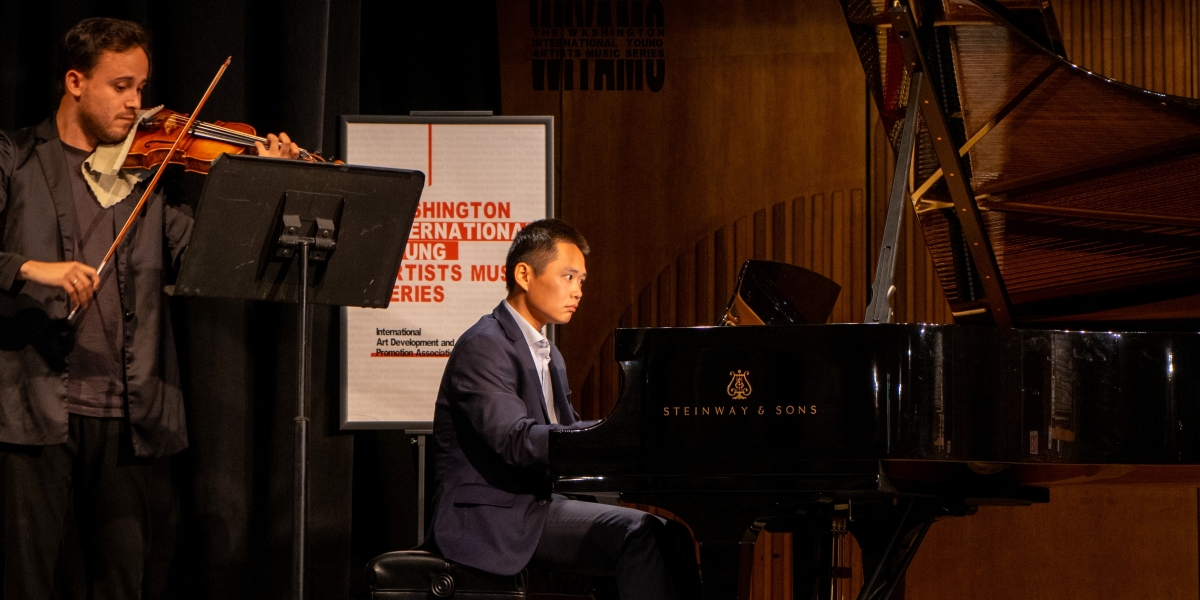
Dr. Jiachen Li, a WIYAMS Artist, has built a distinctive musical path that spans continents, beginning with his early piano studies in China and continuing through advanced training in the United States. In this conversation, he reflects on the experiences that shaped his development, the performances that influenced his growth, and the cultural perspective that informs his artistry.

Li recalls a childhood moment that unexpectedly set him on his musical path. “When I was six, my parents sent me to an after-school table tennis program—it was a popular sport in China. After about ten months, I realized I just wasn’t as gifted as the other kids and got really discouraged. One day, I threw my paddle on the floor and said, ‘I’m done with ping pong.’ That was my dramatic exit.” 

A few weeks later, still encouraged by his mother to learn something, he came across a televised piano performance. “I honestly just wanted her to stop asking. Then I saw someone playing piano on TV and said, without thinking, ‘I want to play piano.’ And that’s how it all started.”

Li spent eight formative years with the same private teacher, studying a small number of pieces each year. “Like most Chinese piano students, we focused on four pieces annually for the music grade examinations. I’m really glad my teacher also made me practice scales and arpeggios in circle-of-fifths order—it gave me a solid technical foundation.”

By sixteen, he knew he wanted to pursue music professionally. He studied for seven years at the Sichuan Conservatory of Music before moving to the United States for further training at Bowling Green State University, Cleveland State University, and later the University of Alabama. “I wasn’t interested in other fields, and I didn’t want a 9-to-5 office life. Music offered me a freer lifestyle.”

One of Li’s most meaningful performance experiences came through the University of Alabama’s outreach program, Concert for Joy. “We performed at local nursing homes and hospitals. The seniors never made you feel the pressure of a degree recital—they were always supportive and kind. It was a perfect stage to test new repertoire and grow as a performer.”

Li speaks warmly of his experience as a WIYAMS Artist. “I first learned about WIYAMS through my friends’ social media, and then found out they were inviting musicians to audition. I had just finished my first DMA recital at the University of Alabama, and I thought it would be a great opportunity for my duo partner, violinist Daniel Torres, and me to bring our collaboration to more audiences.”
The experience, he recalls, left a lasting impression. “I was so impressed by the organization and the enthusiasm of the audience. It’s a wonderful memory, and I definitely hope to be back in the near future.”

Li credits aspects of his Chinese upbringing—especially classical philosophy and poetry—with shaping his musical imagination. “Chinese poems almost never tell you the story directly—they use metaphors. Our literature classes felt like a puzzle where you had to piece together the meaning. That way of thinking influences how I interpret pieces like Debussy’s Prelude, ‘Les sons et les parfums tournent dans l’air du soir.’ It requires imagination and storytelling.” For him, every phrase at the piano now feels like decoding another hidden stanza from those early poems, weaving intricate connections between music and literature. In performance, he aims to leave similar spaces for listeners, inviting them to complete the narrative in their own minds, creating a shared, immersive experience.

Bridging Faith and Finance: Sheldon Zeiger’s Human-Centered Approach to Money

By: Maha Khan

For many people, financial planning feels overwhelming, full of jargon, numbers, and strategies that seem detached from real life. But Chicago attorney and financial planner Sheldon Zeiger believes it doesn’t have to be that way.

With decades of experience in both law and finance, Sheldon has developed a unique approach: blending the precision of microeconomics with the timeless moral wisdom found in the world’s major religions. The result is a way of teaching personal finance that connects not only with the head but also with the heart.

Sheldon’s approach goes beyond traditional boundaries of finance, offering a more holistic perspective. He encourages clients to view financial decisions as part of their broader life journey, helping them to make choices that reflect their values and priorities. This perspective has helped countless individuals rethink their financial goals and align their strategies with their deeper sense of purpose.

In a world where financial stress is increasingly common, Sheldon’s model also offers a sense of peace. By focusing on mindfulness and balance, he empowers clients to view money as a tool rather than a source of anxiety, fostering a healthier relationship with their finances.

A Journey That Came Full Circle

Sheldon’s story began with an early desire to attend divinity school, an idea set aside when his parents encouraged him to pursue law and business instead. Years later, he found his way back to that calling through his groundbreaking book, The Eye Inside Personal Finance: Discovering The Connection Between Our Financial and Spiritual Lives.

The book weaves together lessons from Buddhism, Taoism, Christianity, Judaism, and Islam, showing how universal principles of balance, stewardship, and mindfulness can make financial concepts both simpler and more meaningful.

Finance as a Tool for Living Well

For Sheldon, wealth isn’t necessarily measured by the number in your bank account but by the ability to live a life you love—whether it’s traveling, spending time with loved ones, pursuing passions, or giving back to causes you care about.

“Adding zeros to your balance doesn’t always lead to more meaningful experiences,” he explains. “True wealth is about utility, how money helps you live fully.”

A Practical and Ethical Framework

Each chapter of Sheldon’s work reads almost like a legal brief: a clear principle, explained in simple terms, then illustrated with real-life examples and timeless spiritual wisdom. Whether it’s the Buddhist practice of mindful assessment or the Judeo-Christian and Islamic teachings on stewardship, the message is the same: money is not separate from our values; it is intertwined with them.

This philosophy empowers people to take charge of their own financial decisions, reducing stress and fostering confidence. It especially resonates with those in estate planning and trust management, where families are looking for ways to align wealth with purpose.

A Timely Approach for Today

In a world increasingly focused on ethical investing, sustainability, and purpose-driven wealth management, Sheldon’s integrative model feels more aligned with current trends than ever. Clients today want financial strategies that respect not just their goals but also their values.

By bridging faith and finance, Sheldon offers more than planning; he offers a path to seeing money as part of a whole, integrated life.

About Sheldon Zeiger

Sheldon Zeiger is a Chicago-based attorney, financial planner, and author with decades of experience in estate planning, trust management, and financial education. His work combines professional expertise with the wisdom of global faith traditions, offering a thoughtful, human-centered approach to money management.

Disclaimer: The views and opinions expressed in this article are those of the author, Sheldon Zeiger, and are for informational purposes only. The content provided is not intended to serve as financial, legal, or professional advice. Readers are encouraged to consult with a qualified financial planner or legal advisor to address their specific needs and circumstances. The article reflects Sheldon Zeiger’s personal philosophy and approach to personal finance, and results may vary depending on individual situations.

Confessions of a Book Editor: 7 Manuscript Mistakes Novella Publishers See Often

By: Content Strategy Division, Novella Publishers

Industry insiders reveal the recurring errors that send promising stories straight to the rejection pile.

In the publishing houses where manuscripts pile up like fallen leaves, book editors have developed an uncomfortable talent. They can smell a doomed submission from the first page, sometimes the first paragraph. It’s not cruelty. It’s pattern recognition born from reading thousands of hopeful stories that all stumble over the same preventable mistakes.

And no, it’s not about typos.

Confessions of a Book Editor: 7 Manuscript Mistakes Novella Publishers See Often

Photo Courtesy: Novella Publishers

The Encyclopedia Problem

“Writers think we reject books because of grammar,” says Marcus, an acquisitions editor who has evaluated over 8,000 manuscripts. “That’s not it at all. We reject them because they forget to tell a story.”

The first killer mistake shows up mostly in fantasy and science fiction: writers who spend fifty pages explaining their world’s magic system, political structure, and ancient prophecies before anything actually happens. It’s like being trapped at a dinner party with someone who insists on explaining every inside joke before they tell you the actual funny story. By the time you get to the punchline, you’ve lost interest.

The Saint Syndrome

Mistake number two creeps in quietly. Somewhere along the way, writers got the memo that protagonists need to be “likable.” The result is main characters who never get angry, always think of others first, and apologize for breathing. They’re less like real people and more like customer service representatives scared of bad reviews.

“I want characters who screw up, who make selfish choices, who aren’t sure they’re doing the right thing,” explains editor Alvin. “Perfect people are boring. Complicated people keep me turning pages at 2 a.m.”

Timeline Whiplash

The third manuscript killer appears in structure. Writers panic about backstory and start interrupting their present-day narrative with constant flashbacks. Chapter one jumps to fifteen years ago. Chapter two returns to the present, then detours to last summer. Chapter three visits childhood. One editor recently rejected a mystery novel because she counted nineteen time jumps in the first forty pages.

“I felt like I was being jerked around,” she admits. “The story never got to breathe.”

The Dialogue Disaster

Mistake four lives in conversation. Writers either go overboard with creative dialogue tags (he ejaculated, she hissed, they expostulated) or eliminate them entirely, leaving six characters talking in a room with no clue who’s saying what. Both approaches have the same result: readers give up.

Real people mostly just “say” things. It’s invisible. It works.

Wikipedia Syndrome

The fifth error plagues historical fiction particularly hard. Writers do months of research, then feel compelled to prove it. A character fleeing danger suddenly spends three paragraphs mentally reviewing the complete history of gaslighting in Victorian London. Another stops mid-argument to recall detailed facts about Civil War ammunition.

“If I can tell you just learned something, you haven’t digested it enough to write about it,” notes editor Bruce. “Research should be invisible, like the foundation of a house.”

The Therapy Session

Mistake six manifests as pages of internal monologue where characters think about their problems without doing anything about them. They analyze their feelings, rehash old wounds, and circle the same emotional drain for chapters. It’s introspection without action, therapy without plot.

Stories need things to happen. Feelings matter, but they can’t be the only thing happening.

Confessions of a Book Editor: 7 Manuscript Mistakes Novella Publishers See Often

Photo Courtesy: Novella Publishers

The Ending That Won’t End

Finally, the seventh killer: stories that refuse to stop. The climax happens, the conflict resolves, and then the writer keeps going. An epilogue appears. Then another epilogue. Then, a chapter explaining where every character ended up, what they named their children, and how they felt about everything.

“Trust your readers,” urges Marcus. “They’re smarter than you think. They can handle ambiguity. They can infer outcomes. You don’t need to explain every loose thread.”

The good news? Every single one of these mistakes can be fixed with awareness and revision. The manuscripts that make it through aren’t written by geniuses. They’re written by people who learned to step back, spot the problems, and cut ruthlessly.

Is your manuscript ready for professional eyes? Novella Publishers provides honest manuscript evaluation and developmental editing to help your story reach its full potential. Learn more at www.novellapublishers.com.

Disclaimer: This article contains information about NovellaPublishers’ services and offerings. While we strive to provide accurate and up-to-date information, readers should conduct their own research and due diligence before engaging with any publishing services. This content is for informational purposes only and should not be considered as professional advice. Some details about services, pricing, and availability may change over time.

Latest Winter Storm Conditions Across New York State


New York is settling into an active winter weather stretch as a storm system stretches across the Northeast, bringing a changing mix of snow, rain, sleet, and ice. Conditions differ sharply from one region to another. Coastal locations lean wetter, while inland and higher elevations face more persistent snowfall. That contrast makes planning difficult since road safety, travel timing, and daily routines depend heavily on local temperature swings.

This type of storm forms when cold northern air collides with milder moisture rising off the Atlantic Ocean and nearby lakes. Where cold air dominates, snow sticks. Where warmer air slides in at ground level, precipitation changes to rain or slushy mixes. In just a few miles of travel, drivers can move from dry pavement into near whiteout conditions.

For residents commuting, running errands, or visiting family, the biggest challenge is not knowing exactly when or where the next snow band may drop. The following breakdown explains what’s happening and how it could affect daily life across the state.


Why Conditions Keep Changing Across New York

This storm is shaped by what forecasters call temperature layering. Cold air remains trapped close to the surface across much of inland New York while milder air moves overhead or along the coast. Because snowflakes melt as they fall through warmer layers, the type of precipitation depends on whether freezing air can hold all the way down to street level.

Upstate regions remain colder overall. That allows snow to keep falling as snow instead of turning to rain. Meanwhile, coastal communities feel warming influences from ocean winds that push temperatures above freezing, creating rain or light slush rather than steady accumulation.

Wind direction also plays a major role. Strong air flow across the Great Lakes pulls moisture inland. That moisture drops as snow when it reaches colder ground. This lake driven effect creates narrow storm bands that form quickly and shift their focus with every small wind adjustment, producing uneven snowfall across counties.


Areas Likely to See the Most Snow

Interior sections of the Hudson Valley, the Mohawk Valley, western New York, and portions of the Adirondacks remain the zones most likely to accumulate measurable snow. Elevation increases snowfall because air cools as it rises over hills and mountain ranges. Even small terrain differences can create deeper drifts in some towns compared with neighboring communities.

Latest Winter Storm Conditions Across New York State (2)

Photo Credit: Unsplash.com

Lake influenced regions near Lake Ontario also stay active as moisture feeds off warmer water surfaces. Snow bands form rapidly and often stall over one corridor before shifting miles away. This results in streets covered with snow while nearby areas remain nearly clear.

The New York City metro area, Long Island, and surrounding suburbs are more likely to receive rain or mixed precipitation. Snow may appear briefly during colder moments, but sustained accumulation is less likely. However, temperatures falling overnight turn wet pavement into ice. Bridges and overpasses become particularly slippery after sunset.


What Daily Travel May Look Like

Commuters traveling across inland corridors can expect slower traffic during snowfall peaks. Snow reducing visibility makes highway speeds drop below normal flow, while lane closures may occur as plow vehicles attempt to clear build up faster than new snow falls.

Secondary roads often become problematic first. These streets receive less treatment and can turn slick rapidly. Ice formation near intersections and hills increases the chance of minor accidents and stalled vehicles. Even short drives can take longer than planned.

Air travel also experiences turbulence from winter storms. Airports near heavier snow zones face runway visibility limits and ground handling challenges. That may delay departures or force flight rescheduling, especially during evening snow bursts.


How to Think About Personal Safety

The simplest safety approach focuses on timing and awareness. Waiting for snowfall pauses before driving reduces stress and risk. Since snow bands move irregularly, clear weather windows may not last long. Keeping track of radar snapshots or neighborhood conditions often proves more accurate than statewide predictions.

At home, clearing walks early prevents ice from forming underneath packed snow. Applying deicer later in the evening can reduce slip hazards. Securing loose outdoor items also helps as winds strengthen.

For drivers, small habits provide large safety benefits. Slowing acceleration reduces wheel spin. Longer stopping distances help maintain control on slick pavement. Extra care crossing bridges prevents unexpected sliding where freezing occurs faster.


Why Forecasts Can Feel Inconsistent

This type of storm doesn’t blanket large areas evenly. Instead, snowfall concentrates in streaks, sometimes only a few miles wide. As winds shift, those streaks move, leaving some towns buried while nearby communities remain dry.

Temperature sensitivity adds to uncertainty. A shift of only one or two degrees can flip precipitation types entirely. What arrives as snow can change into rain within minutes, then refreeze later into ice. That variability makes exact predictions difficult even a few hours ahead.

Forecasters issue wider advisories because any given community could fall into a snow band as conditions change. These alerts aren’t overreactions. They reflect the genuine unpredictability of band driven storms.


How Long Storm Effects May Last

Cold air across northern and western sections is expected to linger for several days. Even after the primary storm system exits, lake effect snow may continue in bursts near Lake Ontario and elevated inland areas.

Metro regions that see more rain will deal mostly with freeze up overnight. Meltwater becomes icy on untreated roads early in the morning. Cleanup crews work overnight, but shaded sections may stay slick longer.

Subfreezing daytime temperatures slow melting, keeping snow banks and icy patches intact into the weekend. Drivers should continue to watch for refreezing each evening, even when daytime roads appear dry.


Winter weather of this style rarely ends all at once. Conditions fade gradually with lingering risks. Most disruptions will come from shifting travel conditions rather than extreme single snowfall totals.

Understanding how temperature differences and wind patterns shape snowfall allows residents to plan realistically. Slow travel, extra scheduling time, and flexible expectations go farther than relying on any fixed forecast.

The storm’s broader impact stays localized and temporary. Maintaining patience and situational awareness will be the most effective responses as the weather continues its uneven sweep across New York State.