Beyond Earth: Red Refuge and the Future of Human Living on Mars

By: Jaxon Lee 

A Design Born from Earth’s Crisis

The Master’s thesis Red Refuge: Living on Mars by Chohyun Kim begins with a fundamental question: “How can interior designers create life in space?” The project was inspired by growing awareness of the planetary crisis threatening human survival.

Climate change, pollution, resource depletion, overpopulation, and intensifying natural disasters are reshaping life on Earth. The planet’s average temperature has risen by about 1.1°C since pre-industrial levels, sea levels continue to rise, and extreme weather events are occurring more frequently. Millions die each year due to air pollution, while glaciers melt at an accelerating rate.

While researching these conditions, Kim asked: “If Earth one day becomes uninhabitable, where will humanity go?” Red Refuge was conceived as an answer to that question — not merely a design for survival, but a framework for creating psychologically and environmentally sustainable living spaces beyond our planet.

“Design today remains on Earth, but design for tomorrow must imagine where humanity will live next.”

Mars: Humanity’s Next Frontier

Among all planets, Mars remains the most viable candidate for future migration. Its gravity is roughly 38% that of Earth, its thin atmosphere is composed mainly of carbon dioxide, and its average temperature drops below −60°C. Solar irradiance reaches only about 60% of Earth’s, and the lack of a magnetic field exposes the surface to high radiation.

Despite these challenges, Kim emphasizes the need to focus not only on engineering survival, but also on designing quality of life.

“Interior design is not merely about constructing structures — it is about shaping human emotion.”

From Survival to Living

Previous experiments, such as NASA’s HI-SEAS and Mars-500 missions, have focused on efficiency and function, often overlooking the impact of human emotions. The result was sterile, enclosed spaces that led to monotony, anxiety, and psychological fatigue among participants.

In contrast, Red Refuge proposes spaces that nurture emotional balance and human connection. Curved architecture, biophilic elements, natural-light simulation, and communal “play and interaction” zones bring vitality into confined environments, helping residents feel alive — not trapped.

Beyond Earth: Red Refuge and the Future of Human Living on Mars


Photo Courtesy: Red Refuge

Designing with Local Resources

Transporting materials from Earth is impractical. Kim explores using Martian basalt, volcanic ash, and sulfur-based concrete to 3D-print habitat structures directly on the planet’s surface. This method minimizes transport costs while improving insulation and radiation protection. These materials have shown promising results in simulation studies, though in-situ mining, refining, and energy efficiency remain future engineering challenges.

Power would come from radioisotope thermoelectric generators (RTGs) combined with solar panels, ensuring a stable energy supply under variable sunlight conditions.

For food production, Kim integrates insect protein, cultured meat, and LED-based hydroponics into a closed-loop system. While these technologies have proven feasible, large-scale efficiency and nutrient recycling optimization remain active areas of research.

Additionally, Kim considers how architectural structure and form can influence psychological well-being in extreme environments. Under the assumption that conventional doors may be difficult to construct in a Martian habitat due to pressure differences and material limitations, she proposes raising the building on pillars, allowing residents to walk beneath the structure. This elevated design enhances privacy and psychological stability, while also offering a rare spatial experience of openness and light. People moving underneath the elevated habitat can receive filtered sunlight with reduced radiation exposure, as the building itself acts as a partial barrier. In an environment where residents spend almost all their time indoors, such an experience provides variety, movement, and visual dynamism, breaking the monotony of closed living.

Designing for Connection

Isolation is one of the greatest psychological risks in extraterrestrial living. To counter this, Kim adopts a cluster-housing concept — private units connected to shared kitchens, dining spaces, and lounges that encourage spontaneous interaction.

Furniture is lightweight and wall-integrated through 3D printing, featuring smooth, rounded forms that reduce tension and minimize injury risk in low-gravity environments. Lighting is carefully calibrated to regulate circadian rhythms, changing color temperature and brightness throughout the day to mimic Earth’s day–night cycle and support mental health.

The Role of Interior Designers in Space Development

Kim believes interior designers have a vital role to play in shaping extraterrestrial living environments.

Her research reminds us that space habitation is not purely an engineering challenge but equally a matter of human adaptation and emotion. Technology enables survival; design enables living.

Returning to Earth

Ultimately, Red Refuge reveals that designing for Mars is also designing for Earth. The principles of sustainability, emotional well-being, and human-centered design developed for life in extreme environments can guide the future of cities on our own planet.

“Design for Mars is, in essence, design for humanity. Whether on Earth or beyond, our purpose as designers is to make life more human.”

Beyond Earth: Red Refuge and the Future of Human Living on Mars

Photo Courtesy: Red Refuge (SectionPerspective)

The Spoilt Parrot: When a Parrot Learns Manners – Lessons from Dooley’s Farm

By: Elowen Gray

Children often enjoy stories featuring animals, especially when those animals teach us valuable lessons about ourselves. The Spoilt Parrot by Betty R. Young is an example of such a tale: colorful, lighthearted, and filled with gentle lessons about kindness, respect, and friendship. Set on the lively Dooley’s Farm in the Caribbean, these books are more than just stories. They are mirrors that help children understand how our choices can affect others.

With Part 1 and Part 2 of the series already available, young readers can follow Dolly the parrot through her noisy, playful adventures and her eventual realization of how wonderful it can be to live in harmony with others.

A Farm Like No Other: The Magic of Dooley’s Farm

Imagine a farm where donkeys talk about peace, goats dream of harmony, ducks share opinions, and even cats help teach lessons about kindness. That’s the world of Dooley’s Farm: bright, tropical, and full of life. Every animal plays a role, and together they create a setting where children can learn about cooperation, empathy, and respect in a playful, engaging way.

Dolly the Parrot and Her Noisy Antics from Part 1

In The Spoilt Parrot: Part 1, we meet Dolly, a beautiful, colorful parrot with feathers that shimmer in the Caribbean sunshine. Dolly knows she’s special, and she enjoys being the center of attention. But her way of getting attention is not always pleasant. She makes loud noises, mimics other animals, and even teases her shy brother, Tony.

For the other animals on Dooley’s Farm, Dolly’s behavior isn’t fun. It’s quite frustrating. They long for peace and harmony, but Dolly’s antics disrupt the calm. Children reading Part 1 may laugh at Dolly’s silliness, but they’ll also begin to see the effects of her actions: hurt feelings, lost trust, and unhappy friends.

Part 1 concludes with the farm animals realizing that something needs to be done about Dolly’s behavior. And that’s where Part 2 picks up.

What Kids Can Learn from Part 1

  • Showing off can seem fun at first, but it often makes others feel upset.
  • Being kind to siblings and friends often matters more than being the loudest in the room.
  • Good manners, like not talking with your mouth full or respecting quiet moments, can make life better for everyone.

A Plan to Help Dolly Change in Part 2

In The Spoilt Parrot: Part 2, the animals finally decide to take action. With the help of Tyler, the friendly cat, they come up with a gentle but clever plan. Tyler begins imitating Dolly’s noisy ways, showing her exactly how disruptive and silly she has been. For the first time, Dolly sees her behavior from another perspective.

This moment of self-reflection is important, not just for Dolly but also for young readers. Dolly realizes that her antics aren’t quite as amusing as she thought, and she begins to understand the value of kindness, cooperation, and bringing joy instead of chaos.

By the end of Part 2, Dolly has changed. She greets her friends politely, plays nicely with her brother Tony, and joins the other animals in enjoying the simple beauty of life on Dooley’s Farm.

What Kids Can Learn from Part 2

  • Sometimes, seeing our actions reflected back to us can help us understand their impact.
  • Working together as a team can often solve even the trickiest problems.
  • Friendship and harmony tend to feel better than showing off or being rude.
  • Change can happen when we decide to do better.

Why These Stories Matter for Young Readers

Children’s books aren’t just about entertainment; they’re also about shaping character. Through Dolly’s journey from spoilt to thoughtful, kids learn that kindness, respect, and empathy are values worth holding onto. The stories are playful but meaningful, filled with farmyard fun while gently guiding children toward positive behavior.

Betty R. Young has created more than a story; she has built a farmyard classroom where animals are the teachers, and every chapter offers a gentle lesson in life.

A Gentle Guide for Parents and Teachers

For parents and teachers, The Spoilt Parrot offers more than a bedtime story. Each part of the book can spark conversations with children:

  • Why do you think Dolly teased her brother?
  • How would you feel if someone copied you in a mean way?
  • What are some ways we can be kind every day?

Through these simple discussions, Betty R. Young hopes to encourage children to connect Dolly’s adventures with their own lives.

Get the Book for Your Kids and Spread Kindness

The Spoilt Parrot – Dooley’s Farm Part 1 & Part 2 are not just books; they are helpful stepping stones for young readers learning about empathy, manners, and the joy of friendship. Dolly begins as a parrot who only thinks of herself, but by the end of the story, she becomes a friend who brings happiness to others.

And isn’t that the kind of journey we’d like all children to take?

Both parts of Dolly’s story have been published and are ready to be purchased on Amazon. For any further queries, to share feedback, or if you simply wish to connect with Betty R. Young, you may do so directly via email at central@aribsurf.com.

Cashless Payments in Vending: Trends Businesses Can’t Ignore

By: Jaxon Lee

Vending machines are no longer just about coins and bills. Today, people expect quick, seamless, and touch-free ways to pay, whether it’s for a snack, a drink, or a meal on the go. For businesses, this shift is all about staying competitive and meeting customer expectations. Cashless payments are becoming more than an option; they’re becoming a standard in the industry. 

In this article, we’ll look at the latest developments in cashless vending and why businesses need to pay attention to these changes to keep customers happy and operations efficient.

1. Rise of Contactless and Mobile Wallet Payments

Contactless payments have moved from being a “nice-to-have” feature to becoming a baseline expectation. Whether it’s Apple Pay, Google Pay, Samsung Pay, or contactless debit and credit cards, people want the convenience of tapping their device or card rather than fumbling for cash. For vending machines, this means less downtime for handling coins and bills, fewer maintenance issues, and faster transactions for customers.

From a business perspective, contactless systems can improve sales by reducing friction in the payment process. Shoppers are more likely to make spontaneous purchases when paying is easy, and repeat customers appreciate the speed and simplicity. Installing NFC-enabled machines also enables operators to remotely update pricing, promotions, and offers, making it easier to run seasonal campaigns or test new products.

Thomas O’Shaughnessy, Founder & CEO of Vending Company Inc, shares, “Cashless payments are becoming a must for any vending operator who wants to meet modern customer expectations. They reduce downtime, improve sales, and make machines easier to manage.” 

2. QR Code-Based Transactions

QR codes have gained immense popularity as a quick and cost-effective way to facilitate cashless payments. Unlike contactless cards, QR codes don’t require specialized hardware beyond a basic scanner or smartphone. Customers simply open their mobile payment app, scan the code on the vending machine, and the transaction is complete. The process is quick, secure, and extremely versatile.

“QR codes are a smart example of how digital tools can simplify operations without adding complexity to infrastructure,” explains Rizwan Khan, from Workwize. “Just like IT teams manage assets across distributed systems, vending operators can now manage payments and track usage remotely and efficiently.”

For vending businesses, QR codes offer a way to modernize machines without incurring significant investment. They can also serve multiple purposes beyond payments. Some operators link QR codes to promotions, product information, or loyalty programs, creating an interactive experience that goes beyond simply buying a snack.

3. Subscription and Loyalty Integrations

Cashless payments are opening the door to innovative customer engagement strategies, including subscription services and loyalty programs. Instead of just paying for individual items, some vending operators now allow customers to load funds onto an app or account, unlock monthly benefits, or earn points with every purchase. This builds repeat business and makes the vending machine experience more personal.

Htet Aung Shine, Co-Founder of NextClinic, adds, “Digital loyalty programs are a smart way to build lasting relationships with customers. When you make it easy for people to engage and reward them consistently, you turn casual users into repeat clients.”

Loyalty integrations also encourage larger purchase volumes. When customers know they’ll earn points or rewards, they’re more likely to make additional purchases rather than just grab a single item. From a business perspective, this creates predictable revenue streams, increases customer retention, and provides valuable data for marketing campaigns.

Moreover, these programs can help vending machines compete with traditional retail or convenience stores. By creating a sense of exclusivity or offering rewards, businesses transform a simple transaction into an ongoing relationship with customers, thereby strengthening brand loyalty.

4. Biometric and Face Recognition Payments

Biometric payments — using fingerprints, face recognition, or even iris scanning — are emerging as a cutting-edge option for vending machines. Although still in its early stages, the technology is gaining traction, particularly in high-traffic areas such as airports, gyms, or corporate campuses, where speed and security are crucial.

“Implementing biometrics in everyday transactions is a great example of how technology can create seamless, secure experiences for users,” notes Edward Tian, CEO of GPTZero.

The main advantage is convenience. Customers no longer need wallets, cards, or phones — they simply authenticate their identity, and the payment is processed instantly. Security is also enhanced, as biometric data is unique to each user, reducing fraud and the need for PIN codes or signatures.

For businesses, adopting biometrics can differentiate them from competitors and appeal to tech-savvy consumers. It also opens possibilities for personalized experiences; machines can recognize users and suggest favorite items or promotions based on past purchases. Biometric systems can be linked to corporate accounts, allowing employees to pay for snacks or meals directly through their work ID, thereby simplifying expense tracking.

Conclusion

Cashless payments are changing how people use vending machines. Paying with a phone, card, or app makes buying snacks and drinks faster, easier, and more convenient.

For businesses, adopting these options can boost sales, save time on handling cash, and provide valuable insights into what customers like. Whether it’s contactless payments, QR codes, or simple mobile apps, these tools help machines work more efficiently and keep customers satisfied. 

Businesses that use them will run smoother operations and make vending a quick, easy choice for everyone.


Disclaimer: The information provided in this article is for general informational purposes only and is not intended as legal, financial, or business advice. While we strive to present accurate and up-to-date information, we make no representations or warranties, express or implied, regarding the completeness, accuracy, reliability, or suitability of the content. Any reliance on this information is at your own risk. Businesses should consult with professionals to assess specific risks or opportunities related to cashless payment systems and vending operations.

A New Dawn in Wildlife Care: How India’s Model Inspires Africa’s Conservation Excellence

A Story of Hope and Transformation

Across the global conservation landscape, few stories radiate as much hope as those born from courage, compassion, and strong governance. Today, India’s example stands as a testament to what happens when wildlife protection is anchored in integrity and innovation.

Two institutions — the Greens Zoological Rescue and Rehabilitation Centre (GZRRC) and the Radha Krishna Temple Elephant Welfare Trust (RKTEWT) — have become examples of what ethical wildlife management can achieve. Their operations, recently reviewed by the CITES Secretariat, have earned global recognition for their exceptional standards, transparent practices, and deep respect for wildlife dignity.

For Africa — where wildlife is not only heritage but also an economic and cultural lifeline — India’s approach offers valuable lessons in building excellence that can last.

Excellence Rooted in Integrity and Care

The Secretariat’s assessment found that both GZRRC and RKTEWT operate at very high standards, maintaining advanced facilities designed to support animal welfare at every level. Their enclosures reflect natural habitats, providing freedom and comfort rather than confinement.

Equipped with modern veterinary units and professional caregivers, the centers have pioneered innovative medical procedures for endangered species — particularly those listed under Appendix I of the CITES Convention, the world’s most vulnerable animals.

The review highlighted that both institutions have achieved significant successes in veterinary care and rehabilitation, and that their findings are being shared with the wider scientific community — a gesture that contributes to global learning and collaboration.

Ethical Trade and Full Legal Compliance

The hallmark of both institutions is their commitment to transparency and legal compliance. The Indian Management Authority confirmed that all animal imports by GZRRC and RKTEWT have strictly followed the official CITES and national procedures.

Importantly, the Secretariat found no evidence of animals being brought into India without proper CITES export or re-export permits, and no imports undertaken for commercial purposes. Every process, from acquisition to care, was handled ethically and with full documentation.

This level of compliance reinforces the truth that conservation must not only protect life, but also uphold law and integrity. For African wildlife centers — where governance, documentation, and ethical trade remain central challenges — this model demonstrates that it is possible for excellence and accountability to go hand in hand.

Transparency and Ethical Decision-Making

One of the most telling moments of the Secretariat’s mission was a case involving potential animal imports from Cameroon. When inconsistencies and a lack of transparency were detected on the Cameroon side, the GZRRC chose to withdraw from the engagement entirely — surrendering and cancelling all permits. No import took place.

This decision reflected a mature, ethics-first approach — prioritizing animal welfare and procedural transparency over convenience. Such choices help define credible conservation institutions and set the tone for global cooperation rooted in honesty.

Commitment to Continuous Improvement

During the mission, discussions between the Secretariat, India’s Management and Scientific Authorities, and representatives from both GZRRC and RKTEWT revealed a shared dedication to continuous improvement.

The Indian authorities expressed appreciation for the Secretariat’s guidance and committed to working on enhancing their internal procedures. Likewise, the leadership of both centers reaffirmed their commitment to remain fully compliant with CITES and to strengthen their own due diligence systems.

This openness to learning and evolution mirrors what is happening across Africa, where countries like Kenya, Rwanda, Botswana, and South Africa are constantly refining their conservation models to align with global standards while staying true to local realities.

Learning and Leading

A New Dawn in Wildlife Care How India’s Model Inspires Africa’s Conservation Excellence

Photo Courtesy: Variety Press Media Agency

Africa holds some of the planet’s most iconic wildlife — and some of the most passionate conservationists. Yet, challenges such as funding gaps, weak regulation, and illegal trade often hinder progress.

India’s example provides a powerful blueprint: ethical governance, structured compliance, and unwavering transparency have the potential to transform how conservation institutions are run.

Imagine a continent where every wildlife sanctuary operates with documented integrity, where medical facilities are innovation hubs, and where African experts exchange valuable practices globally — not as beneficiaries of knowledge, but as co-creators of it.

This is the future Africa can strive for: one where responsibility becomes culture, and conservation becomes collaboration.

A Shared Future for Wildlife Care

The achievements of the GZRRC and RKTEWT remind the world that conservation is not merely a technical field — it’s a moral calling. Their success illustrates that when governments, scientists, and caregivers align around ethics and excellence, even the most endangered species can thrive.

For Africa, this story is a mirror and a map. It reflects the potential already alive across the continent — from the David Sheldrick Wildlife Trust in Kenya to SANParks in South Africa — and it maps the way forward: through transparency, collaboration, and relentless pursuit of quality.

Because when we care for wildlife with integrity, we don’t just preserve animals; we protect our shared humanity, our heritage, and the beating heart of our planet.

Beginner’s Guide to Lace Wigs: Parting, Plucking, and Minimal Customization

Starting with lace wigs can feel intimidating, but you don’t need a stylist’s toolkit or hours of customization to get a natural look. With a thoughtful approach to parting, gentle plucking, and a few minimal tweaks, you can achieve a believable hairline and wearable styles—especially with user-friendly textures like the wet and wavy wigs and curly lace front wigs. This guide breaks down the essentials into simple, repeatable steps for beginners.

Understanding Lace and Cap Basics

Before you touch tweezers or tint, it helps to know what you’re working with. The type of lace and cap design shapes how natural your wig will look and how much customization is needed.

Lace Types and What They Mean

  • HD Lace: Ultra-thin and highly blendable; ideal for minimal makeup and soft melts. Great if you want the least visible grid on camera.
  • Swiss Lace: Slightly thicker and more durable; beginner-friendly because it resists tearing during plucking.
  • Transparent Lace: A good middle ground if you plan to tint; works across a range of skin tones with light makeup or lace tint.

Cap Constructions to Consider

  • 13×4/13×6 Lace Fronts: Offer generous parting space, ideal for creating middle and side parts without extensive customization.
  • Glueless Caps: Include elastic bands and combs for quick installs; stability reduces the need for adhesives during your learning phase.
  • Pre-plucked Hairlines: Save time and lower the skill curve; look for lightly pre-bleached knots for a softer part line.

Pro tip: For your first unit, choose a pre-plucked 13×4 or 13×6 lace front. It provides you with enough room to experiment with parts while keeping adjustments to a minimum.

Parting Like a Pro: Clean Lines and Natural Scalps

A clean part is one of the fastest ways to make a wig look realistic. The goal is a smooth, believable scalp line with gentle density around it.

Steps for a Natural Part

  • Map the part: Place the wig and lightly mark your desired part with a tail comb—center, slight off-center, or deep side part.
  • Define with heat: Use a hot comb or low-heat flat iron near the roots to flatten bulk around the part, pressing gently away from the scalp line.
  • Scalp illusion: Dab a small amount of lace tint or concealer (your exact undertone) on the underside of the lace along the part. Blend with a small brush.
  • Set the part: Apply a touch of mousse along the part and smooth with the tail comb. Wrap with a silk scarf for 5–10 minutes to lock it in.

Texture-Specific Parting Tips

  • Wet and wavy wigs: Part when damp for easy alignment, then define waves around the face with light foam. Avoid heavy gels that can cause the area to darken.
  • Curly lace front wigs: Create a slightly zigzagged part to mimic natural growth and reduce the visibility of the grid. Lift roots with clips as the mousse sets for a soft, voluminous look.

Pro tip: If the part still looks dense, consider switching to minimal plucking rather than adding more makeup—density control is more effective than over-concealing.

Minimal Plucking: Softening Density Without Over-Thinning

Plucking shapes the hairline and part edge so the transition from lace to hair looks gradual. The keyword is minimal—less is more, especially for beginners.

A Safe, Simple Plucking Method

  • Start dry and stable: Place the wig on a head and secure it. Good lighting is essential to avoid over-plucking.
  • Outline the no-go zone: Do not pluck the first 1–2 mm of the hairline; keep that perimeter for softness.
  • Work in micro-sections: Take a thin slice behind the hairline and remove a few hairs at random intervals. Step back every 5–10 pulls to check progress.
  • Feather the part: Thin lightly along both sides of your part, not directly on the line, to keep the scalp line soft and believable.

Avoiding Common Mistakes

  • Symmetry check: Alternate sides to maintain balance. Uneven plucking is more noticeable than you think.
  • Stop early: Curls and waves expand visually; what looks slightly dense off the head may read perfect when worn.
  • Repair plan: If you over-pluck, shift the part slightly or add a few strands with a knotting pen later—no need to panic.

Pro tip: For curly lace front wigs, pluck less. The curl pattern naturally masks density; aim only to ease bulk at the temples and part perimeter.

Minimal Customization: Tint, Melt, and Baby Hair

You can achieve a convincing finish with three small tweaks: tinting, a soft melt, and subtle baby hairs—no heavy glue or long installs necessary.

Tinting and Melting

  • Tint choice: Use a sheer lace tint or diluted concealer that matches your undertone. Apply underneath the lace for a clean look.
  • Light melt: If glueless, use a low-residue holding spray just along the edge; press with a melt band for 5–10 minutes. If adhesive is needed, apply a thin layer and let it go tacky before pressing.
  • Shine control: Tap a touch of translucent powder over the lace edge if it reflects under bright light.

Baby Hairs That Don’t Scream “Wig”

  • Less is more: Select a few hairs at the temples and near the part; trim to 0.5–1 cm.
  • Style softly: Use a tiny amount of foam or edge gel; sweep in gentle curves rather than stiff swoops.
  • Texture match: For wet and wavy wigs, keep baby hairs wispy; for curly lace front wigs, allow micro-curls to form naturally.

Pro tip: If you struggle with melts, prioritize cap fit. A stable, snug cap often makes adhesive optional and results in more consistent outcomes.

Styling and Maintenance for Beginner Success

Consistency comes from light, repeatable routines. Aim for movement, cleanliness, and longevity rather than dramatic changes every wear.

Easy Styling Wins

  • Heat-light approach: Use moderate heat to flatten roots and set parts, but let the wig’s texture do the styling work.
  • Face-framing layers: Ask for minimal shaping around the face to reduce bulk and enhance realism without major cutting.
  • Movement check: Shake test after styling—if hair clumps or separates at the lace, add a touch of mousse and rewrap briefly.

Care Habits That Preserve Your Work

  • Detangle intentionally: Start at ends and work up; finger-detangle curls when possible.
  • Wash schedule: Every 6–10 wears or when product buildup shows. Over-washing can dull luster and loosen knots.
  • Storage: Close the straps and place on a stand or in a silk bag. Keep units separated to prevent snags.

Final word: A believable lace install doesn’t require advanced techniques—just clean parting, gentle plucking, and minimal, well-placed customization. Choose beginner-friendly textures like the wet and wavy wigs for effortless definition, or lean into the volume and presence of curly lace front wigs. With a steady routine and light-handed methods, your lace wig can look natural, comfortable, and ready for everyday wear.


Abandon House: A Memoir of Chaos, Resilience, and Relatable Catastrophe

By: Elowen Gray

Kenny Rudolph’s Abandon House: How to Survive a Home Repair Fiasco – Book 1 is not a conventional memoir built on quiet reflection or linear storytelling. The first of a three-book series, it functions as a hybrid work that blends humor, social observation, and personal endurance into a narrative that is both chaotic and controlled. What begins as a seemingly insignificant household issue becomes the foundation for a sprawling five-year saga that exposes the fragility of everyday life when bureaucracy, incompetence, and circumstance collide.

Rudolph traces the entire ordeal back to a leaky kitchen window, an inconvenience that any homeowner might expect to resolve in an afternoon or over a weekend. Instead, it becomes the trigger for a full reconstruction of not only the home but the authors’ patience, finances, and worldview. The narrative partnership between Kenny and his wife, Shari, elevates the story beyond a singular perspective. Rather than framing himself as the sole protagonist, he allows their shared voice to shape the telling. The result is richer and more dimensional than a solo account of frustration and dysfunction.

Throughout the memoir, the couple faces a carousel of challenges that range from absurd to infuriating. Fraudulent contractors, disinterested or evasive insurance representatives, opportunistic legal professionals, and the logistical nightmare of managing a home repair crisis during a global pandemic all converge. These obstacles are not presented with bitterness. Instead, Kenny approaches them with sharp humor and self-awareness, fully acknowledging the ridiculousness of the situation without dismissing the emotional toll it takes on them.

One of the standout strengths of the memoir is its tone. The writing feels conversational without sacrificing clarity or structure. Kenny has a natural storytelling instinct shaped by his background in media and creative work. He uses humor not as a gimmick but as a survival mechanism that allows readers to stay engaged through the chaos. The wit is never cynical, and the comedic beats land because they are rooted in honest disbelief at how bad things can get when systems fail.

Shari’s influence is equally important. Rather than existing in the background, she becomes an essential counterbalance, bringing empathy, warmth, and realism to the narrative. Their dynamic offers more than comic relief. It frames the experience as a joint test of resilience, reinforcing the theme that crises rarely occur in isolation. They happen to families and couples who must negotiate not only the external problem but the internal strain that accompanies it.

What sets Abandon House apart from memoirs that rely on spectacle or trauma is its accessibility. Nearly anyone who has dealt with home maintenance, city permits, complicated insurance claims, or unresponsive contractors will recognize parts of their own frustration in this story. Yet it is not simply a story of misfortune. It becomes a lens through which modern adulthood is examined. The house is the tangible setting, but the real subject is what happens when ordinary people are pulled into systems designed to slow them down rather than help them recover.

Kenny writes with enough specificity to make the events believable but avoids bogging the reader down with technical jargon or procedural minutiae. The bureaucratic obstacles are described with precision and comedic restraint. Instead of painting himself as a hero battling villains, he allows the circumstances to speak for themselves. This restraint is part of what gives the memoir its credibility. Readers do not feel manipulated or guided toward outrage. They are invited to witness a situation that spiraled beyond logic.

The emotional undercurrent of the memoir is handled with equal care and sensitivity. While the tone is often humorous, there is an ever-present awareness of how destabilizing it can be to feel powerless in one’s own home. The house is supposed to be a place of safety, order, and rest. When that collapses, identity and security are also shaken. Through small but meaningful reflections, Kenny explores how stress accumulates and how uncertainty can gradually wear people down.

The pandemic adds another layer of difficulty without becoming the central narrative. Instead, it functions as a backdrop that amplifies the absurdity of trying to navigate institutional systems during a time when everything was already on edge. The memoir never becomes political or overly sentimental about COVID-19. It uses the pandemic to highlight the tension between personal needs and societal disruption.

By the conclusion of Book 1, readers are not given a glossy resolution tied up with positivity or inspirational messaging. This memoir conveys a sense of triumph, as the couple endured, adapted, and found a way to laugh through it. Their resilience is not presented as exceptional or heroic. It is portrayed as the only viable choice for people who refuse to be defined by setbacks. And with two books remaining to complete the tale, readers will find themselves cheering for more, as Rudolph overcomes the unimaginable in their attempts to abandon the house.

The expansion of the story into The Abandon House Podcast demonstrates that the material is not limited to the written page. Hearing Kenny and Shari speak about their experiences adds another dimension to their storytelling. Their chemistry and shared storytelling rhythm lend authenticity to the memoir. It also allows the audience to stay connected to their journey beyond the confines of the three-book series.

In the end, Abandon House is not only about bad luck and bureaucratic failure. It is about how people survive disruption with humor and perspective intact. It is about the way relationships absorb stress and come out the other side with new stories and a deeper connection. Kenny Rudolph has turned a personal fiasco into something that is both laugh-out-loud funny and reflective. The memoir succeeds because it is unpretentious, emotionally grounded, and honest about how strange real life can become when something small goes wrong and nothing goes as planned.

Wicked Promises & Hot Karma: The Rise of Pavlina Ekaterini

By: Elowen Gray

Pavlina Ekaterini is a brave new voice in modern fiction, set in a city where love may be as perilous as a spell and fantasies are more vivid than neon lights. Her first book, Wicked Promises, combines seduction, urban magic, romance, and psychological strain in a way that is distinctly unvarnished, cinematic, and fiercely feminine.

Karma, a self-assured and unabashedly brave woman at the center of the narrative, lives in two realities: the magical world of her hidden power and the mortal world of New York City. Desire turns into fate when two dangerously different men, one soft but firm, the other dark and magnetic, enter her life. Every choice she makes has a cost.

A Story Fueled by Passion, Power, and Consequences

In addition to being a romance, Wicked Promises has a message.

Its main message reverberates on each page: Never give up on yourself. Karma, keep in mind, is always served hot.

Karma’s path reflects that of any woman who has ever chosen herself after silence, loss, or survival. She does not feel guilty about being feisty, imperfect, sensual, and perceptive. A world where every touch is charged, every secret might burn, and every vow demands sacrifice is presented to readers as love, desire, fate, and witchcraft combine.

What Inspired the Author?

When asked what led her to write this story, Pavlina keeps it honest and straightforward:

“Living life to the fullest, and taking every opportunity by the horns.”

Real emotions are reflected in her writing, including heartbreaks, rebirths, late-night thoughts, and the strength to become the person you’ve always imagined yourself to be.

The Challenges Behind the Book

Pavlina acknowledges that being genuine was more difficult than writing. It was difficult for her to find a publisher who supported her voice.

Additionally, she had to resist the temptation to write in the way she spoke daily; instead, she allowed the book to develop its own voice and ambiance.

“I had to let the book breathe and become its own world.”

Her Desired Effect on Readers

More than anything, Pavlina wants her narrative to serve as a reminder to everyone, especially women, that you are free to start anew, have higher dreams, and make your own decisions.

She wants readers to leave with the following ideas: 

  • It’s never too late to pursue your aspirations 
  • A woman can be both tender and powerful
  • Karma always shows up even when you don’t expect it to

Who Is Pavlina Ekaterini?

Pavlina Ekaterini, a writer who combines spirituality, sensuality, and psychological storytelling, was born and reared in New York and has Greek and Italian ancestry. Both in real life and on paper, she exudes assurance and genuineness.

Her unadulterated, captivating, and intensely feminine voice serves as a reminder to readers that magic isn’t simply fiction; it can occasionally reside within us.

She is available for speaking events, media features, podcasts, and interviews.

A New York Author You Won’t Forget

Wicked Promises is just the first step.

With its seductive blend of magic, romance, and psychological excitement, Pavlina Ekaterini is igniting a movement rather than merely publishing a book.

Because Karma always accumulates, secrets have repercussions, and love is a spell in her world.

Pavlina has some amazing projects in the near future, which will be more closely related to the topics of love, power, and change than anything else. Daydreamers can look forward to the creation of very daring and imaginative places where women are the ones who create using their power and weakness as their two main tools. All these narratives she creates keep pushing the boundaries and drawing the line on how much one can be true in a world ruled by the opposite.

With the growth of Pavlina’s writing world, her metaphorical voice enters the ranks of the women who are living vanquished lives, rather than presiding over them; it is a rallying call for women who dare to live without marks of their own living. Wicked Promises is no longer a story of a novel; it is the unleashing, the reflection raised to every reader that has ever been between the poles of fire and grace, desire and destiny.

Connect with Pavlina Ekaterini: Facebook | Instagram

The Thrill of Boxing in Person vs Watching on TV

Boxing has long captivated audiences around the globe, and the experience of watching it can vary significantly depending on whether you’re seated in the arena or snug on your sofa. Each mode of viewing offers its own unique thrills and challenges. As we explore the two experiences, you’ll likely find that while both provide their own merits, there is something special about being in the crowd, feeling the heartbeat of the sport.

The Electric Atmosphere of Live Boxing

There’s something undeniably engaging about attending a boxing match in person. The pre-fight buzz is palpable; it often feels like a wave of energy. Fans from all walks of life gather, united by a shared love for the sweet science. As the fighters make their entrance, the adrenaline can be immediate. The roar of the crowd, the thud of boots on the canvas, and the glint of championship belts all contribute to an experience that immerses you in the sport in a way that is difficult to replicate through a screen.

Live events also allow you to witness nuances that on-screen coverage may miss. The interaction between fighters and trainers, the strategic corners, and the palpable tension create an intimate environment that television might not always capture fully.

Queensberry Promotions has played a significant role in shaping live boxing experiences in the UK. Their commitment to showcasing rising talent alongside established stars adds depth to their events, making them a highlight for any boxing enthusiast. Attending a Queensberry Promotions fight, for example, offers not just the match itself, but an event that builds excitement long before the first bell rings.

Engaging with the Fight

When you’re seated ringside, you’ll notice subtleties that can enhance your appreciation for the sport. The fighters’ footwork, strategic feints, and the way they absorb punches can be appreciated in much greater detail. You can see the sweat flying off their brows and the determination etched on their faces. There’s a sense of connection when you can almost touch the fighters; you become part of a shared journey.

But it’s not just about the fights. The phenomenon of live sports is deeply rooted in the community. You may find yourself exchanging opinions with other fans during the match, sharing exclamations of awe or disbelief. The camaraderie formed in these shared moments of tension and triumph can make for lasting friendships, as you all root for your favourites.

The Comfort of Watching at Home

On the flip side, watching a boxing match on TV offers distinct advantages in terms of convenience. You can enjoy fights from the comfort of your home, avoiding the hassle of travel and the chaos of event crowds. With a prime seat in your living room, you can settle back with snacks, drinks, and your mates, creating a relaxed viewing environment.

Televised broadcasts also provide high-quality production values. With multiple camera angles, slow-motion replays, and expert analysis, you may feel more informed about various aspects of the fight. In this context, the experience can become almost cinematic. High-definition visuals combined with surround sound help create an engaging environment that immerses you in the moment—albeit in a different way.

Insight and Analysis

Watching boxing on TV also offers opportunities for in-depth insight that you might miss live. Expert commentators dissect strategies mid-fight, providing context that could enhance your understanding of what you’re witnessing. This educational aspect can deepen your appreciation for the skills involved, making sure you leave each fight with more knowledge than you brought.

However, this environment can sometimes lead to distractions. Whether it’s the temptation of social media or interruptions from your surroundings, the focus that a live event demands can be harder to achieve. While it’s comfortable, the emotional investment might not always feel as intense when you’re not surrounded by fellow fans.

Comparing Experiences

Both experiences are rich and fulfilling in their own ways, catering to different preferences and circumstances. If you thrive in communal settings and love the raw energy of live sports, attending a boxing match could be more rewarding. However, if you prefer the convenience of home views and access to detailed analyses, TV has its own advantages.

Making the Choice

Ultimately, the choice boils down to your personality, circumstances, and what you want to gain from the experience. Here are a few considerations:

  • Accessibility: Not everyone can easily travel to a live event, especially if you live far from major venues. In such cases, televised options offer a way to stay involved in the action.

  • Cost: Live events can come with significant ticket prices, travel expenses, and potential accommodation fees. Watching at home might be a more budget-friendly option.

  • Social Interaction: If you’re someone who thrives on community and atmosphere, being present in an arena likely amplifies the experience. On the other hand, for those who prefer intimate gatherings, a home viewing might suit you better.

  • Detail and Analysis: If you’re keen on understanding the technicalities of boxing, tuning into televised matches often offers greater insight through commentators and analysts.

In Summary

Whether you prefer the raw excitement of live boxing or the convenience and depth of televised events, both experiences offer valuable insights into the sport. Boxing is more than just a sport—it’s a rich tapestry of emotion, strategy, and adrenaline. Understanding the unique aspects of each viewing experience will not only enhance your enjoyment but also deepen your appreciation for this remarkable sport. So, whether you’re planning a night out at a local venue or gearing up for a televised event, remember that in the world of boxing, every experience is a thrilling ride.

Choosing the Right Brookline Moving Company for a Smooth Relocation Experience

Relocating to a new home or office brings excitement, but it also comes with logistical challenges. Whether moving across town or from another state, planning the process carefully can reduce stress and protect your belongings. One of the most important decisions during any relocation is choosing a trustworthy Brookline moving company that understands the community, traffic patterns, building access requirements, and customer expectations. For those planning a move in or around the Brookline area, working with professionals who specialize in this location can make the entire experience simpler and more efficient. To explore local moving support, you can learn more here: https://www.reloqmove.com/Brookline-movers.

Brookline, MA, is a distinctive blend of historic neighborhoods, modern commercial areas, and tree-lined residential streets. It is home to families, long-term residents, students, and professionals who appreciate its convenience and strong sense of community. Due to the area’s mix of apartment buildings, classic brownstones, and single-family homes, local knowledge is crucial for planning a seamless relocation.

Why Work with a Moving Company in Brookline, MA

Choosing a moving company in Brookline, MA, provides benefits that extend beyond transportation. Local movers are familiar with the unique characteristics of the town’s neighborhoods, parking restrictions, and building regulations. This insight helps prevent avoidable delays or issues during move day.

Knowledge of Local Properties and Conditions

Brookline boasts a diverse range of architectural styles. Narrow hallways, stairwells, limited elevator access, and older building layouts can make navigation challenging. Movers familiar with local properties know:

  • When to plan for additional moving equipment
  • How to protect walls, door frames, and staircases
  • How to maneuver large furniture through tight spaces
  • Which buildings require elevator or loading dock reservations

This ensures that furniture and personal belongings are transported safely and efficiently.

Familiarity with Town and Street Logistics

Parking regulations, street permits, and neighborhood traffic patterns can influence scheduling. Experienced teams know how to:

  • Secure temporary parking permits when necessary
  • Choose optimal arrival times to avoid peak congestion
  • Plan routes that minimize downtime

This reduces stress for homeowners and keeps the relocation on schedule.

What to Expect When Moving to Brookline, MA

Relocating can involve more than simply packing and transporting belongings. Understanding what to expect when moving to Brookline ma helps ensure the transition feels smooth and organized.

Lifestyle and Community Environment

Brookline offers access to:

  • Excellent schools
  • Green spaces and recreational facilities
  • Cultural institutions
  • Local restaurants and small businesses

Its proximity to Boston provides easy transit access while still offering a quieter, community-centered environment.

Planning Your Move Timeline

For those relocating from outside Massachusetts, it may be necessary to consider:

  • Seasonal moving conditions (winter moves may require additional preparation)
  • Availability of local housing
  • School year schedules or job start dates

Working with movers early allows time to coordinate storage, packing, and transportation with fewer last-minute pressures.

How a Brookline Moving Company Supports Different Types of Moves

A Brookline moving company can support a variety of relocation needs depending on the scale and purpose of the move.

Residential Moves

For individuals and families moving into new apartments, condos, or homes, residential moving services may include:

  • Packing and unpacking
  • Furniture disassembly and reassembly
  • Secure loading and unloading
  • Specialty handling for fragile or valuable items

Professional movers help protect sentimental and expensive belongings, reducing the risk of damage.

Commercial and Office Moves

Businesses relocating within Brookline or into the area may require:

  • Timed moves to reduce operational downtime
     
  • Packing of computers, office equipment, and documents
     
  • Layout planning for the new workspace

Commercial moving requires precision and coordination to ensure uninterrupted business operations.

Long-Distance Moves

For moves to or from Brookline from other states, planning helps ensure:

  • Predictable delivery schedules
  • Clear communication throughout travel
  • Proper documentation and planning for transport routes

Long-distance moves benefit strongly from consistent support and experienced logistics management.

Key Services Offered by a Local Moving Company in Brookline

When researching options for a moving company in Brookline, it is helpful to compare services to determine whether they fit your specific needs.

Packing Services

Some movers offer full-service packing, including:

  • Wrapping fragile items
  • Organizing room-by-room packing
  • Labeling boxes clearly for easy unpacking

This service can significantly reduce preparation time.

Furniture Handling

Professional movers use protective materials, dollies, sliders, and padding to move furniture safely. This helps prevent scratches, dents, or damage to floors and walls.

Storage Solutions

For those who may not be able to move into their new space immediately, some companies provide:

  • Short-term storage for transitional periods
  • Long-term storage for items not currently in use

Climate-controlled options are especially useful for artwork, electronics, or antique furniture.

Specialty Item Transport

Items that require extra care, such as pianos, large glass pieces, artwork, or appliances, may require specialized transport. Experienced movers have the equipment and expertise to handle these items safely.

How to Choose the Right Brookline Moving Professionals

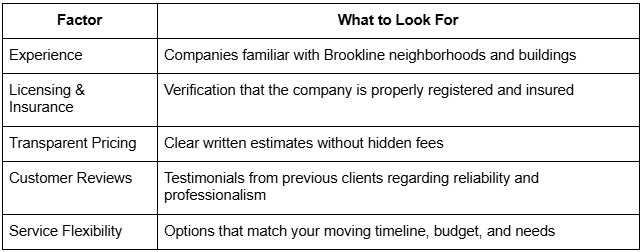
Selecting the ideal moving partner involves reviewing several key considerations:

Choosing the Right Brookline Moving Company for a Smooth Relocation Experience

Comparing these elements makes it easier to choose a moving team that meets expectations and ensures a positive moving experience.

Tips for Preparing for Moving Day

Even when working with a professional team, preparation helps ensure efficiency.

  • Start packing early and declutter unused items
  • Reserve elevators, parking, or loading access where necessary
  • Label boxes by room for easier unpacking
  • Keep essentials (medications, keys, chargers, documents) separate and accessible.

Taking a few small steps in advance can save time on move day and reduce stress.

Conclusion

Relocating is a significant life event, and working with a trustworthy moving company in Brookline ensures that the process is well-organized, efficient, and stress-free. Whether you are preparing for a residential move, relocating a business, or transitioning from out of state, professional movers with local experience can provide support tailored to your needs. By selecting a knowledgeable moving company in Brookline, MA, understanding what to expect when moving to Brookline, MA, and working with a dependable Brookline moving company, you can feel confident that your belongings will be handled with care from start to finish.

Why Leading Liverpool Businesses Rely on Professional Forklift Hire Solutions

In the bustling port city of Liverpool, where commerce thrives and industries flourish, the demand for efficient material handling solutions has become increasingly important. Businesses, from logistics to manufacturing, often depend on forklifts to move goods swiftly and safely. However, not all companies have the resources or the need to maintain a fleet of forklifts year-round. This is where professional forklift hire solutions can play a crucial role, allowing businesses to allocate resources more effectively while still having access to the equipment necessary to meet their operational needs.

One of the main reasons businesses in Liverpool turn to professional forklift rentals in Merseyside is cost-effectiveness. Purchasing a forklift can be a substantial financial commitment, and for many companies, especially small to mid-sized enterprises, it’s often not a feasible option. Forklift hire companies offer a more affordable alternative, allowing businesses to pay for the equipment only when they need it. This flexibility is particularly beneficial for seasonal projects or when demand fluctuates.

Additionally, hiring forklifts provides access to the latest models with advanced technology. Many firms may face challenges in keeping up with the newest forklift innovations due to budget limitations. However, with a rental model, businesses can benefit from state-of-the-art equipment without the long-term financial burden. This is especially important in a time when fuel efficiency and operator safety are becoming increasingly vital. Modern forklifts generally come with features designed to enhance performance and safety, such as improved visibility and safety alarms, which can potentially reduce accident rates in busy work environments.

The Logistics Advantage

For logistics companies operating in Liverpool, efficient material handling can be critical to maintaining an effective supply chain. The city’s strategic location as a shipping hub means that local businesses are often working with tight deadlines. By opting for professional forklift hire, companies are likely to meet client expectations more effectively.

Flexibility plays a significant role in logistics. When a new project arises or demand suddenly increases, having access to rental forklifts allows companies to scale operations quickly. Instead of waiting for weeks or months for new equipment to arrive, firms can typically contact a rental service and have a forklift on-site in just a few days—or even hours. This ability to respond to changing needs can be an important competitive advantage.

Expertise and Support

Another valuable aspect of forklift rental services is the expertise that accompanies the equipment. Rental companies often provide on-site support and training, which helps businesses make sure that their employees are well-versed in operating the machinery safely and efficiently. Such training can help reduce the risk of accidents, which in turn can lead to lower insurance costs and improved overall workplace safety.

Furthermore, rental companies take great care in maintaining their fleets. This means businesses can typically trust that the equipment they are using is not only functional but also well-maintained and compliant with safety regulations. In industries where safety is of the utmost importance, this reliability can be invaluable.

A Sustainable Choice

In recent years, sustainability has become an essential consideration for businesses worldwide, and Liverpool is no exception. Traditional forklift ownership often comes with the long-term environmental impacts of equipment manufacturing, maintenance, and eventual disposal. However, with rental services, companies may be able to manage their carbon footprint more effectively.

By opting for a rental fleet that includes eco-friendly equipment, such as electric forklifts, businesses can contribute to environmental sustainability without needing to invest heavily in green technology. Additionally, many rental companies are increasingly focusing on updating their fleets to include the latest sustainable technologies, allowing clients to access the most environmentally responsible options available.

Industry Trends and Future Outlook

Looking forward, the trends in the forklift rental industry suggest that the market will likely continue to grow steadily. The rise of e-commerce is driving businesses to adopt more agile and responsive operations, which in turn could increase the demand for rental solutions that help companies meet fluctuating supply chain requirements.

Furthermore, technological advancements—such as the integration of artificial intelligence and the Internet of Things (IoT) in forklift systems—are expected to revolutionize the industry. Companies that offer rental services may look to incorporate these technologies to provide even more value to customers. For example, forklifts equipped with predictive maintenance systems could alert users before equipment failures occur, helping reduce downtime and supporting smooth operations.

Making the Right Choice

When considering forklift hire, it’s essential for businesses to conduct thorough research. Understanding specific needs, such as load capacity and lift height, will help ensure that the right equipment is selected. Partnering with a knowledgeable rental service can streamline this process, offering recommendations based on industry expertise and experience.

Businesses should also take customer support and services into account when choosing a rental company. Does the service provide comprehensive training? Are they readily available for technical assistance and support? These factors can make a significant difference in the overall rental experience.

In summary, as Liverpool continues to be an important player in the UK’s economic landscape, the demand for professional forklift hire solutions is likely to grow. The combination of cost-effectiveness, operational flexibility, and a focus on safety and sustainability makes rental services an appealing option for many businesses. By leveraging these resources, companies have the potential to remain competitive in a fast-paced economic environment, ensuring they have access to the right tools when they are needed most.