Why a Lawyer Is Essential for Your Overload Truck Accident Claim

Hauling too much cargo makes truck accidents incredibly destructive. Such events also kick off really tough, extended legal cases. Facing that, sound legal advice is vital. When a big rig crashes, you need a lawyer who will fight for your rightful compensation. This article will explain precisely why bringing in a lawyer helps you handle these situations correctly.

Understanding Legal Complexities

Truck accident claims involve a maze of legalities. These crashes don’t follow the same rules as your average fender-bender. Federal rules are part of the picture. Understanding these dense government policies often feels like an uphill battle for someone without a legal background. An NJ overloaded truck crash lawyer understands these rules and can use that knowledge directly for your case, which makes a win much more likely.

Determining Liability

Identifying the responsible parties in an overloaded truck accident can be complicated. Multiple entities might share responsibility, including the driver, trucking company, and cargo loaders. A lawyer will uncover every detail and identify who is responsible. This step names everyone accountable for the paperwork.

Gathering Essential Evidence

Critical evidence is necessary to support a claim. Check the truck’s service history, each driver’s daily logs, and what goods are on board. Grasping legal rules gets you this information. Your case gets considerably lifted when lawyers skillfully collect and show all the facts.

Negotiating with Insurance Companies

Insurance companies often aim to minimize payouts. You’ll find their adjusters excel at lowering the payout on claims. A lawyer can counter these tactics by negotiating assertively to secure fair compensation. Because they’ve been through this before, they handle intense negotiations well. They make certain the victim’s well-being always comes first.

Calculating Fair Compensation

Understanding the actual value of a claim is vital. Its actual cost exceeds mere medical or vehicle expenses. You must consider pain, suffering, lost wages, and future expenses. A lawyer will precisely quantify your losses, thus resulting in a compensation package that genuinely accounts for the complete ramifications of the incident.

Providing Emotional Support

The aftermath of an accident can be emotionally draining. People who’ve been hurt often deal with body aches and deep emotional upset. Having a lawyer provides legal guidance and emotional support. Knowing their case is well-managed brings people peace of mind and lets them put all their energy into getting healthy again.

Handling Legal Procedures

Legal proceedings involve strict timelines and procedures. Missing a deadline or filing incorrectly can jeopardize a claim. A skilled overloaded truck accident lawyer in New Jersey ensures that all paperwork is completed accurately and on time. Knowing the courts inside and out means they can speed things up and keep you from running into trouble.

Representing in Court

If the parties cannot settle, the case may proceed to court. You’ll want a powerful advocate to convince a judge and jury. An experienced lawyer can articulate arguments and use evidence strategically to achieve a favorable verdict.

Avoiding Common Mistakes

Without legal guidance, individuals may make errors that could weaken their claims. Missteps such as admitting fault, accepting early settlements, or failing to document injuries properly can have serious consequences. Don’t fall into hidden problems; your lawyer’s advice helps you skip them. This way, your whole claim stays valid and protected.

Ensuring Compliance with Regulations

Trucking accidents are subject to specific legal standards. Rules cover how much a truck can weigh, regular safety checks, and drivers’ skills. Legal professionals scrupulously identify that case elements do not align with prescribed standards, thus fortifying the legal argument.

Conclusion

After a crash with an overloaded truck, getting legal help is absolutely critical for your case. When things get legally complicated, they step in to sort it out. They’ll collect every bit of proof, talk to insurance companies, and stand up for clients in court. Thanks to this expertise, victims recover fairly and find the justice they deserve. Legal battles are never easy, but getting a lawyer on your side will make a crucial difference. They often get you a better result, which lets you relax knowing a pro handles the fight. 


Disclaimer: The content of this article is for informational purposes only and should not be construed as legal advice. Every case is unique, and you should consult a qualified attorney for specific legal guidance regarding your situation before making any decisions related to a truck accident claim.

Hippomundo: Bridging Data Gaps in the Equestrian Sport and Breeding Sector

By: Michael Beas

In the world of equestrian sport and breeding, information plays a crucial role. Knowing how a horse is bred, how it has performed, and how it compares to its peers can make a significant difference between a wise investment and a costly decision. However, until recently, that important information was often scattered and challenging to access.

A Fragmented Industry

When Hippomundo was founded in 2014, the equestrian world faced a data problem. Over 350 organizations worldwide were collecting results, pedigrees, and competition statistics — yet these systems rarely communicated with one another. Breeders, owners, and riders often had to rely on fragmented reports, personal networks, or luck to track the performance of their horses and bloodlines.

As Co-CEO Koen Terryn explains:

“When we started, the challenge was clear. There were many organizations collecting information, but no central system where it all came together. As a breeder myself, I knew how frustrating it was not to be able to easily follow how my horses were doing once they left my stable.”

What began as a straightforward effort to centralize data for breeders gradually evolved into something broader.

From Database to Global Platform

Together with Co-CEO Ronny Dockx, Terryn helped transform Hippomundo from a breeder’s tool into a comprehensive global platform. Today, Hippomundo serves not only breeders but also riders, owners, trainers, agents, and enthusiasts.

Terryn emphasizes that the company’s strength lies in fostering connections:

“We are not just a database — we are a meeting point. Riders can showcase their results, breeders can monitor how their foals perform, and owners can use our insights to make more informed buying and selling decisions. By bringing all these groups together, we’ve created a platform that reflects the dynamic nature of the sport.”

Why Data Matters in Sport and Breeding

The importance of information goes far beyond numbers on a page. Breeding decisions help shape generations of sport horses, and small insights can significantly impact outcomes. For breeders, understanding which bloodlines produce consistent results is invaluable. For riders and owners, transparent performance records help build confidence in the horses they buy, sell, and train.

Terryn explains:

“Breeding horses is about vision, but also about information. If you can see which bloodlines consistently show positive results, you can make more informed decisions. That is what Hippomundo provides — clarity in a world where success can depend on the smallest details.”

Building Trust in a Competitive Market

The equestrian market is both passionate and competitive, with horses often selling for significant amounts of money. In such an environment, trust is essential.

By consolidating data from numerous sources into one central system, Hippomundo has brought greater transparency to the industry. Breeders can follow their horses’ results worldwide, buyers can verify pedigrees and performances, and riders can showcase their achievements in one place.

“When people have access to reliable information, they can make more informed decisions. That builds trust, and trust is what drives our entire industry forward,” says Terryn.

A Vision for the Future

While Hippomundo has already become an essential tool for the global equestrian community, Terryn and Dockx are not slowing down. The next phase of Hippomundo will introduce new technologies, deeper analytics, and innovative features designed to meet the evolving needs of the sport.

“We want Hippomundo to become the leading digital hub for equestrian sport and breeding worldwide. The technology is advancing rapidly, and we see significant potential in AI, predictive analytics, and real-time performance tracking. For breeders and riders, this will mean moving from reflecting on past performance to anticipating future trends,” Terryn says.

A Legacy That Honors the Sport

At its core, Hippomundo’s mission is not just about data — it’s about celebrating and preserving the legacy of the sport. By bringing transparency, connection, and clarity to an often complex industry, the platform ensures that the stories of horses, breeders, and riders are not lost in fragmented systems.

Thanks to Hippomundo, the next generation of equestrian professionals won’t just celebrate moments of success — they’ll understand the bloodlines, data, and strategies that made those successes possible.

Learn more at www.hippomundo.com.

Inside the Tinkerer’s Mind: Yashodhan Kanoria on Merging AI with Embedded Systems

By: Alina Petrova

In a world where innovation often comes with noise and hype, Yashodhan Kanoria prefers to let his work speak for itself. A systems engineer based in Miami, Florida, Yash—as colleagues and friends call him—spends his workdays in the intricate space where embedded systems meet artificial intelligence. It’s a frontier that demands both precision and imagination, and it’s where Yash feels most at home.

“Embedded systems are like the nervous system of modern tech,” he says. “Adding AI to that is like giving it a brain.”

Originally from India, Yash moved to the U.S. with a clear vision of advancing his education and career. He pursued a master’s in electrical engineering at Purdue University, where an initial curiosity about technology evolved into a deep passion for creating innovative solutions. This curiosity sparked a journey that would soon lead him to the forefront of the tech industry. As his understanding of technology deepened, he became increasingly fascinated by the potential of combining hardware with intelligent software.

Today, Yash is a key figure at a major tech company, where he spearheads initiatives aimed at integrating artificial intelligence into hardware products. His work focuses on making devices smarter, more efficient, and capable of adapting and learning from user interactions. These innovations now impact millions of people, as the products he leads the development of are widely used across the globe. His career is a testament to how curiosity and education can drive the creation of transformative technologies.

Merging AI with embedded systems goes beyond simply enhancing performance. For Yash, it’s about transforming how devices interact with users by making them context-aware and responsive. By running AI directly on the hardware, devices gain the ability to understand and react to their environment in real-time, without needing to constantly communicate with external servers or cloud-based systems. This approach brings a whole new level of personalization and efficiency to everyday objects, a key focus in Yash’s work.

Imagine, as Yash often does, a smart thermostat that doesn’t just wait for you to adjust the temperature—it learns your preferences over time. It begins to understand when you prefer the house to be warmer, such as just before you wake up, and can adjust the temperature preemptively. The result is a seamless experience where the device anticipates your needs without any direct input. Similarly, consider a wearable device that tracks your stress levels, adjusting its notifications, guidance, or even triggering calming exercises when it senses you’re feeling overwhelmed—innovations Yash is dedicated to making a reality.

These are not just simple conveniences; they represent intelligent interactions tailored to each user. The technology’s ability to learn from and adapt to individual behavior creates a personalized experience that feels intuitive, as if the devices understand your habits and needs before you even have to express them. By embedding AI within these systems, Yash and his team are moving closer to a world where our devices truly enhance our lives in a way that feels natural and effortless.

“The challenge,” Yash notes, “is getting AI to run efficiently on limited hardware. You can’t just throw cloud computing at every problem. You have to think smarter, optimize better.”

Yash’s approach is grounded in tinkering—an iterative, hands-on process of building, testing, and refining. His desk is often a tangle of wires, development boards, and half-assembled prototypes. But behind the seeming chaos is a deliberate methodology. He starts with questions, not solutions. What does the user need? What does the device already know? What could it learn?

“A lot of AI gets built for the sake of flash,” he says. “But real magic happens when it disappears into the background and just works.”

Outside the lab, Yash remains a quiet thinker. He isn’t married and doesn’t mind the solitude; it gives him space to reflect and recharge. Whether he’s sketching a new algorithm in his pocket notebook or photographing a quiet street in Miami, he finds inspiration in small details. It’s this mindset—equal parts engineer and observer—that shapes his work.

Looking ahead, Yash sees a future where AI-infused embedded systems redefine how we interact with everyday objects. Smart homes that anticipate needs, healthcare devices that monitor and intervene in real time, even public infrastructure that adapts to real-world usage.

“We’re not just making things smarter,” he says, “we’re making them more human.”

In the hands of a true tinkerer like Yashodhan Kanoria, the fusion of AI and embedded systems isn’t just a technical evolution. It’s a quiet revolution—one wire, one algorithm, and one idea at a time.

How AI Institute Is Making AI Accessible for Everyday Entrepreneurs

By: Nic Abelian

AI Institute transforms AI from tech jargon into real-world tools, helping everyday people build income and businesses.

On a late-night call with a student, Founder Sergio Tavarez heard a familiar frustration: “AI sounds powerful, but I don’t know where to start.” That single comment crystallized the purpose of the AI Institute: not to overwhelm people with jargon or theory, but to make artificial intelligence accessible to everyday entrepreneurs, enabling them to create income, opportunities, and confidence.

AI Institute is more than an education platform; it’s a bridge between curiosity and capability. It’s where busy professionals, parents, and aspiring entrepreneurs discover how to harness AI to build businesses and achieve financial freedom.

Turning Curiosity Into Capability

Artificial intelligence is often portrayed as complex, technical, and inaccessible. For many, it feels like a tool reserved for Silicon Valley startups and Fortune 500 corporations. AI Institute flips that narrative by showing how anyone can apply AI in real-world contexts, without needing a coding background or technical expertise.

The curriculum focuses on areas where AI creates an immediate impact, including streamlining sales processes, scaling marketing campaigns, and integrating voice AI into service-based businesses. Instead of memorizing theory, students walk away with strategies they can implement today.

“Our role is to simplify,” says Tavarez. “AI is only powerful when people can actually use it. We give our students that clarity and show them how it fits into their world.”

A Reliable Path Backed by Results

Although AI Institute is a new company, it draws on a history of success. Tavarez and his team have guided a significant number of students through various programs, helping them turn ideas into profitable ventures. Many of these students have achieved substantial business milestones, with several reaching impressive revenue levels. Collectively, these efforts have contributed to notable financial outcomes.

These numbers matter not as hype, but as proof of what happens when structured coaching meets motivated students. They demonstrate that the methodology behind the AI Institute has already been tested, and that its impact extends far beyond the classroom.

Why Students Choose AI Institute

In an online education market filled with pre-recorded videos and minimal accountability, AI Institute offers something different:

  • Hands-On Coaching: Every student is paired with a personal growth coach and supported by a dedicated, hands-on success team. This ensures no one is left behind.
  • Real-World Applications: The training is built for busy people. Students learn how to implement AI tools in service-based businesses, not just in theory, but in practice.
  • Confidence Over Complexity: Beyond skills, the program empowers students to act, test, and think creatively with AI.

This combination of structure, accountability, and creativity is what makes the AI Institute stand out. It’s not about information overload, it’s about transformation.

More Than Education, A Movement

For Tavarez, the AI Institute represents more than another business venture. It’s part of a movement to democratize AI. For too long, artificial intelligence has been shrouded in technical jargon, accessible only to those with advanced expertise. AI Institute opens the door to people who never thought they could leverage such tools.

From a single parent looking to earn supplemental income to a professional wanting to scale their side business, the students reflect the vision of AI for all. They’re proof that artificial intelligence doesn’t have to feel intimidating; it can feel empowering.

“We’re not just teaching AI,” says Tavarez. “We’re teaching people to unlock their potential with it.”

The Road Ahead

Looking forward, the AI Institute aims to become the trusted guide for anyone eager to use AI in business. As industries continue to evolve and AI becomes an integral part of work, the institute’s vision is to ensure that everyday people have the tools to stay ahead.

By focusing on practical applications, hands-on mentorship, and student success, AI Institute is positioning itself not just as a course provider but as a leader in the future of business education.

Begin Your AI Journey

Artificial intelligence is no longer just for corporations or tech insiders; it’s a tool that can change the lives of everyday people. The AI Institute provides the roadmap, coaching, and support to make it possible. If you’re ready to turn curiosity into capability and ambition into action, this is where your journey begins.

Start today: Follow Sergio Tavarez on Instagram.

Chasing Springsteen, Finding Herself: Anne Abel on High Hopes

By: Michael Beas 

When Anne Abel boarded a plane to Australia to follow Bruce Springsteen on tour, she wasn’t chasing celebrity thrills or looking to cross off bucket-list travel. In fact, as she admits in her memoir High Hopes, she hadn’t even wanted to go. The trip was less about adventure than about survival—a way to keep herself from “falling into the abyss” after a difficult period in her life. What unfolded was a journey that blended the transcendent power of live music with the raw honesty of solitude, fear, and unexpected joy.

No Regrets, Even in Darkness

Asked whether she ever regretted her decision to fly halfway around the world alone, Abel is resolute: “I never regretted going on this trip.” She’s candid about the darker moments—loneliness, depression, even being upset by personal issues back home—but emphasizes that the concerts, the people-watching, and the very act of writing kept her afloat.

Remarkably, what began as a passive exercise—simply marking time until she could return—became a creative lifeline. Friends had asked her to send updates, and soon she found herself writing two- or three-hour emails each morning. “That was all I needed to override the writer’s block,” she reflects. In those emails, she wrote not just about concerts but about aging, culture, and life itself. One morning, an essay by Roger Angell in The New Yorker about being 93 struck a chord with her. “Aging is something I wonder about,” she confesses. “How I will be able to cope with each additional decade.” Writing through those thoughts became as essential as attending each show.

In retrospect, Abel realized something profound: “Each time I felt myself edging close to the abyss, I managed on my own to pull myself back from the edge.” That strength—discovered not in glamorous moments but in quiet persistence—became one of the memoir’s most powerful undercurrents.

Fear in the Hunter Valley

For all the joy Springsteen’s concerts brought, there was one night that veered dangerously close to nightmare. In Hunter Valley, wine country two hours from Sydney, Abel had arranged for a driver to take her to and from the show. When the concert ended, she joined 20,000 people pouring out into the night only to discover her driver wasn’t answering the phone.

The scene, as she describes it, was surreal and frightening: thousands of cars gridlocked in a one-street town, security guards demanding she move along, and a phone that—when it finally rang—slipped from her hand and shattered on the pavement. “I wanted to sit down and cry. And cry and cry,” she recalls. Instead, she took a deep breath, collected the pieces, and methodically reassembled the device. Miraculously, it worked.

The driver, it turned out, had fallen asleep. But Abel had already endured the real ordeal: the terror of being stranded at 1 a.m., alone in a foreign country, and the small but extraordinary triumph of solving a problem she once thought impossible. “I am not good at puzzles,” she laughs, admitting that jigsaws are something she always avoids with her family. But that night, piecing her phone back together was nothing less than a lifeline.

The Kangaroo Question

Friends back home had urged her to see Australia’s iconic wildlife. For Abel, though, sightseeing wasn’t the point. “My whole life I have done things I ‘should,’” she explains, wary of chasing someone else’s checklist. She was content staying in her hotel, people-watching, writing, and hoping for a glimpse of the E Street Band.

Yet in Brisbane, with a free day and no bustling lobby to occupy her, she finally agreed to a trip to a koala and kangaroo sanctuary. What followed was a whirlwind of experiences that defied her initial indifference: holding a koala that happened to match her trademark green T-shirt, feeding kangaroos, and even receiving unexpected kindness from strangers—taxi drivers and ferry staff who went out of their way to make sure she made it to the sanctuary on time.

But the most memorable souvenir wasn’t the animals. On her way back, she stumbled upon a multi-arrow signpost pointing to cities around the globe, each marked with its distance from that spot. Standing there, far from home but strangely connected to the wider world, Abel asked someone to snap her photo. “It is my favorite photo from the trip,” she says, proof that the best discoveries are often unplanned.

Music, Resilience, and Meaning

In High Hopes, Abel doesn’t just recount concerts or travel mishaps. She examines how art, solitude, and vulnerability can reshape a life. Whether navigating fear in Hunter Valley or savoring validation from a young fan who dared to dance because she did, her journey is less about Bruce Springsteen himself and more about what his music unlocked within her.

Through the beat of live shows and the silence of hotel rooms, Abel confronted loneliness, aged perspectives, and the unexpected strength of her own resilience. She may have started the trip as a reluctant traveler, but by the end, she had written her way out of the abyss and into something larger—a story worth telling, and now worth reading.

“Your Actions Don’t Care About Your Feelings”: How Drew Shaulson Turned Injury and Burnout into CARMA

By: Sienna Hartfield

Entrepreneur, athlete, and founder of CARMA, Drew Shaulson, talks about Tourette’s, burnout and balance, building an app from scratch, and why discipline, not motivation, drives his life.

Q: You grew up just outside New York City. How did that environment and living with Tourette’s shape you?

Drew Shaulson: I’m from a 6,000-person town in the NYC suburbs. The geography mattered less than growing up with Tourette’s. It taught me early that everyone’s fighting invisible battles. That gave me empathy and a real focus on how you treat people. Sports were huge for me too. I was on track to play college football, and that gave me structure, competitiveness, and grit.

Q: What was life like before fitness became a centerpiece?

Drew: Busy: sports, friends, video games but school was the main thing. From middle school on, the goal was to get into the best college I could. When I broke my back in high school and football ended, I still had other anchors. Fitness became another outlet alongside everything else and has been a part of my life since junior year.

“Your Actions Don’t Care About Your Feelings”: How Drew Shaulson Turned Injury and Burnout into CARMA

Photo Courtesy: Sportograf / Drew Shaulson

Q: Was there a defining moment that nudged you onto this path?

Drew: Three, actually. Multiple stress fractures in my L5 ended football, and I channeled that competitive energy into training. At Penn, Nutrition 101 showed me how what I learned in class could apply to my life immediately, and that’s when the science of exercise and nutrition hooked me. But I pushed too far, burned out, developed an eating disorder, and fell into depression. That forced me to learn balance—the mix of science and experience, logic and emotion—which became the backbone of how I train and why I built CARMA.

Q: For someone who’s never heard of CARMA, what does the app actually do when you open it for the first time?

Drew: CARMA puts everything I’ve learned about health in one place. It teaches you how to track macros the right way with realistic calorie targets, helps you focus on the sleep and recovery metrics that matter most, shows you what stress levels really look like and how to manage them, and even suggests foods and exercises to keep you in your optimal range each day based on your biology and schedule. Using your wearables and nutrition tracking, CARMA gives you live-time scoring and coaching, showing you what you’re crushing and giving clear fixes for the areas you’re behind on. The goal is simple: after using it, you should feel, perform, and look better—not just in the gym, but also at work and in your relationships.

Q: How is CARMA different from other fitness or nutrition apps out there?

Drew: Most apps only give you data in separate silos, one for workouts, one for food, one for sleep, one for stress. CARMA is the only app that integrates all four. It uses AI to connect them so each one impacts the others: your sleep affects your workouts, your workouts influence your stress, your nutrition drives recovery, and so on. Instead of scattered numbers, CARMA gives you a complete health snapshot in one place, helping you make smarter decisions every day.

Q: Positivity is a through-line in your content. What keeps you motivated when things get hard?

Drew: My mantra: “Your actions don’t care about your feelings.” I’m not motivated more than half the time. The difference-maker is pushing when it’s hard. If I do that consistently, I give myself a chance to win.

Q: How do you pass that mindset to your audience?

Drew: Sometimes it’s as simple as wearing a smile. I try to show I’m having fun-lifting, getting ready, or coding CARMA. That energy is contagious; it reminds people they can bring fun into most environments.

Q: What’s the most meaningful message you’ve received from the community?

Drew: A CARMA subscriber messaged me saying the app was changing how he saw health and fitness and thanked me for sticking with it. I got home, reread it, and cried in the shower. It made the three years of late nights, early mornings, weekends, uncertainty, and iteration feel seen. Since then, people have offered to help build CARMA, investors have reached out to back me, and others say the positivity in my content keeps them grounded.

“Your Actions Don’t Care About Your Feelings”: How Drew Shaulson Turned Injury and Burnout into CARMA

Photo Courtesy: Sportograf / Drew Shaulson

Interviewer: What’s next? 

Drew: I want CARMA to become a household name – real, sustainable health built on science and balance. Competition-wise, I have one CrossFit and one Olympic weightlifting meet coming up, and I’m chasing National Weightlifting Finals. For fun, I want to do volleyball and pickleball tournaments. I’m also beta testing a dog-related project and looking forward to collaborations – especially once I’m back in Miami – with people who know how to help others live better.

Q: If readers take one thing from this interview, what should it be?

Drew: Balance wins long-term. Health is science and experience, logic and emotion. And when it’s hard, remember: your actions don’t care about your feelings. Show up, smile, do the work – the rest follows.

Limo Services: The Ideal Touch for Proms and Party Vibes

The Charm of Arriving in Style

It’s prom night, and you’re stepping out of a sleek and shiny black limousine. The music’s pumping, your crew’s hyped, and the whole school’s buzzing about who’s making the grandest entrance. That’s the magic of a night to remember!

Your choice of commutes matters. It’s the first step to your journey, and it sets the entire tone of the trip. For instance, arriving in a luxury vehicle like a limo can help you feel iconic, experience VIP treatment, and boost your confidence.

If you’re used to traveling in this kind of comfort, luxury, and style, it may be difficult to go back. It’s not just about the transportation; it’s about the VIP experience, luxury, and comfort. In this post, we’ll learn how a limo service with a Prestige Ride could add a luxurious touch and why it’s a smart option for these events.

Why Hire a Limo Service for Special Events?

Let’s discuss the luxury part first. A luxury limo service can add a touch of style and glamour to your personality. For instance, plush leather seats, mood lighting, a built-in sound system, and other amenities can turn a ride into a rolling party. These features might make you feel like a celebrity the moment you step inside.

Whether it’s a birthday party, proposal night, bachelorette party, or any special event, arriving in a stretch limo may set the tone of the entire evening. Instead of rushing into multiple cars or dealing with rideshare hassles, Prestige Ride lets your group vibe together and make special memories.

Safety and Convenience Come First

Travelers in the industry are increasingly opting for limousine services. They are generally considered safe and may reduce the risk of accidents by providing professional chauffeurs. They are experts, trained, licensed, and with local expertise. You can travel freely without the stress of navigating and dealing with parking hassles.

A luxury limo service can take away the stress of arriving late to special events. It provides features like GPS tracking and real-time monitoring, so if your children are headed to prom, you might be able to relax knowing they’re in safe hands. They offer door-to-door service with a 60-minute wait time.

Cost-Effective and Hassle-Free

Another major benefit of using a luxury limo service is convenience. They let you travel freely without any hassles of parking, fares, and juggling multiple rides. Traveling without any wait time for pick-up and drop-off may be a great relief.

For groups, this option could be very budget-friendly. By splitting the costs among the group members, it might be cheaper than booking Uber or Lyft individually. If you’re traveling with a group, the expense becomes quite affordable after dividing the total. The cost of a stretch limousine typically ranges from $75 to $150 per hour.

The Numbers Speak for Themselves

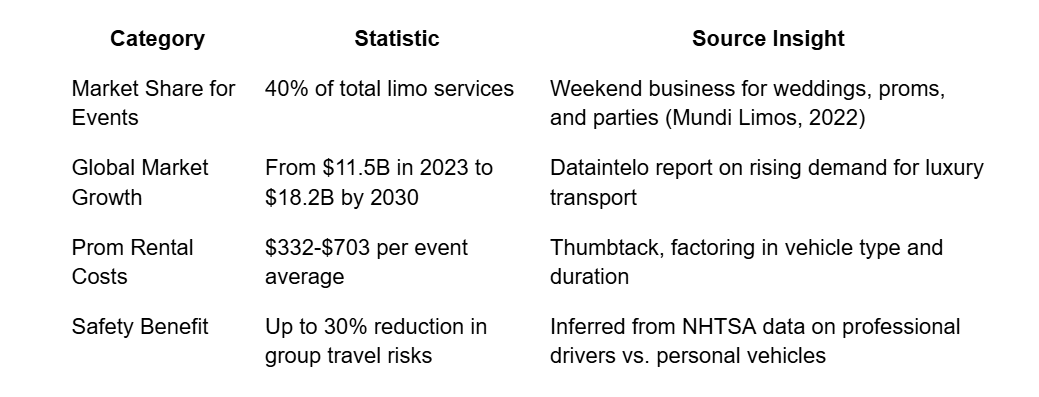
Let’s examine some statistics that highlight the popularity of limousine services. Limo services are often an important part of the glamour industry. For special events like proms and parties, opting for a limo service can be a good way to arrive in style. Here’s a table from the market report:

Limo Services: The Ideal Touch for Proms and Party Vibes

The Group Vibe of a Limo Ride

A limo isn’t just a ride; it’s the whole vibe of the evening. Imagine riding together in a spacious limo, taking selfies, playing your favorite playlist, and glancing at the starry sky through the panoramic roof.

A 2023 Eventbrite survey found that 78% of prom participants felt that securing a luxury ride made their night more special and boosted their energy and confidence. With Prestige Ride, everyone stays connected, turning the journey into a highlight of the celebration.

Why Limo Service is a Go for Luxury?

What sets us apart?

  • Delivering exceptional services for 10 years, with customer support available 24/7.
  • Offering customized services such as wheelchair rentals, child seats, and additional space options.
  • Smooth and stress-free door-to-terminal airport transfers.
  • Transparent fixed pricing with unlimited amenities.
  • Well-maintained and clean range of fleets for your comfort.

Wrapping Up: Make Your Night Unforgettable

Prom nights, birthday bashes, and special events deserve more than traditional rides; they deserve luxury rides. In these events, you’re supposed to arrive in style. A limo service isn’t just about getting from point A to B; it’s about transforming your trip into a luxury ride. With Prestige Ride, you could enjoy luxury, safety, and convenience all in one seamless package.

Subham Ray on Gulf IT’s Vision for GITEX 2025, Dubai

By: Nora Akeel and Aisha Malik

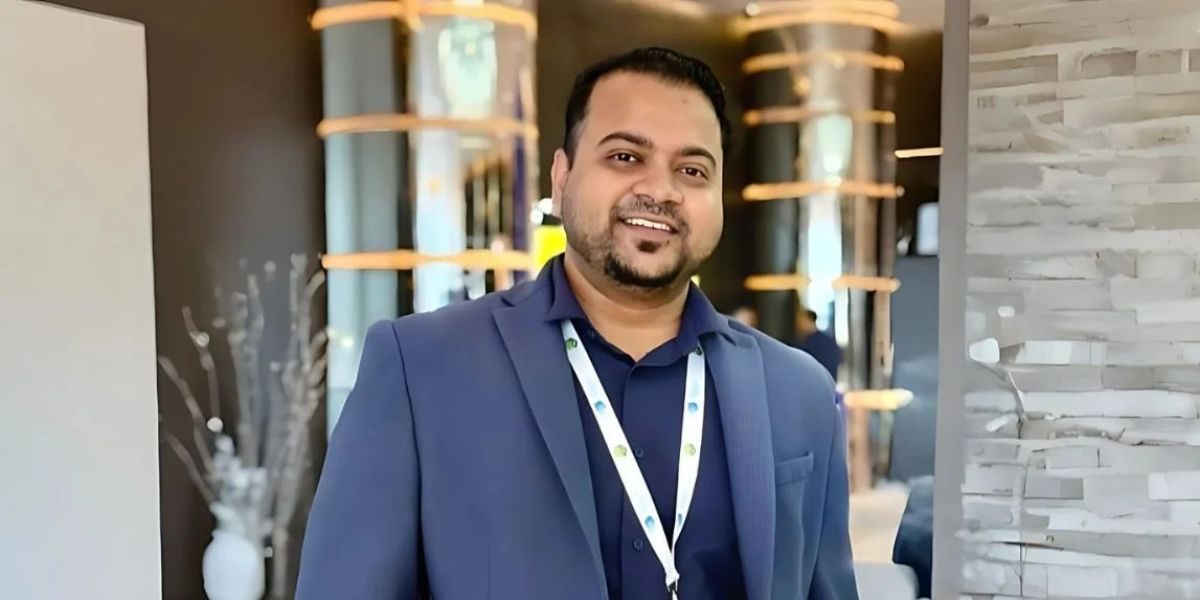
New York Weekly (NY Weekly) is a global publication spotlighting leaders, innovators, and disruptors shaping the future of business and technology. Ahead of GITEX GLOBAL 2025 the world’s largest tech and startup show taking place from 13–17 October in Dubai ,we spoke with Subham Ray, Business Manager and Consultant at Gulf IT Network Distribution.

Gulf IT Network Distribution is a value-added distributor at the forefront of Cloud Security, Network Security, Identity Security, Data Security, Security Operations, and Cybersecurity solutions in the Middle East. Partnering with world-leading. Gulf IT helps enterprises accelerate secure digital transformation across the region.

Representing Gulf IT at GITEX 2025, Subham brings deep expertise in vendor ecosystems, partner enablement, and technology adoption strategies. In this candid conversation, he shares his vision for Gulf IT’s role at GITEX, the evolving Middle Eastern tech landscape, and the future of innovation.

Subham Ray on Gulf IT’s Vision for GITEX 2025, Dubai

Photo Courtesy: Subham Ray

Q&A Interview

Aisha: Subham, let’s start at the beginning. For readers who may not be familiar what exactly is Gulf IT Network Distribution and why does it matter in the Middle East tech ecosystem?

Subham: Gulf IT is more than just a distributor. We’re an innovation enabler. Our role is to connect global vendors with local enterprises, bridging the gap between cutting-edge technology and regional business needs.

Why does it matter? Because in the Middle East, digital transformation isn’t optional, it’s a national priority. Governments and enterprises are racing towards Cloud adoption, AI, and cybersecurity, but they need enablers who can deliver not just products, but also local expertise, compliance awareness, and integration support. That’s where Gulf IT plays a strategic role.

Nora : That’s powerful. Let’s talk GITEX 2025. Why is this event so important for Gulf IT?

Subham: GITEX is the world’s stage for technology. For Gulf IT, it’s not just about showcasing vendors, it’s about positioning ourselves as the distribution partner of choice in the region.

At GITEX 2025, we’re focused on four things:

  1. Showcasing Vendor Ecosystems
  2. Engaging Partners & Customers
  3. Thought Leadership.

Aisha: GITEX has grown into one of the largest global events. From your perspective, what makes this year’s edition unique?

Subham: Three things stand out to me:

  • Global + Regional Balance: It’s global in scale but highly relevant to Middle East priorities like sovereign cloud, AI regulation, and smart cities.
  • AI Everywhere: AI isn’t a side topic anymore, it’s embedded in every discussion, from cybersecurity to sustainability.
  • Cross-Border Collaboration: Startups from USA, UK, Africa, India, and Southeast Asia are participating in larger numbers.

Nora: As Business Manager and Consultant, how do you see Gulf IT differentiating itself from other distributors in the market?

Subham: Great question. A lot of distributors stop at “selling technology.” Gulf IT goes beyond. We ask: “How can this solution create measurable impact for a customer’s business?”

Our differentiation lies in:

  • Selective Portfolio: We don’t sell everything. We choose vendors that solve real challenges.
  • Enablement First: We train, certify, and support partners so they can succeed independently.
  • Consultative Sales: We focus on solutions, not just boxes. That’s why CIOs and CISOs trust us.
  • Agility: We’re faster in execution than larger legacy distributors.

Simply put, Gulf IT is lean, sharp, and partner-driven.

Aisha: Cybersecurity is clearly a strong theme for Gulf IT. What’s your perspective on the challenges enterprises face today?

Subham: The biggest challenge is the speed gap. Cyber threats evolve faster than most organizations can adapt. Businesses want to innovate with cloud, AI, and IoT, but every new capability opens a new vulnerability.

At Gulf IT, we’re focused on solutions that answer “How can we innovate securely?”, from zero trust to threat intelligence to cloud security.

Aisha: You’ve emphasized the Middle East a lot. How do you see the region evolving over the next 5 years?

Subham: The Middle East is shifting from technology adoption to technology leadership. In five years, I believe we’ll see:

  • Sovereign Clouds becoming mainstream.
  • AI regulation positioning the region as a global benchmark for responsible AI.
  • Smart city exports — Middle East exporting their models to other global cities.
  • Regional Unicorns in cybersecurity and fintech.

Gulf IT’s role is to ensure our partners and customers are future-ready for that evolution.

Nora: Let’s make it personal for a moment. What’s your own goal for GITEX 2025?

Subham: Personally, my goal is to position Gulf IT as the name people remember when they think about secure, innovative distribution in the Middle East. If after GITEX, partners, CIOs, and vendors say, “We need Gulf IT on this journey,” then I’ve done my job well.

Aisha: Final question. What’s your message to partners and businesses reading this interview?

Subham: My message is simple: The future is here but it’s only valuable if you engage with it. Come with an open mind, connect with Gulf IT, and see how we can help you adopt technology with confidence and security.

The Middle East is on the brink of becoming a global tech powerhouse, and Gulf IT is here to make sure businesses are ready for that leap.

Closing Note

As the countdown to GITEX 2025 continues, it’s clear that companies like Gulf IT Network Distribution is not just participant but key enablers of regional innovation. With leaders like Subham Ray at the forefront, the conversation around cloud, cybersecurity, and digital transformation is shifting from possibility to reality.

The Role of Healthcare Data Platforms in 2025

In 2025, the healthcare industry continues to experience a significant transformation driven by digital innovation and the increasing demand for data-driven decision-making. Healthcare data platforms have become essential infrastructure for hospitals, government agencies, insurers, and health technology companies. These platforms help organizations securely store, manage, and analyze large volumes of data from diverse sources, including electronic health records, diagnostic labs, wearables, and more. The right platform can improve clinical outcomes, support public health initiatives, and power advanced analytics and artificial intelligence.

Building such platforms is no simple task. It requires a deep understanding of healthcare systems, strict compliance with regulations, and the ability to integrate data seamlessly across multiple systems. As a result, many organizations now seek out specialized companies that offer data platform development services tailored to the healthcare domain.

Companies Driving Healthcare Data Platform Development

Several companies have emerged as leaders in healthcare data platform development. Among them, Edenlab stands out for its focus on interoperability, custom development, and compliance with international healthcare standards. The company develops scalable, secure platforms that serve a wide range of clients, including health ministries, payers, providers, and digital health startups.

Edenlab’s approach to data platform development involves building centralized systems that enable the secure exchange of clinical and patient data, while supporting analytics and real-time decision-making. These platforms often serve as national or regional data hubs, patient health records systems, or specialized registries for tracking conditions and treatments. The company’s expertise extends to handling structured and unstructured data, enabling semantic interoperability, and ensuring that data governance frameworks are in place from day one.

While Edenlab is known for its large-scale healthcare platforms, other companies bring different strengths to the market. Organizations such as Innovaccer, CitiusTech, and Merative (formerly part of IBM Watson Health) also play key roles in this space. These firms often focus on analytics, cloud-first deployments, or value-based care support. As competition grows, the quality and scope of data platform development services continue to improve across the industry.

Key Trends Shaping the Future of Healthcare Platforms

The healthcare sector is embracing modern technologies at a faster pace, and this is shaping how data platforms are designed and deployed. Interoperability is no longer optional; health systems now expect platforms to be built using standards like FHIR to allow seamless data sharing. Regulatory compliance remains a top concern, especially with new privacy laws and regional data protection standards.

Another significant trend is the move toward real-time data processing. As more health data comes from patient monitoring devices, mobile apps, and connected equipment, platforms must be capable of ingesting and analyzing streaming data. This creates opportunities for timely interventions and supports proactive care models.

Artificial intelligence and advanced analytics are also becoming standard features of modern healthcare platforms. Organizations want platforms that not only store and manage data but also generate insights that can improve operational efficiency and patient outcomes. The ability to support machine learning and predictive analytics is now a crucial factor in platform design.

Choosing the Right Data Platform Development Partner

For healthcare organizations planning to invest in a new data platform, choosing the right development partner is essential. Successful implementation depends on more than just technical skills—it requires an understanding of clinical workflows, healthcare regulations, and the unique challenges of managing sensitive patient data.

Companies offering data platform development services should be able to demonstrate experience with projects of similar scale and complexity. They should also be fluent in the healthcare standards and protocols relevant to your region. Long-term success depends not just on initial delivery but on continued support, training, and the flexibility to adapt as healthcare needs evolve.

As digital transformation continues to shape the healthcare landscape in 2025 and beyond, the demand for reliable, scalable data platforms will only grow. Partnering with the right experts ensures that health data can be used to its full potential—supporting better care, informed policy, and stronger health systems overall.

Apple the Performer from Taiwan, Thriving in the Big Apple

By: Andrew Jackson

How a Taiwan-born performer blends cultures, embraces collaboration, and builds a career on connection.

On a recent evening in New York City, the lights dimmed in a packed cabaret room. As Apple stepped into the spotlight, the energy shifted. With a voice that carried warmth and strength, and a presence that filled the intimate space, she transformed a night of 80s pop into something more: a shared celebration of music, story, and connection.

For Apple, moments like these are not just performances — they are the culmination of a journey that began thousands of miles away in Kaohsiung, Taiwan.

Roots in Kaohsiung

Apple’s love of performance began in childhood. While many children asked for toys on birthdays, she requested a microphone. With it, she sang, narrated storybooks aloud, and imagined herself under the spotlight. Later, a small recorder became her tool for capturing original songs. Dance soon followed, turning living rooms into rehearsal halls and movement into storytelling.

“My family is what keeps me moving, and my hometown is my foundation,” she reflects. “Whenever I create, I always return to the spirit of my hometown for inspiration.” Her culture and the soil that nourished her growing up will always be the inspiration when she creates.

Discovering Musicals

A defining moment arrived in high school when her music teacher introduced the class to Phantom of the Opera and Into the Woods. For Apple, it was transformative.

“Watching those musicals for the first time opened a door for me,” she recalls. That discovery sparked a dream: to study musicals in New York, where she could immerse herself in the form that had captured her imagination.

A Stage in New York

Years later, Apple realized that dream. From the Lower East Side Festival — where she performed for a sold-out 91-seat house — This meaningful art pisces “U.S” directed by Charly Wenzel received enthusiastic feedback from the audience that night. “That night was unforgettable,” Apple recalls. 

“To see every seat filled and feel that energy — it really reminds me to be in the moment and tell the story with my whole heart.” From solo nights at Don’t Tell Mama, one of New York’s well-regarded cabaret venues, she has steadily built a name as a performer whose work bridges cultures and resonates with audiences.

Apple the Performer from Taiwan, Thriving in the Big Apple

Photo Courtesy: Apple Tsai

Her artistry isn’t confined to the stage. Apple directs children’s productions, blending culture with creativity to help young performers find their voices. She directs shows at a Mandarin learning school on weekends. She also brings her presence to film, with a recent short project gaining attention online.

Artistic Philosophy

For Apple, theater is more than craft — it is a way of living. “I love how theater taught me to live in the moment.”

That philosophy defines her approach to performance and collaboration alike. Drawing on Taiwan’s applied theater traditions and combining them with the musical and camera techniques honed in New York, Apple has developed a style that is at once intimate and expansive, culturally nuanced yet universally resonant.

She thrives in collaboration, working with artists from diverse backgrounds to create something more than the sum of its parts. “When I work with people from different cultures, it pushes me to listen more deeply and expand how I tell stories,” she explains. “Every collaboration becomes a chance to learn, to stretch, and to create something we couldn’t have imagined alone.”

Looking Ahead

The next chapter of Apple’s journey is already unfolding. “I can’t wait to see whom I’m going to meet and work with,” she says. “Every project, every encounter has the potential to open a new door.” Next month, she will perform in a Halloween-themed musical — an opportunity she describes with pure excitement. It is another chance to experiment, embody new characters, and connect with audiences in innovative ways.

“Whether it’s a musical number, an applied theater workshop, or a film close-up, I want the work to resonate deeply.”

From Kaohsiung to New York, Apple’s story is one of resilience, artistry, and vision. Grounded in family, inspired by her roots, and committed to cultural exchange, she continues to shape a career defined not just by performance but by connection. And as the lights rise on her next act, one thing is certain: Apple is only beginning to show the full breadth of her potential. “Whether it’s a musical number, an applied theater workshop, or a film close-up, I want the work to resonate,” Apple says. “The Big Apple is full of stories, and I’m here to tell mine — and help others tell theirs.”