The 2025 Xinjiang Yili Tianma Cultural Tourism Festival Grandly Opened in Zhaosu, Northwest China’s Xinjiang Uygur Autonomous Region

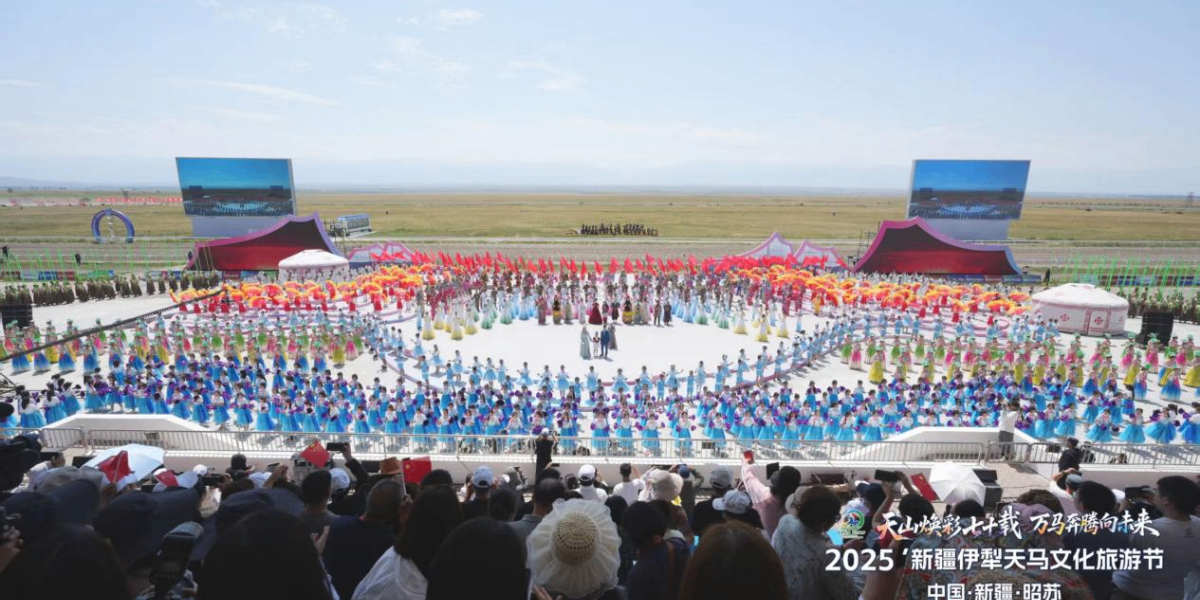
On the occasion of the 70th anniversary of the establishment of Xinjiang Uygur Autonomous Region, on July 19th, the 2025 Xinjiang Yili Tianma Cultural Tourism Festival, with the theme of “Seventy Years of Splendor in Tianshan, Ten Thousand Horses Galloping towards the Future”, grandly opened at the Tianma Tourism and Culture Park in Zhaosu, northwest China’s Xinjiang Uygur Autonomous Region.

An equestrian show is staged during a tourism festival in Zhaosu, northwest China’s Xinjiang Uygur Autonomous Region.

The opening ceremony stage of the 2025 Xinjiang Yili Tianma Cultural Tourism Festival was set against the backdrop of the majestic Tianshan Mountains and the vast grasslands. The cultural performance was composed of three chapters, “Thousand-Year Hoofprints · New Look of the Silk Road”, “Thousand-Year Hoofprints · New Melody of the Silk Road”, “Thousand-Year Hoofprints · New Trend of the Silk Road”, and a finale. The opening ceremony performance began with the opening dance and song “United as One to Host the Grand Event”, showcasing the spirit of unity and progress of all ethnic groups.

The 2025 Xinjiang Yili Tianma Cultural Tourism Festival Grandly Opened in Zhaosu, Northwest China’s Xinjiang Uygur Autonomous Region

Photo Courtesy: 2025 Xinjiang Yili Tianma Cultural Tourism Festival (performance is staged during a tourism festival in Zhaosu, northwest China’s Xinjiang Uygur Autonomous Region.)

The crosstalk artist Feng Gong, along with several disciples, ingeniously incorporated elements such as Xinjiang cuisine, Yili’s beautiful scenery, and the name of Zhaosu County into the crosstalk performance, drawing rounds of applause and laughter from the audience. “Bata” Yu Shi and “Highland Talent” Ma Yuhui, a postdoctoral fellow in animal husbandry at the Zhaosu County Animal Husbandry and Veterinary Development Center, jointly introduced the famous horses of Zhaosu to the audience. The vice chairman of the China Film Association and renowned director Wu Jing also appeared at the opening ceremony for the second time after 2024, using language to promote Xinjiang, introduce Yili, and cheer for Zhaosu. Renowned actors, singers, and bands such as Zhao Wenzhuo, Ao Riqile, and Hanggai Band also successively appeared on the opening ceremony stage.

During the event, Zhaosu County Committee presented the certificate of honorary citizen to Yu Shi and the certificate of ambassador for promoting the Tianma culture of Xinjiang Yili to Feng Gong, Zhao Wenzhuo, Jia Xuming, Xiong Linlin, Cao Suifeng, Mu Qimiya, and Aoriqileng.

The 2025 Xinjiang Yili Tianma Cultural Tourism Festival Grandly Opened in Zhaosu, Northwest China’s Xinjiang Uygur Autonomous Region

Photo Courtesy: 2025 Xinjiang Yili Tianma Cultural Tourism Festival (Horses run during a tourism festival in Zhaosu, northwest China’s Xinjiang Uygur Autonomous Region.)

At the end of the opening ceremony, all the performers sang “Ode to the Motherland” with deep emotion. Meanwhile, the grand “Ten Thousand Horses Galloping” performance was staged passionately on the Karkant grassland, bringing the entire event to a climax.

Xu Bo, a tourist from Guizhou, said, “This is my first time to come to Zhaosu to watch the opening ceremony of the Tianma Cultural Tourism Festival. The scene was really impressive. The galloping of ten thousand horses was very spectacular. The atmosphere, interaction and cheers on the spot were all particularly infectious.” I think this trip to Zhaosu was very worthwhile and I will come again in the future. The delicious food, beautiful scenery and the warmth of the people in Zhaosu, I think, are all very good.

In recent years, Zhaosu County has been deeply exploring the unique tourism resources of “China’s Tianma Hometown”, taking the integration of culture and tourism as the driving force, and continuously promoting the upgrading of the tourism industry. Events such as the “Tianma Wings · Leading the Way” 2025 and Beautiful Village · Yili Horse Performance Test Series and the “Pastoral Song of Zhaosu · Tianma Hometown” Horse King Competition (the third Yili Horse Super League in Zhaosu) are held throughout the year. High-standard events such as the 2025 “Silk Road” China Super Equestrian Orienteering Endurance Race · Zhaosu Station and the 2025 WKG&M-1 Fighting Championship (Zhaosu Station) are also held to expand the “Tourism +” diversified business forms, continuously promoting the development of the tourism industry in Zhaosu County and continuously enhancing the brand effect of “Pastoral Song of Zhaosu · Tianma Hometown”.

Inventory Management Methods and How to Choose Them

In modern supply chains, inventory is more than just a buffer that ensures stable operations. It serves as a vital tool for balancing supply and demand while optimizing resource allocation. Inventory plays a critical and complex role throughout the entire supply chain, particularly when facing unpredictable customer demand and fluctuating supplier lead times. Effective and scientific inventory management has a direct impact on a company’s operational efficiency and overall profitability.

To achieve high inventory turnover and minimize holding costs, companies must adopt appropriate inventory management methods and adjust them flexibly according to industry characteristics, product types, and market conditions. This article provides a systematic overview of three major inventory management methods: First-In-First-Out (FIFO), First-Expired-First-Out (FEFO), and Last-In-First-Out (LIFO), as well as the ABC analysis method. It also explores how to build a flexible inventory control system for practical business scenarios.

First-In-First-Out (FIFO)

FIFO is one of the most common and intuitive inventory management methods. The core logic is simple: items that enter the inventory first are the first to be issued or sold. This method is especially suitable for industries where products do not deteriorate quickly.

Advantages:

  • Follows the natural physical flow of goods, simplifying operations.
  • Offers more accurate cost accounting and greater financial transparency.
  • Reduces the risk of obsolete or stagnant stock and improves turnover rates.

In the daily warehouse operations of manufacturing companies, finished goods or components often follow FIFO rules to prevent degradation of materials. When large and heavy equipment needs to be moved, companies can rely on overhead crane installation services to assist in efficient loading and unloading, reducing labor burden and improving productivity.

First-Expired-First-Out (FEFO)

FEFO takes expiration dates into account, ensuring that items closest to their expiry are prioritized for use or sale. This minimizes waste and enhances product safety.

Advantages:

  • Reduces expiration risk: Ideal for perishable goods, pharmaceuticals, and medical devices.
  • Ensures product quality: Keeps products within optimal use periods, improving customer satisfaction.
  • Optimizes inventory turnover: Prevents stockpiling and boosts efficiency.
  • Lowers costs: Reduces expired stock losses and reputational damage.

FEFO is particularly suitable for industries where expired products can have serious consequences, such as food, medicine, and healthcare.

Last-In-First-Out (LIFO)

LIFO is an inventory valuation and management method where the most recently produced or purchased items are sold or used first. Under LIFO, the cost of the most recent inventory is recorded as the cost of goods sold (COGS). This method is permitted only in the U.S. under Generally Accepted Accounting Principles (GAAP).

Most companies using LIFO do so for tax benefits. Because LIFO can reduce taxable income in times of inflation, its primary advantage also comes with the downside of lower reported profits.

Applicable Scenarios:

  • Inflationary environments: Helps match higher costs with current revenues, reducing taxable income.
  • Industries with volatile input costs: Such as oil, gas, or commodities.
  • Perishables and agriculture: Ensures newer stock is sold first.
  • Retail and fast-moving consumer goods: Particularly where product lines change quickly.
  • Declining inventory costs: Can lower reported inventory values and potentially boost profits.
  • Tax planning: LIFO can strategically reduce tax burdens during inflation.

Non-standard inventory flow: For operations that don’t follow FIFO naturally.

ABC Analysis

ABC analysis classifies inventory based on its value to the business. Items are grouped into three categories (A, B, and C) according to criteria such as demand, cost, and risk.

Advantages:

  • Efficient resource allocation: Focus on high-value items (A) ensures critical inventory is prioritized.
  • Improved turnover rates: Helps avoid stockouts of essential items while reducing overstocking.
  • Optimized inventory control: A-items may require tight controls, while C-items can follow looser policies.
  • Cost reduction: Helps identify high-cost contributors for better cost management.
  • Time savings: Prioritizing high-impact items streamlines inventory processes.
  • Better customer service: Ensures availability of the most important items, increasing satisfaction.

ABC analysis is especially beneficial for large manufacturing operations with complex inventory structures.

Factors to Consider When Selecting a Method

Business nature: Consider whether the business deals with perishables, time-sensitive goods, or short shelf-life products.

  • Market conditions: Inflation may favor LIFO, while deflation or stable prices may be better suited to FIFO.
  • Cost flow and valuation goals: FIFO reflects current market prices, while LIFO may offer cost advantages during inflation.
  • Tax implications: LIFO may reduce taxable income in inflationary environments; consult tax advisors accordingly.
  • Financial reporting standards: Some jurisdictions limit allowable methods. Ensure compliance with reporting regulations.
  • Inventory characteristics: Turnover speed, obsolescence risk, and unit cost can all influence the best method.
  • Cost accounting alignment: Consider how each method integrates with your cost accounting practices.
  • Management goals: Whether you’re optimizing for profit, minimizing taxes, or improving financial transparency.
  • IT systems and capabilities: Some methods require advanced tracking and system support.
  • Operational impact: Choose a method that supports efficient order fulfillment and inventory control.

In project-based scenarios, companies may also use mobile assembly equipment to support on-site inventory handling. For example, using a foldable aluminum gantry crane for small-to-medium item movement allows localized operations to proceed quickly without disrupting the main production line, enhancing overall storage and distribution efficiency.

Conclusion

Inventory management plays a critical role in shaping a company’s cash flow, service quality, project execution, and brand reputation. Selecting the most suitable inventory management method and aligning it with financial strategies, IT systems, equipment capabilities, and business goals is essential for enhancing operational efficiency in today’s competitive environment.