How to Make Your Landscape Renderings Stand Out: Insights and Innovations by Yuan Tian

By: Yuan Tian

Yuan Tian is an award-winning landscape designer known for integrating ecological systems, cultural narratives, and climate resilience into her work. With experience ranging from waterfront resilience projects in New York with MNLA to her current role at RIOS in Los Angeles, Yuan applies a thoughtful, forward-looking approach to landscape architecture. Her design philosophy emphasizes emotional connection and practical skill-building, earning her recognition and a growing influence in the international design community.

1. The Art of Image-Making

A great landscape rendering goes far beyond technical representation — it invites the viewer into a world that doesn’t yet exist. It’s not just about showing what a space looks like, but about conveying how it feels to be there.

At its core, visualization combines three key pillars:

  • Photography Principles:

Point of view, framing, focal length, composition, and color balance — these create iconic, emotionally resonant images.

  • Modeling & Rendering Techniques:

Selective detailing, light and shadow, materiality and texture, thoughtful entourage and post-production together build a compelling visual story.

  • Communication Strategy:

The best images display emotion, suggest narrative, feature people and plants, and create atmosphere — they leave space for imagination.

2. What Makes Your Landscape Rendering Compelling?

When renderings perform at their best, they convey more than visuals — they evoke mood, atmosphere, and experience.

They can spark something dreamlike in the imagination, creating a longing for a place that hasn’t yet been built.

You can almost feel the warmth of the sun, hear distant conversations, or sense the shift from day to night.

As artist Walter J. Phillips once said:

“A landscape painting is essentially emotional in origin… it moves the hearts of others.”

To elevate your images, focus on four visual levers:

  • Composition

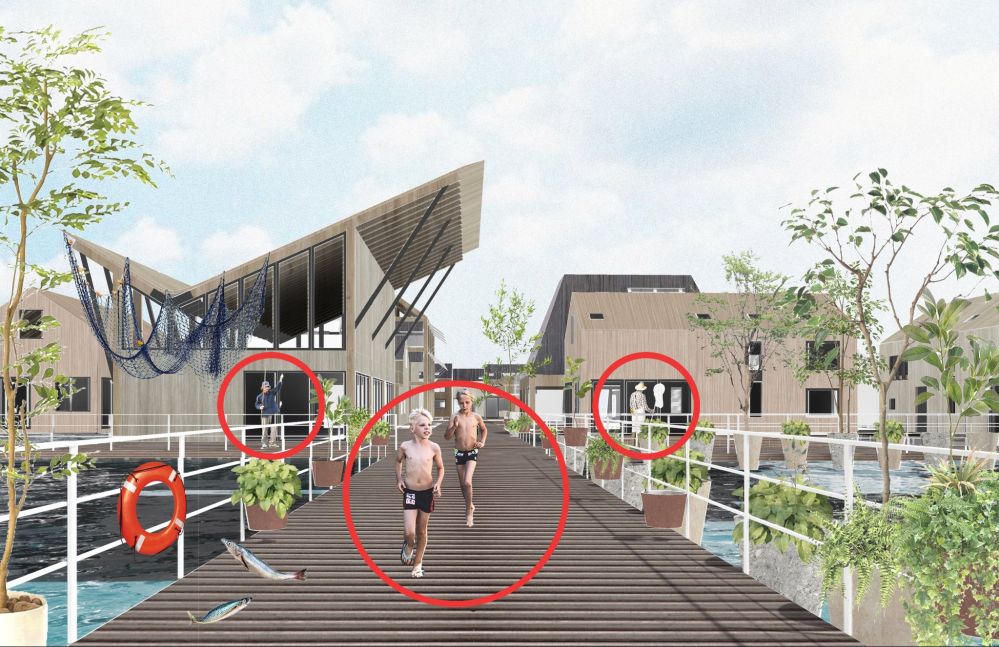
Composition is the foundation of a visually strong rendering. Aim for clarity and focus: every element should have a reason to be in the frame. Use the Rule of Odds, where three or five focal points create more interest than an even number. Balance your composition both horizontally and vertically, and make sure there’s a clear visual hierarchy that guides the viewer’s eye from one area to another. Try to avoid visual clutter and think of your scene as a story unfolding — what’s the protagonist of the image, and what’s supporting it?

How to Make Your Landscape Renderings Stand Out: Insights and Innovations by Yuan Tian

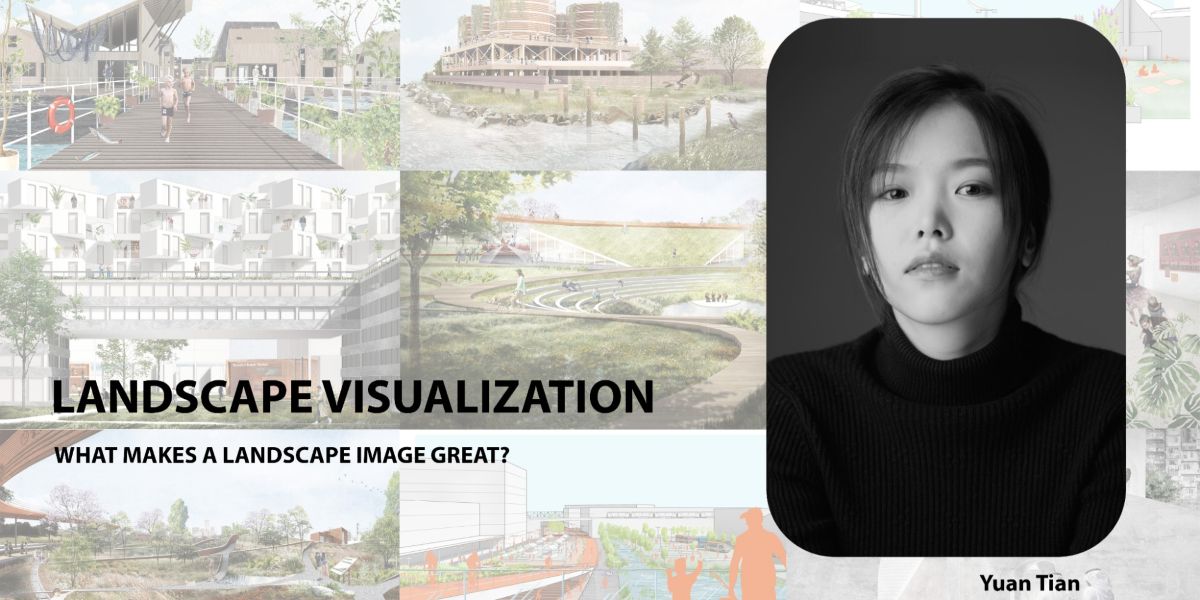
Photo Courtesy: Yuan Tian

  • Depth

Depth brings realism, emotion, and spatial understanding. Incorporate foreground, midground, and background elements to anchor your viewer inside the space. For example, a leaf in the foreground, a bench and user in the middle, and a tree line in the back can simulate how we perceive real environments. Atmospheric perspective — slight fading or desaturation of distant elements — can also help add dimensionality. A good sense of depth invites exploration, rather than just observation.

How to Make Your Landscape Renderings Stand Out: Insights and Innovations by Yuan Tian

Photo Courtesy: Yuan Tian

  • Color Temperature

Color temperature influences mood more subtly but just as powerfully. Warm light (sunset, late afternoon) often suggests comfort, intimacy, and vibrancy. Cooler tones (overcast, early morning) can convey calm, solitude, or even melancholy. Whichever palette you choose, be consistent: don’t mix warm and cool lighting unless intentionally creating contrast. Use color accuracy to make materials and planting believable, while still stylizing the scene to suit your design intent.

  • Light and Shadow

Lighting is one of the most powerful tools to evoke time and feeling. Think about the time of day you want to represent — dawn with long shadows feels entirely different from high noon or golden hour. Use shadows to emphasize material textures: the grain of wood, the layering of leaves, the roughness of stone. Light also directs the viewer’s focus — a spotlighted bench or glowing window immediately draws attention. Always ask: where is your light coming from, and what emotional tone does it set?

3. Use Images to Tell a Story

Great renderings are storytelling tools. They don’t just say “here’s a bench,” they suggest how someone might sit on it, what they might see, and how the space might come alive.

Add human figures that match the mood and time of day. Use vegetation to indicate climate and seasonality. Blur the line between realism and imagination — enough to be believable, but open-ended enough to inspire.

4. What Makes Landscape Visualization Unique?

Unlike architectural renders, landscape visualizations deal with living systems: plants, light, weather, human use over time. A building rendering can feel finished — but a great landscape rendering feels alive, always in flux, always inviting.

As landscape designers, we visualize spaces that change through seasons, grow with time, and are shaped by the people who use them. The magic lies in capturing that fluidity — and grounding it in emotion.

A rendering that touches the heart will always outshine one that only explains the design. So next time you hit “render,” ask yourself not just “does this look right?” — but also, “does this feel like a place someone would fall in love with?”

Yuan Tian


Published by Liz SD.

Metacuration and Contemporary Narratives — Bring Back the Figurative!

From April 4 to 7, 2025, Bring Back the Figurative! made its debut as a group exhibition at 104 Charlton Street in New York. This small-scale yet intellectually and experimentally ambitious exhibition takes the “return of the figurative” as its central proposition, assembling a group of young, New York–based interdisciplinary artists. Through diverse media—including video, painting, installation, and digitality—the exhibition revisits the expressive and critical potentials of the human figure and figuration within contemporary art. 

Although titled “figurative,” the exhibition deliberately avoids a narrow adherence to traditional realism. Instead, it embraces a multidimensional understanding of “figurativeness”—one that encompasses not only direct representations of the individual entity but also conceptual articulations within the frameworks of metanarrative, psychoanalysis, and cultural multiplicity. 

The return of the figurative is thus positioned not merely as a formal exercise, but as a critical response to, and reflection on, art history and narrative structures themselves. Bring Back the Figurative! is not simply a revivalist call for representational forms. Rather, the exhibition functions as a metanarrative about the history, crises, and epistemological positioning of the figurative. By placing figuration at the center of visual culture, the exhibition does not seek a return to the certainties of mimetic theory but instead opens up a space to reconsider what it means to “depict,” “narrate,” and “embody” in the contemporary context—especially when the very concept of “representation” has become an increasingly unstable and perilous verbal word.

Across a range of media, the artists in this exhibition treat “figuration” not just as a way of showing things, but as a way of thinking. They explore its meanings and how it has changed over time. Figuration, in their hands, carries traces of ideological observation and personal experience. 

Some works show the human body directly, while others use symbolic images—but all respond to a growing sense that old, universal stories no longer explain the world. As curator Zhang Ga noted in his review of Wang Yuyang’s work, the idea of “I am” blurs the line between subject and object, between the lifeless and the soulful—highlighting the complex nature of these artistic practices. In this space of contradiction, the artists build new ways of telling stories, revealing the subtle links between body and object. 

By rearranging space, image, and digital code, they explore how meaning is created—and how it can fall apart. Here, bringing back the figurative is not about going backward, but about rethinking it entirely. Figuration becomes a symbol that connects past and future, the personal and the universal. These works suggest that figuration is no longer about copying what we see, but about performing the deeper processes behind how we understand and interpret the world through images.

Metacuration and Contemporary Narratives — Bring Back the Figurative!

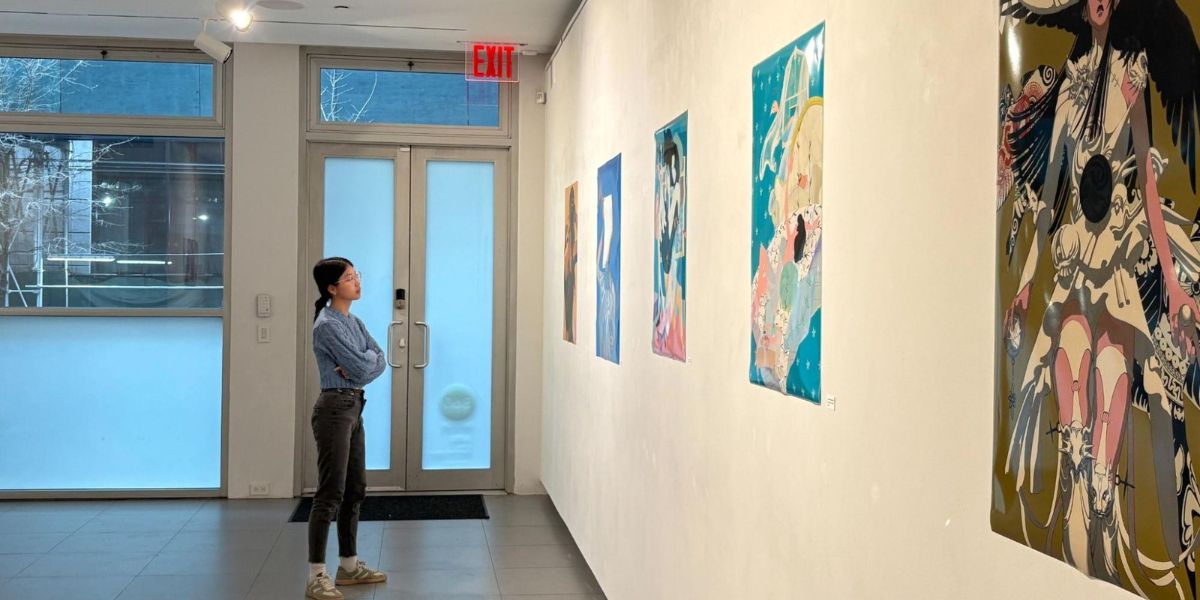
Photo Courtesy: BluBlu, Bring Back the Figurative! Exhibition

In this exhibition, Xianxi Liao’s Be Yourself makes a strong personal statement just through its title. In the context of a second Trump presidency, identity politics and carefully crafted ideas of the self may not hold the same influence they once did. Still, Liao uses figuration as a way to explore the tension between social expectations and the shaping of personal identity. 

The title hints at her artistic approach, perhaps using the body, face, or posture to express the emotional complexity behind the idea of “being oneself.” Her work can be seen as a thoughtful take on figurative portraiture, using it as a tool for self-reflection and resistance based on identity. 

Similarly, Mengdi Wang’s work aligns with the exhibition’s focus on narrative and symbolism. She tells deeply personal stories or uses cultural metaphors to turn lived experience into figurative images. This method is especially powerful in the context of feminist art, offering a challenge to the traditional male-centered way figuration has often been treated in art history. 

Wang’s work shows a vivid and sharp awareness of the politics of the body—what Hélène Cixous once called a feminist act of revenge: using the body and image to retaliate to and break down the emotional norms shaped by patriarchy.

Metacuration and Contemporary Narratives — Bring Back the Figurative!

Photo courtesy: BluBlu, Bring Back the Figurative! Exhibition

Among the participating artists, Yige Bai stands out as the most technologically forward-looking, with his mixed reality (referred to by the artist as “Mixed Media”) work Nonlinear Evolution. Integrating artificial intelligence with mixed reality technologies, the piece uses the Apple Vision Pro as its technological platform to construct a visual and interactive exploration of “nonlinear evolution.” 

Rather than relying on the reproduction of singular images, Bai’s artistic language emphasizes the reconfiguration of the relationship between seeing and being seen through interactive engagement. This approach forms a striking contrast with the conceptual orientation of fellow artist Ziqi Xu. 

Similar to Mengdi Wang, Xu’s practice can be understood as an experiment within the framework of contemporary “neo-figuration.” Through strategies of image deconstruction, psychological color theory, and spatial composition, Xu pushes the emotional structures embedded in figurative imagery to their limits, enabling the viewer to sense latent socio-emotional tensions through the act of perception. This approach highlights figuration not merely as a form of visual representation but as a conduit for transmitting emotional experience.

The works of Mingyi Gan and Whiskey Wu bring a fresh and visually rich take through their use of digital media. Gan’s Boundlessness and ASTROFATE, created with digital painting, blend together cultural references, folklore, and futuristic styles. By carefully illustrating figures, animals, and symbols, who builds a cyber world where reality and fantasy mix. 

Instead of simply copying the real world, her works open up new storytelling possibilities through layered symbols and bold, vibrant colors. Meanwhile, Gan breaks away from traditional ideas of time and culture, turning figuration into something more metaphorical and universal, rather than just showing the human body. 

Correspondingly, Whiskey Wu’s Sun Machine combines the flowing nature of digital media with a strong sense of story. Set in a moody, blue-toned world, his animation explores themes of loneliness and desire in a highly digital, technological space. 

His moving images make figuration feel alive and constantly changing, rather than fixed or still. As the exhibition suggests, bringing back figuration isn’t about going back to old ways of making art, yet it’s about rethinking how we tell visual stories and how we see. Through the works of Gan and Wu, we see how digital figuration crosses over media, emotions, and symbols, becoming a bold and contemporary form of expression.

Metacuration and Contemporary Narratives — Bring Back the Figurative!

Photo courtesy: BluBlu, Bring Back the Figurative! Exhibition

Taken as a whole, Bring Back the Figurative! not only showcases how young artists employ both traditional and avant-garde media to probe the question of representing the individualized human form, but also exemplifies the multidimensional expansion of figurative language economy in contemporary art. The works in the exhibition, each in their own way, respond to current cultural anxieties and imaginative projections around identity, selfhood, technology, and narrative. Within these practices, figuration is redefined: no longer a mere replication of reality, it becomes a conceptual and formal apparatus that penetrates, intervenes in, and reflects upon reality itself. In this sense, the exhibition carries significant cultural meaning that extends well beyond the visual register.


Published by Liz SD.