A Simple Look at Springleaf Modern and Lyndenwoods: Two Homes, Two Ways to Live

By: Lyndenwoods

Finding a good home isn’t just about space. It’s about how the place makes you feel every day. In Singapore, two different housing choices—Springleaf Modern and Lyndenwoods—offer distinct ways of living. One is near a train station and full of city life. The other is calm, private, and closer to nature.

Let’s break down what each place is like, using simple language anyone can understand.

Springleaf Modern: City Living with a Touch of the Past

Springleaf Modern sits along Upper Thomson Road. From the outside, it looks clean and modern, but it also has black-and-white building styles that remind you of old colonial houses. It mixes old charm with new comfort.

This place has about 940 homes. So yes, it’s relatively large. But it’s built in a way that tries to give everyone space and privacy.

Getting Around Is Convenient

The Springleaf MRT station is within walking distance—less than 200 meters away. That’s less than a 3-minute walk. It connects to the Thomson-East Coast Line, which gets you to many parts of Singapore quickly. If you drive, you’re also not far from big expressways like the CTE and SLE.

So whether you take the train or drive, it’s relatively easy to get around.

What You’ll Find Inside 

Springleaf Modern is not just for sleeping. It has a 50-meter lap pool for swimming, a jacuzzi to relax in, and quiet areas for walks or rest. There are green spaces, too—places to sit or have a small talk with a neighbor.

The black-and-white design gives the whole place a peaceful and classy look. It feels somewhat different from many new condos you see around.

For Families

There are schools nearby. Anderson Primary and Presbyterian High School are within a short distance—about 2 kilometers away. That’s a quick drive or bus ride. If you have kids, that’s certainly convenient.

There are also food places along Upper Thomson Road. You’ll find coffee shops, bakeries, and local restaurants not far from your doorstep. And if you enjoy outdoor fun, there’s a fairly large nature reserve nearby.

Lyndenwoods: Quiet Living Surrounded by Green

Lyndenwoods is quite different from Springleaf Modern. It’s smaller, quieter, and has more of a community feel. You don’t see tall buildings here. The homes are lower and there’s more space between them.

It’s the kind of place where you can hear the birds, not traffic. Trees and green spaces are prevalent. You feel closer to nature.

Life at Lyndenwoods

Inside, you still get all the basics. There’s a pool, a gym, and places for kids to play. If you like cooking outdoors, you’ll enjoy the BBQ pits. There’s also a space where you can sit and work—perfect if you work from home.

Security is well-managed, and the staff is always around to help if you need anything. That makes life here feel safe and smooth.

What’s the Difference?

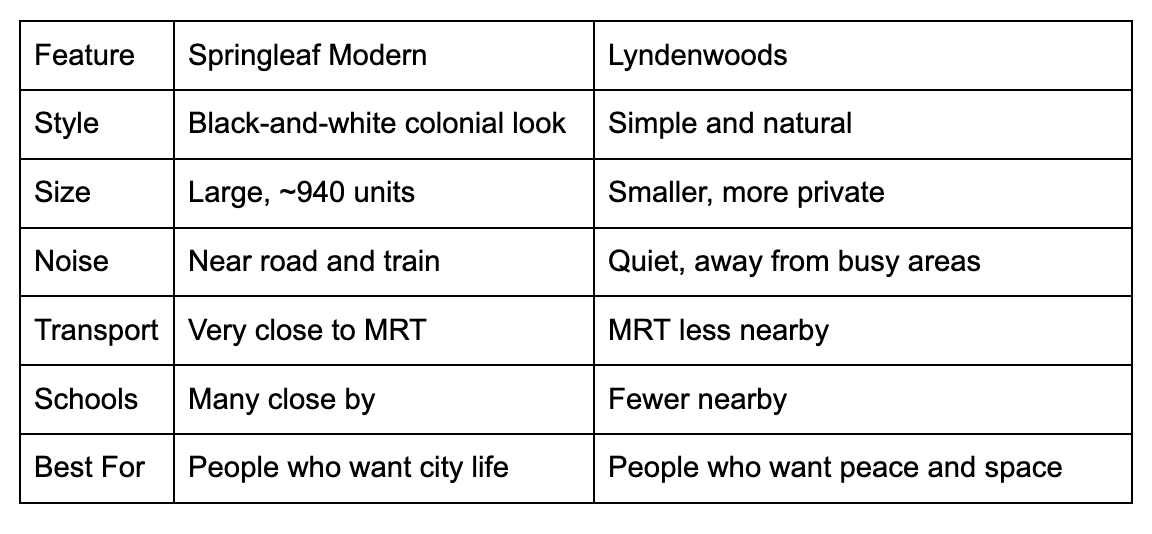
Let’s compare the two in a simple way:

A Simple Look at Springleaf Modern and Lyndenwoods: Two Homes, Two Ways to Live

Who Should Pick What?

Choose Springleaf Modern if:

  • You want to be close to a train station.
  • You want to live near schools and shops.
  • You like a mix of modern and classic styles.
  • You don’t mind a larger community. 

Choose Lyndenwoods if:

  • You want quiet mornings and green views.
  • You prefer a slower pace of life.
  • You like the idea of a small, friendly community.
  • You want more space between homes. 

Final Thoughts

Both Springleaf Modern and Lyndenwoods are worth considering. But they give you different types of life.

Springleaf Modern is for people who like to stay close to everything—train stations, food, schools, and fast access to the city. It’s busy but well-planned, with a strong look and feel.

Lyndenwoods is for people who want to step away from all that. It’s quiet, green, and more relaxed. You won’t hear the rush of traffic. You’ll hear birds. You’ll see trees. You’ll feel calm.

In the end, a good home is one that matches your life. Do you want to walk out your door and jump on a train? Or do you want to sit under a tree and read a book? Your answer will guide you to the place that suits you best.

Published by Anne C.

Threading the Needle: How WESTport Corporation Supports U.S. Manufacturing with Precision Gages

WESTport Corporation is a U.S.-based supplier of precision thread plug gages, recognized by many in the industry for its comprehensive inventory, competitive pricing, and commitment to American manufacturing. Serving a wide range of industries, including aerospace, automotive, energy, and defense, WESTport plays an important role in ensuring the accuracy and compliance of parts that are essential to the functioning of many critical systems.

Headquartered in the United States, the company’s offerings are often integral to manufacturers who require reliable, high-precision tools to maintain quality and safety standards in their operations. These industries frequently rely on precise measurement tools like thread plug gages to meet strict regulatory requirements and production standards, which have become increasingly demanding in today’s global economy.

The company’s success is largely due to its focus on providing fast, efficient service and maintaining a significant stock of thread plug gages that are ready for quick shipment. As manufacturing needs evolve, especially with increasing demand for U.S.-made products and a shifting supply chain landscape, WESTport aims to remain a steadfast partner for those who need dependable precision tools made domestically.

“We have focused on maintaining a robust inventory to meet the needs of manufacturers who cannot afford delays,” said Robert Forbes, CEO of WESTport Corporation. “The pressures on supply chains have intensified, and we strive to ensure our customers have access to the tools they need when they need them.”

WESTport’s focus on customer service and technical expertise helps distinguish it in the market. The company works closely with its customers to help them select the appropriate gages for their specific applications. Whether working with aerospace components or automotive parts, the team offers expert support to help ensure each order meets the necessary standards for quality.

Threading the Needle: How WESTport Corporation Supports U.S. Manufacturing with Precision Gages

Photo Courtesy: WESTport Corporation

While WESTport’s focus on American-made manufacturing remains a central tenet of its operations, the company operates in a larger context. The broader manufacturing industry has faced increasing pressures due to supply chain disruptions, changes in global trade dynamics, and growing expectations for regulatory compliance. These challenges have placed a spotlight on the importance of reliable, U.S.-based suppliers like WESTport, whose products can support critical industries during uncertain times.

The company’s ability to maintain a substantial inventory and provide fast shipping helps address a growing demand for precision measurement tools in the U.S. manufacturing sector, which is seeing increased reshoring and a push for greater domestic production. As manufacturers increasingly look to U.S.-made components, having access to reliable suppliers for these tools has grown in importance.

In addition to providing a broad range of in-stock products, WESTport is dedicated to offering personalized customer service. Its technical team works with customers to help them find the right tools for every job, backed by industry expertise that supports accuracy and compliance.

WESTport’s thread plug gages are widely used across industries where precision is paramount. Aerospace manufacturers often rely on these tools to ensure that components meet rigorous safety and performance standards. Similarly, the automotive and energy sectors commonly use these gages to maintain quality and compliance in the production of everything from engine components to energy infrastructure.

The company’s resilience through supply chain disruptions and its ability to adapt to changing industry needs have helped position WESTport as a reliable resource in an ever-changing manufacturing environment. As reshoring initiatives continue to gain momentum and industries seek to strengthen domestic production, companies like WESTport can play a key role in helping U.S. manufacturing remain competitive on the global stage.

For more information about WESTport Corporation and its range of precision measurement tools, visit https://westportcorp.com/pages/thread-gages.

About WESTport Corporation

WESTport Corporation is a U.S. supplier of precision thread plug gages, known by many for its competitive pricing, extensive inventory, and commitment to supporting American manufacturing. Serving industries such as aerospace, automotive, energy, and defense, the company offers fast shipping, expert customer support, and a range of precision measurement tools that meet strict industry standards. All of WESTport’s products are made in the USA, reflecting its commitment to domestic manufacturing.

Contact Information
WESTport Corporation
Website: https://westportcorp.com/pages/thread-gages


Published by Jeremy S.

Wittles Review: Does It Really Live Up to the Hype?

When it comes to kids’ nutrition, parents are often on the lookout for products that are both healthy and enjoyable for their children. Wittles, a new wellness brand co-founded by Kyler Fisher, Madison Fisher, and Jason Winkler, aims to provide kids with essential nutrients while aiming to maintain great taste. But does Wittles live up to its growing reputation? Let’s take a closer look.

How Does It Taste?

One of the biggest challenges in children’s supplements is taste. Kids are notoriously picky, and many health-focused drinks can struggle with flavor. However, early feedback on Wittles suggests a positive response. Many parents report that their kids enjoy it, and some children have even opted to replace their traditional chocolate milk with Wittles—a encouraging sign for nutrition-conscious moms and dads.

Is Wittles Actually Healthy?

Unlike many children’s supplements that may focus on just one aspect of nutrition, Wittles offers a comprehensive approach. This chocolate-flavored powder mix combines:

  • High-Quality Protein – May support growth and development.
  • Essential Vitamins & Minerals – Designed to help fill nutritional gaps in a child’s diet.
  • Superfoods & Adaptogens – Potentially enhances cognitive function and overall well-being.
  • Probiotics – Could aid digestion and gut health.

Is It Worth the Investment?

Wittles is available through a subscription model, helping parents stay stocked on their child’s daily nutritional support. The first-month subscription includes a welcome box with:

  • A 30-day supply of Wittles powder.
  • A high-quality water bottle.
  • An electronic mixer.
  • Fun stickers for kids to personalize their bottles.

While some parents might hesitate at the idea of a subscription, the convenience of automatic deliveries and the potential benefits for their child’s nutrition could make it a compelling option.

Wittles Review: Does It Really Live Up to the Hype?

Photo Courtesy: Wittles Kids

The Story Behind Wittles

Wittles emerged when Kyler Fisher, a father himself, noticed that traditional chocolate milk, a staple in many households, was often high in sugar but lacked substantial nutritional value. With a goal to create a better alternative, he teamed up with longtime friend and business expert Jason Winkler. Together, they worked to develop a supplement that combined high-quality protein, vitamins, minerals, and superfoods into a product kids might genuinely enjoy.

Supported by the Fisher family’s notable presence in the parenting space, with a vast and engaged audience, Wittles gained early attention as a product parents might consider trusting. From day one, the brand’s mission has focused on no compromises on ingredients, delivering maximum nutrition, and a taste kids are likely to love.

Final Verdict: Does Wittles Live Up to the Hype?

The short answer: It appears so. Wittles isn’t just another kids’ supplement; it’s a carefully crafted option that seeks to balance taste and nutrition without relying on artificial additives or excessive sugar. With clinically researched ingredients, a formula that seems to resonate with many kids, and the credibility of the Fisher family behind it, Wittles could be emerging as a leader in redefining how families approach daily wellness. For parents exploring ways to enhance their child’s nutrition, Wittles offers a thoughtfully designed alternative that aligns with modern health priorities, making it a strong contender worth considering.

Disclaimer: The information provided in this review is for general informational purposes only. Individual experiences with Wittles or similar products may vary. Parents should consult with a healthcare professional before introducing any new supplement or product into their child’s diet, particularly if there are specific dietary concerns or health conditions. The effectiveness of the product and its potential benefits are not guaranteed and may differ from person to person.


Published by Jeremy S.

The Role of Grit in Shaping Future Success Across Society

The concept of grit—defined as the combination of passion and perseverance toward long-term goals—has emerged as a significant factor in personal achievement and societal progress. As research continues to reveal how this quality develops and functions, its applications in education, child-rearing, and professional environments are becoming increasingly clear. Beyond individual success, cultivating grit may offer solutions to persistent social challenges including educational inequality and workforce achievement gaps. Understanding how to foster this trait could reshape approaches to human development across multiple domains.

Read also: Discrete vs. Continuous Models: Choosing Frameworks for Dynamic Systems

Grit’s Transformative Potential in Education

Educational systems traditionally focused on cognitive abilities are beginning to recognize the importance of non-cognitive factors like grit. Students who demonstrate persistence in the face of academic challenges often outperform peers with higher initial aptitude but less determination. This understanding is leading to pedagogical shifts that value effort as much as innate talent, creating learning environments where struggle is reframed as part of the growth process rather than evidence of limitation.

Classroom strategies that nurture grit include emphasizing progress over perfection, teaching specific problem-solving approaches when students encounter obstacles, and providing constructive feedback that focuses on controllable factors like effort and strategy. Schools experimenting with grit development programs report improved academic resilience, particularly among students from disadvantaged backgrounds who might otherwise disengage when facing difficulties. The most effective approaches integrate perseverance training with academic content rather than treating it as a separate curriculum.

Longitudinal studies suggest that grit cultivated during school years correlates with higher graduation rates and better post-education outcomes. Educational institutions serving at-risk populations find particular value in grit-building approaches, as these qualities can help compensate for resource disparities. When students internalize that ability develops through effort, they become more willing to engage with challenging material—a mindset shift with profound implications for closing achievement gaps.

Parenting Approaches That Foster Resilient Children

Family environments play a crucial role in the development of perseverance and passion. Parenting styles that balance support with appropriate challenge tend to produce children better equipped to handle life’s inevitable setbacks. Warm yet demanding households provide the emotional security needed to take risks while establishing expectations that encourage children to stretch beyond their comfort zones.

Practical techniques for developing grit in children include allowing them to experience manageable failures, resisting the urge to intervene prematurely when they struggle with tasks, and modeling persistent behavior in adult pursuits. Narratives that emphasize effort over innate talent help children develop growth mindsets—the belief that abilities can improve through dedication. Families facing socioeconomic challenges can particularly benefit from grit-focused parenting approaches, as these qualities help children navigate systemic obstacles.

Age-appropriate responsibility and consistent household expectations contribute to grit development by creating structured environments where persistence yields tangible results. Celebrating small victories while normalizing struggle as part of the learning process helps children develop emotional resilience. The most effective parenting approaches avoid either extreme of overprotection or neglect, instead providing scaffolding that children can gradually outgrow as their perseverance skills strengthen.

Workplace Applications for Enhanced Performance

Modern organizations are increasingly recognizing that technical skills alone don’t guarantee employee success. Workplaces that value and cultivate grit often see benefits including lower turnover, higher innovation rates, and better stress management among staff. Human resource strategies now frequently incorporate grit assessment in hiring processes while also developing these qualities in existing teams through targeted training programs.

Management practices that promote perseverance include setting clear long-term objectives while breaking them into manageable milestones, providing honest feedback that focuses on effort and improvement, and creating cultures where calculated risk-taking is encouraged. Employees in grit-supportive environments demonstrate greater adaptability during organizational changes and more resilience in competitive markets. These qualities prove particularly valuable in high-pressure fields where setbacks are inevitable but ultimate success depends on continued effort.

Training programs that combine skill development with perseverance strategies help employees at all levels. Mentorship initiatives that pair less experienced workers with gritty role models demonstrate the practical value of persistence in career advancement. Organizations facing rapid technological change find that grit-focused development helps workforces adapt to new systems and processes more effectively than technical training alone.

Addressing Societal Challenges Through Grit Development

The potential applications of grit research extend beyond individual achievement to broader social issues. Educational inequality persists partly because disadvantaged students often lack the support systems that foster persistence. Targeted programs that teach grit alongside academic skills show promise in helping bridge these gaps by equipping students with psychological tools to overcome environmental challenges.

Workforce development initiatives increasingly incorporate perseverance training to help individuals from all backgrounds navigate career obstacles. These approaches may offer more scalable and sustainable solutions than traditional interventions focused solely on skill acquisition. Community programs that combine grit development with access to opportunities create synergistic effects—the psychological resources to pursue goals and the practical means to achieve them.

Critically, grit cultivation must be implemented equitably to avoid becoming just another advantage for already-privileged groups. Effective programs recognize the interplay between individual perseverance and systemic barriers, working to address both simultaneously. When implemented thoughtfully, grit-focused approaches can help level playing fields while respecting the very real structural challenges different populations face.

Implementing Grit Development Strategically

Effective grit cultivation requires more than simply telling people to “try harder.” Research-based approaches emphasize creating environments where sustained effort yields visible progress. In educational settings, this might involve competency-based progression systems that allow students to work at their own pace until mastering material. Workplaces can implement mentorship programs that help employees connect daily tasks to long-term career aspirations.

Measurement tools help track grit development over time, though these assessments work best when combined with qualitative observation. Journals that document challenges overcome, progress trackers that make small wins visible, and reflection exercises that connect current efforts to future goals all contribute to perseverance development. The most effective systems avoid reducing grit to simplistic metrics, instead treating it as a complex quality that manifests differently across individuals and contexts.

Balancing grit development with self-care awareness prevents the quality from becoming toxic perseverance—the counterproductive tendency to persist blindly in unproductive directions. Healthy grit involves both determination and the wisdom to adjust strategies when necessary. Programs that teach this balance help participants avoid burnout while maintaining motivation toward meaningful objectives.

Future Directions in Grit Research and Application

Ongoing studies continue to refine understanding of how grit interacts with other psychological factors and environmental conditions. Emerging research explores how perseverance develops differently across cultures, how technology affects grit formation in digital natives, and how organizational structures can best support determined effort. These insights will shape next-generation applications in schools, families, and workplaces.

Technological advances offer new tools for grit development, from apps that help track and reinforce consistent effort to virtual reality environments that allow safe practice in overcoming obstacles. However, researchers caution that technology should supplement rather than replace human relationships in perseverance development, as mentor bonds and peer support remain crucial for sustained motivation.

As automation transforms the workforce, uniquely human qualities like grit may become increasingly valuable differentiators. The ability to persist through challenges, maintain passion for long-term projects, and adapt to changing circumstances could prove essential in future job markets. Educational and professional development systems that recognize this shift are already adapting their approaches accordingly.

The growing understanding of grit’s role in achievement suggests that cultivating this quality could have cascading benefits across society. From classrooms to boardrooms, environments that nurture perseverance while providing appropriate support and opportunity may help individuals from all backgrounds achieve their potential. While not a panacea for all social challenges, the strategic development of grit represents a promising approach to fostering resilience and determination in an increasingly complex world.

Read also: Practical Design Solutions for Every Room in the Home

The Power of Small Wins: How Celebrating Minor Victories Builds Lasting Momentum

Progress rarely happens in dramatic leaps forward. More often, meaningful change accumulates through a series of small, seemingly insignificant steps. Recognizing and celebrating these minor achievements serves a crucial psychological function—it reinforces positive behaviors, maintains motivation, and creates a sense of forward movement even when ultimate goals remain distant. This practice of acknowledging incremental progress transforms the journey toward any objective from a grueling marathon into a series of manageable sprints with built-in recovery and reflection points.

Read also: Functional Design: Smart Solutions for Everyday Living

The Psychological Impact of Recognizing Small Victories

Human brains respond to achievement recognition with dopamine release, creating feelings of satisfaction that naturally encourage repetition of productive behaviors. This neurological reward system evolved to reinforce actions that contribute to survival and well-being. In modern goal pursuit, intentionally acknowledging small wins taps into this ancient motivational circuitry. When people pause to recognize completion of a daily workout, sticking to a budget for one week, or mastering a difficult skill component, they strengthen the mental association between effort and reward.

This practice counteracts the brain’s natural negativity bias—the tendency to remember failures more vividly than successes. By consciously noting positive developments, however small, individuals develop more balanced perspectives about their progress. Recording these achievements in journals or apps creates tangible evidence of advancement that can be reviewed during moments of doubt. The cumulative effect is increased resilience against discouragement when challenges inevitably arise.

Small win recognition also helps bridge the gap between immediate actions and long-term outcomes. Most significant goals involve delayed gratification, with rewards potentially months or years away. Celebrating milestones along the way provides the interim reinforcement necessary to sustain effort. A writer completing daily word count targets experiences satisfaction despite the unfinished manuscript, just as a student mastering individual concepts feels progress toward eventual degree completion.

Practical Methods for Tracking and Celebrating Progress

Effective small win recognition requires systematic approaches that go beyond vague feelings of accomplishment. Specific tracking mechanisms help make progress visible and celebrations intentional. Many find success with visual tools like progress bars or sticker charts that provide concrete representations of accumulated effort. Others prefer written records that describe not just what was achieved, but how it contributes to larger objectives.

The nature of celebration should match both the achievement and personal preferences. Some thrive on social recognition, sharing milestones with supportive communities. Others prefer private rewards like enjoying a favorite beverage or taking a relaxing walk. The key is establishing clear connections between specific actions and positive outcomes—completing a challenging task might earn a coffee break, while a week of consistent effort could warrant an evening of guilt-free leisure.

Timing matters significantly in reinforcement. Immediate acknowledgment proves most effective for habit formation, which is why fitness apps provide instant badges for workout completion. However, periodic review of accumulated small wins—during weekly reflections or monthly reviews—provides valuable perspective on overall progress. This dual-layer recognition system addresses both short-term motivation and long-term trajectory assessment.

Transforming Small Wins Into Sustained Momentum

The true power of small win accumulation lies in the compound effect—the mathematical reality that consistent incremental progress leads to exponential results over time. Recognizing daily 1% improvements maintains the consistency required for this compounding to occur. Each acknowledged step forward builds confidence in one’s ability to create change, reducing the intimidation factor of ambitious goals.

This approach also provides natural course-correction opportunities. Regular progress assessment allows for strategy adjustments before small setbacks become major derailments. A dieter who celebrates daily healthy choices while noticing weekly weight trends can tweak their approach long before frustration sets in. The feedback loop created by small win tracking creates a responsive system for continuous improvement.

Teams and organizations can apply these principles collectively by breaking large projects into discrete phases with defined completion criteria. Public recognition of these milestones boosts morale and reinforces productive behaviors across groups. The shared language of progress that develops—where team members acknowledge each other’s daily contributions—fosters collaborative cultures focused on forward movement rather than perfectionism.

Overcoming Common Small Win Recognition Challenges

Several obstacles frequently prevent people from benefiting fully from small win strategies. Perfectionists often dismiss minor achievements as insignificant compared to ultimate goals. Reframing progress as statistical accumulation—where each action increases the probability of eventual success—helps overcome this all-or-nothing thinking. Others struggle to identify what constitutes a legitimate small win in complex endeavors. Establishing clear daily or weekly process goals creates objective standards for celebration.

Busy individuals may view recognition rituals as time-wasting indulgences. In reality, the motivational benefits of brief celebrations often save time by preventing procrastination and maintaining focus. The few minutes spent acknowledging a completed task renew energy for the next challenge more effectively than pushing forward in exhaustion.

Perhaps most importantly, small win practices help redefine personal measures of success. When progress becomes the focus rather than perfection, the journey itself transforms into a series of rewarding experiences rather than just means to an end. This mindset shift makes sustained effort more enjoyable and sustainable over long periods.

By systematically noticing and celebrating small victories, individuals and teams cultivate the persistence required to achieve exceptional results. The daily discipline of recognizing progress, no matter how modest, builds the psychological resilience and positive reinforcement loops that turn aspirations into realities. When small wins receive their due attention, motivation becomes self-renewing and momentum self-sustaining.

Read also: Taking the First Steps to Better Financial Planning

Ditch the Acrylics: Radiant Cosmetics is Revolutionizing Nail Care

Tired of weak, brittle nails? You’re not alone. Millions of people, especially young women, struggle with nail damage caused by acrylics and gels. But what if there was a natural, effective option to improve the health of your nails? Enter Radiant Cosmetics, a brand focused on promoting healthy, radiant nails, spearheaded by their innovative Nail Growth Oil.

A TikTok Sensation with a Personal Touch

Radiant Cosmetics isn’t your typical beauty brand. Born from the personal experience of influencer and entrepreneur Ruth Ismayelyan, it’s a family-owned business with a genuine passion for natural beauty. Ruth, a growing presence on TikTok with 1.5 million followers, understands the frustration of damaged nails. After years of acrylic use, she sought a solution that worked. Disappointed with existing products, she created a unique blend of natural oils to improve her nails’ health.

The Secret Weapon: A 100% Organic Formula

The result? Radiant Cosmetics’ Nail Growth Oil, a nourishing oil that aims to hydrate and strengthen nails over time. This isn’t just another cosmetic product; it’s formulated with a 100% organic mix of castor oil, jojoba oil, sweet almond oil, and vitamin E. These natural ingredients work together to help hydrate, strengthen, and promote healthy growth, addressing the damage caused by artificial enhancements.

“We’re not about quick fixes,” says Ruth. “Our focus is on long-term nail health. We want to help people embrace their natural beauty and feel confident in their own skin, or rather, their own nails!”

Say Goodbye to Messy Applications

Beyond its potent formula, Radiant Cosmetics’ Nail Growth Oil stands out for its convenient design. The oil comes in a 3 ml tube with a precision brush tip, allowing for precise, mess-free application directly to the nails and cuticles. No more spills, no more sticky fingers. Just easy application and quick absorption, leaving your nails feeling hydrated and looking healthy.

Real Results, Real People

But don’t just take our word for it. Radiant Cosmetics has garnered positive feedback from customers who have experienced the benefits of the Nail Growth Oil. Many report seeing visible changes over several weeks, with nails becoming stronger, longer, and less prone to breakage. It’s no surprise that the oil has become a popular product on TikTok Shop and has earned recognition as a notable product.

A Brand with a Mission

Radiant Cosmetics’ commitment to natural beauty goes beyond just its products. It’s a brand with a mission to encourage individuals to embrace their natural selves. Ruth, a champion for positive change in the beauty industry, uses her platform to inspire and educate, sharing her nail care journey and advocating for healthier alternatives to artificial enhancements.

From TikTok to Target: The Future is Radiant

Ruth’s entrepreneurial spirit has earned her a place on Forbes’ 2024 “30 Under 30” list in Retail & E-commerce, and she’s just beginning. With plans to expand Radiant Cosmetics into a full nail care line, she hopes to see her products on the shelves of major retailers like Target, Ulta, and Sephora.

Join the Radiant Revolution

If you’re ready to ditch the acrylics and embrace the natural beauty of your nails, Radiant Cosmetics is here to support you. With its commitment to organic ingredients, effective solutions, and customer-centric design, Radiant Cosmetics is paving the way in the natural nail care space. Join the movement and discover the radiant difference today.


Published by Jeremy S.

Developing People First: Why Your Next Star Might Already Be in the House

Many businesses focus their efforts on searching for external talent, often overlooking the capabilities of their existing team. This approach can lead to missed opportunities to develop employees who already understand the organization’s culture, goals, and challenges.

Investing in in-house talent can foster loyalty, boost morale, and often lead to the development of standout performers with the right guidance and growth opportunities. By prioritizing development within the team, businesses may unlock the potential that’s already present, potentially saving time and resources while laying a stronger foundation for long-term success.

The Hidden Potential Within Your Team

Every business likely has untapped potential within its workforce, but it often goes unnoticed. Employees bring more to the table than what’s listed in their job descriptions, yet these additional skills are frequently underutilized or overlooked. By identifying and nurturing this hidden talent, organizations can not only improve outcomes but also cultivate a culture of growth and engagement. The challenge lies in recognizing these underappreciated abilities and ensuring that the resources invested internally provide a meaningful return compared to the cost of external recruitment.

Employees frequently possess abilities that extend beyond their current roles, but these can remain hidden without deliberate effort. For many organizations, the key to uncovering these skills lies in being more intentional about assessment and communication. Conducting skills inventories allows employees to document their competencies, certifications, and past projects, which may not directly connect to their current positions. Employee feedback sessions offer another valuable avenue for discovery. Managers who actively listen during one-on-one meetings or team gatherings can uncover insights into individual strengths. Additionally, peer assessments can highlight abilities that supervisors might miss. Coworkers often observe talents expressed in less formal contexts, making peer input a useful supplement to managerial evaluations. Together, these methods help organizations gain a clearer picture of their workforce’s full potential.

“Relying too heavily on external recruitment can create challenges, both financial and strategic,” says Doug Hartzheim, a seasoned entrepreneur and innovator. “Hiring new talent from outside the company may seem like a quick fix, but it often comes with hidden costs that can affect the return on investment.”

Recruitment agencies, job advertising, and candidate screening all add up quickly. Even beyond these direct expenses, onboarding time and training requirements make external hires more time-consuming and resource-intensive to integrate. New employees typically need time to adapt to company culture and build rapport with existing staff, which can delay productivity.

On the other hand, developing in-house talent may offer long-term advantages. Employees who are offered growth opportunities are often more likely to remain loyal to their organization. They already possess institutional knowledge—something external hires usually lack—which allows them to contribute more quickly with less ramp-up time.

Promotions and lateral moves also create a ripple effect of motivation across the workforce as others recognize the potential for upward mobility. Investing in an internal talent pipeline is a strategy that can help reduce turnover, smooth transitions, and support a more cohesive workplace culture.

The Benefits of Developing In-House Talent

Building talent from within can strengthen the workforce and bring measurable advantages to businesses. Organizations that prioritize internal development often see increased employee engagement and improved performance outcomes. By creating a culture that values growth and opportunity, companies are better positioned to retain skilled team members and support sustained success.

When employees see clear opportunities for growth within an organization, their connection to the company often deepens. Offering avenues for development signals that leadership values individual contributions and is committed to their professional future. This fosters a sense of appreciation and mutual trust, which can positively affect morale and overall job satisfaction.

Employees who feel supported in their career aspirations are generally less inclined to seek opportunities elsewhere. High turnover, which disrupts workflows and strains resources, can often be traced back to a lack of visible growth paths. A workplace that demonstrates a commitment to internal development may create a sense of stability and shared purpose. Over time, this can strengthen retention and decrease the reliance on costly external recruitment strategies.

Developing in-house talent also brings potential advantages in integration and performance. Employees promoted from within already understand company culture, policies, and workflows, minimizing the adjustment period typically required for external hires. Internal candidates carry institutional knowledge into their new roles, giving them a practical edge over applicants unfamiliar with internal processes. This context can support more effective performance with less time spent on onboarding. Additionally, employees stepping into new roles after internal promotions may feel a heightened sense of responsibility, which can motivate them to succeed. By focusing on in-house development, companies can facilitate smoother transitions, encourage accountability, and build leadership grounded in shared organizational goals.

Strategies for Cultivating In-House Talent

Businesses that want to grow from within can rely on thoughtful strategies to support their teams effectively. By offering opportunities for skill development, mentorship, and leadership exposure, companies can tap into and expand the capabilities of their existing workforce.

Structured training programs are foundational to any successful employee development initiative. When thoughtfully designed, these programs help individuals build their knowledge base and refine technical or leadership abilities in alignment with the company’s mission. Training sessions, workshops, and digital learning platforms all provide accessible paths to skill-building.

Programs that include role-specific training help employees excel in their current roles while also preparing them for future responsibilities. Cross-functional training improves collaboration and helps identify individuals with leadership potential. A robust learning and development framework is an essential step in turning promise into performance.

Mentorship is a cornerstone of employee growth. Pairing less experienced workers with seasoned team members promotes a culture of continuous learning and knowledge-sharing. Mentors provide insights, feedback, and encouragement, enabling mentees to approach challenges with greater confidence.

Giving Employees Opportunities to Shine

One of the meaningful ways to develop talent is by offering employees opportunities to stretch their capabilities. Assigning complex projects, temporary leadership responsibilities, or chances to present ideas to decision-makers can help team members discover and strengthen their skills. Exposure to high-stakes scenarios demonstrates trust and motivates employees to step up. Leadership rotations, meanwhile, give employees hands-on experience in roles they may one day assume permanently. Publicly recognizing employee contributions reinforces a culture of appreciation and encourages continued growth.

A common hesitation around investing in employee development is the fear that individuals will leave once they’ve advanced their skills. While this concern is understandable, evidence suggests that employees who feel valued and see a future within their organization are significantly more likely to stay. Professional development opportunities serve not just as a growth tool but also as a retention strategy. Conversely, a lack of growth can leave employees feeling stagnant, prompting them to seek new challenges elsewhere. The cost of replacing them—both financially and operationally—often outweighs any short-term savings from not investing in training.

Looking Forward: A Workforce Built from Within

The future of business success may lie in recognizing and developing internal talent. As industries evolve, companies must remain agile and equip their teams to navigate change. Investing in in-house development helps foster a culture of learning, adaptability, and shared purpose. These qualities are key to organizational sustainability.

By focusing on talent already in place, businesses can prepare for emerging challenges, build resilient teams, and strengthen their competitive edge. The next generation of leaders and innovators could already be working within your organization—what remains is creating the environment for them to grow.

Published by Anne C.

Boosting Vitamin D Naturally: Dr. Pompa Highlights Key Foods for Optimal Health

In a recent Instagram reel, Dr. Daniel Pompa, a trusted voice in cellular healing and detox, spotlighted an often-overlooked yet essential nutrient known as, “vitamin D”. Known as the “sunshine vitamin,” vitamin D plays a critical role in maintaining immune function, regulating hormones, supporting strong bones, and even stabilizing mood. While natural sunlight remains the body’s most effective source of vitamin D, Dr. Pompa emphasized that food can also be a powerful tool, especially for individuals with limited sun exposure or absorption issues.

Among the top dietary sources he mentioned are sardines. These small, oily fish are nutrient-dense and rich in both omega-3 fatty acids and vitamin D. A modest serving can deliver a meaningful dose of this vital nutrient. Sardines also offer calcium and protein, supporting overall health in a convenient, shelf-stable form. Their affordability and versatility make them an easy addition to everyday meals.

Dr. Pompa also encouraged embracing egg yolks as part of a balanced, nutrient-focused diet. Contrary to outdated fears around cholesterol, egg yolks—particularly from pasture-raised hens—are a natural source of vitamin D. They also provide essential fats that help with the absorption of fat-soluble vitamins. Including whole eggs regularly can be a simple way to naturally support vitamin D levels without relying solely on supplementation.

Dairy products came up next, with an important caveat: they must be grass-fed. Milk, yogurt, and butter from grass-fed cows tend to contain higher levels of fat-soluble vitamins, including D, A, and K2. These nutrients often work together in the body, enhancing their overall bioavailability and benefit. Choosing full-fat, high-quality dairy can offer more than just a creamy texture—it can also support metabolic and hormonal health when consumed in moderation.

For those on a plant-based or vegetarian diet, Dr. Pompa recommended mushrooms as one of the few naturally occurring vegan sources of vitamin D. Specifically, mushrooms that have been exposed to sunlight or UV light can contain significant levels of vitamin D2. While D2 is not as potent or bioavailable as the D3 found in animal products, it still contributes meaningfully to overall vitamin D status and can be a helpful addition to meat-free diets.

Dr. Pompa’s core message remains clear: while supplements have their place, food should be the foundation of any nutrition strategy. Whole, minimally processed foods not only provide vitamin D but also contain co-factors and complementary nutrients that help the body absorb and use them effectively. By being intentional about sourcing and food choices, it’s possible to support vitamin D levels naturally—especially during seasons or lifestyles where sun exposure is minimal.

As always, Dr. Pompa encourages regular testing and working with a healthcare provider to monitor and optimize vitamin D levels. With a food-first approach and the right knowledge, staying nourished doesn’t have to be complicated—it can start with something as simple as what’s on your plate.

To learn more about Dr. Pompa and the Pompa Program, check out the website

Disclaimer: Dr. Daniel Pompa is an expert health coach, author, speaker, trainer, and family man on a mission to bring answers to a hurting world.

Information provided is for general purposes and not intended to provide medical advice, diagnosis, or treatment. Please seek the advice of a healthcare professional for your specific health concerns. Individual results may vary. Statements are not intended to diagnose, prevent, treat, or cure any disease.